
How to Configure a BSNL FTTH Modem (ONT) for Internet & Voice
BSNL usually configures your ONT during installation, so most people never need to open its settings page at all.
Most users never need to open the ONT settings. However, there are a few situations where you may have to log in.
For example, you may have accidentally reset the device, replaced your old ONT with a new one, want to change the default Wi-Fi password, or are troubleshooting an internet problem because the PON light is glowing red.
In these cases, accessing the ONT settings can help you fix the issue.
This guide covers all of that: internet (PPPoE) setup, voice/VoIP configuration, Wi-Fi settings, and a troubleshooting section for the problems that actually send people searching for this in the first place.
BSNL uses several different ONT brands depending on your circle and installation date: Netlink, Huawei, Syrotech, DASAN, and a few others.
The login page and menu labels differ slightly between them, but the underlying settings (PPPoE, VLAN, VoIP) are the same. We’ve used a Netlink ONT for the main walkthrough since it’s the most common, with a comparison table below for other models.
A word of caution before you start: if your internet and calls are already working fine, you generally don’t need to touch anything beyond the Wi-Fi name and password. Changing WAN or VLAN settings incorrectly can disconnect your service, and BSNL support may need to walk you through fixing it.
Only go further into this guide if something is actually broken or you’re deliberately reconfiguring the device.
What You Need Before You Start
- Your BSNL broadband username and password: given to you at installation, or available on your BSNL bill/SMS confirmation.
- Your VLAN ID: specific to your exchange; get this from your local BSNL office or the installing technician if you don’t already have it noted down.
- Connection type: PPPoE: This is what BSNL FTTH uses almost everywhere in India.
- The ONT’s default login credentials: These are usually printed on a sticker on the underside or back of the device. Use this over anything you find online if the two disagree, since firmware batches sometimes change the default password.
Related: How to Change Your BSNL FTTH or Broadband Plan Online?
Step 1: Physical Connections
Connect the fibre cable coming from outside your home into the ONT’s fibre/PON port. This is usually pre-installed by the BSNL technician and shouldn’t need touching.
Connect your computer to the ONT using an Ethernet cable into a LAN port, or connect over Wi-Fi using the default network name and password printed on the device.
Using a wired Ethernet connection for the configuration steps below is more reliable than Wi-Fi. If you change the wrong setting, you won’t lose your access to the admin page along with your Wi-Fi.
Step 2: Access the ONT’s Admin Interface
Open a browser on your connected device and enter the ONT’s default gateway address.
This varies by model, see the table below, but for a Netlink ONT, it’s 192.168.1.1.
Step 3: Log In to ONT Settings
Enter the default username and password. For most Netlink ONTs, this is username admin and password stdONU101.
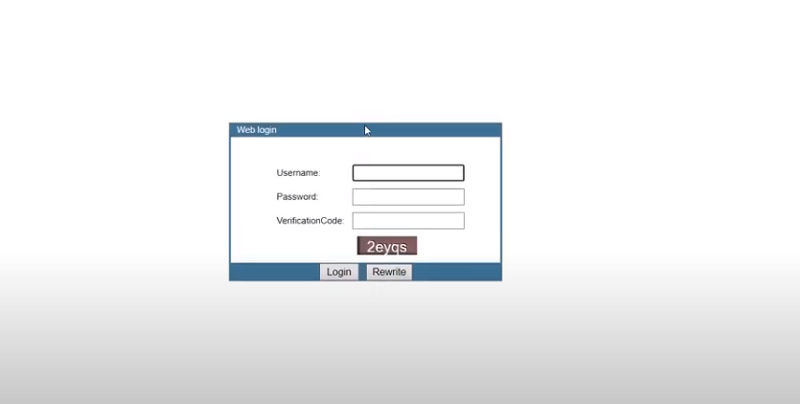
Change this password immediately after your first login. Leaving it at the default is one of the most common ways home networks get compromised, since these defaults are public knowledge.
Related: BSNL FTTH Plans and DSL Broadband Plans
Default Login Details by ONT Brand
| ONT Brand | Default Gateway IP | Default Username | Default Password |
|---|---|---|---|
| Netlink | 192.168.1.1 | admin | stdONU101 |
| Syrotech | 192.168.1.1 | admin | stdONU101 (some newer units use Syro@43210$; check the sticker on your unit if the first doesn’t work) |
| Huawei | 192.168.100.1 | telecomadmin | admintelecom |
| DASAN / HFCL / VSOL | 192.168.1.1 (varies) | admin | admin (check the device sticker; several vendors use device-specific passwords) |
If none of these work, the credentials are almost always printed directly on the device. Check there before assuming something’s wrong, and contact BSNL if the printed credentials genuinely don’t work.
Step 4: Configure Internet (WAN/PPPoE) Settings
Once logged in, go to the Network tab, then Internet Connection (labelled WAN on some models) in the left-hand menu.
If there’s an existing WAN configuration and your internet isn’t working, you can delete it and start fresh. Choose Add a New WAN Connection, then set:
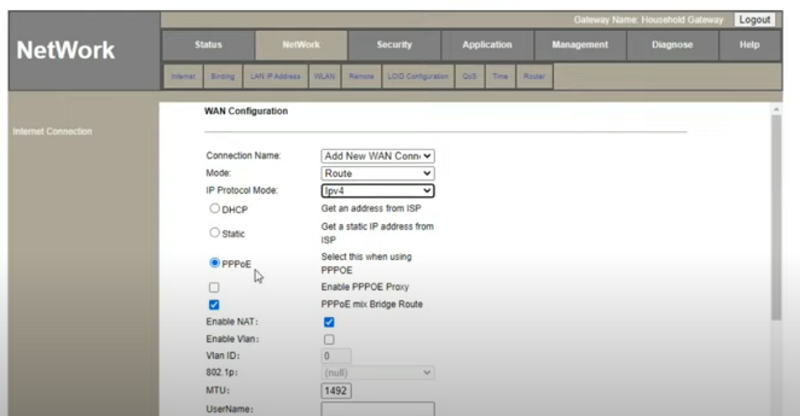
- Mode: Route
- IP Protocol Mode: IPv4
- Connection Type: PPPoE
- Enable NAT: Yes
- Enable VLAN: Yes
- VLAN ID: the value provided by BSNL for your connection
- 802.1p: leave as null/0 initially ; this generally gives better speed
- MTU: 1460 or 1492 (BSNL’s standard value; this is usually auto-filled, but set it manually if it isn’t)
- Username: your BSNL-issued PPPoE username
- Password: your BSNL-issued PPPoE password (password, it is the default one)
- Service Name: BSNL, or any label you prefer
- PPP Type: AUTOCONNECT
- Service Mode: INTERNET
Click Save/Apply. The ONT will reboot, and the PON light should turn steady green once the connection is active. You can also check the connection status under the Status tab.
On the username format: BSNL’s PPPoE username convention varies by circle, but a common pattern is the first two letters of the registered name, followed by the STD code and telephone number, followed by “@ftth.bsnl.in” (for example, a Bengaluru number might look like [email protected]).
Some circles assign a username based purely on the landline number instead. If you’re not certain of your exact username, it’s on your original BSNL installation paperwork or available by contacting your local exchange. Guessing at the format risks a failed PPPoE authentication.
Step 5: Configure Voice (VoIP) Settings
If your BSNL plan includes a landline/voice service, go back to Network > Internet Connection and add a second WAN connection for voice:
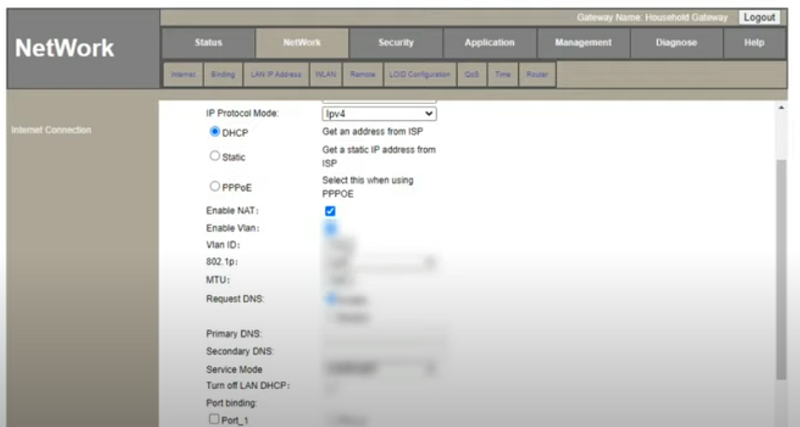
- Mode: Route
- IP Protocol Mode: IPv4
- DHCP: Get an address from ISP
- Enable NAT: Yes
- Enable VLAN: Yes
- VLAN ID: the voice VLAN ID from BSNL (usually different from your internet VLAN)
- 802.1p: try null first; if voice doesn’t register, try setting it to 7
- MTU: 1500
- Request DNS: Enabled
- Service Mode: VOICE
- Turn off LAN DHCP: leave as it is unchecked
- Port binding: leave it as it is, unchecked
- Port_1 WLAN(SSID1): leave as it is, unchecked
- Port_2: leave as it is, unchecked
- Click on the Save/Apply button
Save this, then go to the Application tab and enable SIP; without this, you may be able to receive calls but not make outgoing ones.
Under the VoIP tab, enter your telephone number and the SIP/softswitch server details provided by BSNL, with Voice Interface service mode set to VOICE.
Check Status > VoIP Information to confirm registration.
Once registered, both your Internet and Voice WAN connections should show as UP under Status > WAN Connection Info.
Step 6: Configure Wi-Fi (SSID and Password)
This is the setting most people actually come here for.
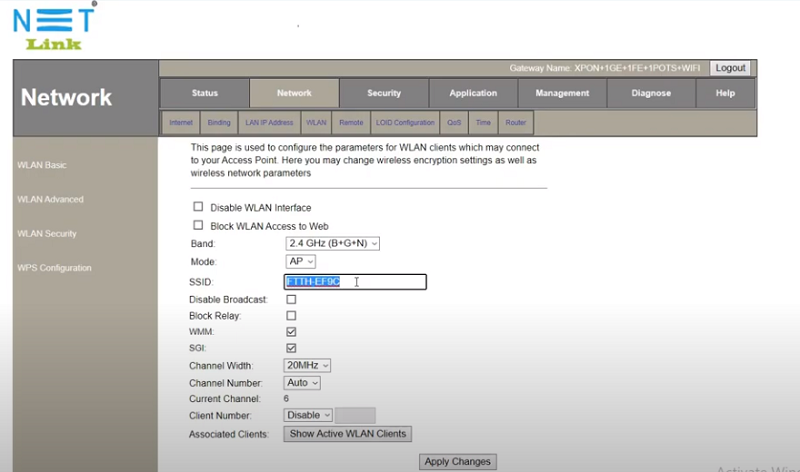
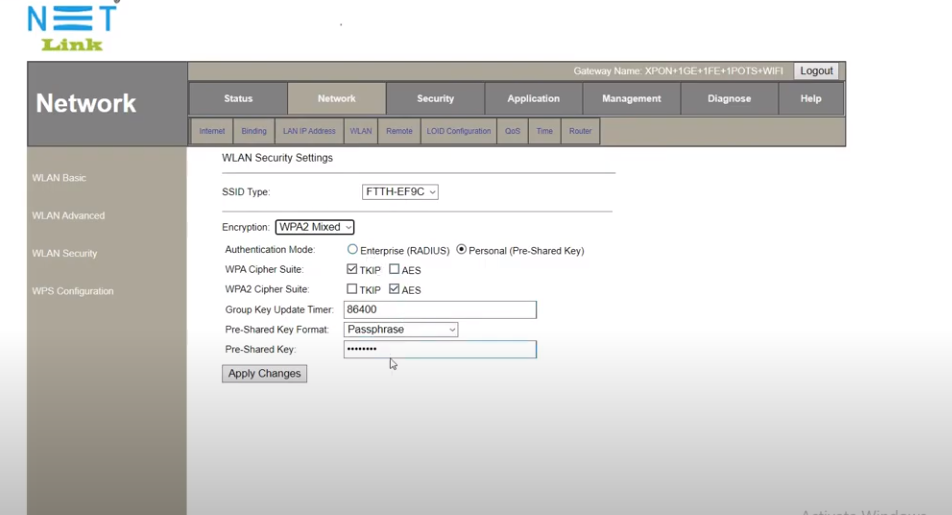
Go to Network > WLAN to change your network name (SSID), and WLAN Security to set a new Wi-Fi password (labelled Pre-Shared Key on most ONTs).
Use WPA2 or WPA3 security mode if given the option; avoid WEP or open networks entirely.
If your ONT’s Wi-Fi doesn’t reach every room, pairing it with a mesh Wi-Fi extender rather than a single stand-alone repeater tends to give more consistent coverage in Indian apartments with concrete walls.
Our best Wi-Fi routers and extenders for Indian homes guide (will be published soon) covers current options by budget.
Step 7: Test Your Connection
After the ONT reboots, confirm internet access from a connected device and check that both the PON and Data/Internet LEDs are steady, not blinking or red.
If voice is configured, place a test call to confirm it connects both ways.
Related: Know About BSNL IPTV Plans and How to Get Them
Troubleshooting: Reading Your ONT’s Lights
Most “my BSNL FTTH isn’t working” situations can be diagnosed just by looking at the LEDs before you touch any settings.
| Light Status | Likely Cause | What to Do |
|---|---|---|
| PON/LOS light red or off | Fibre cable break, or optical power outside the acceptable range (roughly -14dB to -25dB) | This is a physical-layer fault outside your control; contact BSNL, since it needs a technician, not a settings change |
| PON light blinking | ONT/OLT configuration mismatch on BSNL’s side | Contact BSNL support; this usually isn’t fixable from your end |
| Data/Internet light off, PON steady | ONT configuration issue, often after a factory reset or power fluctuation | Re-check your WAN/PPPoE settings as in Step 4 |
| All lights normal, but “No Internet” | Frequently a billing/payment issue | Check your WAN IP under Status; if it starts with 10.x.x.x, this typically indicates a disconnection for non-payment, not a technical fault |
| The Internet works, then drops every few minutes | Often, a signal or authentication instability, rather than a hard fault | Try a firmware update if available, and report intermittent drops to BSNL along with the pattern (e.g. “drops every 5–10 minutes”) |
If your WAN IP starts with 10.x.x.x: pay any outstanding bill through the BSNL Selfcare portal or at a BSNL customer service centre.
Reconnection typically takes a few hours after payment is confirmed. Reboot the ONT once it’s done to pick up the change immediately rather than waiting for it to refresh on its own.
To register a complaint: use the BSNL Selfcare portal (selfcare.bsnl.co.in) and select Bharat Fiber broadband/voice as the complaint category, or call the toll-free number 1800-4444.
Circle-specific BSNL social media handles often respond faster than the call centre for straightforward connectivity complaints.
DNS and MTU: Do You Need to Change Them?
For most users, the defaults work fine and don’t need adjusting. If you’re troubleshooting speed or reliability issues, two settings are worth knowing about:
- MTU: BSNL FTTH connections typically perform best at 1460. If specific websites or VPN connections fail to load while general browsing works fine, an incorrect MTU is a common cause; this is a more specific and often-overlooked fix than most guides mention.
- DNS: BSNL’s own DNS servers (61.1.1.1 and 61.0.3.3) are set by default on most connections. Some users find public DNS services like Google’s (8.8.8.8 and 8.8.4.4) marginally faster for general browsing. This is a matter of preference rather than a fix for a broken connection, and is worth testing rather than assuming.
Related: How to Increase BSNL Internet Speed?
Security Best Practices
- Change the default admin password on first login: this matters more than almost anything else in this guide, since default ONT credentials are publicly documented online (as this article itself demonstrates).
- Use WPA2 or WPA3 for Wi-Fi, never an open network or WEP.
- Disable remote/WAN-side management of the ONT admin panel if the option exists and you don’t specifically need it. This closes off one route for outside access to your home network.
- Keep firmware updated if your ONT offers update checks; BSNL and equipment vendors periodically push updates that fix both stability and security issues.
A Note on Static IP and Port Forwarding
If you’re setting up a home security camera system, a personal server, or need reliable remote access to a device at home, you may eventually need a static/public IP or port forwarding rather than the default dynamic setup covered above.
BSNL FTTH plans that include a static IP require a specific request through your local exchange. It isn’t something you can turn on from the ONT’s settings page alone.
If you’re specifically setting this up for security cameras, see our guide on integrating indoor cameras into a smart home setup for what to configure on the camera side once your network is ready.
Conclusion
For most people, this entire process comes down to two things: changing the default admin password for security, and updating the Wi-Fi name and password to something memorable. BSNL handles the rest at installation.
If you do need to go further, whether after a reset, a replacement ONT, or genuine troubleshooting, the steps above cover internet, voice, and Wi-Fi configuration across the most common ONT brands, along with the fastest way to tell a physical fibre fault from a settings issue just by reading the lights.
If a red PON light or an unusual WAN IP points to something on BSNL’s end, that’s the point to stop configuring and start a support ticket instead.
We hope that this tutorial on BSNL modem configuration has provided you with the fundamental knowledge required to configure the BSNL ONT in your FTTH connection.
If you have any questions about the setup settings, please contact BSNL or your service provider. You can share your problems on this page too.
Frequently Asked Questions
It depends on the ONT brand. Netlink and Syrotech ONTs typically use 192.168.1.1, while Huawei ONTs use 192.168.100.1. Check the sticker on your device if neither works.
Username admin, password stdONU101, for most Netlink units. Change this immediately after logging in for the first time.
A red or unlit PON/LOS light almost always indicates a physical fibre issue, either a cable break or optical power outside the acceptable range, rather than a configuration problem. This needs a BSNL technician visit; it isn’t something you can fix from the settings page.
It’s on your original installation paperwork or BSNL bill/SMS confirmation. The format varies by circle, though a common pattern uses the first letters of your name plus your STD code and phone number, followed by @ftth.bsnl.in.
This typically means your connection has been restricted due to a pending bill payment. Pay through the BSNL Selfcare portal, and the connection should restore within a few hours.
Yes, for the WAN configuration to work, though it’s usually already set correctly by BSNL at installation and rarely needs changing unless you’ve done a factory reset.
1460 is BSNL’s standard value and works for the large majority of connections, including most VPN setups.
Yes, this is the one change most users actually need. Go to Network > WLAN for the network name, and WLAN Security for the password, without touching the WAN/Internet Connection settings at all.
Check that SIP is enabled under the Application tab. This is a common thing to miss during voice configuration, and outgoing calls specifically fail without it, even though incoming calls may still work.
No. Default credentials for common ONT models are widely published (as in this guide), so leaving them unchanged is a real security risk, not just a formality.
Typically, a few hours, though it can take longer in some circles. Reboot your ONT once payment is confirmed rather than waiting for the connection to refresh automatically.
Yes, most BSNL ONTs can be set to bridge mode, or you can simply connect your own router to a LAN port on the ONT and disable the ONT’s Wi-Fi radio, letting your own router handle Wi-Fi while the ONT handles the fibre connection.
This is often a signal stability or authentication issue rather than a hard outage. A firmware update sometimes resolves it; otherwise, report the specific pattern (e.g., “drops every 5 minutes”) to BSNL, since intermittent faults are harder to diagnose from steady-looking status lights alone.
Rarely, and only if you’ve recently done a factory reset or your ONT is a fresh replacement. If your connection was working and suddenly stopped, the VLAN ID is very unlikely to be the cause. Check the PON light and WAN IP first.
Some BSNL FTTH plans support static/public IPs, but this needs to be requested and provisioned through your local exchange rather than configured directly on the ONT.
We hope you are interested in this tutorial and consider following our Facebook, Instagram, and Twitter pages for regular updates.
Subscribe to our free newsletter to get similar articles and regular updates directly in your Email Inbox.
Also, share this article with your friends and relatives. Bookmark this page for future reference.
Subscribe to be the first to learn about new information
Disclosure: We will receive an affiliate commission on some, but not all, of the products or services we recommend if you follow our links to a retailer’s website and make a purchase.