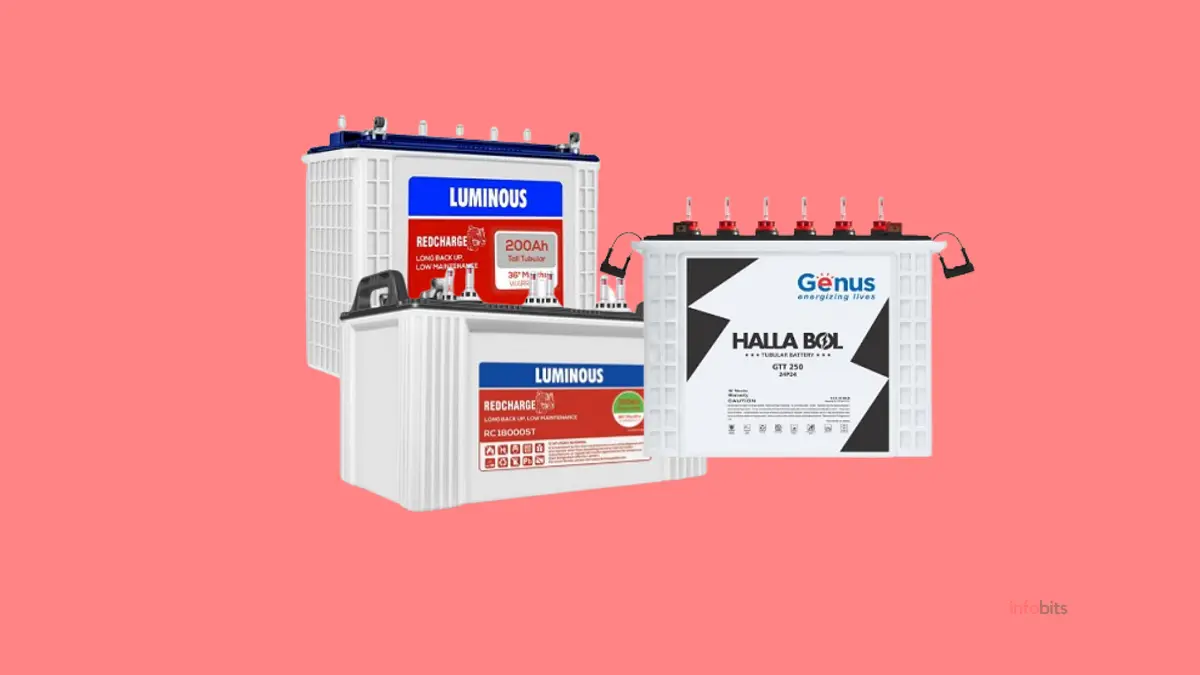
Best Inverter Battery for Home Use in India (2026): Top 7 Picks Compared
Quick answer: For most Indian homes, the Exide InvaTubular IT500 (150Ah) is the safest all-round pick. It’s the single most widely recommended tubular battery in the country, backed by a 66-month warranty and Exide’s nationwide service network. If you are satisfied with a shorter but steady warranty instead, the Luminous Shakti Charge SC18060 comes with a 5-year cover.
Power cuts in India aren’t rare events; they’re an ongoing problem.
Whether it’s a scheduled load-shedding window in a smaller town or an unpredictable outage during a Mumbai monsoon, the difference between “mildly annoying” and “ruined evening” usually comes down to one component: the battery sitting quietly in your inverter setup.
Most buying guides for this topic either repeat one brand’s catalogue or get lost in technical jargon. We’ve done neither.
Below, you’ll find seven genuinely different inverter batteries, spanning five major brands. Each is picked for a specific reason, followed by a complete buying guide covering capacity, battery types, maintenance, and the questions Indian homeowners actually ask before buying.
Quick Picks: Best Inverter Batteries for Home Use
Best Overall: Exide InvaTubular IT500
Best Warranty: Luminous Shakti Charge SC18060
Best Value for Money: Livguard IT1560STT
Best for Hot Climates: Amaron AR150TT42
Best for Large Homes: Luminous Red Charge RC 25000
Best Premium Pick: Genus Hallabol GTT250
Best Budget Pick: Luminous Red Charge RC 18000 ST
Key Takeaways
- Tall tubular batteries are the right default for most Indian homes; they handle frequent, unpredictable power cuts better than flat-plate batteries, even though they cost more upfront.
- Warranty length varies more than you’d expect between similarly priced batteries, anywhere from 36 to 66 months for batteries in the same price band, so it’s worth comparing this specifically rather than assuming it’s standard.
- Capacity (Ah) should be chosen based on your actual appliance load and desired backup duration, not just “bigger is better”. An oversized battery for a small home wastes money and space.
- Brand reputation matters, but so does your local service network. A great battery from a brand with no technician nearby is a worse buy than a slightly less premium one with strong local support.
- Lithium-ion inverter batteries are becoming more common in India but still cost significantly more upfront than lead-acid tubular batteries; for most homes, lead-acid remains the practical choice in 2026 (we cover the lithium trade-off in the buying guide below).
Comparison: Specs Side by Side
| Product | Capacity | Battery Type | Warranty | Best For |
|---|---|---|---|---|
| Exide InvaTubular IT500 | 150Ah | Tall Tubular | 66 months (48 FOC + 18 pro-rata) | Most homes, general use |
| Luminous Shakti Charge SC18060 | 150Ah | Tall Tubular | 60 months | Buyers who prioritise warranty length |
| Livguard IT1560STT | 150Ah | Tall Tubular | 60 months (36 FOC + 24 pro-rata) | Value-conscious buyers |
| Amaron AR150TT42 | 150Ah | Tall Tubular | 42 months | Hot, humid climates (South/Coastal India) |
| Luminous Red Charge RC 25000 | 200Ah | Tall Tubular | 18+18 months | Larger homes, longer backup needs |
| Genus Hallabol GTT250 | 220Ah | Tall Tubular | 48 months | Frequent, extended outages |
| Luminous Red Charge RC 18000 ST | 150Ah | Short Tubular | 36 months | Budget buyers, shorter/frequent outages |
1. Exide InvaTubular IT500 (150Ah) : Best Overall
Ask an electrician or a battery dealer anywhere in India which inverter battery they install most often, and there’s a good chance the answer is some version of the Exide InvaTubular IT500.
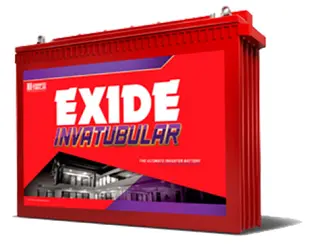
It isn’t flashy, but it’s built around Exide’s Torr Tubular technology with thicker plates and roughly 30% more acid volume per ampere-hour than a standard tubular battery. This translates to better deep-discharge recovery and a longer working life under repeated power cuts.
The 66-month warranty (48 months free replacement + 18 months pro-rata) is among the longest available at this capacity, and Exide’s service network is genuinely nationwide, which matters a lot if something goes wrong three years in.
Pros: Longest warranty in this list at this capacity; excellent deep-discharge recovery; thick plates rated for harsh, frequent outages; huge dealer and service network across India.
Cons: Priced slightly higher than some competitors at the same capacity; like most lead-acid batteries, it’s heavy and needs two people to install.
Who should buy it: Anyone who wants a single, low-risk recommendation without comparing five brands; this is the safe default choice for most Indian homes.
Buy on Exide InvaTubular IT500 Amazon | Buy on Exide InvaTubular IT500 Flipkart
Who should avoid it: If your absolute priority is the lowest upfront price, the Luminous RC 18000 ST below is cheaper, though with a shorter warranty.
2. Luminous Shakti Charge SC18060 (150Ah) : Best Warranty
The Shakti Charge line is one of Luminous’s most recognised inverter battery ranges in India, and the SC18060 stands out specifically for its 5-year warranty.
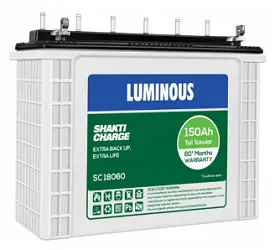
A genuinely long cover for a tall tubular battery at this capacity. It’s built with a corrosion-resistant alloy and a homogeneous, void-free grain structure, which Luminous says improves charge acceptance and reduces water loss over time.
In practice, this means faster recharging after a power cut and less frequent maintenance, useful if you don’t want to be topping up distilled water every few weeks.
Pros: Longest warranty-to-price ratio in this list; fast charge acceptance; low water loss reduces maintenance frequency; widely available through Luminous’s large dealer network.
Cons: 150Ah capacity may not be enough for larger homes with heavy appliance loads during long outages.
Who should buy it: Buyers who want maximum warranty coverage and plan to keep the same battery for 5+ years.
Buy Luminous 18060 On Amazon | Buy Luminous SC18060On Flipkart
Who should avoid it: Larger households running ACs, large refrigerators, or multiple heavy appliances during outages should look at the 200Ah+ options below instead.
3. Livguard IT1560STT (150Ah): Best Value for Money
Livguard is a newer name compared to Exide or Luminous, but it’s earned a reputation for offering similar tall tubular construction. It has a superior plate grid design and high electrolyte volume, at a noticeably more competitive price, especially during exchange offers.
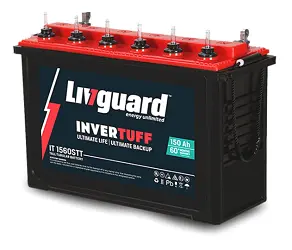
The IT1560STT carries a 60-month warranty (36 months free + 24 pro-rata), matching or beating several pricier competitors.
It’s built specifically with Indian power conditions in mind: frequent voltage fluctuations, long unscheduled outages, and the kind of heat and humidity that shortens battery life faster than in milder climates.
Pros: Strong warranty-to-price ratio; designed specifically for Indian grid conditions; low maintenance design; growing dealer network.
Cons: Livguard’s service footprint, while expanding, is still smaller than Exide’s or Luminous’s in some smaller towns; worth checking local availability before buying.
Who should buy it: Budget-conscious buyers who still want a long warranty and don’t mind going with a slightly newer brand name.
Buy Livguard IT1560STT on Amazon | Buy Livguard IT1560STT on Flipkart
Who should avoid it: If you live somewhere with very limited Livguard service presence, Exide or Luminous may offer easier long-term support.
4. Amaron AR150TT42 (150Ah): Best for Hot Climates
Amaron has built a strong reputation specifically around heat tolerance. Its tall tubular batteries use extra electrolyte volume and low-antimony alloys, which slow water loss and internal wear in hot, humid conditions.
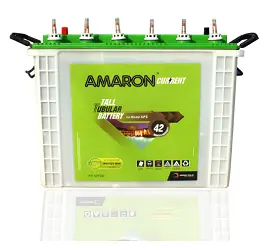
This makes it a particularly strong pick for South India, coastal regions, and anywhere summer temperatures regularly cross 40°C.
The AR150TT42 carries a 42-month warranty, shorter than some competitors here, but Amaron’s reputation for consistent performance under thermal stress is well established among electricians and dealers.
Pros: Excellent heat tolerance and slower water loss in hot climates; low maintenance; consistent, predictable performance; strong reputation among installers.
Cons: Shorter warranty (42 months) compared to the Exide, Luminous, and Livguard picks above.
Who should buy it: Homes in hot, humid regions where battery longevity is more affected by climate than by outage frequency.
Buy on Amaron AR150TT42 Amazon | Buy on Amaron AR150TT42 Flipkart
Who should avoid it: If warranty length is your top priority, the SC18060 or IT1560STT offer longer coverage at a similar capacity.
5. Luminous Red Charge RC 25000 (200Ah): Best for Large Homes
This remains one of our original picks, and it earns its place by being a genuine step up in capacity for homes that need more backup than a standard 150Ah battery can provide.
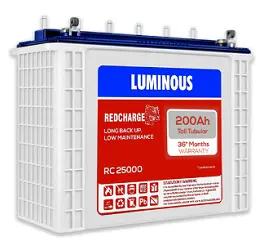
The 200Ah capacity suits medium-to-large households running multiple fans, lights, a refrigerator, and a TV simultaneously during extended outages.
It’s built with the same corrosion-resistant alloy and void-free grain structure as the smaller Luminous models in this list, and it’s available across 120Ah, 150Ah, 180Ah, and 200Ah variants if you need to size up or down.
Pros: Higher capacity suits larger households and longer backup needs; available across multiple capacity options under the same range; low water loss and minimal maintenance; works well even in high-cyclic, frequent-outage conditions.
Cons: Shorter warranty (18+18 months) than several competitors at similar or lower capacity; physically larger and heavier, so confirm it fits your existing battery stand/space.
Who should buy it: Medium-to-large homes that regularly run several appliances during outages and need more runway than a 150Ah battery offers.
Buy Luminous RC 25000On Amazon | Buy Luminous RC 25000On Amazon
Who should avoid it: Smaller households or those with modest power needs are better served (and save money) with a 150Ah option instead.
6. Genus Hallabol GTT250 (220Ah) : Best Premium Pick
Genus remains a strong, slightly less mainstream alternative to the big three (Exide, Luminous, Amaron). The Hallabol GTT250 is its flagship play for homes that experience genuinely long, frequent outages.
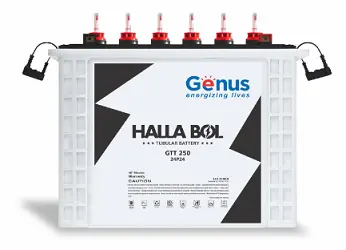
At 220Ah, it’s the highest-capacity battery in this list, and its Selenium Low Antimonial Alloy plates are built specifically for corrosion resistance and minimal water topping.
A notable build detail: the container and lid are thermally sealed at a specific temperature to prevent acid leakage. A small but meaningful detail for a battery that’s likely to sit in a utility area for years without much attention.
Pros: Highest capacity in this list, ideal for the longest outages; leak-resistant sealed construction; minimal water-topping maintenance; solid 48-month warranty; also available in 150 and 165Ah if you need a smaller option.
Cons: Less mainstream brand recognition than Exide, Luminous, or Amaron in some regions — check local service availability first.
Who should buy it: Homes in areas with genuinely long, unpredictable outages (rural areas, regions with unstable grid infrastructure) that need maximum capacity.
Who should avoid it: If you’ve never had Genus service available locally, it’s worth confirming dealer presence in your area before committing.
7. Luminous Red Charge RC 18000 ST (150Ah, Short Tubular): Best Budget Pick
This is the one short tubular battery in our list, and it’s here deliberately. Short tubular plates are genuinely well-suited to homes with frequent but shorter power interruptions, rather than long, sustained outages.
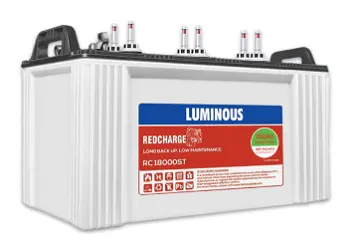
It’s also typically the most affordable tubular option in a given capacity, making it a sensible budget pick rather than a compromise.
Its float indicators, fitted with microporous ceramic discs, give a visual cue on electrolyte levels, and its polyethene separator and low grid corrosion help it perform consistently even in harsher temperatures.
Pros: More affordable than tall tubular batteries at the same capacity; well-suited to frequent, shorter outages; built-in float indicators simplify maintenance checks; decent oxidation resistance for the price.
Cons: Shorter design generally means a shorter lifespan and lower total backup capacity than tall tubular batteries under sustained, long outages.
Who should buy it: Budget-conscious buyers in areas with frequent but relatively short power cuts (a few hours at a time) rather than multi-hour or overnight outages.
Buy Luminous RC 18000 ST on Amazon | Buy Luminous RC 18000 ST on Flipkart
Who should avoid it: If your area regularly experiences long, multi-hour outages, a tall tubular battery (like the Exide IT500 or Luminous SC18060 above) will serve you better long-term.
Related: Difference Between Short Tubular and Tall Tubular Batteries
How to Choose the Right Inverter Battery for Your Home (Buying Guide)
Power Requirements and Load Capacity:
Before picking a battery, list every appliance you’d want to run during an outage and add up their wattage. This determines the load your battery needs to support and, combined with your desired backup duration, the Ah capacity you should be shopping for.
Battery Voltage and Compatibility:
Confirm your inverter runs on 12V, 24V, or 48V (most home inverters in India are 12V), and match your battery voltage accordingly. Mismatched voltage can damage your inverter system, not just underperform.
Calculating Backup Time:
The relationship between capacity, load, and backup time follows this formula:
Battery Capacity (Ah) = [Total Load in VA × Backup Time (in hours)] / Battery Voltage
This gives an approximate backup duration. Actual performance will vary slightly based on battery age, depth of discharge, and ambient temperature.
Optimal Capacity for Different Household Needs:
- 100–150Ah: Suitable for smaller homes or brief, infrequent outages.
- 150–200Ah: A solid middle ground for most Indian households running fans, lights, a fridge, and a TV.
- 200Ah and above: Best for larger homes, frequent long outages, or households running multiple heavy appliances simultaneously.
Tubular vs. Flat Plate: Which Type Do You Need?
Tall tubular batteries are the closest thing to a default recommendation for Indian homes. They handle deep, repeated charge-discharge cycles well, lose less water over time, and tolerate extreme temperatures better, at a higher upfront cost.
Short tubular batteries compromise some longevity and capacity for a lower price, and work well for frequent-but-short outages rather than long sustained ones.
Flat-plate batteries are the cheapest and simplest option, suited to lighter, less frequent use. But they generally have a shorter lifespan and underperform during prolonged outages compared to tubular designs.
Related: Lead Acid Battery BMS Explained: How It Works & Why It Matters
Should You Consider a Lithium-Ion Battery Instead?
Lithium-ion batteries offer real advantages over lead-acid: higher energy density, longer overall lifespan, faster charging, and a smaller physical footprint.
The main constraint is upfront cost. Lithium inverter batteries in India typically cost two to three times (now the gap is narrowing) more than an equivalent-capacity lead-acid tubular battery.
For most homes prioritising value and proven reliability, lead-acid tubular remains the practical 2026 choice; lithium makes more sense if you’re also setting up solar, want a longer-term investment, or have specific space/weight constraints.
Maintenance and Safety Tips for Inverter Batteries
Clean battery terminals and connections regularly to prevent corrosion, and check electrolyte levels every 2–3 months, topping up with distilled water only when required (most modern tubular batteries need this far less often than older models).
Keep the battery in a well-ventilated space away from direct sunlight, and never overload it beyond your inverter’s rated capacity. See our guide on fixing the inverter overload problem if you’ve run into this issue.
When handling batteries, always use protective gloves and glasses, avoid open flames nearby, and ensure the installation area has enough ventilation to prevent the buildup of explosive gases from charging.
Related: How to Charge the Inverter/UPS Battery Efficiently?
Common Mistakes to Avoid
The most common mistake we see is buying capacity based on price alone rather than actual load calculation. Normally, it is either ending up with a battery that runs out mid-outage, or overspending on capacity you’ll never use.
A second common mistake is ignoring local service network availability; a battery with an excellent warranty is far less useful if there’s no authorised technician within a reasonable distance when something goes wrong.
Finally, many buyers skip basic maintenance entirely, assuming “maintenance-free” branding means zero upkeep. Even low-maintenance tubular batteries benefit from periodic terminal cleaning and ventilation checks.
Expert Tips
If you’re replacing an old battery, always ask about exchange offers. Most brands knock a meaningful amount off the price for trading in your old unit, and this is reflected in most of the pricing you’ll see online.
If you’re unsure between two capacities, it’s generally safer to size up slightly rather than down, since running a battery near its limit repeatedly shortens its working life.
For more guidance on matching your battery to your inverter setup, see our guide on selecting the right inverter and battery for your home.
How We Selected These Products
We reviewed current pricing, warranty terms, and build specifications across five major Indian inverter battery brands: Exide, Luminous, Amaron, Livguard, and Genus, cross-checking details against manufacturer listings, authorised dealer pricing pages, and genuine buyer feedback.
We deliberately avoided concentrating recommendations in a single brand, since real buyers benefit from genuine comparison rather than a list that’s effectively one brand’s catalogue.
Each product here was chosen for a distinct, clearly stated use case rather than overlapping with another entry on the list.
Why You Can Trust This Guide
Our expert engineers, who possess extensive practical knowledge in the battery and inverter field, write and maintain this guide.
Every recommendation here reflects current, verifiable pricing and warranty information rather than outdated catalogue listings, and the guide is updated periodically as brands update their model lineups.
Conclusion
There’s no single “best” inverter battery for every Indian home. The right choice depends on your outage patterns, climate, household size, and how much you value warranty length versus upfront price.
The Exide InvaTubular IT500 is our safest general recommendation; the Luminous Shakti Charge SC18060 wins on warranty, the Livguard IT1560STT offers the strongest value, and the Genus Hallabol GTT250 is the pick for genuinely long, frequent outages.
Whichever you choose, calculate your actual load needs first; that single step prevents most of the buyer’s regret we see with inverter battery purchases.
Frequently Asked Questions
This depends on battery capacity and your total appliance load. Use the formula: Battery Capacity (Ah) = [Total Load in VA × Backup Time in hours] / Battery Voltage to estimate backup duration for your specific setup.
Regular maintenance is required to ensure the maximum performance and durability of your inverter battery. Every 2-3 months, it is advised that you inspect and clean the battery terminals, check the water level (if required), and ensure sufficient ventilation. Additionally, periodic battery health checks and service by specialists are recommended.
Tubular batteries (tall or short) handle deep discharge cycles better and last longer, making them the better choice for most Indian homes with frequent outages. Flat-plate batteries are cheaper and simpler but have a shorter lifespan and underperform in prolonged outages.
Look for at least 36 months total coverage; several batteries in this list offer 48–66 months. Pay attention to the split between “free of cost” and “pro-rata” periods, since pro-rata coverage usually means a discounted replacement rather than a free one.
The Exide InvaTubular IT500 (150Ah) is the most widely recommended all-round choice, thanks to its 66-month warranty and Exide’s extensive nationwide service network. If you want a different trade-off, the Luminous Shakti Charge SC18060 matches it closely on warranty length.
Lithium offers longer life, faster charging, and a smaller footprint, but typically costs 2–3 times more upfront than an equivalent lead-acid tubular battery. For most homes focused on value, lead-acid remains the more practical choice unless you have specific space, weight, or solar-integration needs.
100–150Ah suits smaller homes or brief outages; 150–200Ah covers most average households; 200Ah and above suit larger homes or frequent, extended outages. Calculate based on your actual appliance load rather than guessing.
We hope you are interested in our articles and consider following our Facebook, Instagram, and Twitter pages for regular updates.
Subscribe to our free newsletter to get similar articles and regular updates directly in your Email Inbox.
Also, share this article with your friends and relatives. Bookmark this page for future reference.
Subscribe to be the first to learn about new information
Disclosure: We will receive an affiliate commission on some, but not all, of the products or services we recommend if you follow our links to a retailer’s website and make a purchase.