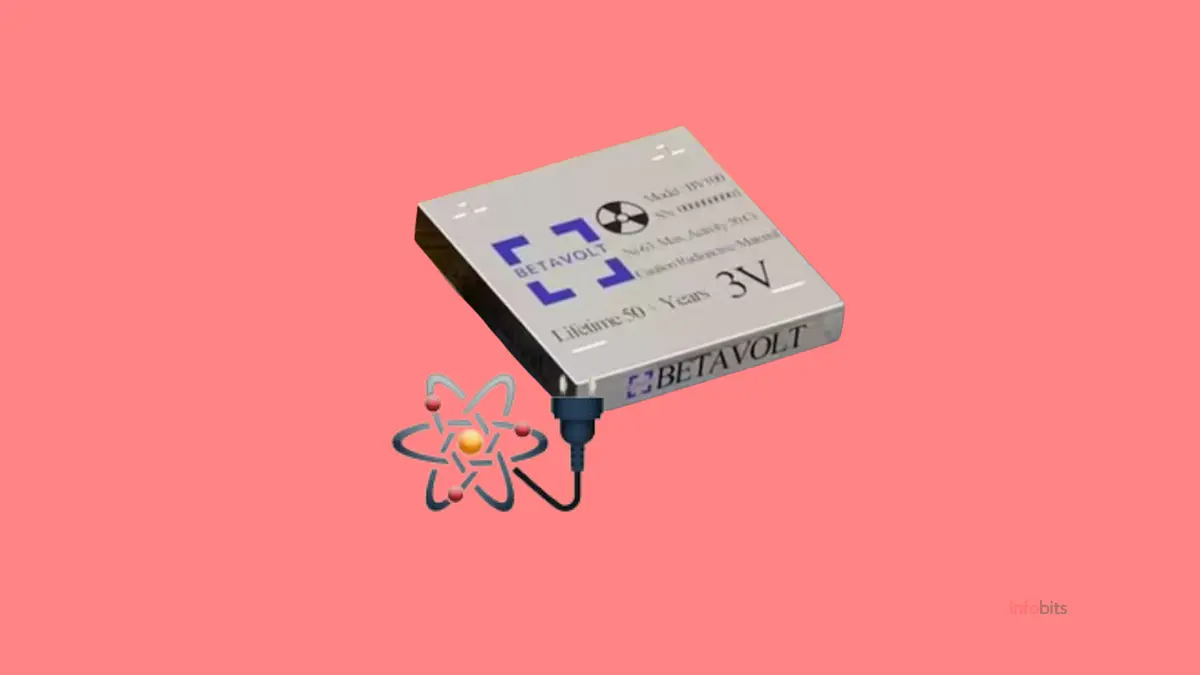
Betavolt’s Nuclear Battery: 50 Years of Power, but Not for Your Phone
A battery that lasts 50 years without ever being plugged in sounds like science fiction.
When Beijing-based Betavolt announced its BV100 “nuclear battery” in January 2024, headlines around the world ran with exactly that framing. Some even suggested it could mean the end of phone charging altogether.
Two years on, it’s worth revisiting this story with a clearer head: what Betavolt actually built, why the “50-year battery” claim is true but seriously misleading if you’re picturing it in your phone, and what’s actually happened in this space since the original announcement made the rounds.
Quick Summary: The Betavolt BV100 is a betavoltaic battery , a coin-sized device that generates electricity from the natural radioactive decay of nickel-63, using a diamond semiconductor to capture the energy. It genuinely can run for around 50 years without recharging, because nickel-63 decays extremely slowly.
The catch: It only produces 100 microwatts of power , roughly 0.01% of what a smartphone needs to function. It’s designed for ultra-low-power applications like medical implants and remote sensors, not phones, laptops, or drones, despite some 2024 coverage implying otherwise.
Reports suggest the BV100 entered limited production in 2025, though Betavolt’s promised 1-watt version , which would make it relevant to a meaningfully wider range of devices , has no confirmed public update as of 2026.
What Betavolt Actually Announced
Betavolt New Energy Technology, a company founded in Beijing in April 2021, announced in January 2024 that it had developed a miniaturised nuclear battery called the BV100.
The pitch was simple and attention-grabbing: a battery the size of a coin that could power a device continuously for 50 years without ever needing to be charged or replaced.
The technology behind it is called betavoltaics, and despite how futuristic it sounds, it’s not new.
The first atomic batteries using this general principle date back to 1954, and betavoltaic devices using promethium-147 were actually used in some cardiac pacemakers in the 1970s, before cheaper, more practical lithium batteries took over.
What Betavolt is claiming credit for isn’t inventing the concept, but a specific manufacturing achievement: successfully doping large-size diamond semiconductor material at scale, which the company says no one else has been able to do commercially.
Related: Lithium Battery Advantages in Inverter and UPS Systems
How the BV100 Actually Works
Here’s the genuinely interesting science, explained simply.
At the core of the BV100 is a 2-micron-thick layer of nickel-63, a radioactive isotope of nickel. Nickel-63 naturally decays over time, and as it does, it emits beta particles, essentially high-speed electrons, as part of the decay process.
It eventually decays into a stable, non-radioactive isotope of copper.
Sandwiching that nickel-63 layer are two 10-micron-thick layers of diamond semiconductor material. When the beta particles from the decaying nickel hit this semiconductor, they knock electrons loose inside it, creating electron-hole pairs.
These get pulled apart by the semiconductor’s internal electric field, and that movement of charge is what generates a usable electrical current, at a steady 3 volts.
This is conceptually similar to how a solar panel works, except instead of harvesting energy from photons of light, a betavoltaic device harvests energy from the beta particles released by radioactive decay.
No moving parts, no chemical reaction to wear out, no combustion, just a slow, steady, physical process that continues for as long as the radioactive material keeps decaying.
Why 50 Years, Specifically?
This number isn’t marketing fluff; it comes directly from nickel-63’s half-life of approximately 101 years.
A radioactive isotope’s half-life is the time it takes for half of it to decay. Because nickel-63 decays this slowly, the BV100 can keep producing a meaningful trickle of power for decades, with output gradually (very gradually) tapering as the nickel-63 is used up.
The Crucial Catch: 100 Microwatts Is Not a Lot of Power
This is the single most important thing to understand about the BV100. It’s where a lot of the 2024 coverage, including, fairly, the earlier version of this article, let the excitement run ahead of the physics.
The BV100 produces 100 microwatts of power at 3 volts.
To put that in perspective: a standard AA alkaline battery can deliver around 2.4 watts. That’s 24,000 times more power than the BV100 produces. The AA battery will be dead within an hour at that output level, but the BV100 keeps trickling out its tiny 100 microwatts for decades.
This is the fundamental drawback of betavoltaic technology: enormous longevity, but at extremely low, near-immovable power density.
According to independent battery science researchers, the power density of current betavoltaic batteries is so low that they cannot power something like a phone or laptop.
Not as a limitation that will be quickly engineered away, but as a near-fundamental constraint of how much energy a small amount of slowly-decaying radioactive material can release at any given moment.
For context on real-world relevance: 100 microwatts is roughly in the range needed for a basic pacemaker or a passive wireless sensor, both genuinely useful applications, but a universe away from running a smartphone screen, processor, and modem.
Why You Can’t Just “Scale It Up”
Betavolt’s own materials note that BV100 units are modular. Multiple units can be wired in series or parallel to produce more total power, similar to how multiple solar panels combine into a larger array.
This is genuinely true and useful for some applications. But scaling power this way means scaling physical size and radioactive material proportionally too.
There’s no shortcut that gets you smartphone-level power (several watts) in a smartphone-sized package using this specific approach. You’d need a battery far too large and containing far too much radioactive material to be practical or, likely, to gain regulatory approval for consumer handheld devices.
So What Is the BV100 Actually Good For?
Given the power constraints, the realistic, near-term applications are quite different from “never charge your phone again”:
- Medical implants, particularly pacemakers, a genuine historical precedent exists, since earlier-generation betavoltaic batteries (using promethium-147) were used for exactly this in the 1970s
- Remote sensors and monitoring equipment in locations where battery replacement is difficult, dangerous, or expensive, deep-sea equipment, remote environmental monitors, or sensors embedded in infrastructure
- Passive wireless sensors that only need to transmit small amounts of data occasionally
- Aerospace and satellite components where the combination of extreme temperature tolerance and decades-long unattended operation is valuable
- Specialised military and industrial applications where a maintenance-free power source justifies a higher cost
These aren’t as headline-grabbing as “phones that never need charging,” but they’re genuinely valuable use cases, particularly for devices placed somewhere humans can’t easily reach to swap a battery.
What’s Happened Since the 2024 Announcement
This is the part most coverage of this topic never gets updated, and it’s worth setting straight.
The 1-watt version Betavolt promised for 2025: In its original announcement, Betavolt said it planned to launch a more powerful 1-watt version of the battery by 2025, which would have made it relevant to a meaningfully wider set of devices.
As of the most recent available reporting in 2026, there is no confirmed public update on whether this 1-watt version has actually launched. Several independent tech outlets reviewing the technology in 2026 have explicitly noted this lack of follow-up confirmation.
Readers should treat the 1-watt milestone as unverified until Betavolt or independent sources confirm it.
Mass production status: Some reports from 2025 indicate the BV100 entered a form of production at limited scale, though independent, verifiable details on production volume, customers, or commercial availability remain sparse.
Betavolt remains a privately held company with no public stock listing, and investment in the company is restricted to private venture capital and institutional channels rather than public markets.
Competing and parallel developments: Betavolt isn’t operating in a vacuum.
In March 2025, researchers at the Daegu Gyeongbuk Institute of Science and Technology (DGIST) in South Korea developed a betavoltaic battery using carbon-14 instead of nickel-63, with radioactive material in both the device’s anode and cathode.
Here, they have achieved an energy conversion efficiency of 2.86%, notably higher than typical nickel-63 designs. Separately, researchers at the University of Bristol have developed carbon-14 diamond batteries with an estimated lifespan stretching into the thousands of years.
This was aimed at applications like space exploration where multi-decade or multi-century unattended operation could be genuinely valuable.
In April 2026, US-based NRD LLC, an established licensed manufacturer of radioisotope-based products, announced its own nickel-63 betavoltaic product line, the NBV series, claiming up to 100 years of operational life.
Notably, NRD’s own announcement was candid that the long-term performance figures depend on the known half-life of nickel-63, but that real-world performance depends on efficiency, shielding, and integration factors that haven’t yet been independently verified.
A useful reminder that this caveat applies across the entire betavoltaic battery category, not just to Betavolt’s claims specifically.
The bigger picture: betavoltaic battery technology is a genuinely active, multi-country research and early-commercialisation space in 2026. China, South Korea, the UK, and the US all have active programmes, rather than a single company’s isolated announcement.
That’s arguably the most important update since the original 2024 story: this isn’t a one-off curiosity; it’s becoming a real, if niche, branch of battery technology.
Is the Radioactivity Actually Safe?
This is a reasonable concern to have, and the science here is genuinely well-established rather than just a company’s marketing claim.
Nickel-63 emits beta particles, essentially fast-moving electrons, rather than the more dangerous alpha particles or gamma rays associated with other radioactive materials. Beta particles from nickel-63 specifically:
- Can only travel about 5 centimetres through air
- Penetrate less than 10 microns into human tissue; they’re stopped by something as simple as a layer of dead skin, a sheet of paper, or the metal casing of the battery itself.
- Pose essentially no external radiation hazard under normal handling
The real safety consideration with any radioisotope, including nickel-63, is ingestion or inhalation. If the material somehow entered the body directly (through a serious breach of the battery’s sealed casing, for instance), it could pose a health risk.
This is why proper sealing and shielding matter, and why Betavolt’s claims about the battery surviving punctures and impacts without leaking are relevant safety claims, even though they haven’t been independently verified by third parties at the time of writing.
For context, the precedent is promethium-147 betavoltaic batteries safely powering pacemakers inside human bodies for years in the 1970s.
It is a meaningful real-world safety data point for this general category of technology; it’s not an unprecedented or untested approach to radioisotope safety.
Related: Why Does a Mobile Battery Blast and How Can You Prevent It?
Betavolt vs. Other Long-Life Battery Technologies: A Quick Comparison
| Technology | Typical Lifespan | Power Output | Best Suited For |
|---|---|---|---|
| Standard Li-ion (phone battery) | 2–4 years before notable degradation | Several watts | Everyday consumer electronics |
| Lithium iron phosphate (LFP) | 10–15 years, thousands of cycles | Several watts to kilowatts | Inverters, EVs, solar storage |
| Betavolt BV100 (nickel-63) | ~50 years | 100 microwatts | Pacemakers, remote sensors, passive monitors |
| DGIST carbon-14 betavoltaic | Decades+ (carbon-14 half-life ~5,700 years) | Low microwatt range, improved efficiency | Similar niche long-life applications |
| University of Bristol carbon-14 diamond battery | Potentially thousands of years | Extremely low | Space exploration, ultra-long-term unattended systems |
Related: PAM/NAM Ratio in Lead Acid Batteries: What It Is and Why It Matters
Common Misconceptions About the Betavolt Battery
Misconception 1: “This means phones will never need charging again” Not with this generation of the technology, and not in the near term. The power output is roughly four orders of magnitude too low for a smartphone’s actual energy demands.
Unless a future, dramatically more powerful version emerges, which would require fundamentally different engineering, not just incremental improvement. This technology’s near-term relevance to phones is essentially nil.
Misconception 2: “Betavolt invented nuclear batteries” The underlying concept of converting radioactive decay directly into electricity dates back to at least 1954.
Betavoltaic batteries specifically have a documented history going back over 50 years, including real medical use in pacemakers in the 1970s.
Betavolt’s claimed innovation is specifically around diamond semiconductor manufacturing at a commercially viable scale, a genuine and meaningful engineering achievement, but not the invention of the underlying physics.
Misconception 3: “Nuclear battery means it could explode or leak radiation dangerously” The amount of radioactive material involved is extremely small; the beta particles it emits are easily blocked by thin shielding (even clothing or a thin metal casing).
The company’s claims about safety even under punctures or impacts are consistent with what’s independently known about how nickel-63 beta emissions behave physically. This is a fundamentally different risk profile from large-scale nuclear technology.
Misconception 4: “This is a brand-new, one-company technology” As of 2026, multiple research institutions and companies across China, South Korea, the UK, and the US are actively developing competing or parallel betavoltaic battery designs.
This is a real, broadening field of research rather than a single isolated product announcement.
What Would Need to Change for This to Reach Consumer Devices
For betavoltaic technology to become genuinely relevant to phones, laptops, or other everyday consumer electronics, several things would need to happen, none of which are imminent:
- A dramatic increase in power density: likely requiring a fundamentally different isotope, semiconductor material, or device architecture, not just incremental refinement of the current nickel-63/diamond approach
- Regulatory approval pathways for consumer-grade radioisotope devices: current regulations around handling and selling radioactive materials, even in small, well-shielded quantities, are understandably strict, particularly for mass-market consumer products.
- Cost reduction at scale: diamond semiconductor manufacturing and radioisotope handling are both currently expensive processes; Betavolt itself has acknowledged these batteries will be expensive initially
- Public comfort and trust: even with strong safety data, consumer comfort with carrying a radioactive (however minimally) device in their pocket is a real adoption barrier that pure technical safety data doesn’t automatically solve
None of this means the technology is a dead end. The genuinely valuable niche applications (medical implants, remote sensors, aerospace) are real and worth taking seriously.
It simply means the “you’ll never charge your phone again” framing that accompanied the original 2024 announcement was, and remains, premature.
Conclusion
Betavolt’s BV100 is a real, scientifically grounded achievement.
A working miniaturised betavoltaic battery using nickel-63 and diamond semiconductor technology, capable of genuinely operating for around 50 years without recharging. That part of the original claim holds up well under scrutiny.
What got lost in a lot of the original 2024 coverage was the crucial context: 100 microwatts of power is nowhere close to what a phone, laptop, or drone needs to function, and the promised 1-watt upgrade that would have changed that picture has no confirmed public update as of 2026.
The technology’s real near-term value lies in genuinely useful but less glamorous applications, pacemakers, remote sensors, and aerospace components, where decades of maintenance-free operation matter more than raw power.
What has changed meaningfully since the original announcement is the breadth of the field.
This is no longer a single Chinese company’s isolated claim, but an active area of research with parallel developments in South Korea, the UK, and the US.
Betavoltaic batteries are a genuinely interesting, if niche, branch of energy technology worth watching, just not, for now, a replacement for the battery in your pocket.
Frequently Asked Questions
The BV100 is a coin-sized betavoltaic battery developed by Beijing-based Betavolt New Energy Technology, announced in January 2024. It generates electricity from the natural radioactive decay of nickel-63, using a diamond semiconductor to capture and convert the released beta particles into usable electrical current. It’s claimed to operate for around 50 years without needing to be recharged or replaced.
No, not with the current version. The BV100 produces only 100 microwatts of power, which is roughly 0.01% of what a smartphone needs to function. A standard AA battery delivers around 2.4 watts, 24,000 times more power than the BV100, just for a much shorter time. Betavolt announced plans for a more powerful 1-watt version, but there’s no confirmed public update on whether that version has launched as of 2026.
A betavoltaic battery uses a radioactive isotope (in the BV100’s case, nickel-63) that naturally decays over time, releasing beta particles (high-speed electrons). These particles strike a semiconductor material (diamond, in Betavolt’s design), knocking electrons loose and creating an electric current, similar in concept to how a solar panel converts light into electricity, except using radioactive decay instead of sunlight as the energy source.
The nickel-63 isotope used emits beta particles, which are far less dangerous than alpha particles or gamma rays. These beta particles can only travel about 5 centimetres through air and penetrate less than 10 microns into human tissue, easily blocked by a layer of skin, a sheet of paper, or the battery’s casing. The main safety consideration with any radioisotope is ingestion or inhalation, which is why proper sealing matters. A similar betavoltaic technology (using promethium-147) was safely used in cardiac pacemakers in the 1970s.
No. The underlying concept of converting radioactive decay directly into electricity dates back to at least 1954, and betavoltaic batteries specifically have over 50 years of history, including genuine medical use in pacemakers during the 1970s. Betavolt’s claimed innovation is specifically in manufacturing large-sized diamond semiconductor material at a commercially viable scale, a real engineering achievement, but not the invention of betavoltaic technology itself.
Given its extremely low power output (100 microwatts), realistic applications include medical implants like pacemakers, remote sensors and monitoring equipment in hard-to-access locations, passive wireless sensors, and aerospace or satellite components where decades of unattended, maintenance-free operation is valuable. It is not suitable for phones, laptops, or drones at current power levels.
There is no confirmed public update on this as of 2026. Betavolt’s original 2024 announcement stated plans to launch a 1-watt version of the battery in 2025, which would have made it relevant to a much wider range of devices. Several independent tech outlets reviewing the technology in 2026 have explicitly noted the lack of follow-up confirmation on this milestone, so it should be treated as unverified.
Some reports from 2025 suggest the BV100 entered a limited form of production, but independently verifiable details about production volume, commercial availability, and customers remain sparse. Betavolt remains a privately held company with no public stock listing, so detailed production figures aren’t subject to public disclosure requirements the way a publicly traded company’s would be.
The 50-year figure comes from the half-life of nickel-63, which is approximately 101 years. A radioactive isotope’s half-life is the time it takes for half of the material to decay. Because nickel-63 decays this slowly, the battery can keep producing a small but steady trickle of power for decades, with output very gradually decreasing as the nickel-63 is consumed.
Yes. As of 2026, betavoltaic battery development is an active, multi-country field. In March 2025, researchers at South Korea’s DGIST developed a carbon-14-based betavoltaic battery with improved energy conversion efficiency. Researchers at the University of Bristol in the UK have developed carbon-14 diamond batteries with potential lifespans of thousands of years, aimed at space applications. In April 2026, US-based NRD LLC announced its own nickel-63 betavoltaic product line. This is a genuinely growing area of research, not a single company’s isolated claim.
Yes. Betavolt has stated that BV100 units can be wired in series or parallel, similar to how solar panels combine into larger arrays, to produce more total power for a given application. However, scaling power this way also scales the physical size and amount of radioactive material required proportionally. There’s no way to get smartphone-level power output (several watts) in a smartphone-sized package using this specific design approach.
Betavolt states the BV100 can operate stably across an unusually wide temperature range, from -60°C to 120°C, thanks to its diamond semiconductor material and multilayer construction. This extreme temperature tolerance is one reason the technology is being considered for aerospace and remote sensing applications, where ambient conditions can be far outside what conventional batteries tolerate well.
Nickel-63 decays into a stable, non-radioactive isotope of copper. Betavolt states the battery’s waste products are non-radioactive and pose no additional environmental risk once the decay process completes, since the end product (copper) is a common, non-hazardous material.
As of the most recent available information, the BV100 is not available as a standard consumer retail product. Betavolt is a private company, and while some sources indicate the battery may have entered limited production in 2025, it remains primarily relevant to specialised industrial, medical, and aerospace applications rather than general consumer purchase.
They use entirely different processes and scales. A nuclear power plant relies on nuclear fission, splitting atoms to release large amounts of heat, which is then converted to electricity through steam turbines. A betavoltaic battery uses the natural, passive radioactive decay of a small amount of isotope material to directly generate a tiny electrical current through a semiconductor, with no fission, no heat-driven turbines, and vastly lower (but far more sustained) power output. The two technologies share the word “nuclear” but operate on fundamentally different physical principles and scales.
We hope you are interested in our articles and consider following our Facebook, Instagram, and Twitter pages for regular updates.
Subscribe to our free newsletter to get similar articles and regular updates directly in your Email Inbox.
Also, share this article with your friends and relatives. Bookmark this page for future reference.