12 Best Mixer Grinders in India (2026): Tested Picks for Every Kitchen
A mixer grinder is the one appliance every Indian kitchen runs on, every single day. Chutneys in the morning, batter in the evening, masalas in between; it never really switches off.
That also means a bad one gets found out fast. Motors that overheat. Jars that crack. Blades that go blunt in a year.
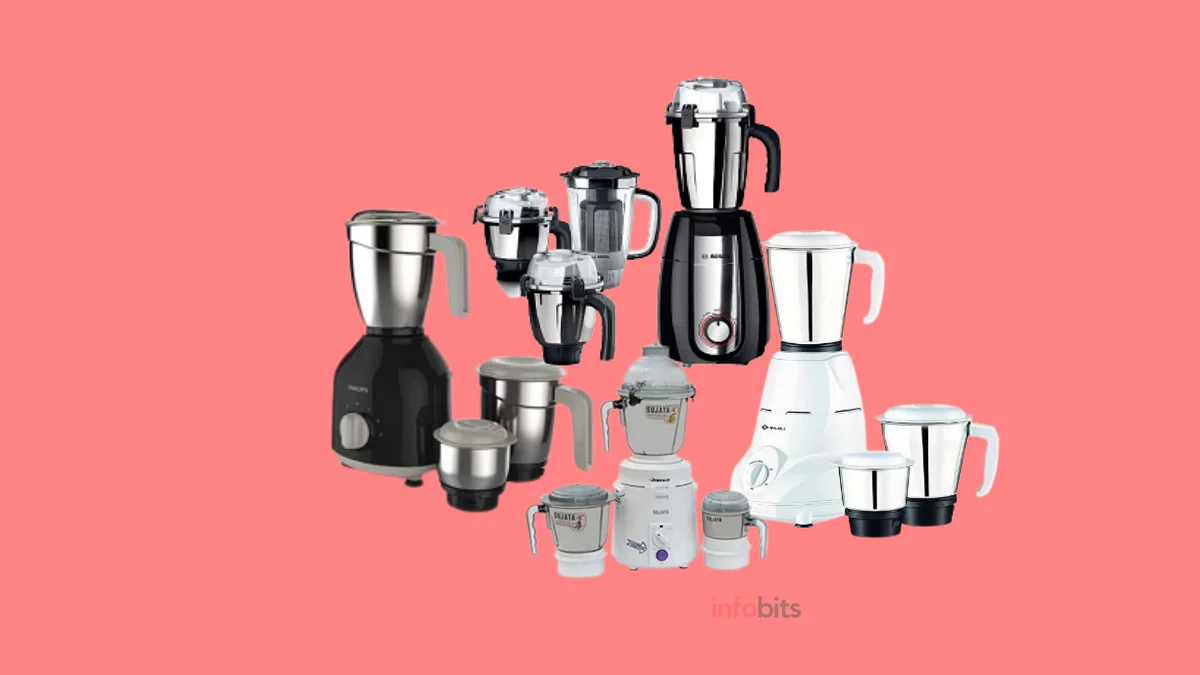
We’ve rebuilt this guide from scratch for 2026. We looked at 12 popular models across Bajaj, Sujata, Bosch, Philips, Preethi, Butterfly, Morphy Richards, and Orient Electric, checked current prices and specs, and compared them against what’s actually winning in Indian kitchens right now.
Here’s everything you need to pick the right one; no guesswork.
Quick Picks: Best Mixer Grinders in India
Best Overall: Sujata Dynamix 900W Mixer Grinder
Best Budget Pick: Bajaj Rex 500W Mixer Grinder
Best Premium / Best 1000W: Bosch Pro 1000W Mixer Grinder MGM8842MIN
Best for Beginners: Philips HL7756 750W Mixer Grinder
Best Value for Money (900W): Sujata Supermix 900W Mixer Grinder
Best for Professionals: Preethi Zodiac MG-218 Mixer Grinder
Best for Large Families: Butterfly Smart Plus 750W Mixer Grinder (5 Jars)
Best Compact Option: Preethi Diamond (Blue Leaf) Mixer Grinder
Best Mid-Premium 750W: Bosch TrueMixx Pro 750W Mixer Grinder MGM8642BIN
Best for Juicing: Sujata Multimix 900W Juicer Mixer Grinder
Best 4-Jar All-Rounder: Morphy Richards Icon Superb 750W Mixer Grinder
Best Entry-Level Pick: Orient Electric 500W Mixer Grinder
A quick way to think about it: if you cook for 2–3 people and mostly need chutneys and light grinding, 500W is enough. For daily dosa batter and masala grinding, 750W is the sweet spot. If you grind in bulk or run a joint household, 900W–1000W pays off in speed and motor life.
Prices change frequently across Amazon, Flipkart, and brand stores. Check current listings before buying.
The 12 Best Mixer Grinders in India; Reviewed
| Model | Power | Jars | Speed Settings | Motor Warranty | Best For |
|---|---|---|---|---|---|
| Sujata Dynamix | 900W | 3 | 3 + whip | 2 years | Daily batter & masala |
| Bajaj Rex | 500W | 3 | 3 + incher | 2 years | Small households |
| Bosch Pro MGM8842MIN | 1000W | 4 | Multi-speed | 5 years | Heavy, frequent use |
| Philips HL7756 | 750W | 3 | 3 + pulse | 5 years | First-time buyers |
| Sujata Supermix | 900W | 3 | 3 + whip | 2 years | Value-conscious buyers |
| Preethi Zodiac MG-218 | 750W | 5 | 3 + pulse | 5 years | Food prep + juicing |
| Butterfly Smart Plus | 750W | 5 | 3 speed | 2 years | Big families |
| Preethi Diamond | 750W | 3 (flexi lid) | 3 + pulse | 2 years | Compact kitchens |
| Bosch TrueMixx Pro MGM8642BIN | 750W | 4 | Multi-speed | 2 years | Balanced daily use |
| Sujata Multimix | 900W | 3 | 3 + whip | 2 years | Juice + grind combo |
| Morphy Richards Icon Superb | 750W | 4 | 3 + pulse | 5 years | All-rounder use |
| Orient Electric 500W | 500W | 3 | 3-speed | 2 years | Light, occasional use |
1. Sujata Dynamix 900W Mixer Grinder: Best Overall
The Dynamix has been India’s best-selling mixer grinder for years, and using one tells you why. The 900W motor runs on double ball bearings, which is the main reason these units last well past a decade in kitchens that use them two or three times a day.
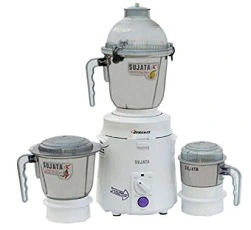
It comes with three stainless steel jars: a 1500ml dome jar for wet grinding like idli and dosa batter, a 1000ml jar for dry spices and pulses, and a 500ml chutney jar. The dome jar takes three interchangeable blades, so it also handles whisking and mincing.
Sujata rates the motor for 90 minutes of continuous running, which matters if you’re prepping for a big meal or a joint family kitchen.
Noise is on the higher side compared to some 750W models, simply because the motor is doing more work. Build quality is where it wins back that issue. The body, couplers, and jar locks feel noticeably sturdier than most mixers in this price band, and spare parts are easy to find since Sujata service centres are widespread.
Pros: Powerful 900W double ball bearing motor, excellent build quality, 90-minute continuous run rating, strong resale and service network.
Cons: Louder than 750W models, only 3 jars in the base variant.
Who should buy it: Households that grind daily batter, thick masalas, or cook for larger families and want a mixer that won’t need replacing in three years.
Who should avoid it: If you live alone or cook lightly, this may be more motor than you need. A 500W or 750W model saves you money without a loss in daily usability.
2. Bajaj Rex 500W Mixer Grinder: Best Budget Pick
The Rex is the mixer grinder most Indians grew up with, and Bajaj hasn’t changed the formula much because it doesn’t need to be. A 500W motor spinning at roughly 18,000–20,000 RPM handles daily Indian cooking ( chutneys, thin batters, and light dry grinding ) without fuss.
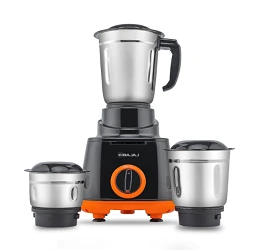
It ships with three stainless steel jars: a 1.2-litre liquidising jar, a 0.8–1-litre multipurpose jar, and a 0.3-litre chutney jar, all set in a rust-resistant ABS body with vacuum feet that keep it from sliding on the counter. Three-speed control plus an incher button gives you enough range for most everyday jobs.
Where it falls short is with heavier loads. Thick idli batter in bulk, or continuous dry grinding of turmeric and whole spices, will make a 500W motor work harder and heat up faster than a 750W unit would. It’s also a fairly basic mixer: no pulse-specific jar, no food processor add-ons, just a dependable grinder.
Pros: Very affordable, compact and light, reliable Bajaj service network, good enough for daily light-to-medium cooking.
Cons: Struggles with heavy or continuous grinding, only a 1-year product warranty on some listings, basic feature set.
Who should buy it: Small families, bachelors, or second-kitchen use where budget matters more than raw power.
Who should avoid it: Homes that grind batter in bulk regularly should look at 750W+ options instead.
3. Bosch Pro 1000W Mixer Grinder MGM8842MIN : Best Premium Pick
This is the mixer grinder for people who’ve outgrown 750W. The 1000W 3-C series motor with 100% copper windings pushes out serious torque, and Bosch’s Stone Pounding Technology ( a blunt-edged blade that pounds rather than slices dry ingredients) genuinely changes the texture of dry masalas, getting closer to what a traditional stone grinder produces.
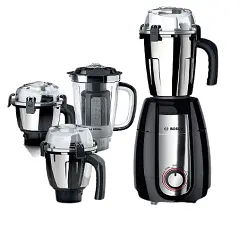
It comes with four jars: a 1.5-litre plastic blender jar with the MaxxJuice Extractor for juicing and smoothies, a 1.5-litre wet grinding jar, a 1-litre dry grinding jar, and a 0.4-litre chutney jar, all with Active Flow Breakers that improve batter aeration. Hands-free operation via lid locks and strong suction feet round out the package.
At this price, you’re also paying for German engineering and Bosch’s after-sales network, plus a substantial 5-year motor warranty against a 2-year product warranty. It’s a genuinely premium mixer, and it prices accordingly. This isn’t the pick if you just need something reliable for daily chutney duty.
Pros: Very powerful 1000W motor, Stone Pounding Technology for authentic masala texture, 4 versatile jars, long motor warranty.
Cons: Priced well above 750W and 900W alternatives, heavier unit, motor rated for 30-minute cycles rather than continuous running.
Who should buy it: Large households, people who cook elaborate meals daily, or anyone who wants the most powerful mixer on this list.
Who should avoid it: If your budget tops out around ₹5,000, the Bosch 750W sibling below gives you most of the same technology for less.
4. Philips HL7756 750W Mixer Grinder: Best for Beginners
The HL7756 has stayed near the top of “best mixer grinder” lists for years because it does the fundamentals well without asking the buyer to think too hard. The 750W turbo motor handles black gram dal and other tough dry ingredients comfortably, and Philips’ air ventilation system keeps the motor cooler over long grinding sessions, which extends its life.
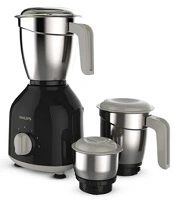
Three stainless steel jars cover the basics: a 1.5-litre wet jar, a 1-litre multipurpose jar, and a 0.3-litre chutney jar, each finished with custom rubber gaskets so lids seal tightly and don’t leak mid-grind. The compact, groove-free triangular design is genuinely easier to wipe clean than mixers with more complex body shapes.
It isn’t the most feature-rich mixer here ( no juicer jar, no food processor attachments ), but that’s also why it’s an easy first mixer grinder to live with. A 2-year product warranty and 5-year motor warranty back it up, and Philips’ service reach in India is extensive.
Pros: Reliable 750W performance, easy to clean, transparent jars for consistency checks, strong warranty and service network.
Cons: No juicer or food processor jar, fairly basic jar sizes for very large families.
Who should buy it: First-time mixer grinder buyers and small-to-medium families who want a trustworthy, low-maintenance option.
Who should avoid it: If you specifically want juicing capability built in, the Sujata Multimix or Preethi Zodiac cover that better.
5. Sujata Supermix 900W Mixer Grinder: Best Value for Money
The Supermix shares its 900W double ball bearing motor and 22,000 RPM speed with the pricier Dynamix, which makes it the smarter buy if jar size isn’t your priority.
The main difference is the blender jar: Supermix ships with a 1750ml unbreakable transparent jar (versus the Dynamix’s 1500ml stainless steel dome jar), which is better suited to shakes, purees, and cold coffee rather than heavy idli-batter grinding.
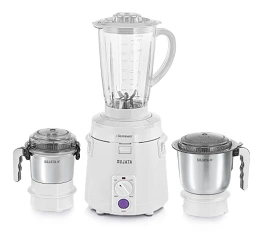
You still get a 1000ml stainless steel jar for dry grinding of spices and pulses, and a 500ml chutney jar with a safety lock, both with the same high-strength food-grade blades. The 90-minute continuous running rating carries over too, so it isn’t a lesser motor, just a different jar configuration aimed at everyday blending over heavy-duty batter work.
For most households, that trade-off is a win: you get Sujata’s proven motor reliability at a noticeably lower price than the Dynamix, and the transparent blender jar is genuinely more versatile for daily juices and shakes.
Pros: Same 900W motor as the Dynamix at a lower price, versatile transparent blender jar, strong build quality.
Cons: Blender jar isn’t ideal for very thick batter grinding, still limited to 3 jars.
Who should buy it: Buyers who want Sujata’s motor reliability without paying Dynamix pricing, especially if smoothies and juices matter more than batter.
Who should avoid it: If idli/dosa batter is your main daily task, the Dynamix’s stainless dome jar handles that slightly better.
6. Preethi Zodiac MG-218 Mixer Grinder: Best for Professionals
The Zodiac is less a mixer grinder and more a compact food-prep station. Its 750W Vega motor is tuned to grind turmeric in about two minutes, and it comes with five jars, including a 3-in-1 Insta Fresh juicer jar (centrifugal juicer, extractor for coconut milk or tamarind, and blender) and a 2.1-litre Master Chef Plus jar that kneads atta, chops, slices, grates, and minces meat.
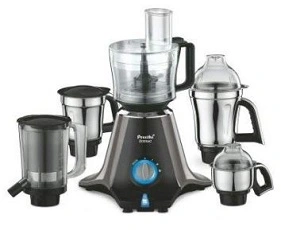
That combination ( juicer, food processor, and standard mixer grinder jars in one motor base) is genuinely rare at this price point and is why the Zodiac appeals to serious home cooks and small commercial kitchens rather than casual users. The overload indicator changes colour when the motor trips, which is a small but useful safety touch, and Preethi backs the motor with a 5-year warranty.
It’s a bigger investment of both money and counter space than a standard 3-jar mixer, so it makes sense mainly for people who’ll actually use the food processor functions regularly, rather than leaving that jar in a cupboard.
Pros: Genuine food processor + juicer + mixer grinder in one unit, fast turmeric grinding, 5-year motor warranty.
Cons: Pricier than standard 750W mixers, takes up more storage space, home demo may carry a charge in select cities.
Who should buy it: Home cooks who want dough kneading, chopping, and juicing alongside standard grinding without buying separate appliances.
Who should avoid it: If you’ll only ever use the basic wet/dry/chutney jars, you’re paying for functions you won’t touch. Go for the Philips or Bosch 750W instead.
7. Butterfly Smart Plus 750W Mixer Grinder (5 Jars): Best for Large Families
Butterfly has quietly built a strong reputation in South Indian kitchens, and the Smart Plus is a good example of why. The 750W heavy-duty motor comes with five jars: three stainless steel jars for wet, dry, and chutney grinding, a polycarbonate juicer jar, and a smaller “Grind & Store” jar with its own lid for grinding small batches of spices or nuts and refrigerating them directly.
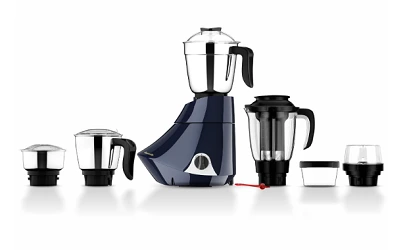
That last jar is a genuinely useful addition most competitors skip. The high-gloss, low-porosity ABS body is also designed to resist food particles sticking to it, which makes cleanup noticeably easier after daily use. A 3-speed rotary switch keeps the controls simple.
At its typical street price, this is one of the most jar-for-jar generous mixers on this list, and Butterfly backs it with 2 years each on product and motor. The main trade-off is that Butterfly’s service network isn’t as widespread outside South India as Bajaj’s or Philips’, which is worth checking for your city before buying.
Pros: Five jars including a useful grind-and-store jar, competitive pricing, easy-clean body design.
Cons: Service network less widespread in North India, only 2-year motor warranty versus 5 years on some rivals.
Who should buy it: Larger families who want maximum jar variety without stepping up to a food processor.
Who should avoid it: If after-sales support outside South India is a concern, Bajaj or Philips have denser service coverage.
8. Preethi Diamond (Blue Leaf Diamond MG-214) Mixer Grinder: Best Compact Option
The Blue Leaf Diamond solves a problem most mixer grinders don’t even try to: adjustable jar volume. Its Flexi Lid design lets you change the usable capacity of the main jar depending on how much you’re grinding, so you’re not always working with a jar sized for a family of six when you just need a small batch of chutney.
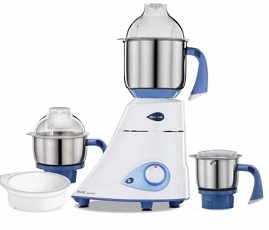
The 750W motor runs on a shock- and corrosion-resistant ABS body, with jars that Preethi says are salt-spray and water-load tested during manufacturing for longer life. Three speed levels plus a pulse function let you fine-tune texture, and a thermal cut-off protects the motor from overload; standard safety features executed well.
Preethi backs it with a notably generous offer: a 2-year warranty plus lifetime free service with no labour charges, which meaningfully lowers the cost of ownership over the years, even if a repair is needed.
Pros: Unique adjustable Flexi Lid jar, compact footprint, lifetime free service with no labour charges.
Cons: Fewer jars than 4–5 jar competitors, motor warranty period is shorter than Preethi’s own Zodiac.
Who should buy it: Smaller kitchens or households whose grinding quantities vary a lot from day to day.
Who should avoid it: If you regularly need dedicated juicer or food processor jars, look at the Zodiac or Sujata Multimix instead.
9. Bosch TrueMixx Pro 750W Mixer Grinder MGM8642BIN : Best Mid-Premium 750W
This is effectively the 1000W Bosch Pro’s smaller sibling, and it carries over almost the same feature set at a friendlier price. The 750W 2-C series HiFlux motor spins up to roughly 22,000 RPM, and you still get Stone Pounding Technology, Active Flow Breakers for fluffier batter, and the MaxxJuice Extractor built into the blender jar.
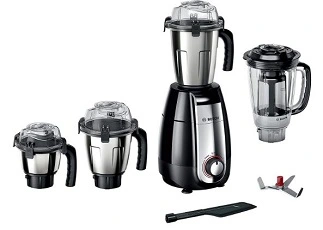
Four jars come in the box: a 1.5-litre blender jar, a 1.5-litre wet grinding jar, a 1-litre dry grinding jar, and a 0.4-litre chutney jar, all in food-grade stainless steel with leak-proof lids. Hands-free operation via lid locks and suction feet is identical to the 1000W model, so the day-to-day user experience barely changes. Means that you’re mainly trading outright power for a lower price.
For most Indian kitchens that don’t need 1000W of continuous grinding muscle, this strikes a genuinely good balance: German engineering and Bosch’s speciality grinding tech, at a price much closer to mainstream 750W mixers than to the premium 1000W tier.
Pros: Same Stone Pounding Technology and jar design as the pricier 1000W model, strong build quality, 4 jars included.
Cons: 2-year motor warranty is shorter than Bosch’s 1000W variant, 30-minute duty cycle rather than continuous running.
Who should buy it: Buyers who want Bosch’s grinding technology without paying the 1000W premium pricing.
Who should avoid it: Very heavy daily users (large joint families, frequent bulk batter prep) may still prefer the extra headroom of the 1000W version.
10. Sujata Multimix 900W Juicer Mixer Grinder: Best for Juicing
If juicing is a daily habit rather than an occasional treat, the Multimix earns its place. It carries Sujata’s familiar 900W double ball bearing motor and 90-minute continuous run rating, but swaps in a dedicated juicer attachment with a honeycomb filter mesh designed for better yield from fruits like apple, beetroot, carrot, and pineapple.
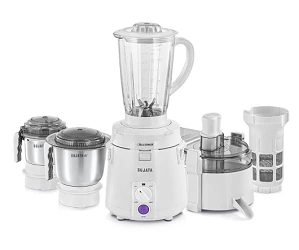
The same juicer jar doubles as a coconut milk extractor with a separate mesh filter, which is genuinely handy for Kerala-style curries and Thai dishes that call for fresh coconut milk. Beyond the juicer, it keeps the standard Sujata jar lineup: a 1750ml transparent blender jar, a 1000ml stainless steel dry-grinding jar, and a 500ml chutney jar with safety lock.
It’s essentially the Supermix with a juicer bolted on, so if you don’t juice often, that added cost and counter space may not be worth it. But for households that do want fresh juice most mornings, buying a mixer that already does both jobs beats owning a separate single-purpose juicer.
Pros: Built-in juicer with coconut milk extraction, proven Sujata motor and build quality, 90-minute continuous run rating.
Cons: Premium over Supermix mainly justified only if you juice regularly, still 3 core jars for grinding.
Who should buy it: Households that juice fruits and vegetables regularly and want one appliance instead of two.
Who should avoid it: If juicing is rare for you, the Supermix gives the same grinding performance for less money.
11. Morphy Richards Icon Superb 750W Mixer Grinder: Best 4-Jar All-Rounder
The Icon Superb packs in more jars than most 750W competitors at a similar price. Its 750W Ultron Maxx motor spins at roughly 20,000 RPM, and the box includes four jars: a 1.7–1.8-litre juicer jar with a pulp and seed filter, a 1.5-litre liquidising jar, a 1-litre dry/wet grinding jar, and a 0.4-litre chutney jar; a genuinely well-rounded set for the price.
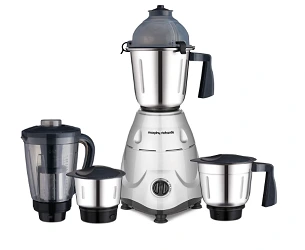
Four hardened stainless-steel blades handle chopping, mincing, and grinding, and the motor is rated for 30 minutes of flawless continuous running, which is adequate for most home-cooking sessions without needing back-to-back cycles. Overload protection is standard, and the ABS jar bases add extra durability against daily wear.
The main point here is warranty length. Some listings carry only a 1-year product warranty from Morphy Richards, which is shorter than most competitors on this list, so it’s worth double-checking the warranty terms on whichever retailer you buy from before you commit.
Pros: Four jars including a proper juicer jar, competitively priced for the features included, decent motor power for daily cooking.
Cons: Warranty terms vary by listing and can be shorter than rivals; motor runs noticeably louder under heavy load.
Who should buy it: Buyers who want juicing plus full grinding capability in one box without paying Preethi Zodiac-level prices.
Who should avoid it: If a long warranty matters more to you than jar count, Philips or Preethi options offer longer coverage.
12. Orient Electric 500W Mixer Grinder: Best Entry-Level Pick
Orient’s 500W mixer (sold as the Fine Blend or Kitchen Kraft line, depending on the retailer) is built for buyers who want a no-frills grinder and nothing more.
The copper-wound, balance-coil motor is engineered for a longer working life at this power tier, and the three jars ( roughly a 1.2-litre liquidising jar, a 0.7–0.8-litre wet/dry jar, and a 0.3–0.35-litre chutney jar) cover the basics competently.
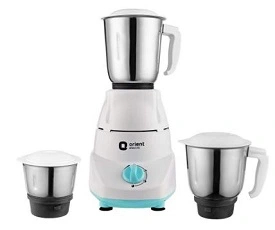
Improved flow breakers reduce lump formation during batter grinding, and overload protection is included as standard, which isn’t a given at this price point. The sleek, compact ABS body is one of the more contemporary-looking designs among budget mixers, and it’s genuinely light enough to move around a small kitchen easily.
It won’t compete with 750W+ machines on tough dry grinding or continuous heavy use, and there’s no juicer or speciality jar here. But for light, everyday tasks in a small household, it’s a sensible, low-cost option with a real 2-year warranty behind it.
Pros: Genuinely affordable, compact and lightweight, solid 2-year warranty, decent flow-breaker design for lump-free batter.
Cons: Limited to light-to-medium grinding tasks, no juicer or food processor jars, fewer available service centres than Bajaj or Philips.
Who should buy it: Students, bachelors, or small households wanting a basic, dependable mixer at the lowest realistic price.
Who should avoid it: If you grind dense masalas or thick batter often, step up to a 750W model for less strain on the motor.
How We Selected These Products
We evaluated each mixer grinder on six factors: motor power and RPM, jar quality and versatility, safety features like overload protection, build materials, warranty coverage, and real-world value for money at current Indian market prices.
We cross-checked specifications against brand websites and multiple retailers (Amazon, Flipkart, Croma, Reliance Digital, Vijay Sales) to confirm accuracy, and factored in genuine buyer feedback patterns around durability and after-sales service. None of the brands featured here paid for placement or reviews consideration.
Why You Can Trust This Guide
This list is updated to reflect 2026 pricing, specifications, and product availability in India. We don’t accept payment from manufacturers to be included, and every product recommendation is based on published specifications, brand documentation, and patterns in verified buyer reviews across multiple retail platforms.
Where we’ve changed a recommendation from an earlier version of this guide, we explain why in the Product Changes section below. We’d rather be transparent about updates than pretend our first list was perfect.
Buying Guide: How to Choose the Right Mixer Grinder
1. Motor Power (Wattage)
Wattage decides how easily a mixer breaks down tough ingredients. For most Indian households, 500W–750W is enough for daily chutneys, batters, and spice grinding. If you cook for a large family or run a shared kitchen, 900W–1000W gives you faster grinding and less motor strain over time.
2. Motor Speed (RPM)
RPM tells you how fast the blades spin, and it directly affects grinding fineness. A domestic mixer grinder in the 18,000–24,000 RPM range is ideal, enough to grind hard spices finely without straining the motor.
3. Number and Size of Jars
Most kitchens need at least three jars: one for wet grinding (batter, chutney), one for dry grinding (spices, pulses), and one small chutney jar. If you juice often or want food-processor functions like kneading and chopping, look at models with dedicated jars for those tasks instead of trying to force one jar to do everything.
4. Blade Quality
Look for food-grade stainless steel blades, ideally SS304 grade, since this resists rust and corrosion and holds its edge longer. Blunt or lower-grade blades are one of the most common reasons a mixer grinder stops performing well within a year or two.
5. Overload Protection
A thermal cut-off or overload protector is now standard on most models, but it’s still worth confirming before you buy. This feature protects the motor from burning out if a jar is overfilled or run for too long in one stretch.
6. Warranty and Service Network
A 2-year product warranty with a 2–5 year motor warranty is a reasonable baseline in 2026. Just as important is whether the brand has an active service centre in your city. A great warranty on paper means little if the nearest technician is three towns away.
7. Price and Value
Don’t compare mixer grinders purely on sticker price. A cheaper 500W model that needs replacing in two years often costs more over time than a slightly pricier 750W mixer that lasts a decade. Match the price to how often, and how hard, you’ll actually use it.
Common Mistakes to Avoid
- Buying based on wattage alone. A 1000W motor with poor blade quality can underperform a well-built 750W model.
- Ignoring jar capacity for your household size. A single-person kitchen doesn’t need a 2-litre jar, and a family of six will find a 0.5-litre jar frustrating.
- Running the motor non-stop past its rated cycle. Most mixers are rated for 30–90 minutes continuous use. Pushing past that shortens motor life significantly.
- Overfilling jars. This is the single biggest cause of premature motor burnout, even with overload protection in place.
- Skipping the service-centre check. Confirm your city has an authorised service centre for the brand before buying, especially for less mainstream brands.
Expert Tips for Longer Mixer Grinder Life
Let ingredients cool to room temperature before grinding. Very hot or very cold contents stress the motor and jar seals. Start on the lowest speed and work up, rather than jumping straight to full power, which reduces strain on the coupler and blades.
Clean and fully dry all jars and lids after each use, since trapped moisture around the coupler is a common cause of early rust and blade corrosion.
Alternatives and Upgrade Picks
If you’ve outgrown everything on this list, or want something genuinely different from these picks, a few alternatives are worth a look.
The Atomberg Zenova Mixer Grinder uses a BLDC motor that draws far less power for comparable output and includes a slow-grind mode that mimics traditional stone grinding. It is a strong pick if energy efficiency and low noise matter to you.
For heavy commercial-style use, the Sujata MG03 Mixer Grinder steps up to a 1000W motor with a coconut milk extractor jar built in.
Conclusion
There’s no single “best” mixer grinder for everyone. The right pick depends on how many people you cook for, how often you grind tough ingredients, and how much counter space and budget you’re working with.
If you want one safe, well-rounded recommendation, the Sujata Dynamix 900W or the Philips HL7756 750W will serve most Indian kitchens well for years. For tighter budgets, the Bajaj Rex 500W remains a dependable starting point.
Whichever you choose, prioritise blade quality, overload protection, and a strong local service network over marginal wattage differences. Those are the factors that actually determine how long your mixer grinder lasts.
Quick Picks Summary:
| Product | Category |
|---|---|
| Sujata Dynamix 900W | Best Overall |
| Bajaj Rex 500W | Best Budget Pick |
| Bosch Pro 1000W MGM8842MIN | Best Premium / Best 1000W |
| Philips HL7756 750W | Best for Beginners |
| Sujata Supermix 900W | Best Value for Money (900W) |
| Preethi Zodiac MG-218 | Best for Professionals |
| Butterfly Smart Plus 750W (5 Jars) | Best for Large Families |
| Preethi Diamond (Blue Leaf) | Best Compact Option |
| Bosch TrueMixx Pro 750W MGM8642BIN | Best Mid-Premium 750W |
| Sujata Multimix 900W | Best for Juicing |
| Morphy Richards Icon Superb 750W | Best 4-Jar All-Rounder |
| Orient Electric 500W | Best Entry-Level Pick |
Frequently Asked Questions
It depends on your usage. For most households, the Sujata Dynamix 900W offers the best balance of power and durability. For tighter budgets, the Bajaj Rex 500W remains dependable, and for maximum power, the Bosch Pro 1000W leads this list.
Yes, for the large majority of households. A 750W motor comfortably handles chutneys, dosa/idli batter, and dry spice grinding for families of 2–5 people without overheating.
For light, occasional use, 500W is sufficient. For daily batter and masala grinding, 750W is the practical sweet spot. Households that grind in bulk or run a joint kitchen benefit more from 900W–1000W.
Three jars. Wet grinding, dry grinding, and chutney cover most daily needs. Add a juicer jar only if you juice regularly, and a food-processor jar only if you’ll genuinely use kneading, chopping, or grating functions.
Bajaj, Philips, and Preethi have some of the widest service networks across Indian cities. Sujata and Bosch also have strong reputations, though coverage can be thinner in smaller towns. It’s worth checking availability in your specific city before buying.
Not necessarily. RPM in the 18,000–24,000 range is ideal for most Indian grinding tasks. Beyond that, gains are marginal, and what matters more is motor torque, blade quality, and jar design working together.
Only if you’ll genuinely use it. Food-processor jars for kneading dough or chopping vegetables are convenient, but they add cost and counter space. If you already own a separate food processor or rarely need these functions, a standard 3–4 jar mixer grinder is more practical.
We hope you are interested in our articles and consider following our Facebook, Instagram, and Twitter pages for regular updates.
Also, share this article with your friends and relatives. Bookmark this page for future reference.
Subscribe to our free newsletter so that you will get similar articles and regular updates directly in your Email.
Subscribe to be the first to learn about new information
Disclosure: If you follow our links to a retailer’s website and make a purchase, we will get an affiliate commission on some, but not all, of the things or services we promote. Your price is unaffected by this.