1400mm vs 1200mm Ceiling Fan: Which Size Do You Actually Need?
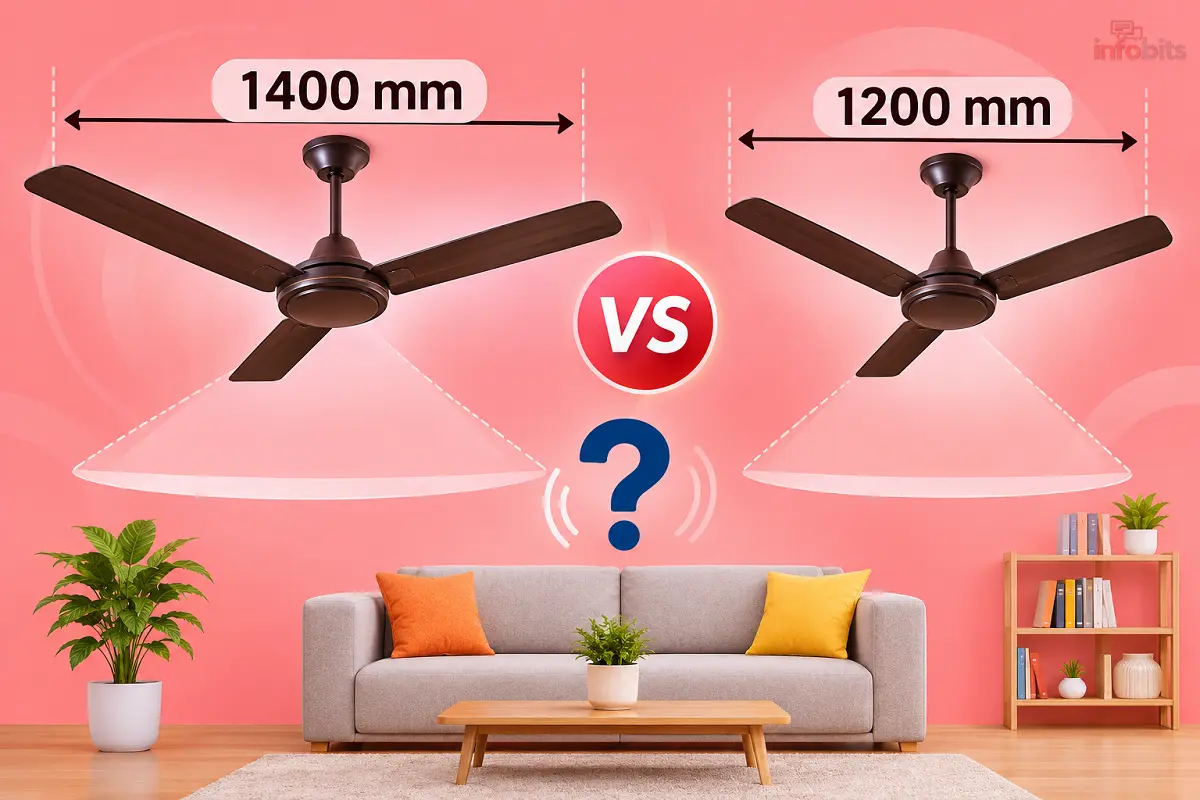
In a showroom, a 1200mm fan and a 1400mm fan look almost the same. The difference is just 200mm, about 8 inches. Yet that gap decides whether your room gets an even breeze or has still corners.
This guide gives you simple room-size rules, real airflow and power numbers, and a tie-breaker for in-between rooms. Read it once, and you will know which size to order.
Quick answer: Choose a 1200mm fan for rooms up to about 150 sq ft and a 1400mm fan for rooms of roughly 150 to 225 sq ft. If your room is 130 to 170 sq ft, decide using room shape, ceiling height and wall clearance (checklist below). Rooms above 225 sq ft, or long and narrow ones, usually need two fans.
1200mm vs 1400mm fans at a glance
| 1200mm fan | 1400mm fan | |
|---|---|---|
| Sweep size | About 47–48 inches (4 ft) | About 55–56 inches (4.6 ft) |
| Suitable room area | Up to ~150 sq ft | ~150 to 225 sq ft |
| Typical airflow | ~210 to 240 CMM | ~250 to 280 CMM |
| Typical power, 5-star BLDC | ~28 to 35W | ~28 to 35W |
| Typical power, induction | ~70 to 80W | ~75 to 90W |
| Comfortable minimum room width | ~9 ft | ~10 ft |
| Best for | Bedrooms, average living rooms, home offices | Large bedrooms, big living rooms, halls |
Note: Figures are typical. Always check the label of the exact model.
Notice how close the BLDC power figures are. In a modern fan, size changes the wattage only a little. The motor type changes it a lot.
Related: BLDC Fan vs Normal Fan: Why You Should Switch
What do 1200mm and 1400mm actually mean?
The number is the sweep. It is the diameter of the circle the blades draw as they spin. So a 1200mm fan covers a circle about 4 feet across, and a 1400mm fan covers about 4.6 feet.
To measure a fan you already own, switch it off. Measure from the centre of the motor to the tip of one blade, then double it. This works for 3-blade and 4-blade fans alike.
Which fan size suits your room?
Start with your room area. Multiply length by width in feet. A 10 × 12 ft room is 120 sq ft.
For measuring, a basic 5-metre steel tape is enough, and a laser distance measurer from a brand like Bosch (view on Amazon) is handy if you are checking several rooms.
| Room area | Best size | Notes |
|---|---|---|
| Up to 100 sq ft (10 × 10) | 900mm to 1200mm | 1400mm is usually oversized |
| 100–130 sq ft (10 × 12) | 1200mm | The safe, standard choice |
| 130–170 sq ft (12 × 12, 12 × 14) | 1200mm or 1400mm | Grey zone; use the checklist below |
| 170–225 sq ft (12 × 15, 14 × 16) | 1400mm | One fan, near the centre |
| Above 225 sq ft, or long and narrow | Two fans | Space them out |
Why is there a grey zone? Brand charts disagree. Some switch to 1400mm at around 120 sq ft. Others wait until 150 sq ft. Both can be right, because room shape and clearance matter as much as area.
Here are a few worked examples:
- 10 × 12 ft bedroom (120 sq ft): 1200mm. A bigger fan adds nothing here.
- 12 × 12 ft room (144 sq ft): Grey zone. Either works, so use the checklist.
- 12 × 15 ft living room (180 sq ft): 1400mm, fitted near the centre.
- 10 × 18 ft hall (180 sq ft): Two 1200mm fans. One fan in the middle leaves the corners stagnant.
- 15 × 20 ft open-plan space (300 sq ft): Two matched fans, ideally 1400mm each.
How to choose in the grey zone (130–170 sq ft)
Go for 1400mm if most of these are true:
- The room is close to square.
- The shorter side is 10 ft or more.
- You can leave 2 to 3 ft between the blade tips and every wall, beam or fixture.
- Your ceiling is 9 ft or higher.
- The fan runs many hours a day, and you prefer a soft, wide breeze.
Stay with 1200mm if most of these are true:
- The room is narrow, or the shorter side is under 10 ft.
- A wardrobe, beam, curtain rail or light fixture sits close to the fan’s path.
- The ceiling is low, or you plan a flush mount.
- The room is mainly for sleeping, and the bed sits directly under the fan.
- You want to keep the cost down.
Tip: Tape out a 4.6 ft (140cm) circle on the floor under the spot where the fan will hang. If it feels too close to furniture or walls, choose 1200mm. It takes two minutes and avoids an expensive mistake.
Does a 1400mm fan cool better than a 1200mm?
It moves more air, but not as much more as people expect. Typical figures are about 210 to 240 CMM for a 1200mm fan and 250 to 280 CMM for a 1400mm fan. That is roughly 10 to 20% extra.
Where 1400mm really helps is spread. A wider sweep reaches more of the room at a lower blade speed. That gives a softer, broader breeze, which many people like in large bedrooms.
Remember what a fan actually does. It cools you, not the room. Moving air helps sweat evaporate from your skin, so switch the fan off when nobody is in the room.
Myth vs fact
| Myth | Fact |
|---|---|
| A bigger fan always cools better. | It moves 10–20% more air. Fit and placement matter more. |
| A 1400mm fan uses far more electricity. | In BLDC fans, the gap is small, often just a few watts. |
| Higher RPM means better cooling. | CMM and sweep size tell you more than RPM. |
| If unsure, always go bigger. | An oversized fan in a tight room feels cramped and turbulent. |
| A fan lowers the room temperature. | It only makes you feel cooler through airflow. |
Power use and running cost
Motor type matters more than size here. This table shows yearly running cost at top speed, 8 hours a day, at ₹8 per unit.
| Fan | Typical watts | Units per year | Cost per year |
|---|---|---|---|
| 1200mm induction | 75W | 219 | ₹1,752 |
| 1400mm induction | 85W | 248 | ₹1,986 |
| 1200mm 5-star BLDC | 30W | 88 | ₹701 |
| 1400mm 5-star BLDC | 35W | 102 | ₹818 |
Moving from 1200mm to 1400mm in a BLDC fan costs about ₹120 a year extra. Switching from induction to BLDC saves roughly ₹1,000 to ₹1,200 a year, whichever size you pick. If your budget is tight, choose BLDC first and size second.
Your real bill will be lower, because few people run a fan at full speed all day. Check your own tariff and the label on the box. In summer, a fan running alongside an AC often lets you raise the thermostat a little.
Related: AC Power Consumption Calculator: Units Per Hour & Monthly Bill
Ceiling height, clearance and mounting
Room area is only half the story. Ceiling height and clearance decide how well the fan works and how safe it is.
| Ceiling height | Mounting |
|---|---|
| 8 to 9 ft | Flush mount or very short downrod |
| 9 to 10 ft | Standard downrod, usually no change needed |
| 10 to 12 ft | Extension rod of about 18 to 24 inches |
| Above 12 ft | Longer extension of about 36 to 48 inches |
If your ceiling is 10 ft or higher, order a downrod extension (view the options on Amazon) made for your fan’s brand, and confirm it fits your model before buying.
Here are the clearance rules that matter:
- Keep the blades about 8 to 9 ft above the floor. As a safety rule, never go below 7 ft.
- Leave roughly 8 to 10 inches between the ceiling and the blades, so air can flow above the fan.
- Keep 2 to 3 ft between the blade tips and any wall, beam or fixture.
- With a false ceiling, measure from the false ceiling surface, not the concrete slab.
A 1400mm fan is heavier. Use a proper fan hook, not a light-fitting hook, and switch off the MCB before you start. If you are unsure, ask a qualified electrician to fit it.
If the room has a low ceiling or very tight space, a ceiling fan may not suit it at all. In that case, a wall fan can solve the problem.
Related: Best Wall Fans in India: 10 Tested Picks & Buying Guide
Best fan size for each room
| Room | Recommended size | Why |
|---|---|---|
| Small bedroom, study (up to 100 sq ft) | 900mm to 1200mm | Enough airflow without crowding |
| Standard bedroom (100–150 sq ft) | 1200mm | The standard fit |
| Large or master bedroom (150 sq ft+) | 1400mm | Gentler breeze at lower speed |
| Living or drawing room | 1200mm up to 150 sq ft, 1400mm above | Match area, then check shape |
| Hall or open-plan space | 1400mm, or two fans | Spread the airflow |
| Dining room | 1200mm | Check clearance above the table |
| Kitchen | 900mm to 1200mm | Space is tight, pair with an exhaust fan |
| Kid’s room | 900mm to 1200mm | Keep blades well out of reach |
Which fan to buy once you know the size
Size is only the first decision. Look for a 5-star BEE rating, the airflow in CMM, and the wattage. A higher CMM per watt means a more efficient fan.
If you are leaning towards 1200mm, a 5-star BLDC such as the Atomberg Renesa 1200mm or the Orient 1200 mm Aeon BLDC PRO is a sensible place to start. Both are listed at roughly 28 to 30W and available on Amazon.
For larger rooms, the Atomberg Renesa Enzel 1400 mm (view on Amazon) is worth a look, since the brand lists its 1400mm BLDC fans at about 250 to 270 CMM.
Want a wider comparison? Read our best BLDC fans in India article. On a tighter budget, see the best ceiling fans under ₹1,500.
Using a BLDC fan with an inverter or in thunderstorms
BLDC fans draw very little power, so a 1400mm model barely shortens your inverter backup compared with a 1200mm one. They do contain electronics, so a pure sine wave inverter is the safer choice.
Related: Sine Wave vs Square Wave Inverter: Which Is Right for You?
If your inverter trips when several fans run, see fixing inverter overload. In lightning-prone areas, protect the fan’s electronics too.
Common mistakes to avoid
- Choosing by price or looks alone. Size and airflow come first.
- Using one big fan in a long, narrow room. Two smaller fans work better.
- Ignoring wall and beam clearance. A 1400mm fan needs more free space than you think.
- Skipping the downrod on tall ceilings. A fan stuck near a 12 ft ceiling cools very little.
- Comparing RPM instead of CMM. RPM alone says little about airflow.
- Forgetting the hook. An old light hook may not safely support a heavier fan.
- Measure before the false ceiling or furniture is final. Measure after the layout is fixed.
Warning signs you picked the wrong size
| Fan too small | Fan too big |
|---|---|
| Corners stay warm and still | Air bounces back from the walls |
| You always run it at top speed | Blades feel too close to walls or furniture |
| Far corners of the room get no breeze | The room feels cramped under the fan |
| The fan seems to be working hard | Loose papers and curtains flutter even at low speed |
Troubleshooting common problems
| Problem | Likely cause | Fix |
|---|---|---|
| Fan wobbles | Loose canopy or hook, unbalanced or bent blade | Tighten fittings, check the hook, rebalance the blades |
| Weak airflow | Blades too close to the ceiling, dust, low voltage | Lower on a downrod, clean blades, check the supply |
| Slow on inverter or low voltage | Induction motor loses speed | Consider a BLDC fan, which holds speed better |
| Humming on inverter | Non-sine-wave output | Use a pure sine wave inverter |
| Corners still warm | One fan cannot cover the shape | Add a second fan instead of going bigger |
| Papers fly, strong draft | Fan oversized for the room | Lower the speed or switch to 1200mm |
If a wobble stays after tightening everything, a ceiling fan blade balancing kit costs little and often fixes it.
Always use a sturdy foldable ladder rather than a chair when you work on the fan, such as an aluminium multipurpose ladder.
Dust on the blades can reduce airflow over time. Clean them every few weeks with a long-handled microfibre duster so that you can do it from the floor.
Quick checklist before you order
- Measure the room area and the shorter side.
- Check the ceiling height and whether there is a false ceiling.
- Confirm 2 to 3 ft of clearance from every wall, beam and fixture.
- Decide between one fan and two, based on room shape.
- Pick BLDC and a 5-star rating if you can.
- Compare CMM and wattage, not just RPM.
- Check the price trend before you buy.
Related: How to Track Amazon Price History Before You Buy
Still stuck? Use this 3-question test
- Is the room under 130 sq ft? Buy 1200mm.
- Is it 170 sq ft or more and roughly square? Buy 1400mm.
- Is it in between, or long and narrow? If the shorter side is under 10 ft, buy 1200mm. If it is a long room, use two 1200mm fans. Otherwise, 1400mm will give a softer breeze.
Final verdict
For most Indian homes, 1200mm is the right answer. It fits average bedrooms and living rooms; it is easy to place, and it works well on standard ceilings. Pick 1400mm only when your room is genuinely large and has the clearance for it.
Whichever size you choose, the motor matters as much as the sweep. A 5-star BLDC fan will cut your running cost far more than moving between 1200mm and 1400mm.
Frequently Asked Questions
Neither is better for every room. A 1200mm fan suits rooms up to about 150 sq ft, and a 1400mm fan suits roughly 150 to 225 sq ft. Pick by room size, shape and ceiling height.
A 12×12 room is 144 sq ft, which is in the grey zone. A 1200mm fan works well if the room is square and has furniture or beams nearby. Choose 1400mm if you want a softer, wider breeze and have 2 to 3 ft of wall clearance.
A 1200mm fan. At 120 sq ft, a 1400mm fan is usually oversized.
A 12×15 room is 180 sq ft, so a single 1400mm fan fits best. Mount it near the centre of the room.
1200mm is about 47 to 48 inches, or 4 ft. 1400mm is about 55 to 56 inches, or 4.6 ft. Brands round these numbers differently.
Slightly, and mostly in induction fans. A 5-star BLDC fan of either size typically draws about 28 to 35W at top speed. Induction fans usually draw roughly 70 to 90W, a little more in 1400mm.
Typically about 10 to 20% more. Manufacturer charts show roughly 210 to 240 CMM for 1200mm and 250 to 280 CMM for 1400mm. The real benefit is wider coverage at a lower speed.
You can, but it is rarely a good idea. Blades come close to the walls, air bounces back, and the fan feels cramped. Stay with 1200mm or smaller below about 130 sq ft.
Yes, if the room is up to about 150 sq ft and not long and narrow. For bigger or elongated rooms, use one 1400mm fan or two 1200mm fans.
For a roughly square hall up to 225 sq ft, one 1400mm fan is simpler and cheaper to run. For long, narrow or L-shaped halls, two 1200mm fans cover the corners better. Keep them at least 4 ft apart, tip to tip.
A standard 9 to 10 ft ceiling works well. Blades should sit about 8 to 9 ft above the floor, and never below 7 ft. For taller ceilings, add a downrod extension.
Usually yes, since the wiring and hook are the same. Check wall clearance, ceiling height, and that your hook can carry the extra weight. Ask an electrician to confirm.
Motor and build quality matter more than size. A larger fan can deliver similar airflow at a lower speed, which is often quieter. Compare the noise rating (dB) of the specific model.
Only if your room needs the extra coverage. In a 150 to 225 sq ft room, it is worth it. In a smaller room, the extra money buys very little.
No. The star rating shows efficiency, meaning airflow per watt, not physical size. Always check the label for the exact model.
Yes. BLDC fans draw little power, so size barely changes your backup time. A pure sine wave inverter is the safest choice.
Keep about 2 to 3 ft between the blade tips and the nearest wall, beam or fixture.
1200mm, or about 48 inches. It suits most bedrooms and living rooms.
We hope you are interested in our articles and consider following our Facebook, Instagram, and Twitter pages for regular updates.
Also, share this article with your friends and relatives. Bookmark this page for future reference.
Subscribe to our free newsletter to get similar articles and regular updates directly in your Email Inbox.
Subscribe to be the first to learn about new information
Disclosure: If you follow our links to a retailer’s website and make a purchase, we will get an affiliate commission on some, but not all, of the items or services we promote. This will cause no price change for you.