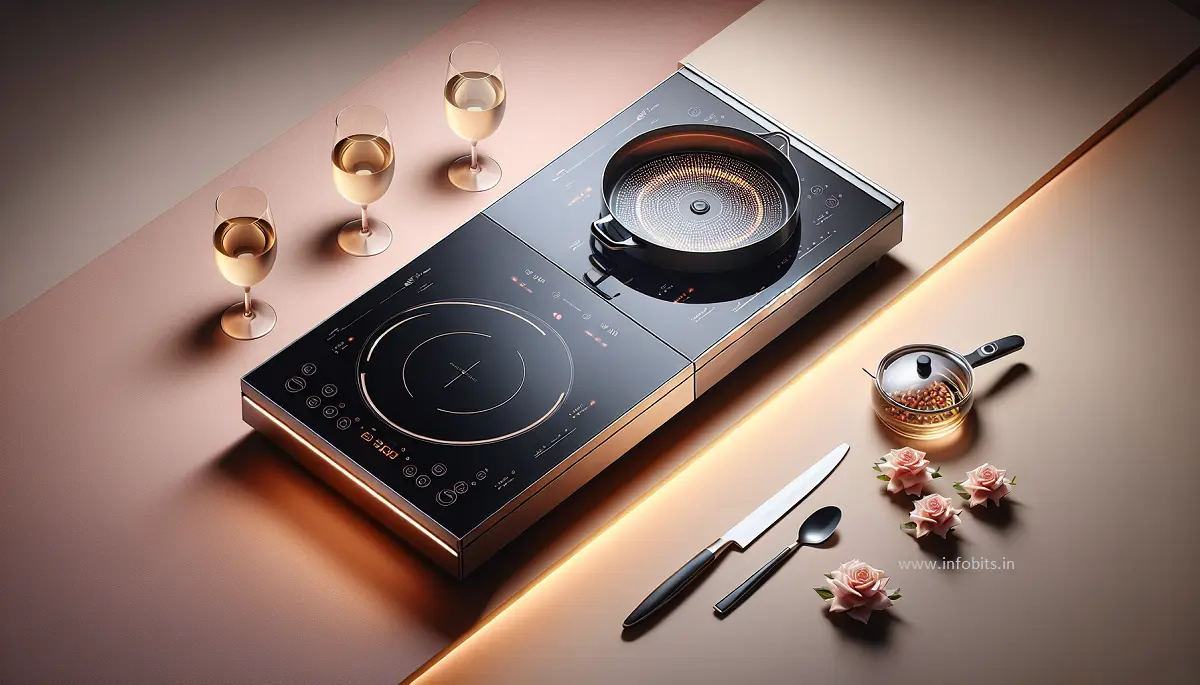
Induction vs Infrared Cooktop: Which Is Better for Indian Kitchens?
Quick Answer:
Neither is universally “better”. It depends on your existing cookware and cooking style. Induction is faster, cheaper to run long-term, and ideal for everyday Indian cooking like dal and tadka, but it only works with magnetic (steel/cast iron) cookware. Infrared works with everything you already own ( aluminium, copper, clay) and costs less upfront, but runs slightly less efficiently and gets hot to the touch.
- Choose induction if: most of your cookware is steel/cast iron and you want the lowest running cost
- Choose infrared if: your cookware is mostly aluminium/copper/clay and you want to avoid extra spending
- Price in India: Induction ₹1,500–₹8,000+ | Infrared ₹1,400–₹5,000
- Big Indian-kitchen catch: neither lets you roast rotis or papad directly over an open flame the way gas does. Infrared allows it with a mesh; induction doesn’t allow it at all
If you’ve ever stood in front of the electric appliances section wondering whether to pick up an induction cooktop or an infrared one, you’re not alone. Both promise faster cooking, lower gas dependency, and a safer kitchen. But they’re built on completely different technology, and that difference matters more than the shop assistant usually lets on.
We’ve used both types over the months, and the honest answer is: neither one is “better” in every situation. It genuinely depends on what cookware sits on your kitchen shelf right now, how you cook your rotis, and whether you’re chasing the lowest electricity bill or the lowest upfront cost.
This guide breaks down exactly how each one works, what it actually costs to run in India, and, more importantly, which one fits your kind of cooking. No fluff, just the stuff you need before you spend your money.
Induction vs Infrared Cooktop: Quick Comparison
| Feature | Induction Cooktop | Infrared Cooktop |
|---|---|---|
| How it heats | Creates a magnetic field that heats the cookware directly | Heats the glass surface, which then transfers heat to the cookware |
| Cookware needed | Only magnetic-base cookware (stainless steel, cast iron) | Works with almost anything: aluminium, glass, copper, clay, non-stick |
| Energy efficiency | Around 85–90% of electricity converts to cooking heat | Around 60–70% of electricity converts to cooking heat |
| Cooking speed | Fastest; heat is generated inside the vessel | Fast, but slightly behind induction |
| Cooktop surface | Stays cool to the touch | Gets noticeably hot, glows during use |
| Roasting rotis/papad directly | Not possible; needs a vessel to work at all | Possible with a mesh/jali, though not ideal for daily use |
| Typical price (India) | ₹1,500–₹8,000+ | ₹1,400–₹5,000 |
| Running cost | Lower long-term electricity bill | Slightly higher, still cheaper than LPG |
| Voltage fluctuation tolerance | Some models are sensitive to unstable voltage | Generally more tolerant |
| Best suited for | Precise, everyday Indian cooking; tadka, simmering, pressure cooking | Kitchens with mixed cookware, grilling, and occasional roasting |
How an Induction Cooktop Actually Works
Under the glass top of an induction cooktop sits a copper coil. When you switch it on, electric current flows through that coil and creates a rapidly changing magnetic field.
Place a pan with a magnetic base on top, and that field induces electric currents directly inside the metal of the pan. Those currents generate heat right inside the cookware itself, not on the cooktop’s surface.
This is the reason induction feels almost instant: there’s no glass or coil to heat up first. The energy goes straight into your dal or tadka.
The catch is that the pan has to be magnetic. A steel test with a fridge magnet works well here. If a magnet sticks firmly to the base of your pan, it’ll work on induction. Aluminium, copper, glass, and most non-stick cookware without a steel base simply won’t heat up at all.
If most of your cookware is aluminium or copper, it’s often cheaper to pick up an induction-base pressure cooker or a magnetic-bottom kadhai rather than replacing your entire kitchen. Something like a Hawkins induction-base pressure cooker (available on Amazon) handles this conversion well for under a couple of thousand rupees.
How an Infrared Cooktop Actually Works
An infrared cooktop looks almost identical from the outside; same flat glass surface, same touch controls. But it heats things completely differently.
Inside, a heating element (often a halogen coil or ceramic element) heats up and radiates infrared energy, similar to how sunlight warms your skin from a distance. This energy first heats the glass surface of the cooktop, and the glass then passes that heat upward into whatever pan you’ve placed on it.
Because it doesn’t rely on a magnetic reaction, it genuinely doesn’t care what your cookware is made of. Steel, aluminium, copper, glass, ceramic, even your grandmother’s old aluminium kadhai; all of it works.
The limitation is that since heat has to travel through the glass first, some energy escapes as ambient heat, and the surface itself gets hot enough to glow. That’s worth knowing if you have young children in the house, since the “cool touch” claim on the box refers to the housing edges, not the actual cooking zone.
Energy Efficiency and Running Costs: The Numbers That Matter
This is where most buying guides stay vague, so let’s get specific.
Induction cooktops convert roughly 85–90% of the electricity they draw into actual cooking heat. Very little escapes into the surrounding air, which is why a pot of water comes to a boil noticeably faster on induction than on a regular electric coil stove.
Infrared cooktops convert around 60–70% of electricity into cooking heat, since some of it is used to heat the glass surface before it ever reaches your food. It’s still far more efficient than a traditional coil stove or a gas burner in terms of usable heat, just not quite in induction’s league.
Here’s what that means in rupees. A 2000W induction cooktop running for one hour uses about 2 units (kWh) of electricity. At an average Indian tariff of ₹6–8 per unit, that works out to roughly ₹12–16 an hour, or ₹8–20 for a typical 20–40 minute meal. An infrared cooktop of similar wattage will land somewhat higher because of the extra heat lost through the glass, though both remain cheaper per meal than a full LPG cylinder, which currently costs upward of ₹900 in most Indian cities.
If you cook multiple times a day, every day, that efficiency gap between the two adds up over a year. This is mostly enough to offset the higher upfront price of an induction cooktop within 12–18 months of regular use.
Cookware Compatibility: The Real Deciding Factor for Indian Kitchens
Ask anyone who’s actually switched from gas to electric cooking, and cookware compatibility- not price – is usually what tips the decision.
Most Indian kitchens have a genuine mix: a steel patila for dal, an aluminium kadhai for frying, a copper tapeli for milk, maybe a clay handi for slow-cooked biryani or a pressure cooker with an aluminium body.
Induction cooktops are strict about this. Only cookware with a magnetic base ( stainless steel, cast iron, or specially made induction-base cookware) will heat up at all. If most of your utensils are aluminium or copper without a magnetic layer, you’re looking at replacing a chunk of your kitchen, which can cost anywhere from ₹3,000 to ₹8,000 depending on how much you need to swap out.
Infrared cooktops sidestep this problem entirely. Every vessel you already own ( aluminium, copper, glass, ceramic, ordinary steel) works exactly as it would on a gas stove, with zero additional investment.
If you’re set on induction but don’t want to replace your whole cookware set immediately, starting with a single induction-base tawa and kadhai combo like Tramontina Aura 4-Pc Cookware Set (available on Amazon) is usually enough to cover 80% of daily cooking.
Related: Best Mixer Grinders in India (2026): Tested Picks for Every Kitchen
What About Roti, Phulka, and Direct Roasting?
This is genuinely underdiscussed in most comparisons, and it matters a lot for Indian cooking.
On a gas stove, many of us roast phulkas directly over the open flame for a few seconds to get that puffed, slightly charred finish, or roast papads and baingan directly over the burner.
Induction cooktops can’t do this at all. Since the magnetic field only activates when a compatible vessel is sitting on the surface, there’s no way to place a roti directly on the cooktop and get it to puff or char. You’ll need a separate roti puffer accessory or stick to a tawa.
Infrared cooktops handle this slightly better. Because the surface itself radiates heat like a glowing element, you can place a wire mesh or roasting jali over it and roast papads or vegetables directly, getting a result reasonably close to an open flame. It’s not something to do daily, since it can leave stubborn stains on the glass, but it’s an option induction simply doesn’t offer.
If direct roasting is a regular part of your cooking routine, this is worth weighing more heavily than the energy-efficiency numbers.
Safety: Surface Heat, EMF, and What’s Actually Worth Worrying About
Surface Temperature
An induction cooktop’s glass surface stays relatively cool during cooking, since the heat is generated inside the pan, not on the glass. Spills don’t burn onto the surface as easily, and there’s a lower risk of accidental burns. This is a genuine plus if you have young children or elderly family members in the kitchen.
An infrared cooktop’s surface gets hot enough to glow orange and stays warm for a while after you switch it off. It’s not dangerous with normal care, but it does need a bit more caution around kids and pets, and you shouldn’t place anything on it immediately after cooking.
The EMF and Pacemaker Question
This comes up a lot, so let’s address it directly: induction cooktops do generate an electromagnetic field to heat cookware, and this occasionally raises health questions online.
For the general population, credible research and appliance manufacturers agree that normal domestic use ( standing at a regular cooking distance with the pan properly centred) falls well within safety limits, and there’s no established evidence of harm to a healthy adult.
The one group that genuinely needs to be careful is people with pacemakers or implantable cardiac devices.
Modern devices are shielded against everyday electromagnetic interference, and most cardiologists confirm induction cooktops are safe to use with reasonable precautions such as staying an arm’s length away, keeping the pan centred and fully covering the coil, and avoiding leaning directly over the cooking zone.
If you or someone in your household has such a device, it’s still worth a quick check with your cardiologist before buying, purely for peace of mind.
Infrared cooktops don’t raise this concern at all, since they don’t rely on a magnetic field to function.
Voltage Fluctuations
Indian households, especially outside major metros, still deal with voltage fluctuations during peak hours or storms. Infrared cooktops tend to tolerate these swings better, since their heating elements are less sensitive to minor voltage instability.
Some induction models, particularly budget ones without surge protection, can shut down or behave erratically during a voltage dip. If your area has an unreliable supply, look specifically for induction cooktops with built-in surge protection. Most mid-range and premium models from Prestige, Philips, and Havells include this and can be found on Amazon.
Cooking Performance: Where Each One Genuinely Shines
Induction wins for: simmering dal on low heat for a long time without it catching at the bottom, quick boiling for rice or pasta, precise sautéing where you need to adjust heat instantly, and melting chocolate or making delicate sauces that scorch easily. The instant heat response is genuinely hard to replicate with any other electric cooking method.
Infrared wins for: grilling and roasting where even heat distribution matters more than instant temperature changes, slow-cooking in heavier vessels like clay handis or thick-bottomed pots, and situations where you’re regularly switching between different types of cookware without wanting to think about compatibility.
Most Indian households actually use a mix of both cooking styles across a single day, which is partly why many families end up owning one of each, using the induction for quick tadka-based cooking and the infrared as a backup or for occasional grilling.
Related: Is a BLDC Mixer Grinder Worth It? Atomberg Zenova Review
Common Mistakes to Avoid
- Buying an induction cooktop without checking your existing cookware first. Do the magnet test before you buy. Hold a fridge magnet to the base of your most-used vessels.
- Assuming “cool touch” applies to the entire infrared surface. Only the outer housing stays cool; the actual cooking zone gets hot.
- Ignoring wattage for your household size. A 1600W cooktop is fine for a single person or couple; a family of four or more usually needs 2000W or higher for faster, more even cooking.
- Skipping surge protection in areas with unstable power. This single feature prevents a lot of early appliance failures.
- Using undersized pans on induction. If the pan doesn’t fully cover the coil, you lose efficiency and the cooktop may not detect it at all.
Myth vs Fact
Myth: Induction cooktops emit harmful radiation like a microwave. Fact: Induction uses electromagnetic induction, a form of non-ionising energy, and operates well within international safety limits for the general population during normal use.
Myth: Infrared cooktops are basically the same as induction, just cheaper. Fact: They use entirely different heating principles. Infrared heats the glass and then the pan, while induction heats the pan directly. This is exactly why infrared works with all cookware and induction doesn’t.
Myth: You can cook everything on induction that you would on gas. Fact: Direct-flame techniques like roasting phulkas or papads over an open burner aren’t possible on induction at all.
Myth: A higher wattage cooktop always cooks food faster in a meaningful way. Fact: Beyond 2000–2200W, the difference in real cooking time for typical Indian dishes is marginal; higher wattage mostly helps with large-volume or bulk cooking.
Which One Should You Actually Buy? A Simple Decision Guide
Choose induction if:
- Most of your cookware is stainless steel or cast iron, or you’re willing to invest in a small set of induction-compatible vessels.
- You want the lowest possible running cost over the long term.
- You cook a lot of dal, curries, or dishes needing precise, steady heat.
- You use a pressure cooker daily and want features like automatic whistle counters (several Prestige models offer this).
Choose infrared if:
- You want to use your existing cookware ( aluminium, copper, clay, or otherwise ) without spending extra.
- You want the lower upfront cost, especially for a first electric cooktop or a hostel/bachelor setup.
- You regularly grill, roast, or want to occasionally roast papads and vegetables with a mesh.
- Your area has frequent voltage fluctuations.
Consider getting both if:
- You cook a wide variety of dishes daily and don’t want to compromise on cookware flexibility or running cost. Many Indian households end up doing exactly this, using each for what it does best.
Popular Brands to Consider in India (2026)
For induction cooktops, Prestige, Philips, Bajaj, Havells, Usha, Pigeon, and iBELL remain the most widely available and serviced brands, with preset Indian cooking menus (idli, dosa, curry, etc.) now standard even in budget models. Premium picks with 2100W+ power and stronger surge protection come from Philips and Hafele.
For infrared cooktops, Glen, Longway, and INALSA are well represented in the Indian market, generally at a lower price point than induction, with a simpler control layout that suits first-time buyers.
If you’re leaning toward induction and want a reliable everyday model with Indian preset menus and solid after-sales support, the Prestige PIC series or Philips Viva Collection are dependable starting points on Amazon.
Frequently Asked Questions (FAQs)
It depends on your cookware and cooking style. Induction is faster and cheaper to run long-term but needs magnetic cookware. Infrared works with everything you already own and costs less upfront, but runs slightly less efficiently.
Yes. Induction converts roughly 85–90% of electricity into cooking heat, while infrared converts around 60–70%, since some heat is lost warming the glass surface first.
No. Induction only works with cookware that has a magnetic base, such as stainless steel or cast iron. Aluminium, copper, and glass cookware without a magnetic layer won’t heat at all.
Yes, infrared cooktops work with virtually any cookware, including aluminium, copper, glass, ceramic, clay, and steel.
Induction heats slightly faster since it generates heat directly inside the cookware. Infrared is close behind but loses a small amount of time and energy heating the glass surface first.
Not on induction. It needs a vessel to function, so direct roasting isn’t possible. On infrared, you can use a wire mesh to roast papads or vegetables, though it’s not recommended for daily use since it can stain the glass.
Yes, induction cooktops are considered safe for general household use. The surface stays relatively cool, reducing burn risk, and most models include auto shut-off, child lock, and overheat protection.
Modern pacemakers are shielded against everyday electromagnetic interference, and induction cooktops are generally considered safe with normal precautions. If you or a family member has a pacemaker, it’s still worth checking with your cardiologist before buying.
Induction is generally better for everyday Indian cooking like dal, sabzi, and pressure cooking, thanks to precise heat control and preset Indian menus available on most models. Infrared is a strong choice if your cookware collection is mixed or non-magnetic.
Yes, both can replace LPG for most daily cooking needs, and many Indian households now use them as their primary cooktop. Some prefer keeping a small gas or single-burner backup for high-heat techniques like deep frying in bulk.
Infrared cooktops generally tolerate voltage fluctuations better. Budget induction models without surge protection can be more sensitive to an unstable power supply.
A 2000W induction cooktop used for about an hour a day costs roughly ₹250–₹500 a month at average electricity tariffs, depending on your local per-unit rate and cooking frequency.
A 2000W to 2200W cooktop is generally sufficient for a family of four to five, offering a good balance between cooking speed and energy consumption.
No. Infrared cooktops work with your existing cookware, regardless of the base material, so there’s no additional investment needed.
Because infrared heating warms the glass surface first, which then transfers heat to your cookware. This is different from induction, where the glass stays relatively cool since the pan itself is heated directly.
Both have flat glass surfaces that wipe clean easily. Induction has a slight edge since spills don’t burn onto a cool surface, whereas infrared’s hot surface can occasionally cause spills to stick if not wiped promptly.
Yes, infrared cooktops are commonly used for outdoor cooking, buffets, and events because of their portability, lower cost, and universal cookware compatibility.
Not proportionally. Beyond roughly 2000–2200W, the improvement in everyday cooking speed becomes marginal for most Indian dishes; higher wattage mainly benefits bulk or large-volume cooking.
Infrared cooktops are often preferred for bachelor or hostel setups because of their lower upfront cost and the flexibility to use whatever cookware is available without extra purchases.
Yes, both support pressure cooking, though you’ll need an induction-base pressure cooker for an induction cooktop. Infrared works with a standard pressure cooker as-is.
We hope this comparison helped clear up the confusion. If you’re setting up or upgrading your kitchen, check out our other appliance guides below for more buying advice tailored to Indian homes.
We hope you have been interested in our articles and consider following our Facebook, Instagram, and Twitter pages for regular updates.
Also, share this article with your friends and relatives. Bookmark this page for future reference.
Subscribe to our free newsletter to get similar articles and regular updates directly in your Email Inbox.
Subscribe to be the first to learn about new information
Disclosure: We will receive an affiliate commission on some, but not all, of the products or services we recommend if you follow our links to a retailer’s website and make a purchase.