Best Mi TVs in India (2026): Xiaomi & Redmi TVs for Every Budget
Xiaomi has quietly become one of the biggest TV sellers in India, and in 2026 its lineup has grown more confusing, not less.
Beyond the familiar Mi and Redmi budget TVs, Xiaomi has now split its software between Google TV and Fire TV depending on the model, and launched an entirely new premium Mini LED range to compete with Samsung and Sony at the high end.
We’ve broken down the current Xiaomi and Redmi TV lineup by budget and screen size, so you can find the right one without wading through a dozen confusingly similar model names. Whether you want a basic 32-inch bedroom TV or a flagship Mini LED for your living room, there’s a genuinely good Xiaomi option at every price point in 2026.
Quick disclosure: this isn’t a paid roundup, and we’re not affiliated with Xiaomi. We may earn a small affiliate commission if you buy through our links, at no extra cost to you. Full details are at the bottom of this article.
Quick Picks: Best Mi TVs at a Glance
| Product | Best For | Price Range |
|---|---|---|
| Xiaomi A Series 32″ (Google TV) | Best Entry-Level (Google TV) | ₹10,000–₹14,000 |
| Xiaomi/Redmi Fire TV 32″ | Best Entry-Level (Fire TV) | ₹10,000–₹15,500 |
| Xiaomi A Series 43″ Full HD | Best 43″ Budget Pick | ₹18,000–₹23,000 |
| Redmi Fire TV 43″ 4K | Best 43″ Budget 4K | ₹26,000–₹38,000 |
| Xiaomi X Pro 2025 QLED 43″ | Best 43″ QLED (Premium) | ₹31,000–₹45,000 |
| Xiaomi X Pro 2025 QLED 55″ | Best Large-Screen QLED | ₹40,000–₹52,000 |
| Xiaomi FX Mini LED 2026 55″ | Best Mini LED (New for 2026) | ₹39,999–₹44,999 |
| Xiaomi X Pro QLED 2026 (75″) | Best Premium Large Screen | ₹69,999+ |
| Xiaomi S Mini LED 2026 (75″) | Best Ultra-Premium Pick | ₹99,999+ |
Note: Prices fluctuate constantly with sale events. Always confirm the live price before buying.
1. Xiaomi A Series 32-inch HD Ready Smart Google TV: Best Entry-Level (Google TV)
If you want the simplest possible entry point into Xiaomi’s TV lineup, the A Series 32-inch is it. It runs Google TV out of the box, giving you Chromecast built in, Google Assistant voice control, and direct access to the Play Store for TV apps.
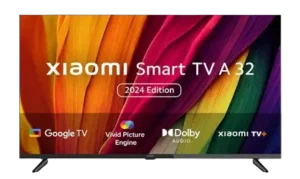
You get an HD Ready display with a 60Hz refresh rate, dual-band Wi-Fi, two HDMI ports, two USB ports, Bluetooth 5.0, and both Ethernet and optical audio out, which is a genuinely well-rounded connectivity set for a TV this size.
Sound comes from 20W speakers with Dolby Audio and DTS Virtual:X support, which is more than adequate for a bedroom or secondary TV setup.
Xiaomi backs it with a 1-year comprehensive warranty plus an extra year specifically on the panel, which is a meaningful reassurance at this price point. Because panel issues are usually the most expensive thing to go wrong on a budget TV.
Pros: Full Google TV experience with Chromecast built-in, solid connectivity for the price, 2-year panel warranty
Cons: HD Ready resolution only. It is fine for a 32-inch screen at normal viewing distance, but don’t expect sharp text or fine detail up close.
Best for: Bedrooms, kitchens, or as a straightforward secondary TV where you want full smart features without paying for size or resolution you don’t need.
2. Xiaomi Fire TV 32-inch HD Ready Smart LED TV: Best Entry-Level (Fire TV)
If you’re already inside the Amazon ecosystem ( Prime Video, Alexa devices, Fire TV Stick elsewhere in the house), the Fire TV variant of Xiaomi’s 32-inch TV makes more sense than the Google TV version. Same core hardware, different software experience.
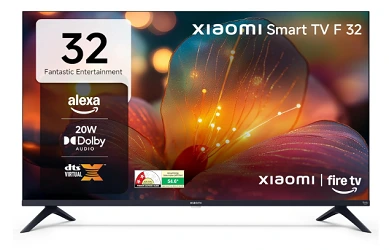
Fire OS gives you access to over 12,000 apps through the Fire TV Appstore, plus a voice remote with Alexa built in. One genuinely useful feature here is direct DTH set-top box integration. You can switch between live TV channels and streaming apps from the same home screen without juggling remotes.
Display Mirroring works with both AirPlay and Miracast, so it plays nicely with iPhones and Android phones alike.
Audio and connectivity match the Google TV version closely, which are 20W Dolby Audio-tuned speakers, dual-band Wi-Fi, dual HDMI and USB ports, and Bluetooth 5.0.
Pros: Full Fire TV ecosystem with Alexa, DTH integration on the home screen, works well with AirPlay and Miracast
Cons: Same HD Ready resolution limitation as the Google TV version; Fire OS app selection outside mainstream apps is thinner than Google Play
Best for: Households already using Amazon Alexa or Fire TV devices who want their TV’s interface to match.
Related: Best 32 Inch Smart TVs in India (2026): Tested Picks
3. Xiaomi A Series 43-inch Full HD Smart Google TV: Best 43″ Budget Pick
Stepping up to 43 inches, the A Series moves to Full HD resolution, which makes a genuine difference in sharpness for a screen this size compared to the 32-inch HD Ready models above.
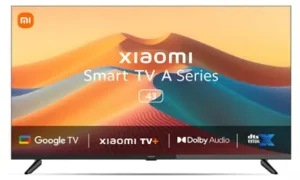
You get the same Google TV smart platform, HDR10 support, and Xiaomi’s Vivid Picture Engine for improved contrast and colour. ALLM (Auto Low Latency Mode) is a welcome inclusion for casual console gaming, automatically switching the TV to low-latency mode when it detects a game console; something budget TVs often skip.
Connectivity remains solid with dual HDMI, dual USB, Bluetooth 5.0, and both Ethernet and optical audio out, giving you flexibility for a soundbar or older AV receiver down the line.
Pros: Full HD resolution at a genuinely budget price, ALLM for casual gaming, strong connectivity options
Cons: Only 20W of audio output, which is fine for casual viewing, but you’ll likely want a soundbar for movies
Best for: Living rooms on a tight budget where Full HD is sufficient and you don’t need 4K resolution for a 43-inch screen.
4. Redmi Fire TV 43-inch 4K Ultra HD Smart QLED TV: Best 43″ Budget 4K QLED
If 4K resolution matters to you at 43 inches, and with more 4K content available on streaming services now than ever, it’s a reasonable ask. The Redmi Fire TV 43-inch is the budget-friendly way to get there.
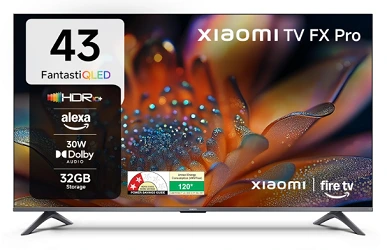
It steps up to 30W speakers with Dolby Audio, DTS Virtual:X, and DTS-HD support, noticeably fuller than the 20W setups on the entry-level models. The metal bezel-less design looks more premium than the price suggests, and you get three HDMI ports instead of two. This is useful if you’re connecting a set-top box, gaming console, and soundbar simultaneously.
Fire TV’s Picture-in-Picture mode and Smart Home Dashboard are genuinely useful additions here, letting you keep an eye on a live match in a corner window while browsing other content, or control smart home devices without leaving the show you’re watching.
Pros: Genuine 4K resolution at a budget price, three HDMI ports, stronger audio output than entry-level models
Cons: 2GB RAM keeps app-switching a little slower than pricier models. But it is fine for daily use; don’t expect flagship-level snappiness.
Best for: Buyers who want real 4K content on a 43-inch screen without stepping up to QLED pricing.
5. Xiaomi X Pro 2025 QLED 43-inch: Best 43″ QLED (Premium)
The X Pro QLED 2025 Edition represents a genuine step up in picture quality over the LED models above, thanks to Quantum Dot technology that delivers noticeably richer colour and better contrast. This has effectively replaced Xiaomi’s older non-Pro X series as the brand’s mainstream 4K QLED option in India.
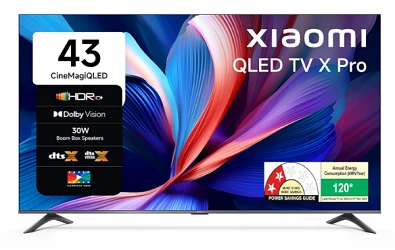
You get Dolby Vision support alongside HDR10+, plus a Filmmaker Mode that switches off unnecessary post-processing to show content the way its creators intended; a feature usually reserved for pricier TVs. The 34W built-in speaker system (an upgrade from the 30W on the previous generation) handles Dolby Audio, DTS:X, and DTS Virtual: X.
Under the hood, a quad-core A55 processor with 2GB RAM and 32GB of storage keeps the Google TV interface responsive, and the 2-year warranty (1 year comprehensive plus an additional year on the panel) is a strong reassurance at this price tier.
Pros: Genuine QLED picture quality with Dolby Vision, Filmmaker Mode, stronger 34W audio, 2-year warranty coverage
Cons: Meaningfully pricier than the LED models above. Make sure the picture quality upgrade matters to you before paying the premium.
Best for: Buyers who watch a lot of streaming content and want noticeably better colour and contrast than standard LED, without jumping to Mini LED pricing.
6. Xiaomi X Pro 2025 QLED 55-inch: Best Large-Screen QLED
The same X Pro QLED technology as above, scaled up to a 55-inch screen. The size most Indian buyers land on when upgrading their primary living room TV. Everything that makes the 43-inch model good carries over here, with the larger canvas making the Quantum Dot colour and Dolby Vision HDR genuinely more impactful.
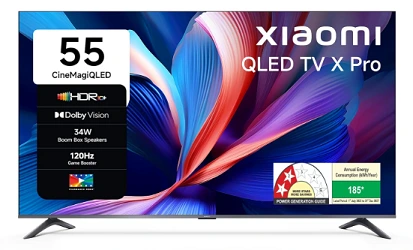
At this size, the 34W integrated speaker system does a better job filling a living room than it would need to on a smaller screen, though as with most flat-panel TVs, a soundbar will still noticeably improve the experience for movies.
The same three HDMI ports, Wi-Fi, Bluetooth, and eARC support carry over, making it straightforward to add a soundbar or AV receiver later without connectivity limitations.
MEMC (motion estimation, motion compensation) smooths out fast-moving content like sports, which is genuinely useful at this screen size where motion blur becomes more noticeable.
Pros: Excellent size-to-price ratio for QLED technology, Dolby Vision and MEMC both included, strong warranty coverage
Cons: Same audio limitation as the 43-inch model. Budget for a soundbar if movies and music matter to you
Best for: Most Indian households upgrading their main living room TV who want a genuine picture quality upgrade over basic LED.
7. Xiaomi FX Mini LED 2026 (55-inch): Best Mini LED (New for 2026)
This is the single biggest addition to Xiaomi’s lineup in 2026, and it wasn’t available when we last updated this list. Mini LED technology uses thousands of smaller backlight LEDs with local dimming zones, delivering noticeably deeper blacks and better contrast control than standard QLED or LED panels, which is genuinely closer to OLED-level contrast at a fraction of the price.
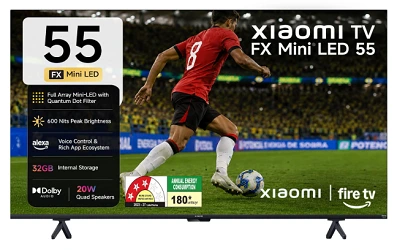
Xiaomi’s Vivid Picture Engine 2 combines with Quantum MagiQ technology here, blending QLED colour reproduction with Mini LED’s superior light control. You get HDR10+, Filmmaker Mode, and a four-driver speaker configuration on this size (larger than the 43-inch model’s setup) for genuinely fuller sound without a soundbar.
It runs Fire TV rather than Google TV, giving you access to Xiaomi’s full 12,000+ app library along with Alexa voice control, profiles, and parental controls. Larger sizes in this series also support DLG 120Hz for smoother gaming and sports playback, along with Quick Wake that powers the TV on in under five seconds.
Pros: Genuine Mini LED contrast and black levels, four-driver speaker setup, DLG 120Hz support, fast Quick Wake
Cons: New technology for Xiaomi in India. Fewer long-term reliability reports available yet compared to its established LED and QLED lines
Best for: Buyers who want the best picture quality Xiaomi currently offers in India without paying OLED or premium international-brand pricing.
8. Xiaomi X Pro QLED 2026 (75-inch): Best Premium Large Screen
If you’re going big ( genuinely big ), the X Pro QLED 2026 in 75 inches is Xiaomi’s flagship-size QLED option, and it undercuts premium brands like Sony and Samsung significantly at this screen size while still delivering Dolby Vision, a 120Hz game mode, and eARC.
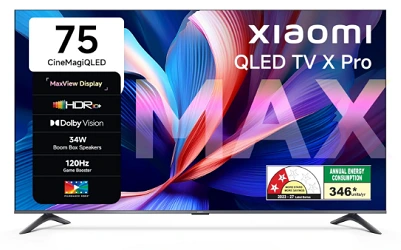
It retains the same quad-core A55 processor and 34W “Boom Box” speaker setup as the smaller X Pro models, along with three HDMI ports, dual USB, Ethernet, and optical audio. Google TV powers the smart platform here, with support for Miracast, Google Cast, and Apple AirPlay 2, so it plays nicely regardless of which phone ecosystem your household uses.
At this size, the 120Hz refresh rate genuinely matters more than it does on smaller screens. Fast motion in sports and gaming is noticeably smoother, and ALLM automatically optimises latency when it detects a connected console.
Pros: Genuinely competitive pricing for a 75-inch QLED with Dolby Vision, 120Hz refresh rate, strong smart TV app support via Google TV
Cons: A TV this large needs serious room space and viewing distance to make sense. Measure your space before committing.
Best for: Home theatre setups and larger living rooms where screen size is the priority and you want QLED quality without premium-brand pricing.
9. Xiaomi S Mini LED Series 2026: Best Ultra-Premium Pick
At the very top of Xiaomi’s current Indian lineup sits the S Mini LED Series 2026, available across 55, 65, and 75-inch sizes. This is Xiaomi’s direct answer to premium Mini LED TVs from Samsung, TCL, and Hisense, with up to 1,200 nits of peak brightness and up to 120Hz refresh rate across the range.
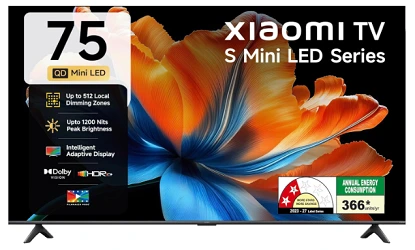
The higher peak brightness compared to the FX Mini LED series makes a genuine difference for HDR content, providing brighter highlights, more visible detail in bright scenes, and better performance in daylight-lit rooms.
Local dimming across thousands of individually controlled LED zones delivers contrast that competes credibly with far pricier OLED panels in most real-world viewing conditions.
This is Xiaomi’s premium push in India, and pricing reflects that. It’s meaningfully more expensive than the FX Mini LED series, but for buyers who’ve been eyeing premium Samsung or Sony Mini LED models, it’s worth cross-shopping directly against those before deciding.
Pros: Class-leading brightness and contrast for the Xiaomi lineup, competitive against premium international brands, available across three large screen sizes
Cons: Premium pricing to match the premium positioning. This isn’t a budget pick, and pricing varies significantly by retailer and ongoing offers.
Best for: Buyers who want the absolute best picture quality Xiaomi currently sells in India and are comparing directly against premium Samsung or Sony Mini LED and OLED models.
Google TV vs Fire TV: Which Xiaomi Software Should You Choose?
This is a genuinely important decision that the original Mi TV lineup didn’t always make obvious, since Xiaomi now splits its own TVs between two different smart platforms depending on the model.
| Factor | Google TV Models | Fire TV Models |
|---|---|---|
| App ecosystem | Google Play Store apps | 12,000+ apps via Fire TV Appstore |
| Voice assistant | Google Assistant | Alexa |
| Casting | Chromecast built-in | Requires separate Fire TV Stick-style casting via Fire OS |
| Best paired with | Android phones, Google Home devices | Amazon Echo devices, Fire TV Stick elsewhere in the house |
| PatchWall UI | Available (Xiaomi’s content-discovery layer) | Not present; Fire TV uses Amazon’s own interface instead |
| DTH/Set-top box integration | Supported via IR cable setup | Built into the Fire TV home screen more directly |
Our take: if you’re already using Google services and Android devices throughout your home, go Google TV. If you use Alexa devices or already own a Fire TV Stick elsewhere, the Fire TV variant will feel more familiar and consistent. Neither is objectively “better”. It genuinely comes down to which ecosystem your household already lives in.
Common Features Across Mi and Redmi TVs
Video and Sound Modes
Xiaomi TVs across the lineup include preset Video Modes, namely Vivid, Standard, Movie, and Sports, letting you match the picture to what you’re watching. Vivid mode specifically activates the Vivid Picture Engine for enhanced colour and contrast. Sound modes (Game, News, Movie, Standard) work similarly for audio, and both can be manually fine-tuned if you want more control.
Vivid Picture Engine
This is Xiaomi’s in-house image processing technology, now in its second generation (Vivid Picture Engine 2) on newer models. It’s designed to boost colour depth and contrast for a more immersive viewing experience, and it’s present across nearly the entire current lineup, from entry-level LED to the flagship Mini LED models.
Data Saver
A genuinely useful feature if you’re streaming via a mobile hotspot: Data Saver lets you stretch your data allowance roughly three times further for the same usage, and includes a data usage counter plus the ability to view phone media on the TV without consuming mobile data.
PatchWall
PatchWall is Xiaomi’s content-discovery layer, similar in spirit to how MIUI once worked across Mi smartphones. It’s present on Google TV models and curates content across multiple streaming services into a single searchable interface, so you’re not opening and searching within each app individually.
Note: PatchWall is specific to Xiaomi’s Google TV models. Fire TV variants use Amazon’s own Fire TV interface instead, without PatchWall.
App Availability
Google TV models come with the Google Play Store pre-installed, giving you access to TV-optimised versions of most major streaming and utility apps. Fire TV models instead use the Fire TV Appstore, with over 12,000 apps available.
Single Remote for TV and Set-Top Box
Most Xiaomi TVs let you control your DTH set-top box using the same remote as the TV itself. You’ll need an additional Mi IR Cable for this, with the cable connected to the TV and pointed toward the set-top box. Once set up under the TV’s remote settings, you can configure this feature here.
How Did We Choose These TVs?
We prioritised TVs that are currently in active production and stock across Amazon and Flipkart, rather than older models that may show up in search results but are difficult to actually purchase.
We cross-referenced pricing and specifications across multiple retailer listings and recent 2026 launch coverage to make sure every recommendation reflects Xiaomi’s current lineup, not a discontinued generation.
We also made sure to cover the full range of what Indian buyers are actually shopping for, from simple 32-inch bedroom TVs to Xiaomi’s brand-new Mini LED flagship series, rather than clustering picks around a single price tier.
Why You Can Trust This Guide
Infobits has covered consumer electronics and TV buying guides for the Indian market for several years. This article is based on published manufacturer specifications, verified current pricing from Amazon India and Flipkart, and recent 2026 product launch coverage.
We’re not paid by Xiaomi or any retailer featured here, and our recommendations reflect what we’d genuinely suggest to a friend shopping for a new TV. Full affiliate disclosure is at the bottom of this article.
What to Look for When Buying a Mi TV
Screen Size and Room Fit
As a rough guide, sit roughly 1.5 to 2.5 times the screen’s diagonal size away from it for comfortable viewing. A 43-inch TV suits smaller rooms or bedrooms, while 55-inch and above suit larger living rooms with more viewing distance.
Resolution: HD Ready vs Full HD vs 4K
HD Ready is genuinely fine for 32-inch screens at typical viewing distances, but becomes noticeably soft at 43 inches and above. Full HD works reasonably well up to around 43 inches.
For anything 43 inches and larger where you sit reasonably close, 4K resolution makes a genuine, visible difference, especially with the amount of 4K streaming content now available.
Panel Technology: LED vs QLED vs Mini LED
Standard LED panels are the most affordable but offer the least impressive contrast and colour. QLED steps up colour vibrancy and brightness through Quantum Dot technology.
Mini LED goes further still, using many more individually controlled backlight zones for genuinely deeper blacks and better HDR performance. The closest thing to OLED-level contrast that Xiaomi currently offers in India.
Refresh Rate
60Hz is standard and perfectly fine for most viewing, including regular streaming and TV content. If you game on a console or care about sports and fast motion, look for models supporting 120Hz or DLG 120Hz, found on Xiaomi’s larger Mini LED and premium QLED models.
Audio Output
Built-in TV speakers, even at 30-34W, rarely match a dedicated soundbar for movies and music. If audio quality matters significantly to you, budget for a soundbar regardless of which TV you choose. But higher-wattage models with Dolby Audio and DTS:X support will sound noticeably better even before adding external speakers.
Related: Best Soundbars in India: Tested Picks for Every Budget & Room Size
Smart Platform: Google TV vs Fire TV
Covered in detail above. This is worth deciding early, since it affects your day-to-day experience more than most spec differences between similarly priced models.
Warranty
Look specifically for panel warranty coverage, not just the standard comprehensive warranty. Xiaomi’s 1-year comprehensive plus 1-year additional panel warranty (found on most models in this list) is a genuinely reassuring standard, since panel replacement is by far the most expensive repair a TV can need.
Common Mistakes to Avoid When Buying a Mi TV
- Buying a screen too large or small for your room: An oversized TV in a small room causes eye strain from sitting too close; an undersized TV in a large room wastes the resolution and detail you paid for.
- Ignoring the Google TV vs Fire TV distinction: Buying based on price or size alone and ending up with a smart platform that doesn’t match the rest of your household’s devices leads to a genuinely more frustrating daily experience than the spec sheet suggests.
- Assuming all “4K” TVs deliver the same picture quality: Resolution is only one factor. Panel technology (LED vs QLED vs Mini LED), HDR support, and processing all affect how good 4K content actually looks.
- Overlooking panel warranty terms: Standard comprehensive warranty often doesn’t automatically cover panel defects for the same duration. Check this specifically before buying.
- Not checking HDMI port count before buying: If you plan to connect a set-top box, gaming console, and soundbar, make sure your chosen model has at least 3 HDMI ports, not the 2 found on the most basic models.
Related: Dolby Atmos vs DTS X: Which Surround Sound Tech is Right for Your Home
Expert Tips for Getting the Best Mi TV Experience
- Use Filmmaker Mode (available on X Pro QLED and Mini LED models) when watching movies. It disables unnecessary post-processing that can make content look artificially smooth or oversaturated.
- Enable ALLM before connecting a gaming console. It’s usually off by default and reduces input lag noticeably once activated.
- If you’re using Data Saver on a mobile hotspot, check the built-in data counter periodically. It’s easy to forget it’s running and burn through your plan faster than expected regardless.
- Pair with a budget soundbar even on premium models. Built-in TV speakers, regardless of wattage, are one of the most consistently underwhelming parts of nearly every flat-panel TV.
- If choosing between Google TV and Fire TV variants at the same price and specs, base your decision on which ecosystem (Google or Amazon) the rest of your smart home devices already use. It meaningfully affects daily convenience.
Related: MarQ MA180 Soundbar Review (180W with Wireless Subwoofer)
Who Should Buy Which Mi TV?
Buy an entry-level 32-inch model if: you need a secondary or bedroom TV and don’t need 4K resolution or QLED picture quality.
Buy a 43-inch A Series or Redmi Fire TV if: you want a solid primary TV for a smaller living room on a genuine budget, and can decide between Full HD and 4K based on price sensitivity.
Buy an X Pro QLED model if: you watch a lot of streaming content and want a noticeably better picture than standard LED, without paying flagship Mini LED pricing.
Buy a Mini LED model (FX or S series) if: picture quality is your top priority and you’re comparing Xiaomi directly against premium Samsung, Sony, or TCL models; Xiaomi’s Mini LED range is built specifically to compete at that level.
Conclusion
Xiaomi’s TV lineup in India has genuinely grown in 2026. What used to be a straightforward budget-to-mid-range selection now spans everything from simple 32-inch bedroom TVs to genuinely premium Mini LED flagships competing with established international brands.
The right pick depends far more on your room size, budget, and existing smart-home ecosystem than it does on chasing the single “best” model on this list.
Whichever you choose, prioritise panel technology and warranty coverage over marginal spec differences between similarly priced models. A good QLED or Mini LED panel with solid warranty backing will outlast and outperform a slightly cheaper alternative with a lesser panel, even if the spec sheets look similar on paper.
Quick Picks Summary:
| Product | Category |
|---|---|
| Xiaomi A Series 32″ (Google TV) | Best Entry-Level (Google TV) |
| Xiaomi/Redmi Fire TV 32″ | Best Entry-Level (Fire TV) |
| Xiaomi A Series 43″ Full HD | Best 43″ Budget Pick |
| Redmi Fire TV 43″ 4K | Best 43″ Budget 4K |
| Xiaomi X Pro 2025 QLED 43″ | Best 43″ QLED (Premium) |
| Xiaomi X Pro 2025 QLED 55″ | Best Large-Screen QLED |
| Xiaomi FX Mini LED 2026 55″ | Best Mini LED (New for 2026) |
| Xiaomi X Pro QLED 2026 (75″) | Best Premium Large Screen |
| Xiaomi S Mini LED Series 2026 (75″) | Best Ultra-Premium Pick |
Frequently Asked Questions
Yes, Mi and Redmi TVs remain some of the best value smart TVs in the Indian market. You get premium features like QLED and now Mini LED panels, Dolby Vision, and full smart TV platforms at prices that consistently undercut established international brands.
Neither is objectively better. It depends on your household’s existing ecosystem. Choose Google TV if you use Android and Google services; choose Fire TV if you already use Amazon Alexa devices or a Fire TV Stick elsewhere.
It depends on usage and model, but Mi TVs typically deliver strong peak performance for 4-5 years, with many units continuing to work well beyond that with reduced brightness over time.
Mi TVs generally run Google TV or Fire TV, giving you access to broad third-party app ecosystems, while Samsung primarily uses its own Tizen OS. If you prefer an established, familiar smart TV interface, Mi TVs are usually the more budget-friendly choice at comparable specifications.
QLED uses Quantum Dot technology to enhance colour and brightness over standard LED panels. Mini LED goes further, using many more individually controlled backlight zones for significantly better contrast and deeper blacks; Xiaomi’s current top picture-quality tier in India.
It makes a genuine, visible difference if you sit reasonably close and watch a lot of 4K streaming content, but Full HD remains perfectly watchable at 43 inches for casual viewing at typical distances.
Yes, most current Xiaomi TVs support ALLM (Auto Low Latency Mode), and the larger Mini LED and premium QLED models support up to 120Hz refresh rates for smoother gaming and sports playback.
Yes, with an additional Mi IR Cable connected between the TV and set-top box, you can configure a single remote to control both, following the setup steps in your TV’s remote settings.
Most current models include a 1-year comprehensive warranty plus an additional 1-year warranty specifically on the display panel, giving you 2 years of panel coverage in total.
If picture quality, particularly contrast and black levels, is a priority for you, yes. Mini LED delivers noticeably better HDR performance than QLED, though it comes at a meaningfully higher price.
PatchWall is Xiaomi’s content-discovery interface that curates content across multiple streaming apps into one searchable layer, so you don’t need to open and search within each app individually. It’s available on Google TV models only, not Fire TV variants.
If you’re only connecting one device, 2 HDMI ports are sufficient. If you plan to connect a set-top box, gaming console, and soundbar simultaneously, look for a model with at least 3 HDMI ports.
Yes, Xiaomi’s Data Saver feature can let you stream up to roughly three times longer on the same mobile data allowance when using a phone hotspot, along with a built-in data usage counter.
The X Pro QLED 2026 and Mini LED models support 120Hz refresh rates and ALLM, making them the best current Xiaomi options for console gaming with reduced input lag and smoother motion.
Yes, the FX Mini LED and S Mini LED series launched fresh in 2026, representing Xiaomi’s first dedicated push into Mini LED technology in the Indian market, positioned to compete directly with premium Samsung, Sony, and TCL Mini LED models.
It depends on your priorities. Built-in speakers on the higher-wattage models (30-34W) are genuinely decent for casual viewing, but a soundbar will noticeably improve the experience for movies and music regardless of which Mi TV you choose.
The Xiaomi A Series 32-inch (Google TV) or the Fire TV equivalent are the best budget picks for a small room, offering a full smart TV experience without paying for size or resolution you don’t need.
Redmi-branded TVs are Xiaomi’s more budget-focused sub-brand, generally using similar underlying technology to entry-level Mi models but positioned at a slightly lower price point.
Yes, most current models support screen mirroring. Google TV models work well with Android’s built-in casting and Chromecast, while Fire TV models support both Apple AirPlay 2 and Miracast.
Check that the model is currently listed as in-stock on Amazon or Flipkart’s official Xiaomi/Redmi storefronts rather than third-party sellers, and prefer recently launched models (like the 2025/2026 series covered in this guide) over older generations for the best long-term support and parts availability.
We hope you are interested in our articles and consider following our Facebook, Instagram, and Twitter pages for regular updates.
Please share this information with your relatives and friends if you find it useful. Subscribe to our free newsletter for regular updates, informational ebooks, and the latest deals directly in your inbox.
Subscribe to be the first to learn about new information
Disclosure: If you follow our links to a retailer’s website and make a purchase, we will get an affiliate commission on some, but not all, of the items or services we promote. This will cause no price change for you.