How to Disable Ads in MIUI & HyperOS on Xiaomi Phones
If you’ve just unboxed a new Redmi, Poco, or Xiaomi phone and you’re already staring at a pop-up ad on the lock screen, you’re not imagining things. It’s not a bug. It’s built into the software on purpose, and it happens to almost everyone who buys a Xiaomi device in India.
The good news is that you can turn off most of it in about ten minutes, without rooting your phone or installing any shady “ad blocker” app.
This guide covers both MIUI (if you’re still on an older phone) and HyperOS (Xiaomi’s current software, running on every phone sold since late 2023), because the settings menu has moved around and a few names have changed.
Quick answer: Go to Settings → Passwords & Security (or Fingerprints, face data & screen lock on HyperOS) → Authorisation & Revocation, turn off MSA, then go to Privacy → Ad services and turn off Personalised ad recommendations. After that, repeat the process inside individual apps like Security, GetApps, Mi Browser, and Themes. Full steps, screenshots-style walkthrough, and troubleshooting are below.
Why Does Xiaomi Show Ads on Its Phones?
This isn’t a glitch. It’s the business model. Xiaomi has publicly committed to capping its hardware profit margin at 5% for good, which is a big reason its phones offer flagship-level specs at budget prices.
To make up for that thin hardware margin, Xiaomi leans on internet services revenue in app recommendations, sponsored content, and advertising baked directly into MIUI and HyperOS.
Apple and a few other manufacturers use variants of this “cheap hardware, monetise the software” idea too, though usually less aggressively at the system level. Even if you buy Xiaomi’s most expensive flagship in India, you’ll still see the same ad system unless you switch it off manually; there’s no premium, ad-free tier.
The one thing that has changed since Xiaomi’s early “MIUI ads” backlash years ago is scale. Ads now appear across more apps (Security, GetApps, File Manager, Downloads, Themes) rather than being concentrated in one place, so it takes a few extra minutes to clean everything up properly.
If constant ads and bloatware genuinely put you off Xiaomi’s ecosystem, near-stock Android phones like the Motorola Edge and G-series are worth a look before your next upgrade. Check current Motorola smartphone deals here.
Related: Mobile Buying Guide 2026: How to Select a Mobile Phone?
MIUI or HyperOS: Which One Do You Have?
Before you follow any steps, confirm what’s actually running on your phone, because the menu wording is different in a few places.
- Open Settings
- Scroll down and tap About phone
- Look for either MIUI version or HyperOS version
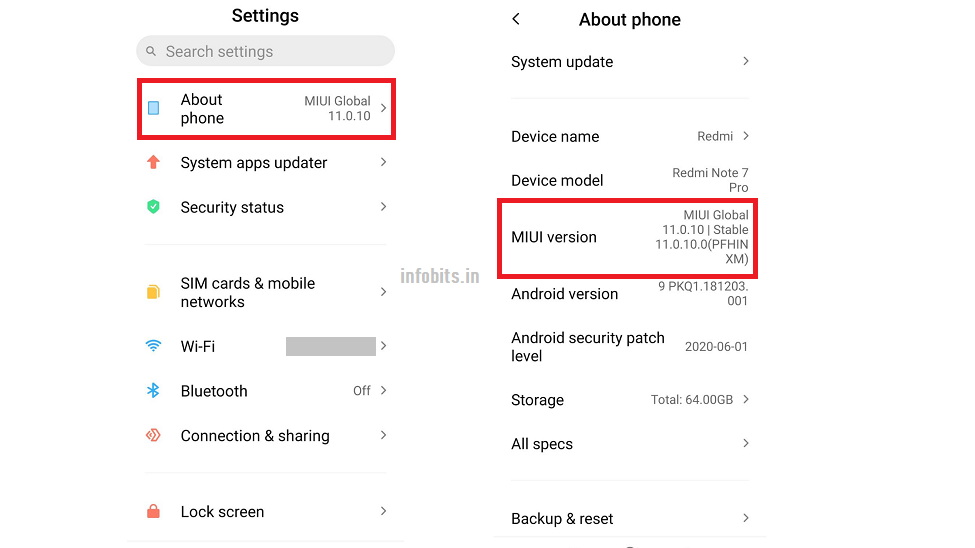
If you bought your phone in 2024, 2025, or 2026, you’re almost certainly on HyperOS (currently HyperOS 2.x, with HyperOS 3 rolling out on newer Android 15/16 devices).
If you see “MIUI 12,” “MIUI 13,” or “MIUI 14,” you’re on an older device that hasn’t received the HyperOS update yet — that’s still common on budget Redmi phones in India that are 2-3 years old.
Both software versions use the same underlying ad system (a component called MSA), so the logic below works either way; only the exact menu labels shift slightly.
Comparison: Where Settings Live in MIUI vs HyperOS
| Setting | MIUI (11/12/13) | HyperOS (1/2/3) |
|---|---|---|
| Security & permissions menu | Passwords & Security | Fingerprints, face data & screen lock |
| MSA toggle location | Authorisation & Revocation | Authorization & Revocation |
| Ad personalisation menu | Passwords & Security → Privacy → Ad services | Privacy → Ad services (sometimes “Advertising Privacy”) |
| Music app ad toggle | Available (Settings → Advanced settings → Show ads) | Removed — no longer present |
| Lock screen ad source | Wallpaper Carousel | Wallpaper Carousel / Lock screen magazine |
| App store | Mi GetApps | GetApps |
Step 1: Disable MSA (MIUI System Ads)
MSA, short for MIUI System Ads, is the background service responsible for most of the ads and “recommendations” you see across the interface. Turning it off first solves the majority of your problem in one move.
You’ll need an active Wi-Fi or mobile data connection for this step to register correctly.
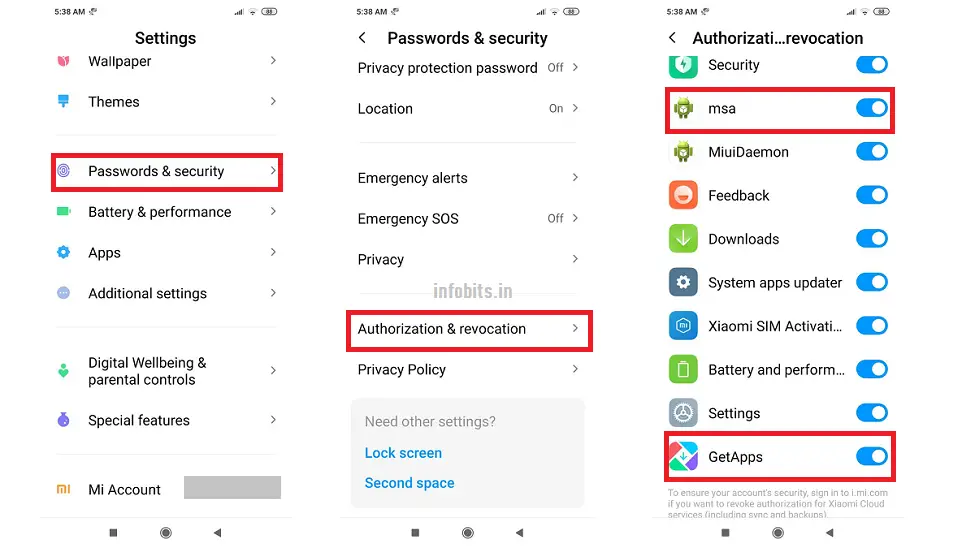
- Open Settings
- Tap Passwords & Security (MIUI) or Fingerprints, face data & screen lock (HyperOS)
- Tap Authorization & Revocation
- Find MSA in the list (Android robot-style icon) and toggle it off
- Wait about 10 seconds, then tap Revoke to confirm
- If it says the authorisation couldn’t be revoked, wait a moment and try again. This is a known quirk, not an error on your part.
- While you’re here, also toggle off GetApps
Expert tip: Restart your phone after this step. It clears cached ad requests and gives the system a clean slate before you move to the next steps.
Step 2: Turn Off Personalised Ad Recommendations
This step stops Xiaomi from using your app usage, browsing, and search behaviour to target ads at you. It won’t remove ads outright, but it makes the ones you do see less invasive — and it’s a genuine privacy improvement either way.
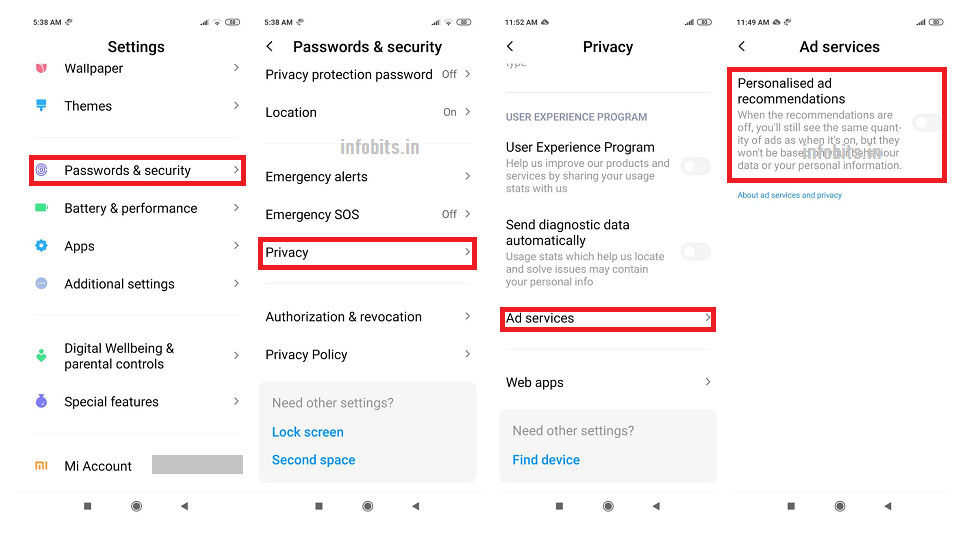
- Open Settings
- Go to Passwords & Security (MIUI) or Privacy directly (HyperOS)
- Tap Ad services (sometimes labelled Advertising services or Advertising Privacy on newer HyperOS builds)
- Toggle off Personalised Ad Recommendations
Step 3: Disable Ads Inside Individual Xiaomi Apps
This is the part most guides, including older versions of this one, skip over, and it’s where most of the remaining ads actually live. Xiaomi’s own apps each carry a separate “recommendations” toggle that MSA doesn’t control.
Go through each app you actually use and disable recommendations from its own settings:
- Security app: Open Security → tap the gear icon → Settings → turn off “Receive recommendations.” Check the Cleaner and Boost tools tabs too, since they carry separate toggles.
- GetApps (Mi’s app store): Open GetApps → tap Me/profile icon → Settings → turn off Recommendations, Personalized recommendations, and App update notifications.
- Mi Browser: Tap your profile icon → Settings → Advanced → disable “Show ads.”
- File Manager: Open the hamburger/three-dot menu → Settings → About → toggle off Recommendations. On HyperOS, also toggle off “Withdrawal of consent” and confirm.
- Downloads app: Three-dot menu → Settings → toggle off “Show recommended content.”
- Themes app: Tap My account → Settings (gear icon) → toggle off Personalised recommendations and Show ads.
- Mi Music (MIUI only): Menu → Settings → Advanced settings → toggle off Show ads. This option has been removed entirely on HyperOS.
Common mistake: People disable MSA and stop there, then wonder why they still see a promo card inside GetApps or Security a week later. MSA controls the system-wide ad delivery layer. It doesn’t reach into each app’s individual settings. Both layers need to be turned off separately.
Step 4: Clean Up the Lock Screen and Notifications
Two more ad surfaces that are easy to miss:
- Lock screen carousel/magazine: Settings → Display → Lock screen → Show Notifications → disable “Content Recommendations” or the wallpaper carousel option.
- Folder suggestions: Long-press the home screen → folder settings → disable “App Recommendations” (these show install suggestions inside app folders).
- Promotional notifications: Settings → Notifications & status bar → App notifications → go through GetApps, Themes, Mi Browser, Security, and Music individually, and disable promotional notification categories. Leave genuine alerts (like storage or battery warnings from Security) turned on — you just want to kill the marketing pop-ups, not safety notifications.
Related: How to Find a Lost Mobile Phone Using IMEI Tracking
Advanced Method: Removing Ad Packages via ADB (No Root)
If you’re comfortable with a PC and a USB cable, you can go a step further and disable the ad-related system packages directly using ADB (Android Debug Bridge). This doesn’t require root access, and it’s reversible.
- Go to Settings → About phone, tap the MIUI/HyperOS version 7 times to unlock Developer options.
- Go to Settings → Additional settings → Developer options and turn on USB debugging.
- Install Google’s Platform-Tools on your PC and connect your phone via USB
- Open a terminal in the platform-tools folder and confirm the connection with
adb devices(accept the RSA prompt on your phone) - Run the following commands one at a time to disable the ad-related packages for your user profile:
pm uninstall -k --user 0 com.miui.analytics
pm uninstall -k --user 0 com.miui.msa.global
pm uninstall -k --user 0 com.xiaomi.mipicks
pm uninstall -k --user 0 com.mi.globalbrowser
Important: This only removes the packages for your current user profile. A full factory reset restores them, and you can always reinstall via the Play Store if something breaks. Don’t run commands you don’t understand, and back up your phone before trying this. If you’re not confident with ADB, the settings-based steps above already handle 90% of the problem safely.
For Rooted Devices
If your phone is already rooted, modules like HyperCeiler let you disable ads and recommendations more thoroughly, including some system-level surfaces the settings menu doesn’t expose.
This is not something we’d recommend for most readers. Rooting voids your warranty and carries real risk if done incorrectly. But it’s worth knowing the option exists if you’re already running a custom ROM setup.
Troubleshooting: Still Seeing Ads After Following These Steps?
- Ads returned after a software update: This happens often. Xiaomi updates sometimes silently re-enable MSA or reset individual app toggles. Make it a habit to re-check MSA and your app-level settings right after any MIUI/HyperOS update.
- Full-screen ads when opening Settings or other apps: On a small number of recent Redmi Note models, users have reported full-screen ads appearing even after disabling MSA and the main recommendation toggles. If this happens, check Settings → Apps → Manage apps for an unfamiliar app with a generic icon (often described as a rocket-style icon) — this is sometimes a separate ad-serving component that needs to be disabled individually.
- MSA won’t revoke: Try again after restarting your phone, and make sure you’re connected to the internet when you attempt it — the revoke action needs to communicate with Xiaomi’s servers.
Myth vs Fact
| Myth | Fact |
|---|---|
| “Disabling MSA will break my phone.” | False. MSA only handles ads and recommendations — turning it off doesn’t affect calling, apps, or core Android functions. |
| “You need root access to remove ads.” | False. Every step in this guide works on a completely stock, unrooted phone. Root only helps you go further; it isn’t required. |
| “Paying more for a Xiaomi flagship removes ads.” | False. There’s currently no ad-free tier — even Xiaomi’s most expensive phones ship with the same ad system. |
| “Third-party ‘ad blocker’ apps fix this.” | Mostly false, and risky. Apps claiming to block all Xiaomi ads instantly often demand VPN or accessibility permissions, which is a bigger privacy risk than the ads themselves. Stick to the built-in settings first. |
Quick Checklist
- [1] Confirmed whether you’re on MIUI or HyperOS
- [2] Disabled MSA under Authorisation & Revocation
- [3] Disabled GetApps authorization
- [4] Turned off Personalised Ad Recommendations in Privacy/Ad services
- [5] Disabled recommendations in Security, GetApps, Mi Browser, File Manager, Downloads, Themes
- [6] Turned off lock screen carousel and folder suggestions
- [7] Disabled promotional notification categories per app
- [8] Restarted the phone once everything is done
Can You Remove Ads Completely?
Realistically, no, not without root access, and even then it’s not guaranteed to be permanent since updates can reintroduce ad surfaces.
What this guide gets you is a dramatically quieter phone. No lock screen promos, no browser ads, no app-store push notifications, and no personalised targeting. That covers the overwhelming majority of what actually annoys people day to day.
If you’d rather sidestep this entirely on your next purchase, it’s worth comparing a couple of options before you buy. See our Xiaomi vs Motorola comparison and current deals to weigh specs against a genuinely ad-free experience.
Frequently Asked Questions
Xiaomi caps its hardware profit margin at around 5% to keep phones affordable, and makes up the difference through advertising and internet services built into MIUI and HyperOS.
Yes. MSA only controls ads and recommendations. Disabling it doesn’t affect calls, apps, storage, or any core phone function.
MSA stands for MIUI System Ads (sometimes referred to as “Mi System Ads”). It’s the background service responsible for most system-wide ads and content recommendations.
No. All the core steps in this guide work on a completely stock, unrooted device. Root access only helps you go further using tools like HyperCeiler.
On HyperOS, that menu was renamed to “Fingerprints, face data & screen lock.” The MSA and Ad services options are still inside it, just under the new name.
No. Turning off settings-based options never affects your warranty. Only rooting or unlocking the bootloader can potentially affect warranty coverage, depending on your service centre’s policy.
Software updates occasionally reset MSA or individual app toggles. Check your settings again after every major MIUI/HyperOS update.
Not currently. There’s no official ad-free tier or one-time payment to remove ads, regardless of how much you spend on the phone.
Yes. GetApps has its own recommendations and notification settings under its in-app Settings menu, separate from the system-wide MSA toggle.
The underlying ad system is the same, but menu names differ slightly. For example, the security settings menu and some app-specific ad toggles (like the one in Mi Music) have changed or been removed on HyperOS.
Yes, unfortunately. Xiaomi’s Security app carries its own “Receive recommendations” toggle, plus separate settings inside its Cleaner and Boost tools.
Not reliably, and many request risky permissions like VPN or accessibility access. It’s safer to use the built-in settings covered in this guide first.
It’s a lock screen feature that cycles through promotional images and content. Disable it under Settings → Display → Lock screen → Show Notifications.
No. ADB commands run from a PC over USB and don’t require rooting the phone. They’re also reversible. A factory reset restores the removed packages.
That toggle was specific to MIUI’s Mi Music app and has been removed in HyperOS, since the underlying ad delivery method changed.
No, but Xiaomi (along with sister brands Redmi and Poco) is among the most consistent about it at the OS level compared to most other Android manufacturers sold in India.
No. It stops ads from being targeted to your behaviour, but you’ll still see generic ads until you also disable MSA and the individual app settings.
Right after any major software update is the safest habit, since updates occasionally reset ad-related toggles.
Not currently in the Indian market. Every MIUI/HyperOS device ships with the ad system enabled by default.
Check Settings → Apps → Manage apps for any unfamiliar system app with a generic icon that might be serving ads independently, and consider a factory reset as a last resort if a specific update introduced the issue.
If you run into a setting that doesn’t match what’s described here, drop a comment below with your exact model and MIUI/HyperOS version; menu wording occasionally differs by region.
We hope you have liked this article, and please consider following our Facebook and Twitter pages.
Subscribe to our free newsletter so that you will get regular updates directly in your Email.
Also, don’t forget to share the article with your friends and relatives.
Subscribe to be the first to learn about new information
Disclosure: If you follow our links to a retailer’s website and make a purchase, we will get an affiliate commission on some, but not all, of the items or services we promote. This will cause no price change for you.