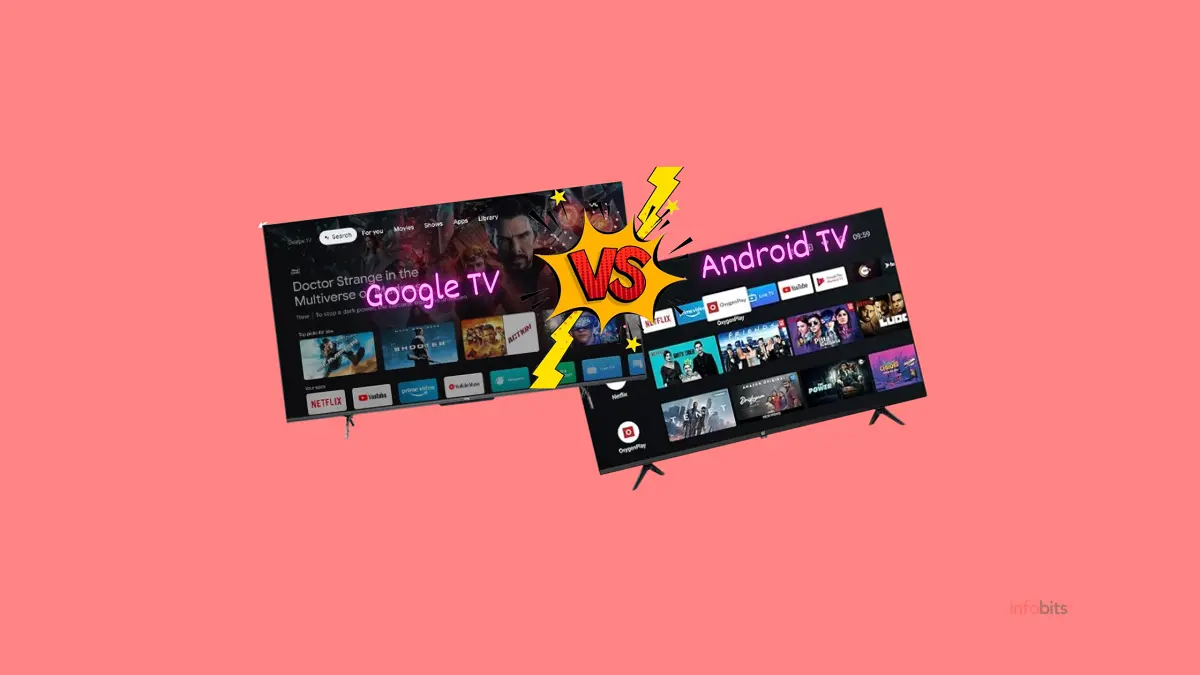
Google TV vs Android TV: What’s the Real Difference? (India 2026 Guide)
If you’ve been shopping for a new television recently, you’ve almost certainly seen both “Google TV” and “Android TV” on product labels, sometimes from the same brand, sometimes in the same price range.
They sound nearly identical. They’re both made by Google. They both support Netflix, YouTube, Prime Video, and JioHotstar. So what exactly is the difference, and does it actually matter which one you buy?
The short answer: yes, it matters, but not for the reasons most people think.
This guide cuts through the confusion and explains every real difference between Google TV and Android TV in plain language, with specific brand examples relevant to Indian buyers in 2026.
Quick Answer: Android TV (launched 2014) is an app-centric smart TV operating system. The home screen shows a row of your apps; you open each app separately to find content.
Google TV (launched 2020) is a newer software layer built on top of Android TV. Its biggest upgrade is a unified “For You” home screen that aggregates content recommendations from all your streaming apps simultaneously ; Netflix, Prime Video, JioHotstar, YouTube, and more So you can browse everything in one place without opening five separate apps.
Both platforms support the same apps, same Google Play Store, and same Google Assistant. Google TV is the newer, smarter evolution; Android TV is still capable but shows its age in content discovery.
In India in 2026, Google TV is the default choice on Sony Bravia, TCL C-series, and Hisense premium TVs; Android TV dominates Xiaomi’s lineup and most budget models.
First: Google TV is Built on Top of Android TV
This is the crucial technical fact that most articles either don’t mention or bury at the bottom. Understanding this makes everything else clear.
Google TV is not a separate operating system. It is a software experience layer that runs on top of Android TV.
Both Google TV and Android TV are ultimately running the same Android-based TV operating system at their core. Google TV adds a more sophisticated home screen UI, unified content discovery, multi-user profiles, and deeper AI personalisation on top of that foundation.
Think of it as an analogy: Android TV is like the base version of Windows. Google TV is like a premium version of Windows with a completely redesigned Start menu and smarter search, but underneath, it’s still Windows. The core engine is the same; the experience on top is different.
Practical implication: A Google TV can run every Android TV app. A Google TV remote works the same way. A Google TV uses the same Google Play Store.
You’re not getting a completely different product. Instead, you’re getting a meaningfully improved interface and content discovery experience on top of the same foundation.
The Most Important Difference: How You Discover Content
This is the change that matters most in daily use, and it’s the reason Google TV was created.
Android TV: The App-First Approach
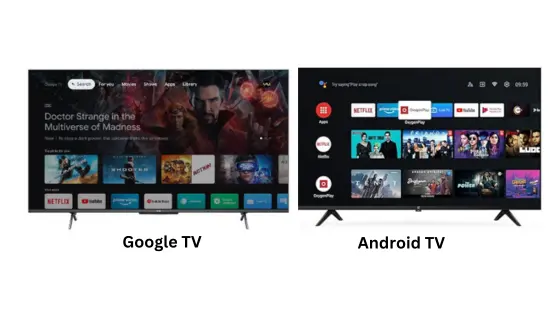
On Android TV, the home screen shows a horizontal row of app icons like Netflix, YouTube, Prime Video, JioHotstar, Zee5, SonyLIV, and so on. Finding something to watch means:
- Think of something you want to watch
- Remember which app it’s on
- Open that app
- Search or browse within that app
- If it’s not there, go back to the home screen
- Open a different app
- Repeat
This is familiar; it’s essentially how a smartphone home screen works. But on a TV, it becomes tedious. If you don’t have a specific show in mind, finding something worth watching requires opening multiple apps one by one.
Google TV: The Content-First Approach
Google TV completely rethinks this with its “For You” tab, a unified home screen that aggregates recommendations from all your installed streaming apps simultaneously.
When you turn on a Google TV, you see a curated feed of movies and shows drawn from Netflix, Prime Video, JioHotstar, YouTube, Zee5, SonyLIV, and any other installed apps, all in one scrollable view. The content is personalised based on your watch history and preferences.
You can see that a specific movie is available on Prime Video and is also being recommended because you watched something similar last week, without having to open Prime Video at all. Tap on it, and it opens directly to that title.
The “Watchlist” feature lets you save titles you want to watch from any app to a single unified watchlist. No more trying to remember that the movie you bookmarked was on Netflix and the series you wanted to continue was in JioHotstar.
The “Live” tab (on Google TV) aggregates live content, live TV from JioTV, sports, and news channels in a separate section for easy access.
How Much Does This Actually Matter?
For viewers in 2026 who subscribe to multiple streaming services, a very common scenario given how affordable JioHotstar, Prime Video, and Netflix are in India, the content discovery difference is genuinely meaningful.
Many Indian households now subscribe to 3 – 5 streaming services, and navigating between them app by app gets old quickly.
Key Differences: Side-by-Side Comparison
| Feature | Android TV | Google TV |
|---|---|---|
| Launch year | 2014 | 2020 |
| Based on | Android OS | Android TV (same core) + new UI layer |
| Home screen | App grid; open each app separately | Unified “For You” feed across all apps |
| Content discovery | App-by-app browsing | Cross-app recommendations in one view |
| Watchlist | Per-app only | Unified watchlist across all apps |
| Live TV tab | Not available | Available; aggregates live content |
| User profiles | Single profile (or basic parental controls) | Multiple personalised user profiles |
| Kids profile | Basic system parental controls | Dedicated Google Kids Space with curated content and Google Family Link integration |
| Google Assistant | Available | More deeply integrated, more capable |
| Ambient mode | Limited | Full “Ambient” mode with photos, art, weather, clock |
| Smart home control | Basic Google Home integration | Full dashboard for smart home devices (cameras, lights, locks) |
| Personalisation | Minimal | AI-driven, improves with viewing history |
| Performance | Depends on hardware; can feel dated | Depends on hardware; UI is optimised for modern chips |
| App compatibility | Google Play Store | Same Google Play Store |
| Google Cast | Supported | Supported |
| Update frequency | Slower; depends on TV manufacturer | Faster; Google updates the experience layer directly |
| Typical price range in India | Budget to mid-range (₹15,000–₹40,000) | Mid-range to premium (₹25,000–₹1,50,000+) |
Which Brands Use Google TV vs Android TV in India?
This is critical information for Indian TV buyers, because the platform you get depends entirely on which brand and model you choose.
Brands Using Google TV in India
Sony: Sony’s entire current Bravia lineup (Bravia 2, Bravia 7, Bravia 8, Bravia 9, Bravia XR series) runs Google TV. Sony has fully transitioned away from Android TV. If you buy a new Sony TV in India in 2026, it’s Google TV.
TCL: TCL’s mid-range and premium models (C6 series and above) run Google TV. TCL is one of the fastest-growing TV brands in India, particularly popular for its QLED and Mini-LED models at competitive prices.
The TCL C6K QD-Mini LED Google TV (43-inch starting around ₹32,000) is a strong value proposition.
Hisense: Hisense’s premium U-series (U7 and U8) runs Google TV. Their entry-level and budget models use Android TV.
Xiaomi / Mi TV, Motorola, OnePlus (select models): Some premium variants use Google TV.
Chromecast with Google TV (streaming stick): Google’s own streaming dongle runs Google TV and can turn any HDMI TV into a Google TV experience. This is available on Flipkart.
Brands Using Android TV in India
Xiaomi / Mi TV: The vast majority of Xiaomi TVs in India still run Android TV (with Xiaomi’s own Patchwall UI layer on top in some models).
Xiaomi dominates the budget smart TV segment in India, with 32-inch to 65-inch options starting from around ₹12,000–₹15,000.
Philips: Most Philips TVs available in India use Android TV.
TCL budget models (A-series and some P-series) use Android TV.
Hisense budget models (A-series): Entry-level Hisense TVs in India use Android TV.
VU, Kodak, Thomson, iFFALCON: Most budget Indian-market TVs from these brands run Android TV (or their own customised Android-based interfaces).
What Samsung and LG Use (Neither!)
An important clarification for Indian TV buyers: Samsung and LG do not use Google TV or Android TV.
- Samsung uses Tizen OS; its own proprietary smart TV platform
- LG uses webOS, its own proprietary smart TV platform
The Google TV vs Android TV debate does not apply to Samsung or LG. Both Tizen and webOS are excellent platforms with their own content discovery features, but they are separate ecosystems entirely.
Related: WebOS vs Android TV: Which OS Is Best for TV?
User Interface: What It Actually Looks Like
Android TV Home Screen
The Android TV home screen has evolved over the years but retains its app-grid roots. A typical layout:
- Top row: Featured/recommended apps
- Second row: Apps you’ve opened recently
- Third row: Content suggestions from individual apps (this varies by app integration)
- Bottom rows: Other apps
Navigation is horizontal scrolling. To find content, you navigate into individual apps. The search function (Google Assistant voice search) does work across apps, but the main browsing experience is app-centric.
Google TV Home Screen
Google TV’s home screen is fundamentally different:
- “For You” tab: AI-curated content feed drawn from all installed apps, the primary discovery interface
- “Movies” and “Shows” tabs: Browse by content type across all apps simultaneously
- “Live” tab: Live TV content aggregated from installed live TV apps
- “Library” tab: Your purchased, rented, or saved content
- Apps row: Installed apps still accessible, but they’re secondary to the content tabs
The experience is comparable to how Netflix’s or Prime Video’s own recommendation engines work, but across all your apps simultaneously.
Performance: Is Google TV Actually Faster?
The truthful answer is more nuanced. Performance depends primarily on the processor, RAM, and storage in the specific TV or streaming device, not inherently on whether it’s Google TV or Android TV.
A well-specced Android TV device can be faster than a poorly-specced Google TV device.
What is generally true:
- Google TV tends to ship on newer hardware with modern processors (Amlogic S905X4 or equivalent on mid-range TVs)
- Many budget Android TVs in India ship with older, slower processors (Amlogic S905X or even older) and limited RAM (1-1.5GB), which can cause sluggishness
- Google TV’s UI is generally smoother on equivalent hardware because it’s been optimised for newer chips
For Indian buyers: If you’re comparing a ₹15,000 Android TV with 1GB RAM against a ₹30,000 Google TV with 2GB RAM and a faster processor, the Google TV will be faster. But that’s mostly a hardware difference, not a platform difference. A budget Google TV on underpowered hardware can still feel slow.
Check the spec sheet: Look for at least 2GB RAM and a quad-core processor for smooth Google TV performance. 1.5GB RAM and below will feel sluggish on any platform.
Google Assistant: Is It Noticeably Different?
Both Android TV and Google TV support Google Assistant voice control. You can say:
- “Hey Google, play [show] on Netflix”
- “Hey Google, show me action movies”
- “Hey Google, turn up the volume”
- “Hey Google, set brightness to 50%”
- “Hey Google, is it going to rain tomorrow?”
Where Google TV goes further: The Google Assistant integration on Google TV is more deeply woven into the home screen experience. Searches return results across apps rather than opening the search interface separately.
The Google TV remote (on devices that include one) has quick-launch buttons for popular streaming services and a dedicated Google Assistant button.
Smart home control is notably more capable on Google TV: you can view live feeds from security cameras, control smart lights and plugs, lock doors, and see a smart home dashboard, all from the TV.
For Indian users who use Mi Smart Home, Philips Hue, or Google Home-compatible devices, this is genuinely useful.
Content and Apps: Is the Library Different?
No. Both Google TV and Android TV use the same Google Play Store for TVs. The app library is identical.
Every Indian streaming app available on Android TV is also available on Google TV:
- Netflix, Amazon Prime Video, Disney+, JioHotstar
- Zee5, SonyLIV, Alt Balaji, Aha
- YouTube, YouTube Kids
- JioTV+, Sun NXT, Manorama Max
- Any other app available on the Android TV Play Store
The difference is not what apps are available; it’s how you discover and navigate content across those apps.
Multi-User Profiles: A Genuine Advantage of Google TV
This is a feature gap that particularly matters for Indian families where multiple people share the same TV.
Android TV: Single Google account, single set of preferences. Parental controls are system-wide but crude.
Google TV: Supports multiple user profiles under one Google account, each with its own:
- Personalised content recommendations
- Independent watchlist
- Separate watch history
- Customised app layout
For children: Google TV’s Google Kids Space is a dedicated, fully separate mode with age-appropriate content. When a child’s profile is selected, the TV switches to a simplified, safe interface.
Parents can manage what’s available through Google Family Link on their phone. This is a meaningful family-friendly feature that Android TV simply doesn’t have.
Can You Upgrade Android TV to Google TV?
This is one of the most common questions, and the answer is: mostly no.
You cannot manually install the Google TV interface on an Android TV. The operating system on a TV is set at the factory. While Android TV does receive OS updates, these are Android TV updates, not upgrades to the full Google TV experience.
Exceptions:
- A small number of Android TV devices received official Google TV upgrades (notably some Sony models and the Nvidia Shield TV in some markets)
- The Chromecast with Google TV can be connected via HDMI to any TV to overlay the Google TV experience, regardless of what smart TV OS the TV itself has. If you have an older Android TV and want the Google TV experience, this is the practical solution.
Related: Top 5 Streaming Devices to Turn Any TV into a Smart TV
Google TV vs Android TV: Which Should You Buy in India?
Buy a Google TV device if:
- You subscribe to multiple streaming services (2 or more) and want to browse across them in one place
- You have family members with different viewing preferences who would benefit from separate profiles
- You have young children and want Google Kids Space with proper content controls
- You use Google Home or other smart home devices and want TV-based control
- You’re buying a mid-range or premium TV (₹30,000+) where Google TV is typically available
Best Google TV options in India :
- Chromecast with Google TV (4K or HD): ₹6,000–₹10,000 – turns any HDMI TV into Google TV; excellent for upgrading older TVs [View on Flipkart]
- Philips 43 inches 8100 Series 4K Ultra HD Smart QLED Google TV: ~₹30,000 – strong mid-range value with QLED panel, good for the remarkable sound quality [View on Amazon]
- Xiaomi 43-inch X Ultra HD 4K Smart Google LED TV: ~₹32,000 – strong mid-range value with LED panel, good for the living room [View on Amazon]
- Sony Bravia 2 43-inch 4K Google TV: ~₹40,000–₹50,000 – premium picture quality, excellent Google TV integration, strong warranty and service network in India [View on Amazon]
Buy an Android TV device if:
- Your budget is under ₹20,000–₹25,000, where Android TV dominates the market
- You primarily watch content on one or two apps and don’t need cross-app discovery
- You’re buying a TV for a kitchen, bedroom, or secondary room where basic smart features are sufficient
- You specifically want Xiaomi’s value-for-money proposition (Xiaomi dominates India’s budget Android TV segment). It seems that they are also upgrading their Android TV lineup to Google TV.
Best Android TV options in India :
- VW 40 inches Spectra Series Full HD Smart QLED Android TV: ~₹22,000–₹26,000 – excellent budget pick with Dolby Vision, solid service network [View on Amazon]
- Hisense A6N 43-inch 4K Android TV: ~₹18,000–₹22,000 – large screen for budget
Consider Samsung (Tizen) or LG (webOS) if:
- Samsung is your choice for best-in-class QLED, Neo QLED, or OLED panels with Tizen’s own content discovery
- LG is your choice for OLED technology with webOS’s elegant, fast interface
- You don’t specifically need Google ecosystem integration
Related: The Ultimate Guide to Choosing the Best 32 Inch Smart TV in India
Myths vs Facts About Google TV and Android TV
| Myth | Fact |
|---|---|
| “Google TV and Android TV are completely different operating systems” | Google TV is a UI layer built on top of Android TV; same core OS, different interface |
| “Google TV has more apps than Android TV” | Both use the same Google Play Store for TVs. App library is identical |
| “Android TV is obsolete and no longer supported” | Android TV continues to receive updates. Xiaomi, a major Indian TV brand, still ships most models with Android TV as of 2026 |
| “You can upgrade your Android TV to Google TV for free” | Generally no; the Google TV interface must be present from the factory. The Chromecast with Google TV stick is the practical workaround |
| “Samsung and LG use Android TV or Google TV” | Neither; Samsung uses Tizen OS, and LG uses webOS. Both are completely separate ecosystems |
| “Google TV is only available on expensive TVs” | The Chromecast with Google TV 4K streaming stick brings Google TV to any TV for ~₹7,000. Google TV is also available on mid-range TCL and Hisense models |
Troubleshooting: Common Issues on Both Platforms
Android TV Running Slowly
- Cause: Most commonly insufficient RAM (1–1.5GB) combined with many apps installed
- Fix: Clear cache for individual apps (Settings → Apps → select app → Clear Cache), remove unused apps, consider a factory reset if the TV has been running for 2+ years without one.
Google TV Home Screen Not Showing Recommendations
- Cause: Google account not linked, or streaming services not connected to Google TV
- Fix: Settings → Accounts & Sign-In → verify your Google account is signed in; then in each streaming app, link the app to your Google account when prompted.
Google Assistant Not Understanding Hindi or Regional Commands
- Fix: Settings → System → Language → add your preferred language. Google Assistant on both Android TV and Google TV now supports Hindi and several Indian regional languages for basic commands.
App Not Available in Play Store on TV
- Fix: Some apps have separate phone and TV versions. Search by the exact app name. For apps not in the TV Play Store, you can sideload the APK on Android TV (this requires some technical steps and is not officially supported but widely used in India for apps like MX Player, some regional apps, etc.)
Related: How to Turn Your Old PC into a Media Centre
Common Mistakes Indian TV Buyers Make When Choosing
Mistake 1: Assuming Android TV will be updated to Google TV automatically. It won’t. The platform is set at manufacturing. Buying an Android TV today means staying on Android TV unless your specific model gets an official Google TV update (rare) or you add a Google TV streaming stick.
Mistake 2: Ignoring the OS when comparing same-priced TVs. Two 43-inch 4K TVs at ₹25,000 may have very different experiences if one has Android TV with 1.5GB RAM and one has a newer processor with Google TV. Always check the platform and the RAM.
Mistake 3: Thinking Samsung or LG TVs run on Android TV or Google TV. A very common misconception. Samsung’s Tizen and LG’s webOS are completely different platforms. Your experience, app library (while similar), and voice assistant will differ. This guide is irrelevant for Samsung or LG decisions.
Mistake 4: Not considering the Chromecast with Google TV as an option. Many Indian buyers upgrade their TV hardware when the actual bottleneck is just the smart TV software. A ₹6,000–₹8,000 Chromecast with Google TV can make a 3-year-old “dumb” TV or underperforming Android TV feel brand new.
Mistake 5: Not checking which Indian streaming apps are pre-installed. In India, pre-installed apps matter. JioHotstar, Zee5, SonyLIV, and JioTV+ should be available on the Play Store on any Android TV or Google TV, but some TVs come with them pre-installed and optimised for better integration. Check before purchasing.
Related: Can Alexa (Amazon Echo) Play FM Radio in India? Complete Guide
Conclusion
Google TV is the better, more modern platform; genuinely. The unified content discovery across streaming apps, multiple user profiles, Google Kids Space, and smarter recommendations are meaningful upgrades over Android TV’s app-grid approach.
But “better” doesn’t always mean “right for you.” Android TV powers India’s best-value budget TVs from Xiaomi and others, and for a bedroom TV or a household that watches content from one or two apps, paying the premium for Google TV isn’t necessary.
The practical recommendation for Indian buyers:
- Under ₹20,000: Android TV is your market; Xiaomi, Hisense, and TCL budget models are the options
- ₹25,000–₹40,000: Look for Google TV here; TCL C-series and select Hisense models bring Google TV to this range
- ₹40,000+: Sony Bravia with Google TV is the benchmark in this segment
- Want Google TV on a budget or on your existing TV: The Chromecast with Google TV streaming stick (~₹6,000–₹8,000) is the best value proposition.
Whatever you choose, both platforms give you access to every Indian streaming service you need. The difference is in how quickly and intelligently you can find something worth watching, and for multi-streaming households, Google TV makes that meaningfully easier.
Frequently Asked Questions
Android TV (launched 2014) is a smart TV operating system based on Android, where the home screen shows an app grid and users browse content within individual apps. Google TV (launched 2020) is a software layer built on top of Android TV that adds a unified “For You” home screen aggregating recommendations from all installed streaming apps simultaneously, multiple user profiles, a dedicated Google Kids Space, a unified watchlist across apps, and a live TV aggregation tab. Both use the same Google Play Store and support the same apps; the difference is in interface and content discovery.
For most users in 2026, yes, Google TV offers a meaningfully better content discovery experience through its unified cross-app recommendation feed, multiple user profiles, and deeper personalisation. The difference matters most for households subscribing to multiple streaming services (Netflix, Prime Video, JioHotstar, etc.) who want to browse across all of them in one place. For basic streaming needs or tighter budgets where Android TV models dominate, Android TV remains perfectly capable.
Yes. Google TV is not a separate operating system; it is a software experience layer built on top of Android TV. Both platforms share the same Android-based core. Google TV adds a new UI, unified content aggregation, multi-profile support, and improved personalisation on top of Android TV’s foundation. This means all Android TV apps work on Google TV.
In India in 2026, Google TV is used by Sony (all current Bravia models), TCL (C6-series and above), Hisense (U7 and U8 series), and is also available via Google’s own Chromecast with Google TV streaming stick. The Chromecast can add Google TV to any HDMI-equipped TV regardless of its built-in smart TV platform.
Android TV is used predominantly by Xiaomi/Mi TV (most models), Philips, TCL budget/entry-level models (A-series and lower P-series), and many budget Indian-market brands like VU, Kodak, Thomson, and iFFALCON. Xiaomi dominates India’s budget Android TV segment with feature-rich TVs starting from around ₹12,000–₹15,000.
Neither. Samsung uses Tizen OS, and LG uses webOS, both proprietary platforms with no connection to Google TV or Android TV. The Google TV vs Android TV comparison does not apply to Samsung or LG decisions.
Generally no. The platform is set at the factory, and most Android TVs will not receive the Google TV interface through an update. A practical alternative is to buy a Chromecast with Google TV streaming stick (~₹6,000–₹8,000) and connect it to your TV’s HDMI port. This overlays the full Google TV experience on any TV, regardless of its built-in platform.
No. Both Google TV and Android TV use the same Google Play Store for TVs. The app library is identical. Every Indian streaming app- JioHotstar, Zee5, SonyLIV, Netflix, Prime Video, YouTube, and others- is available on both platforms through the same store.
The “For You” tab is Google TV’s main home screen feature, a personalised content feed that aggregates recommendations from all your installed streaming apps (Netflix, Prime Video, JioHotstar, Zee5, YouTube, etc.) in one scrollable view. Instead of opening each streaming app separately to browse, you see relevant content from all platforms simultaneously. The feed improves over time as it learns your viewing preferences.
Google Kids Space is a dedicated child-safe mode on Google TV that activates when a child’s profile is selected. The TV switches to a simplified interface showing only age-appropriate content. Parents can manage content restrictions through the Google Family Link app on their smartphone. This feature is not available on Android TV, which only offers basic system-wide parental controls.
Yes. All major Indian streaming apps available on the Google Play Store for TVs are supported on Google TV, including JioHotstar, Zee5, SonyLIV, Alt Balaji, Sun NXT, JioTV+, Aha, Manorama Max, and others. These are the same apps available on Android TV; the platform difference doesn’t affect which Indian streaming services are supported.
Google TV is significantly better for families. Google TV’s dedicated Kids Space mode provides a safe, curated viewing environment for children with age-appropriate content, managed through Google Family Link. Multiple user profiles allow each family member to have personalised recommendations and watch history. Android TV has basic parental controls but lacks these dedicated family features.
The Chromecast with Google TV is a streaming stick made by Google that plugs into any HDMI port and delivers the full Google TV experience on any television. Available in 4K and HD versions, it’s priced at approximately ₹6,000–₹8,000 on Amazon India. It is an excellent option for people who want Google TV on their existing TV, want to upgrade an underpowered Android TV, or want a budget entry point into Google TV without buying a new smart TV.
Both have Google Assistant with voice search and control. Google TV’s Assistant is more deeply integrated; search results appear inline on the Google TV home screen rather than launching a separate search interface. Google TV also offers more comprehensive smart home control, including live camera feeds and device control, through its integrated smart home dashboard.
Performance degradation on both platforms is primarily caused by accumulating app cache, outdated system storage, and hardware that becomes underpowered as apps grow more demanding, not by the platform itself. Google TV on well-specced hardware (2GB+ RAM, modern quad-core processor) stays responsive over multiple years. Budget Android TV devices with 1–1.5GB RAM tend to feel slow after 1–2 years of use because their hardware was already marginal.
Both platforms support JioHotstar and JioTV+, where IPL is primarily streamed in India. Google TV’s advantage is the “Live” tab, which can surface live IPL content directly on the home screen without opening the JioHotstar app separately. Both platforms also support Chromecast from your phone, useful for casting live streams. The actual streaming quality is identical.
No. Google TV requires a Google account for personalised recommendations, the “For You” feed, watchlist, and user profiles. The core of Google TV’s value, personalised content discovery, depends on Google account integration. You can use apps after setup, but the main Google TV experience requires a Google account.
Yes. Google continues to release Android TV updates. Android TV 14 is the current version (as of 2026). Major manufacturers, including Xiaomi, continue to ship new TVs with Android TV and release system updates. Android TV is not abandoned; it simply doesn’t receive the “For You” home screen and other Google TV UI features.
Both support the same Android games from the Google Play Store. For dedicated gaming, neither Google TV nor Android TV is an ideal gaming platform; that’s what gaming consoles, PCs, or dedicated Android gaming TV boxes are for. That said, Google TV’s game streaming support (via cloud gaming through compatible controllers) has improved. For casual gaming on a TV, the experience is comparable on both platforms.
For a living room TV in India in 2026, Google TV is the recommended choice if your budget allows. The unified content discovery across JioHotstar, Netflix, Prime Video, Zee5, and other services is genuinely useful in India’s multi-subscription streaming landscape. Multiple family profiles and Google Kids Space add practical value for Indian households. Mid-range Google TV options from TCL (₹30,000+) offer good value. If budget is the primary constraint (under ₹20,000–₹22,000), Xiaomi’s Android TV lineup remains the best value in India.
We hope you enjoy our articles and will consider following our Facebook, Instagram, and Twitter pages for regular updates.
Also, share this article with your friends and relatives. Bookmark this page for future reference.
Subscribe to our free newsletter to get similar articles and regular updates directly in your Email Inbox.
Subscribe to be the first to learn about new information
Disclosure: If you follow our links to a retailer’s website and make a purchase, we will get an affiliate commission on some, but not all, of the items or services we promote. This will not change the price for you.