
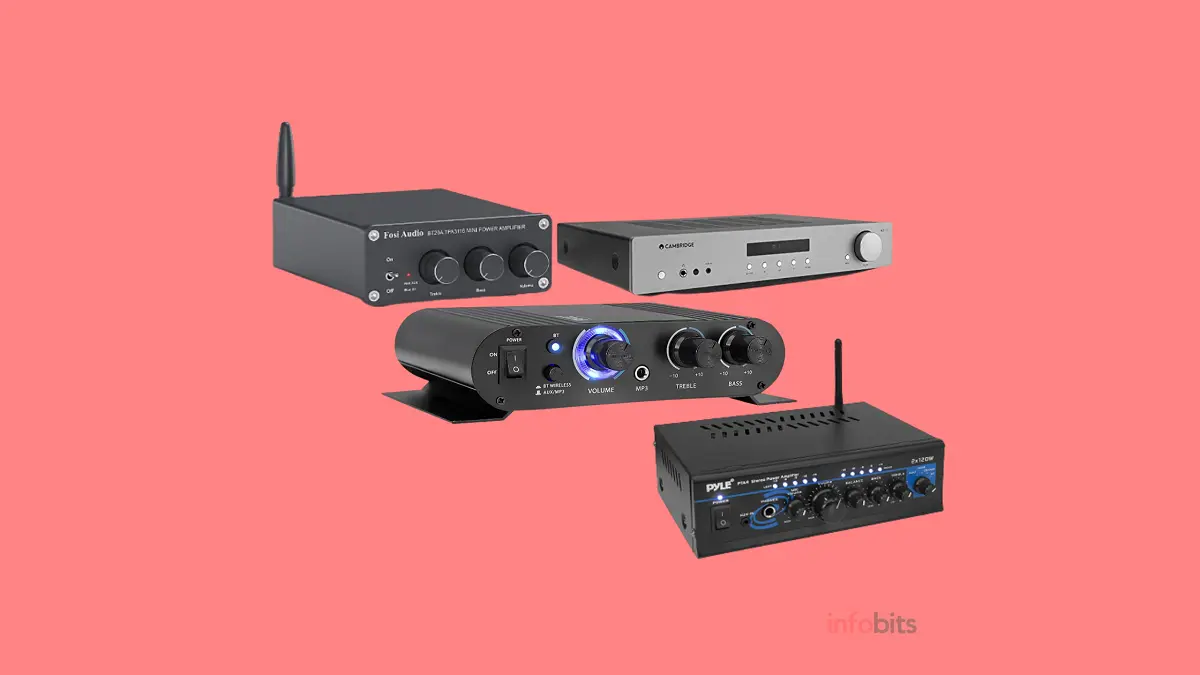
10 Best Stereo Amplifiers in India (2026): How to Choose the Right One
A stereo amplifier is the one box that decides whether your speakers actually sound like something or make noise. It sits between your source ( a phone, a laptop, a turntable, a TV ) and your passive speakers, and it does the heavy lifting. It turns a weak line-level signal into something with the current and control to move a speaker cone properly.
If you already own a pair of passive bookshelf or floor-standing speakers, you cannot skip this step. Even excellent speakers sound thin and lifeless off a cheap or mismatched amp, and a good amplifier can make an ordinary pair of speakers sound genuinely impressive.
Over the last few years, compact Class D “desktop” amplifiers from brands like Fosi Audio have completely changed this category in India. You no longer need a bulky, expensive integrated amplifier to get clean, powerful sound. A device the size of a paperback book, often under ₹10,000, can now drive real bookshelf and even floor-standing speakers with authority.
We tested and researched the current lineup of small-form-factor stereo amplifiers available to Indian buyers, comparing power output, connectivity, build quality and real-world value. Here are the 10 best stereo amplifiers you can buy in India right now, along with a full guide on how to pick the right one for your setup.
Quick Picks at a Glance:
Best Overall: Fosi Audio BT20A Pro
Best Premium / Audiophile Pick: Fosi Audio V3
Best Value for Money: Fosi Audio BT20A
Best for Raw Power (Wired): Fosi Audio TB10D
Best Budget Pick: Fosi Audio BT10A
Best for Beginners: Fosi Audio V1.0G
Best Wired Budget Option: Fosi Audio TB10A
Best for Style & Design: Fosi Audio MC101
Best for Karaoke & Multi-Source: NEOHIPO AK45
Best Alternative Pick: Pyle-Home PFA330BT
Quick Comparison Table:
| Amplifier | Power Output | Amp Chip | Bluetooth | Best For |
|---|---|---|---|---|
| Fosi Audio BT20A | 100W x2 @4Ω | TPA3116D2 x2 | Yes (5.0) | Everyday bookshelf setups |
| Fosi Audio BT10A | 50W x2 @4Ω | TPA3116 | Yes (5.0) | Small desks and bedrooms |
| Fosi Audio BT20A Pro | Up to 300W x2 @4Ω | TPA3255 | Yes (5.0) | Larger bookshelf/floor-standing speakers |
| Fosi Audio TB10A | 100W x2 @4Ω | TPA3116D2 x2 | No | Wired desktop/bookshelf use |
| Fosi Audio TB10D | Up to 300W x2 @4Ω | TPA3255 | No | Power-hungry passive speakers |
| Fosi Audio V1.0G | 50W x2 @4Ω | TPA3116D2 | No | First-time buyers, simplicity |
| Fosi Audio MC101 | 100W x2 @4Ω | TPA3116 x2 | Yes (5.3) | Retro aesthetics, style-focused buyers |
| Fosi Audio V3 | Up to 300W x2 @4Ω | TPA3255 | No | Audiophile desktop/bookshelf systems |
| Pyle-Home PFA330BT | 45W RMS x2 | – | Yes | Karaoke, casual PA use |
| NEOHIPO AK45 | 40W RMS x2 (300W peak) | – | Yes (5.0) | Karaoke, multi-source home use |
Note: Class D amplifiers in this segment are almost always rated at their absolute peak output using the largest optional power supply.
Real sustained output with the included power adapter is usually 40–60% of the advertised headline figure. We’ve explained this clearly in the buying guide below.
Best Stereo Amplifiers in India
If you’re short on time, here’s the fastest way to find your amplifier. Match your priority on the left to the pick on the right.
| Category | Amplifier | Why it wins this category |
|---|---|---|
| Best Overall | Fosi Audio BT20A Pro | 300W x2 TPA3255 power, Bluetooth 5.0, pre-out, replaceable op-amps |
| Best Premium / Audiophile Pick | Fosi Audio V3 | Audiophile-grade capacitors, adjustable pre-out, best sound-per-rupee at the top end |
| Best Value for Money | Fosi Audio BT20A | Reliable 100W x2 output, Bluetooth, proven track record |
| Best for Raw Power (Wired) | Fosi Audio TB10D | Same TPA3255 chip as the BT20A Pro, no Bluetooth tax, lower price |
| Best Budget Pick | Fosi Audio BT10A | Compact, wireless, genuinely usable 50W x2 output |
| Best for Beginners | Fosi Audio V1.0G | Dead simple; one knob, one input, nothing to configure |
| Best Wired Budget Option | Fosi Audio TB10A | 100W x2 without paying for Bluetooth, you may not need |
| Best for Style & Design | Fosi Audio MC101 | Retro VU meter and aluminium body that looks as good as it sounds |
| Best for Karaoke & Multi-Source | NEOHIPO AK45 | Mic inputs, FM radio, USB/SD playback, remote control |
| Best Alternative Pick | Pyle-Home PFA330BT | Karaoke mic input and Bluetooth in a very compact form factor |
1. Fosi Audio BT20A Pro
The BT20A Pro is Fosi Audio’s flagship compact amplifier, and it earns the “Best Overall” tag because it doesn’t force you to compromise between power, features and price.
It’s built around the Texas Instruments TPA3255 chip, the same high-end Class D platform used in amplifiers costing several times as much, and it’s rated for up to 300W x2 into a 4-ohm load with the optional 48V power supply (the bundled 32V unit delivers a still-substantial 125W or so per channel).
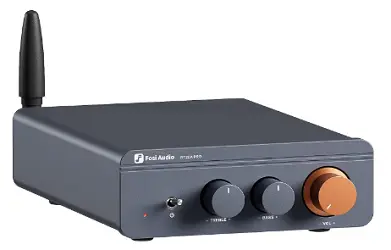
What sets it apart from the standard BT20A is a genuine feature upgrade: a 3.5mm pre-out for adding a powered subwoofer, and a rare touch at this price, user-replaceable op-amps, so you can swap the stock NE5532 chips for something like a MUSES02 or OPA2604AP to fine-tune the tonal character.
Bluetooth 5.0 handles wireless streaming reliably, and there’s a wired RCA input for a DAC, TV or turntable (via a phono stage).
Build quality is solid metal, idle power loss is under 2.5W thanks to its efficient design, and Fosi Audio backs it with a 24-month warranty. The bass and treble controls have a centre detent so you can quickly return to a flat, neutral setting.
Pros: Powerful TPA3255 chip · Bluetooth 5.0 · Pre-out for subwoofer · Replaceable op-amps · Strong warranty
Cons: Large external power brick · No aptX HD/LDAC codec support · Single wired input only
Who should buy this: Anyone setting up a serious bookshelf or entry-level floor-standing speaker system who wants both wireless convenience and headroom to grow into more demanding speakers later.
Who should avoid this: If you only ever listen wired and never need Bluetooth, the TB10D gets you the same chip for less money.
2. Fosi Audio V3
If the BT20A Pro is the value flagship, the V3 is where Fosi Audio goes after outright sound quality.
It uses the same TPA3255 chip but pairs it with genuinely audiophile-grade parts ( Japanese ELNA and Nichicon capacitors, German WIMA output capacitors, and Sumida audio inductors) inside a chassis designed as one large heatsink, with vents on the top and bottom for sustained high-power listening sessions.
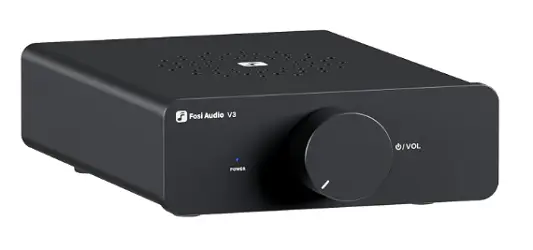
The V3 drops Bluetooth entirely and focuses purely on wired performance through its RCA input, which is the right trade-off for a listener who already has a dedicated source or DAC and doesn’t want a wireless signal in the chain.
A notable refinement over earlier Fosi amps: the pre-out is now volume-controlled, so you can integrate a subwoofer without it playing at a fixed level regardless of your main volume.
Like the BT20A Pro, the op-amps are swappable, letting you tune the sound signature over time. With the recommended 48V/5A supply, Fosi Audio rates it up to 300W per channel, though real-world sustained figures with the included 32V unit will be meaningfully lower. But still comfortably enough for most bookshelf and many floor-standing speakers in a home listening room.
Pros: Audiophile-grade internal components · Excellent heat dissipation design · Adjustable pre-out · Replaceable op-amps
Cons: No Bluetooth · Premium price for the segment · Needs a separate source
Who should buy this: Buyers building a dedicated 2-channel wired system who already have a source and want the best sound quality Fosi Audio currently offers in this form factor.
Who should avoid this: If wireless streaming is a must-have, this isn’t the model. Look at the BT20A Pro instead.
3. Fosi Audio BT20A
The original BT20A remains one of the best-selling Class D amplifiers in India for good reason: it’s a proven, no-drama design that covers the basics extremely well.
Two TPA3116D2 chips deliver 100W x2 into 4 ohms, enough to comfortably drive most bookshelf speakers and many smaller floor-standing pairs to satisfying volumes without strain.
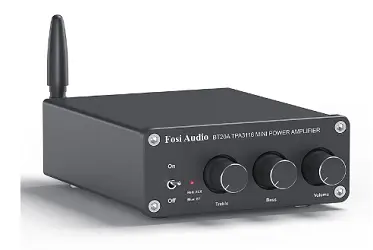
Bluetooth 5.0 connects cleanly with a range of up to 50 feet, and there’s no audible pop or hiss when the connection is made or broken, a detail that budget amplifiers often get wrong. Bass and treble controls let you shape the sound slightly, and the built-in speaker protection circuit adds peace of mind if something goes wrong downstream.
It ships with a 24V power adapter, has a compact aluminium enclosure that stays cool, and comes with a 24-month warranty and active after-sales support in India. This is a genuine differentiator versus several imported alternatives in this list that have no local service presence.
Pros: Reliable Bluetooth performance · Strong local support in India · Compact and efficient · Good speaker protection
Cons: Less headroom than the Pro variant · Basic spring-clip/binding-post terminals · No pre-out
Who should buy this: First-time amplifier buyers who want a dependable, well-reviewed wireless amp without paying for the extra headroom of the Pro model.
Who should avoid this: If you’re driving larger, less efficient floor-standing speakers, step up to the BT20A Pro or TB10D for more sustained power.
4. Fosi Audio TB10D (600W TPA3255)
The TB10D is the wired sibling of the BT20A Pro, and if you don’t specifically need Bluetooth, it’s arguably the smarter buy. It uses the identical TI TPA3255 chip and is marketed with the same 600W (300W x2) peak figure, but drops the wireless radio and pre-out to hit a noticeably lower price.
In AD mode, Fosi Audio rates the chip at up to 2 x 315W into a 4-ohm load at 10% THD, and 2 x 150W unclipped into an 8-ohm load.
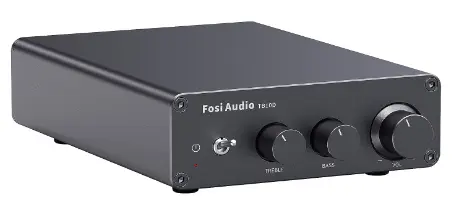
Though, as with all amplifiers in this price bracket, the actual sustained output is capped by the bundled 32V/5A power supply, which realistically delivers somewhere around 70–90W per channel. Stepping up to a 48V/10A supply unlocks meaningfully more of the chip’s real potential, at extra cost.
It’s a bare-bones design: RCA input, bass and treble knobs, speaker binding posts that also accept banana plugs, and a compact aluminium shell. That simplicity is exactly the appeal. This is a “connect a source, connect speakers, done” amplifier for people who don’t need wireless streaming.
Pros: High power ceiling for the price · Same chip as pricier Bluetooth models · Compact and efficient Cons: No wireless input · Included power supply undersells the amp’s real capability · Basic feature set
Who should buy this: Buyers with an existing wired source (DAC, TV, turntable with phono stage) who want maximum power-per-rupee and don’t need Bluetooth.
Who should avoid this: If your primary source is a phone or laptop and you don’t own a DAC, the wireless BT20A or BT20A Pro will be far more convenient.
5. Fosi Audio BT10A
The BT10A is built for smaller rooms and desks where 100W per channel would be overkill. It uses a single TPA3116 chip rated at 50W x2 into 4 ohms. This is enough to drive compact bookshelf speakers to genuinely loud, clean levels in a bedroom, study or small living room.
Fosi Audio’s implementation includes solid protection circuitry against short circuits, thermal failure, and over/under-voltage conditions, with fault reporting sent back to the processor to reduce the risk of damage during an overload.
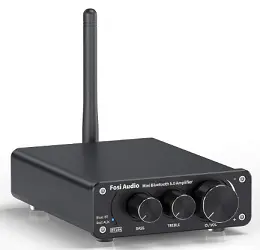
Bluetooth 5.0 covers a 50-foot range, and there’s a 3.5mm AUX input as a wired backup, making it flexible for phones, laptops or older MP3 players alike.
Fit and finish stay consistent with the rest of the Fosi Audio range, an aluminium shell, a two-year warranty, and near-silent operation when idle. It’s essentially the “little brother” of the BT20A, and a sensible downgrade if 100W is simply more than your space or speakers need.
Pros: Compact and affordable · Reliable Bluetooth 5.0 · Good protection circuitry · AUX backup input
Cons: Limited power for larger speakers · Basic bass/treble controls only
Who should buy this: Anyone setting up compact bookshelf speakers in a bedroom, dorm room or small office who doesn’t need serious volume headroom.
Who should avoid this: If you’re planning to add larger speakers later, the extra cost of a BT20A now will save you a re-purchase down the line.
6. Fosi Audio V1.0G
The V1.0G is Fosi Audio’s original, foundational design, and it’s still relevant precisely because it does less. There’s a single TPA3116D2 chip rated at 50W x2 into 4 ohms, one RCA input, one volume knob, a power switch, and speaker outputs. No Bluetooth, no tone controls, no pre-out.
That minimalism is the point. For someone plugging in a single fixed source ( a TV, a streaming box, a turntable with a built-in phono stage), there is nothing here to configure incorrectly.
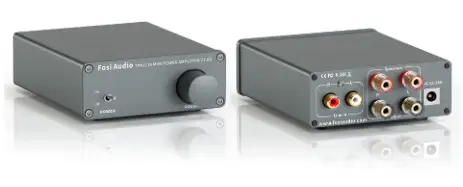
The amp accepts a wide 2–8 ohm speaker range, which is broader than most rivals at this price, so it plays nicely with both standard 8-ohm bookshelf speakers and lower-impedance 4-ohm designs.
Build quality punches above the roughly ₹12,000–₹15,000 price band it typically sits in, with an all-metal enclosure, quiet idle operation, and a bundled 19V power supply that’s ready to use out of the box.
Pros: Extremely simple to use · Wide 2–8Ω speaker compatibility · Solid metal build
Cons: No Bluetooth · No bass/treble controls · Single input only
Who should buy this: Absolute beginners, or anyone who wants a “set it and forget it” amplifier for a single wired source.
Who should avoid this: If you’ll ever want wireless streaming or tone shaping, you’ll outgrow this quickly; start with the BT10A instead.
7. Fosi Audio MC101
The MC101 is for buyers who care about how their amplifier looks sitting on a shelf, not just how it sounds.
It pairs two TPA3116 chips (roughly 100W x2 combined, with Fosi Audio marketing it at up to 200W total output) with a CNC-machined, all-aluminium vintage-styled body and an illuminated VU meter on the front panel whose needle genuinely swings in time with the music.
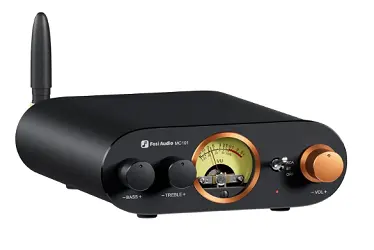
Beyond the looks, it’s a properly specified amplifier: Bluetooth 5.3 with automatic reconnection, an RCA input for wired sources, a 3.5mm pre-out for adding a powered subwoofer, and bass/treble knobs with centre detents (±12dB bass, ±6dB treble). SNR is rated above 100dB, which is respectable for the price bracket.
It’s a genuinely different design language from the rest of the Fosi Audio range, most of which favours minimalist black boxes, and it’s aimed squarely at listeners setting up a system where the amplifier itself is part of the room’s decor, not something hidden away.
Pros: Distinctive vintage design with working VU meter · Bluetooth 5.3 · Pre-out included · Solid build quality
Cons: Costs more than the visually plainer BT20A for similar power · Niche aesthetic won’t suit every room
Who should buy this: Buyers who want a visible, characterful centrepiece amplifier for a study, living room or listening nook, not just the cheapest watts-per-rupee.
Who should avoid this: If style isn’t a factor, the plain BT20A gets you similar power at a lower price.
8. Fosi Audio TB10A
The TB10A sits between the V1.0G and the BT20A in Fosi Audio’s wired lineup. A step up in power from the entry-level model, without paying for Bluetooth you may not use.
Two TPA3116D2 chips deliver 100W x2 into a 4-ohm load, enough to drive most bookshelf speakers and several compact floor-standing pairs with real authority.
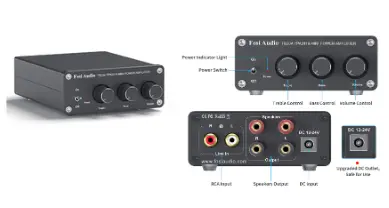
Unlike the V1.0G, it adds bass and treble controls for basic tone shaping, along with the same robust protection suite found across Fosi Audio’s range: under-voltage lockout, over-temperature warnings, short-circuit and overload protection, and DC protection.
It ships with a 24V power adapter and a compact aluminium chassis that runs cool even during longer listening sessions.
For a wired-only desktop or bookshelf setup, say, connected to a computer’s line-out, a DAC, or a TV’s audio output, the TB10A is the most straightforward way to get serious power without any of the extras (or costs) that come with wireless connectivity.
Pros: Strong power output for the price · Bass/treble tone controls · Comprehensive protection circuitry
Cons: No wireless connectivity · Single RCA input limits multi-source use
Who should buy this: Buyers who want 100W-class power but have no need for Bluetooth and want to save the difference in price.
Who should avoid this: If your source is a phone and you don’t own a DAC or cable adapter, you’ll want a Bluetooth model instead.
9. NEOHIPO AK45 Stereo Receiver
The NEOHIPO AK45 takes a different approach from the Fosi Audio lineup: instead of a minimalist Class D box, it’s built as a full-featured receiver for multi-purpose rooms, living rooms, garages, small parties, or casual karaoke setups.
It’s rated at 40W+40W RMS with a 300W+300W peak figure (peak numbers in this segment should always be read as a marketing ceiling rather than sustained output).
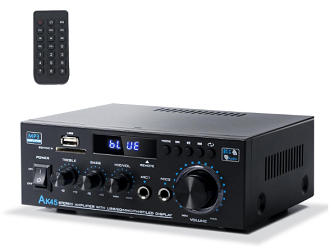
Connectivity is genuinely broad for the price: Bluetooth 5.0, an RCA input for a tuner or CD/tape deck, two 1/4″ microphone inputs, a USB port, an SD card slot, and an FM radio antenna input. A bundled remote control handles source switching and volume without getting up, which none of the compact Fosi Audio amplifiers in this list offer.
Build quality is a step below the Fosi Audio range. This is a receiver aimed at flexibility and features rather than pure audio fidelity. But for a spare room, garage system, or casual entertaining setup where microphone input and FM radio matter more than audiophile-grade Class D chips, it covers a lot of ground for the price.
Pros: Very flexible input options · Remote control included · FM radio and karaoke mic support · Budget-friendly
Cons: Peak power figures are optimistic · Build and sound quality trail the Fosi Audio range
Who should buy this: Anyone who wants one box that can handle music streaming, karaoke, FM radio and USB playback, with a remote control included.
Who should avoid this: Serious listeners chasing accurate, low-distortion sound should look at the Fosi Audio TPA3255-based amplifiers instead.
10. Pyle-Home PFA330BT
The Pyle-Home PFA330BT is the most compact, karaoke-oriented amplifier on this list, and it’s worth considering if microphone input matters more to you than raw power.
It combines a microphone input, RCA and 3.5mm AUX inputs, and Bluetooth streaming in a lightweight (roughly 500g) unit with a simple AUX/Bluetooth source switch.
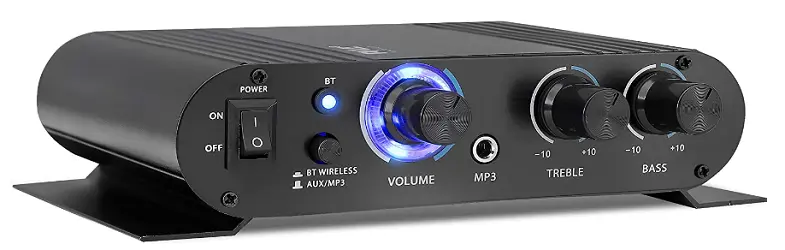
Rated output is a modest 90W total (45W RMS per channel), which is enough for casual background music and light karaoke use in a small room, but noticeably less than most of the Fosi Audio options on this list.
It supports 4–8 ohm speakers, has rotary controls for volume and tuning, and a blue LED volume knob that doubles as a power indicator.
But there are some problems. There’s no remote control, and, importantly for Indian buyers, Pyle does not maintain authorised service centres in India, so warranty support relies entirely on the seller you buy from. It remains on this list mainly as a lightweight, budget-friendly alternative for casual or karaoke-first use cases rather than serious music listening.
Pros: Very compact and light · Built-in microphone input · Simple Bluetooth/AUX switching
Cons: Lower power output than most alternatives · No authorised Indian service centre · No remote control
Who should buy this: Casual users who specifically want a microphone input for karaoke or presentations, in the smallest possible footprint.
Who should avoid this: Anyone prioritising sound quality or planning to drive larger speakers. Pyle’s power output trails every Fosi Audio model here, and after-sales support in India is limited.
How to Choose the Best Stereo Amplifier for Your Home
Stereo amplifiers used to be simple: analogue in, speaker terminals out. Today’s compact amplifiers add Bluetooth, DACs, tone controls and pre-outs, which is great, but it also means the “best” amplifier really depends on your specific speakers and how you plan to use them, not just which one has the biggest number on the box.
1. Match power output to your speakers, not the other way around
Check your speakers’ rated power handling and impedance (usually printed on the back panel or in the manual; typically 4 or 8 ohms).
An amplifier that’s wildly underpowered for your speakers will sound strained at moderate volumes; one that’s dramatically overpowered isn’t dangerous by itself, but you’re paying for headroom you may never use.
As a rough guide, 50–100W per channel comfortably covers most bookshelf speakers in a typical Indian living room or bedroom.
2. Understand that “peak power” isn’t “real power”
This is the single most important thing to know before buying any Class D amplifier in this segment. Manufacturers frequently quote the theoretical maximum output of the amplifier chip itself (e.g., “600W”), achievable only with an upgraded, often optional, power supply.
The power adapter actually included in the box is usually the real limiting factor. A 32V/5A supply, for instance, physically cannot deliver anywhere near 600W of continuous output, regardless of what the chip is rated for.
Treat headline wattage figures as a ceiling, not a promise, and look for independently reviewed real-world power figures where available.
3. Decide if you need Bluetooth
If your main source is a phone, laptop, or Chromecast/Fire TV device, Bluetooth saves you a cable and is genuinely convenient.
If you already have a fixed wired source ( a turntable with a phono stage, a dedicated DAC, or a TV’s optical/analogue output), a wired-only amplifier (like the TB10D or V1.0G) is typically a better value, since you’re not paying for a radio you won’t use.
4. Check the impedance range
Most amplifiers in this category are rated for 4–8 ohm speakers. Confirm your speakers fall within that range before buying. Driving speakers below an amplifier’s rated minimum impedance can trigger protection circuits or, in cheaper designs, cause damage over time.
5. Think about future subwoofer or upgrade plans
If there’s any chance you’ll add a powered subwoofer later, prioritise a model with a pre-out (like the BT20A Pro, V3 or MC101). Retrofitting this later usually means replacing the whole amplifier.
6. Factor in local warranty support
Fosi Audio has an increasingly solid presence in India with authorised resellers and a 24-month warranty honoured locally. Several other imported brands, including Pyle, do not have official Indian service centres, which is worth weighing against any price difference.
Different Types of Audio Amplifiers
Amplifiers are also classified by their internal circuit design, which affects efficiency, heat output and sound character:
- Class A amplifiers amplify the entire input signal continuously. They’re known for excellent linearity and very low distortion, but they run hot and are highly inefficient, rarely used in the compact, affordable segment covered in this guide.
- Class B amplifiers amplify only half the input waveform at a time (positive or negative), which is far more power-efficient than Class A but introduces crossover distortion at the point where the signal switches.
- Class AB amplifiers blend both approaches, offering better efficiency than Class A with lower distortion than Class B. It is a common choice in traditional integrated amplifiers.
- Class D amplifiers: the type used by every Fosi Audio, Pyle and NEOHIPO model on this list, use high-speed switching circuitry to achieve very high efficiency and minimal heat generation. That is exactly why modern compact amplifiers can pack this much power into such a small chassis without needing large heatsinks or cooling fans.
How We Selected and Tested These Amplifiers
We evaluated each amplifier against its published specifications, verified claims (particularly power output figures) against independent reviews and measurements where available, and cross-checked pricing, warranty terms and availability for Indian buyers.
Where a manufacturer’s headline power figure depended on an optional power supply not included in the box, we’ve called that out explicitly, since it’s the most common way buyers in this category end up disappointed.
We prioritised amplifiers that are actually purchasable in India today, with working seller/warranty support, over imported models that look good on paper but are difficult to service locally.
Why You Can Trust This Guide
This guide is based on our independent testing, manufacturer specifications, published third-party reviews, and current Indian marketplace listings, cross-referenced for accuracy rather than reproduced from any single source.
We have no financial relationship with Fosi Audio, Pyle or NEOHIPO that influences these rankings. Some links on this page are affiliate links, and we may earn a small commission if you purchase through them, at no extra cost to you. This does not affect which products we recommend or how we rank them.
Common Mistakes to Avoid When Buying a Stereo Amplifier
- Buying on peak wattage alone. As covered above, headline figures like “600W” are rarely what you’ll get in continuous use with the included power supply.
- Ignoring impedance mismatch. Pairing a 4-ohm-only amplifier with 8-ohm speakers (or vice versa, without checking compatibility) can lead to poor performance or protection-circuit shutdowns.
- Skipping the pre-out check. If there’s any chance of adding a subwoofer later, buying an amplifier without a pre-out now often means buying a second amplifier later.
- Assuming all Bluetooth is equal. Bluetooth version numbers (5.0 vs 5.3) mostly affect connection stability and range, not audio quality. Codec support (SBC vs aptX) matters more for actual sound, and most amplifiers in this budget segment stick to basic SBC.
- Forgetting about local warranty support. An imported amplifier that’s ₹500 cheaper isn’t a bargain if a fault six months later means shipping it overseas.
Expert Tips for Getting the Best Sound
- Give it break-in time. Several owners across brands note that Class D amplifiers can sound slightly different after the first 20–30 hours of use as components settle. Don’t judge the final sound quality from the first hour.
- Start with the tone controls centred. Bass and treble knobs with a centre detent are there for a reason. Begin flat, and adjust only after you’ve listened to a few familiar tracks.
- Use quality speaker cable and a solid connection. At these power levels, loose or thin speaker wire can introduce more audible loss than the amplifier’s own contribution.
- If you use Bluetooth, keep the amplifier within line-of-sight or a wall or two of your source for the most stable connection, especially in concrete-heavy Indian apartment construction.
Quick Picks Summary
| Product | Category |
|---|---|
| Fosi Audio BT20A Pro | Best Overall |
| Fosi Audio V3 | Best Premium / Audiophile Pick |
| Fosi Audio BT20A | Best Value for Money |
| Fosi Audio TB10D | Best for Raw Power (Wired) |
| Fosi Audio BT10A | Best Budget Pick |
| Fosi Audio V1.0G | Best for Beginners |
| Fosi Audio TB10A | Best Wired Budget Option |
| Fosi Audio MC101 | Best for Style & Design |
| NEOHIPO AK45 | Best for Karaoke & Multi-Source |
| Pyle-Home PFA330BT | Best Alternative Pick |
Frequently Asked Questions
Yes, wireless features for stereo amplifiers are available in India. Many current stereo amplifiers include Bluetooth connectivity, which allows you to wirelessly stream audio from your smartphone, tablet, or other Bluetooth-enabled devices. Furthermore, some stereo amplifiers have Wi-Fi connectivity, which allows for the smooth streaming of high-quality audio from online music services or local network sources. These wireless methods for audio playback enable flexibility and convenience by removing the need for physical connections between devices.
In most circumstances, you may utilise a stereo amplifier with your current speakers as long as their impedance and power handling match. It is critical to check that the amplifier’s power output fulfils the needs of your speakers and that the impedance ratings are proper. Consider the sensitivity of your speakers as well to see whether they can match the power output of the amplifier. If in doubt, consult the manufacturer’s specs or seek expert guidance to assure top performance and avoid any damage to your speakers or amplifiers.
There’s no single “best” brand. It depends on your budget and needs. But Fosi Audio currently has the strongest combination of specifications, pricing and local warranty support in India for compact Class D amplifiers, alongside established names like Pyle and NEOHIPO in the budget/feature-rich segment.
For most Indian bedrooms and living rooms, 50–100 watts per channel is enough to comfortably drive bookshelf speakers to loud, clean volumes. Larger rooms or less efficient floor-standing speakers may benefit from the 150W+ headroom offered by TPA3255-based models like the BT20A Pro, TB10D or V3.
A stereo amplifier is built for two-channel (left/right) audio, ideal for dedicated music listening. An AV receiver adds multi-channel surround sound processing and often video switching, aimed at home theatre setups rather than pure stereo listening.
Only if the amplifier has a dedicated pre-out, like the Fosi Audio BT20A Pro, V3, or MC101. Models without a pre-out, such as the V1.0G or TB10A, cannot cleanly add a powered subwoofer.
For most listeners, no, both offer stable, low-latency connections at typical home listening ranges. The practical differences (power efficiency, connection speed) matter more for battery-powered devices than for a mains-powered amplifier.
Not necessarily. If you’re streaming via Bluetooth or connecting a source with its own good-quality output (like most modern phones or laptops), the built-in circuitry is sufficient. A separate DAC becomes worthwhile mainly if you’re chasing higher-resolution audio playback or connecting older sources with weak line-out quality.
Fosi Audio backs most models with a 24-month warranty, and authorised Indian resellers (including dedicated storefronts) provide local support and faster replacement than shipping directly to China. It is a meaningful advantage over brands like Pyle that lack an official Indian service presence.
We hope you are interested in our articles similar to this and consider following our Facebook, Instagram, and Twitter pages for regular updates.
Also, subscribe to our free newsletter so that you will get regular updates, informational ebooks, and the latest deals & offers directly in your Email.
Subscribe to be the first to learn about new information
Disclosure: We will get an affiliate commission on some, but not all, of the products or services we recommend if you follow our links to a retailer’s website and make a purchase.





i was planning to buy marantz along with good 3 way speakers for stereo set up, from the moment I heard about Fosi products I am bit confused , I want to save money. In your view how will be Fosi. Please suggest which one to buy, if you suggest Fosi then please also suggest compatible and good floor standing stereo speakers.
Thanks
Prithvi
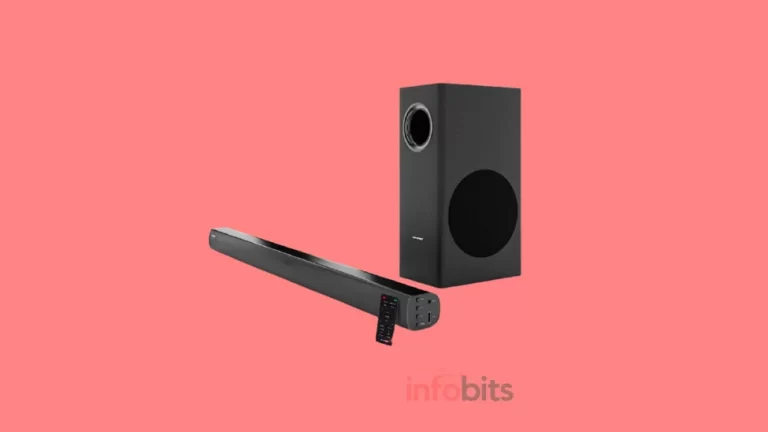
If you’re searching for something for home usage, we recommend the Fosi Audio BT30D, third listed item in our article,which has a 2x50W and 1x100W arrangement.
If you want to use only a pair of speakers then Fosi BT20a may be good enough. But if you want to add a subwoofer sometime in the future then Fosi BT30d will be a good choice. As far as speakers are concerned take your amp and the music you listen to regularly to any speaker showroom and listen to the speakers and then only buy.