Best Memory Cards in India 2026: 9 Tested Picks & Buying Guide
Your phone is out of space again. Your camera just threw a “card full” warning mid-shoot. Sound familiar?
A good memory card fixes this instantly. But in 2026, buying one isn’t as simple as it used to be. A global chip shortage has pushed prices up across every brand, and there are more speed classes, ratings, and formats than ever, including a brand-new one built specifically for the Nintendo Switch 2.
We’ve re-tested and re-researched this guide to reflect what’s actually available in India right now, at current prices, with picks that make sense whether you’re topping up your phone or shooting 4K on a mirrorless camera.
A quick heads-up before you buy: NAND flash (the chip inside every memory card) is in short supply globally because AI data centres are buying it up for servers. Prices on SD and microSD cards have risen sharply through 2026 and are expected to stay elevated into 2027.
If you see a fair price on a card you actually need, it’s a reasonable time to buy rather than wait for a discount.
If you already know what card class, speed, and capacity you need, jump straight to our Quick Picks. If not, our buying guide below breaks it all down in simple language.
Quick Picks: Best Memory Cards at a Glance
| Category | Card | Best For |
|---|---|---|
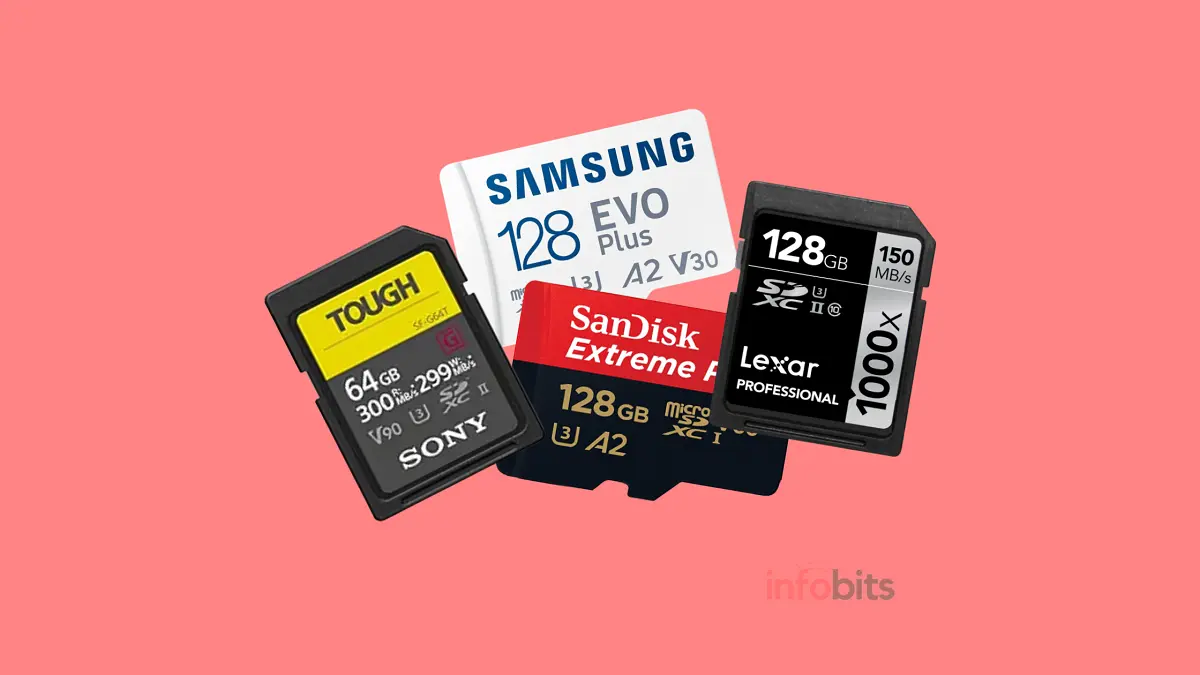
| Best Overall | Samsung EVO Plus 128GB microSDXC | Everyday phone and tablet use |
| Best Value for Money | SanDisk Ultra microSDXC 128GB | Budget Android phones |
| Best for Action Cameras | SanDisk Extreme microSD UHS-I 128GB | GoPro, drones, smartphones |
| Best Budget Pick | Amazon Basics 128GB microSDXC | Basic storage top-up |
| Best Performance | Sony Tough 64GB SDXC UHS-II | Professional cameras |
| Best for DSLR/Camcorders | Lexar Professional 1000x 128GB SDXC | Full-HD and 4K recording |
| Best for High-End Video | ProGrade Digital SDXC UHS-II V90 128GB | 4K/8K cinema-grade footage |
| Best Premium Pick | SanDisk Extreme Pro 128GB microSDXC | Enthusiast photographers |
| Best for Gaming Consoles | SanDisk microSD Express 256GB | Nintendo Switch 2 |
The Best Memory Cards in India
Prices below are indicative as of August 2026. Because of the ongoing NAND shortage, prices can shift week to week. Always check the live price before buying.
1. Samsung EVO Plus 128GB microSDXC: Best Overall
The EVO Plus remains our top all-round pick because it balances speed, durability, and price better than almost anything else on the market. It’s rated U3, Class 10, and V30, with sequential read speeds up to 160 MB/s; plenty for 4K video, fast app loading, and quick photo transfers.
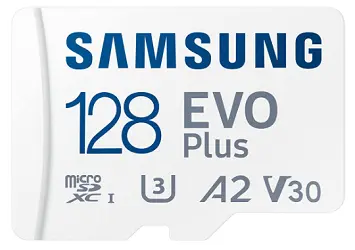
What makes it a safe buy is how little it asks you to compromise. It’s rated waterproof, temperature-resistant, X-ray-proof, magnet-proof, and drop-resistant, so it survives the kind of everyday abuse a card actually goes through in a phone or a dashcam.
Samsung backs it with a reliable warranty, and its wide availability across Indian retailers means genuine stock is easy to find. This is a real concern with lesser-known brands.
It comes in 64GB, 128GB, 256GB, and 512GB, so you can size up without switching brands. The A2 application performance rating also means apps installed to the card open and run noticeably faster than on an A1-rated card, which matters if your phone doesn’t have much internal storage to begin with.
Pros: Excellent speed-to-price ratio, tough build, wide capacity range, easy to find genuine stock.
Cons: UHS-I only, so it’s not built for professional 8K workflows
Who should buy it: Anyone who wants a dependable card for a phone, tablet, or basic camera without researching every spec.
Who should avoid it: Videographers shooting 8K or burst RAW photography – you’ll want a UHS-II card instead (see our Sony and ProGrade picks below).
2. SanDisk Ultra microSDXC 128GB: Best Value for Money
SanDisk’s Ultra line has been the default “good enough” card for Android phones for years, and it still earns that reputation. It’s a Class 10, U1, A1-rated card with rated speeds up to 140 MB/s. It also comes with a 10-year limited warranty, a strong safety net for a card in this price bracket.
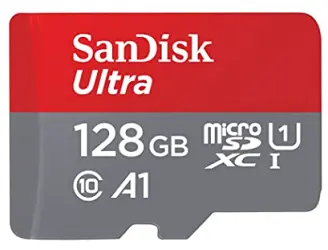
In practice, we’ve found this card frequently outperforms its official U1/A1 rating, behaving closer to a U3-class card in real-world transfers. That’s a nice bonus if you’re buying primarily on price. It’s available from 64GB right up to 1TB, so it scales with your needs.
Where it makes the most sense is a phone or tablet where you’re storing photos, music, and videos on the card while keeping apps on internal storage. The A1 rating is fine for that, though it’s not the best choice if you plan to run games or heavy apps directly off the card.
Pros: Genuinely good value, 10-year warranty, wide size range, reliable brand.
Cons: A1 rating (not A2), UHS-I speeds only
Who should buy it: Budget-conscious buyers who want a trustworthy brand without paying for specs they won’t use.
Who should avoid it: Anyone installing large games or apps directly to the card; step up to an A2-rated card like the EVO Plus instead.
3. SanDisk Extreme microSD UHS-I 128GB: Best for Action Cameras
Built around SanDisk’s Fast Flow technology, this card is tuned for the burst-shooting, always-recording nature of action cameras and drones. It’s rated for reads up to 190 MB/s and writes up to 90 MB/s, comfortably ahead of most cards in this price range.
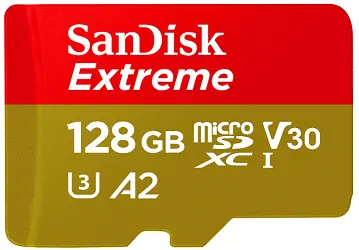
It carries UHS Speed Class 3 (U3) and Video Speed Class 30 (V30) ratings, both of which matter if you’re capturing 4K footage on a GoPro-style camera or a drone that writes continuously to the card. The A2 application rating also helps if you’re using it in a phone for gaming.
Build quality is where this card earns its “Extreme” name. It’s rated temperature-proof, waterproof, shockproof, and X-ray-proof, which matters far more for a card that’s going into a drone or an action camera strapped to a helmet than one sitting inside a phone.
Pros: Strong sustained write speeds, rugged build, A2-rated.
Cons: UHS-I ceiling limits it for the most demanding 4K/8K workflows
Who should buy it: Action camera, drone, and GoPro users who need consistent write speeds for continuous 4K recording.
Who should avoid it: If you’re shooting 8K or high-frame-rate 4K on a professional mirrorless camera, a UHS-II card will serve you better.
4. Amazon Basics 128GB microSDXC: Best Budget Pick
Amazon Basics has quietly built a reputation for offering “good enough” electronics at aggressive prices, and this microSD card follows the same pattern.
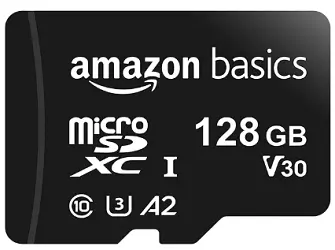
It’s U3-rated, meaning it comfortably handles 4K video and high-resolution photos despite the modest price tag, and it comes bundled with a full-size SD adapter. This is very handy if you also want to use it in a camera or laptop card reader.
In our testing, the rated 100 MB/s transfer speed held up consistently in real-world use, without the stutter or lag you sometimes see from unbranded budget cards. It’s compatible with the usual range of Android phones, tablets, and basic cameras.
It won’t outperform the SanDisk or Samsung cards on this list, and its long-term reliability track record is shorter simply because it’s a newer entrant. But as a low-risk, low-cost way to add storage, it’s a solid option, especially if your budget is the primary constraint.
Pros: Genuinely affordable, U3-rated, adapter included.
Cons: Shorter reliability track record than established brands, availability can be inconsistent
Who should buy it: Buyers who want reliable basic storage without paying a premium brand tax.
Who should avoid it: Anyone who needs a proven multi-year reliability track record for critical data (photographers backing up irreplaceable shoots, for instance).
5. Sony Tough 64GB SDXC UHS-II: Best Performance
If raw speed is what you’re after, this is the card to buy. Sony rates it at up to 300 MB/s read and 299 MB/s write, backed by a V90 video speed class rating. The highest tier that exists, guaranteeing a minimum sustained write speed of 90 MB/s. That headroom means no dropped frames or buffer stalls, even when recording 8K video.
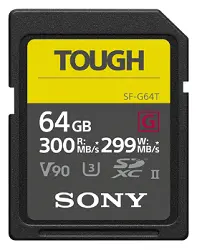
The “Tough” branding isn’t just marketing. Sony builds this card as a single moulded piece using high-hardness materials, making it around 18 times more bend-resistant than the standard SD spec, rated for drops up to 5 meters, and IP68-rated for dust and water resistance.
For working photographers who need a card that survives being dropped on set, this matters.
It requires a UHS-II compatible card slot to hit its top speeds. Check your camera’s spec sheet first, since not every camera (and not every card slot on dual-slot cameras) supports UHS-II.
Pros: Class-leading speed, exceptional build toughness, V90-rated.
Cons: Expensive, only useful if your device supports UHS-II, limited to 64GB in this variant
Who should buy it: Professional photographers and videographers shooting on high-end mirrorless or DSLR bodies that support UHS-II.
Who should avoid it: Casual users. You’re paying a significant premium for speeds your camera or phone likely can’t use.
6. Lexar Professional 1000x 128GB SDXC: Best for DSLR/Camcorders
This card sits in a sensible middle ground: a UHS-II card with a U3 speed rating and transfer rates up to 150 MB/s, priced well below the Sony and ProGrade options above. It’s aimed at DSLR, HD camcorder, and 3D camera users shooting 1080p, 3D, or 4K footage without needing V90-grade sustained write speeds.
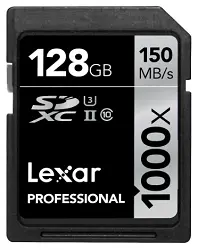
One practical bonus: it includes Image Rescue software, which can recover accidentally deleted photos and videos. This is a genuinely useful safety net that most competing cards don’t offer.
It’s also backwards compatible, running at UHS-I speeds on older, non-UHS-II devices and Class 10 speeds on legacy readers, so you’re not locked out of using it with an older camera or card reader you already own. A 256GB version is available if you need more headroom.
Pros: Good UHS-II speed at a mid-range price, bundled recovery software, backwards compatible.
Cons: Not V90-rated, so it’s not guaranteed for the most demanding 8K workflows
Who should buy it: DSLR and camcorder users who want UHS-II speeds without paying professional-tier prices.
Who should avoid it: 8K shooters; step up to a V90-rated card for guaranteed sustained write speeds.
7. ProGrade Digital SDXC UHS-II V90 128GB: Best for High-End Video
ProGrade is a newer name to most Indian buyers, but it’s built by former SanDisk and Lexar engineers, and it shows in the specs: sequential read speeds up to 300 MB/s and write speeds up to 250 MB/s, with a V90 rating guaranteeing a 90 MB/s minimum sustained write.
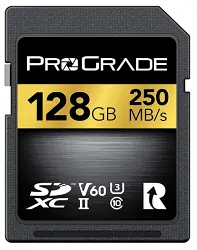
It includes built-in error correction to catch and fix data write and transfer errors. It is a feature aimed squarely at professionals who can’t afford a corrupted card mid-shoot. The V90 rating and sustained speed make it well-suited to high-resolution 4K video and burst RAW photography on modern mirrorless bodies.
Because it’s a less mainstream brand in India, availability can be patchier than SanDisk or Sony, and you should buy only from authorised sellers to avoid counterfeits. This is a real risk with less common professional cards.
Pros: Elite-tier speed, error correction, built for demanding professional workflows.
Cons: Less widely available in India; verify seller authenticity carefully
Who should buy it: Professional shooters who want Sony Tough-level performance with built-in error correction, and don’t mind a less mainstream brand.
Who should avoid it: Buyers who prioritise easy after-sales support and wide retail availability over pure specs.
8. SanDisk Extreme Pro 128GB microSDXC: Best Premium Pick
This is SanDisk’s flagship microSD card, and it’s built for buyers who want the best microSD available without stepping up to a full-size SD card. SanDisk’s QuickFlow Technology pushes read speeds up to 200 MB/s, with write speeds up to 90 MB/s, which is genuinely fast for a microSD form factor.
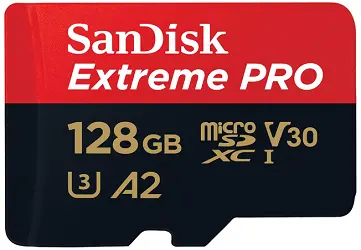
It’s rated UHS-I speed class with a V30 video rating, which comfortably covers 4K UHD, Full HD, and high-resolution photo capture. That makes it a strong fit for Android smartphones, action cameras, and drones; anywhere you need microSD-sized speed without compromise.
Like the rest of SanDisk’s Extreme lineup, it’s built to survive the field: X-ray-proof, waterproof, temperature-proof, and drop-proof. It’s available in 64GB, 128GB, 256GB, 512GB, and even 1TB, giving serious users plenty of headroom to grow into.
Pros: Fastest microSD in this lineup, rugged build, huge capacity range.
Cons: UHS-I ceiling means true UHS-II cards will still outpace it in raw speed
Who should buy it: Enthusiast photographers and drone pilots who want the fastest microSD card available.
Who should avoid it: If your device has a full-size SD slot, the Sony Tough or ProGrade cards above will outperform this at similar money.
9. SanDisk microSD Express 256GB: Best for Gaming Consoles
This is a genuinely new addition, and a necessary one. The Nintendo Switch 2, which launched globally in 2026, only accepts the new microSD Express standard for expandable storage. This is a regular microSDXC card; however fast and it will not work for installing games on it.
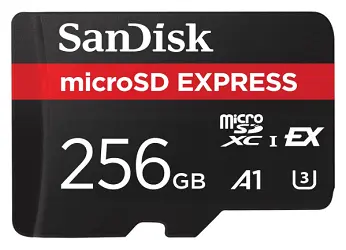
SanDisk’s microSD Express card delivers read speeds up to 880 MB/s and write speeds up to 650 MB/s, several times faster than even a high-end UHS-II card, because microSD Express uses a completely different PCIe-based interface rather than the older UHS bus.
Availability in India is still catching up. Most stock currently comes through import listings on Amazon.in rather than dedicated Indian retail, so prices and stock can be inconsistent. If you own a Switch 2, though, this isn’t optional: it’s the only card format that will let you install games beyond the console’s built-in 256GB.
Pros: Only card format compatible with Switch 2 game installs, exceptional speed.
Cons: Limited Indian retail availability, premium pricing, not backwards-useful in older devices at Express speeds
Who should buy it: Nintendo Switch 2 owners who need to expand storage for installed games.
Who should avoid it: Everyone else; a regular UHS-I or UHS-II card is faster to buy, cheaper, and works fine in phones, cameras, and older consoles.
How to Select a Good Memory Card?
Choosing the right memory card comes down to three questions: what device is it going into, what will you use it for, and how much are you willing to spend. Here’s what actually matters.
Type and Size of SD Cards
Memory cards come in two physical sizes – regular SD and microSD. Most cameras, DSLRs, and compact cameras use full-size SD cards, while smartphones, action cameras, and drones use microSD.
Check your device’s card slot or spec sheet if you’re unsure; a microSD slot is roughly the size of your thumbnail, while a standard SD slot is noticeably larger.
Beyond size, cards are also classified by capacity:
- SD (SDSC): up to 4GB; effectively obsolete today
- SDHC: 4GB–32GB
- SDXC: 64GB–2TB; the sweet spot for most modern devices
- SDUC: 2TB–128TB; rarely used outside specialised professional gear
Most devices released after 2010 support SDXC, so unless you’re using genuinely old hardware, this is the range to shop in. A 128GB card comfortably holds thousands of photos or several hours of 4K footage, which is why it’s the most common capacity across our picks above.
Speed and Ratings of Memory Cards
This is where most buyers get overwhelmed, so here’s the short version.
Speed Class (C2–C10) sets a minimum write speed from 2–10 MB/s. Class 10 is the fastest and the only one worth buying today.
UHS Speed Class (U1 or U3) sets a higher minimum: 10 MB/s for U1, 30 MB/s for U3. U3 is recommended for 4K recording.
UHS Bus Speed (I, II, or III) is different: it’s the maximum possible speed, not the minimum guaranteed one. UHS-I tops out around 104 MB/s; UHS-II can reach up to 312 MB/s. Most consumer devices today use UHS-I; UHS-II is mainly relevant for professional cameras with compatible card slots.
Video Speed Class (V6–V90) is the most reliable indicator for video work, because the number directly states the guaranteed minimum write speed in MB/s. A V90 card guarantees at least 90 MB/s sustained, which is what you want for 8K or high-bitrate 4K. V30 comfortably covers standard 4K.
As a rule of thumb: match the card to your device, not the other way around. Buying a V90 card for a phone that can’t use anywhere near that speed just wastes money.
A1 and A2 Ratings
The Application Performance Class rating (A1 or A2) measures how well a card handles running apps directly from it; relevant mainly for smartphones and gaming devices, not cameras.
- A1 requires 1,500 random read IOPS, 500 random write IOPS, and 10 MB/s sustained sequential write.
- A2 requires 4,000 read IOPS, 2,000 write IOPS, and the same 10 MB/s sustained write.
If you plan to install apps or games to the card, prioritise A2. If the card is purely for storing photos and videos, A1 is fine and usually cheaper.
Brand and Quality
Stick to established brands like SanDisk, Samsung, Sony, Lexar, Kingston, and Transcend; all have a proven track record in the Indian market. Unbranded or heavily discounted “too good to be true” cards carry a real risk of data loss, and the money you save upfront is often spent many times over on data recovery later.
If your device rarely leaves a controlled environment (a phone that never leaves your pocket, for instance), you likely don’t need a ruggedised card. If you’re using a waterproof camera, an action cam, or shooting outdoors regularly, the extra cost of a shock- and water-resistant card is worth it.
Comparison Table: Key Specs at a Glance
| Spec | Options Available | Recommended For Most Users |
|---|---|---|
| Form Factor | SD, microSD | Match your device slot |
| Type | SDHC, SDXC, SDUC | SDXC |
| Speed Class | Class 2–10 | Class 10 |
| UHS Class | U1, U3 | U3 for video |
| UHS Bus Speed | UHS-I, UHS-II, UHS-III | UHS-I for phones, UHS-II for pro cameras |
| Video Speed Class | V6–V90 | V30 for 4K, V90 for 8K |
| App Performance Class | A1, A2 | A2 for gaming/apps |
How We Selected These Memory Cards
We evaluated each card on five factors: real-world read/write performance versus rated specs, build durability, brand reliability and warranty support, price-to-performance value at current Indian market rates, and genuine availability through authorised Indian retailers.
We prioritised cards with a consistent track record over newer entrants with unproven longevity, and we cross-checked every listed spec against manufacturer datasheets rather than relying on retailer copy alone.
Why You Can Trust This Guide
This guide is updated regularly to reflect current pricing, new card formats (like microSD Express), and changes in the Indian retail market.
We don’t accept payment for placement. Every recommendation is based on specifications, independent reviews, and real-world performance data. When we use affiliate links, they don’t influence our recommendations; see our full disclosure below.
Common Mistakes to Avoid
- Buying based on capacity alone. A cheap 256GB card with a slow write speed will bottleneck your camera far more than a well-specced 128GB card will.
- Ignoring the video speed class for video work. UHS ratings alone don’t guarantee no dropped frames. Check the V-class rating too.
- Buying counterfeit cards from unverified sellers. Fake high-capacity cards are common online; buy from authorised retailers and verify capacity with tools like H2testw if you have doubts.
- Overbuying UHS-II speed for a UHS-I device. You won’t see any benefit if your phone or camera doesn’t support the faster bus.
- Skipping the adapter check. If you’re buying a microSD card to use in a full-size SD slot, make sure a quality adapter is included or budget for one separately. Cheap adapters can bottleneck performance.
Expert Tips
- For phones, an A2-rated card noticeably speeds up app installs and load times if you’re routinely low on internal storage.
- For cameras, buy two smaller cards instead of one large one. If a card fails or is lost, you don’t lose your entire shoot.
- Format new cards in-camera or in-device before first use, rather than just on a computer. It sets up the card’s file structure correctly for that device.
- Keep firmware and card reader drivers updated on your computer if you regularly offload footage; outdated readers are a common (and overlooked) cause of slow transfer speeds.
Conclusion
For most people, the Samsung EVO Plus 128GB remains the smartest all-round buy. This is fast enough for daily use, tough enough to survive daily life, and reasonably priced even with the current market pressure on NAND prices.
If you’re shooting professionally, the Sony Tough and ProGrade Digital cards deliver the sustained speed serious video work demands. And if you’ve just picked up a Nintendo Switch 2, the SanDisk microSD Express isn’t optional. It’s the only format that will let you install new games.
Whatever you choose, buy from an authorised retailer, match the card’s speed rating to what your device can actually use, and keep an eye on pricing. In this market, a fair price today is often a better deal than waiting.
Frequently Asked Questions
SanDisk, Samsung, Sony, Lexar, Kingston, and Transcend are the most reliable and widely available memory card brands in India, each backed by strong warranty support and consistent retail availability.
Among traditional SD cards, the Sony Tough UHS-II and ProGrade Digital UHS-II V90 are among the fastest options available, with sequential speeds up to 300 MB/s. For Nintendo Switch 2 owners, microSD Express cards are significantly faster still, with speeds up to 880 MB/s, though they use a different interface entirely.
It depends on use. 32GB suits basic document and music storage. 64GB works for moderate photo and Full HD video storage. 128GB comfortably handles a large photo library, movies, and 4K footage for most users. 256GB and above suit professional photographers, videographers, or anyone recording extensively in 4K or higher.
The Sony Tough UHS-II SD card is among the most durable available, rated for drops up to 5 meters and IP68-rated for dust and water resistance, thanks to its one-piece moulded construction.
Check your device’s supported card type (SD or microSD) and its maximum supported speed class in its manual or spec sheet first. Then match the speed class to your use case. Class 10/U3/V30 for most 4K needs, and choose a capacity based on how much you shoot or store before offloading.
In most cases, yes. Devices are generally backward and forward compatible within their supported card type (SDHC or SDXC). However, check your device specs first, since very old devices may cap out at a lower maximum capacity than the card supports.
A global NAND flash shortage, driven largely by AI data centres buying up chip manufacturing capacity, has pushed memory card prices up sharply through 2026, and industry forecasts suggest prices may stay elevated into 2027. If you need a card now, it’s reasonable to buy rather than wait, since prices are more likely to rise than fall in the near term.
Only if your device specifically requires it. Currently, the Nintendo Switch 2 is the main consumer device that requires microSD Express for installing games. A regular microSDXC card will only work for taking screenshots, not for game storage. For phones, cameras, and every other device on this list, a standard microSDXC card is what you need.
If you are interested in this article, please share it with your friends and relatives.
Also, don’t forget to follow our Facebook and Twitter pages for regular updates.
Subscribe to our free newsletter to get regular updates directly in your Email.
Subscribe to be the first to learn about new information
Disclosure: If you follow the links mentioned in this article to a retailer’s website and make a purchase, we will get an affiliate commission on some, but not all, of the items or services we recommend without affecting your price.