
Best Laptops for Students in India 2026: Top 10 Picks Compared
Buying a laptop for college or school shouldn’t mean spending three weekends comparing spec sheets. It should mean picking something that survives four years of assignments, video calls, browser tabs, and the occasional all-nighter, without draining your budget.
We compared 14 popular student laptops currently sold in India and narrowed them down to the 10 that genuinely earn a spot on this list, based on processor generation, RAM, display quality, warranty, and real buyer feedback.
Below, you’ll find a laptop for nearly every kind of student: budget-conscious first-years, engineering and design students who need real horsepower, and everyone in between.
Quick Picks: Best Laptops for Students
Best Overall: ASUS Vivobook 15
Best for Gaming & Editing: Dell G15-5530
Best Battery Life & Display: HP OmniBook 5 OLED
Best Premium Build: Lenovo ThinkBook 16
Best Alternative Pick: HP 15, i5
Best for Everyday Productivity: Dell 15, i5
Best Value for Money: Dell 15, i3
Best Budget Pick: Lenovo IdeaPad Slim 3, Ryzen
Best for Basic Use: HP 15, i3
Best Compact Budget Pick: Lenovo IdeaPad Slim 3, i3
How We Selected These Laptops
We started with a shortlist of 14 currently available student laptops and dropped four: two with older, lower-resolution hardware that newer options in the same lineup clearly beat, and two that duplicated another model’s processor and RAM without adding anything meaningful.
What’s left is 10 laptops that each earn their place, either through price, performance, display quality, or a genuinely different use case (gaming, AI features, business-grade durability).
We cross-checked specifications against brand listings and Amazon/Flipkart product pages, and weighed in real buyer feedback wherever it was available.
Why You Can Trust This Guide
We don’t accept payment from any brand to influence rankings or product order. Some links on this page may be affiliate links, and we may earn a small commission if you make a purchase. This doesn’t affect the price you pay or which products we recommend.
Best Laptops for Students at a Glance
| Category | Laptop | Price (approx.) |
|---|---|---|
| Best Overall | ASUS Vivobook 15, i5-13420H, 16GB/512GB | ₹47,000–52,000 |
| Best for Gaming & Editing | Dell G15-5530, i5-13450HX, RTX 3050 6GB | ₹73,000–83,000 |
| Best Battery Life & Display | HP OmniBook 5 OLED, Snapdragon X, 16GB/512GB | ₹70,000–84,000 |
| Best Premium Build | Lenovo ThinkBook 16, Ryzen 5 7535HS, 8GB/512GB | ₹47,000–55,000 |
| Best Alternative Pick | HP 15, i5-13420H, 16GB/512GB | ₹67,000–69,000 |
| Best for Everyday Productivity | Dell 15, i5-1334U, 16GB/512GB, FHD | ₹55,000–58,000 |
| Best Value for Money | Dell 15, Core i3/Core 3-100U, 16GB/512GB | ₹49,000–52,000 |
| Best Budget Pick | Lenovo IdeaPad Slim 3, Ryzen 5 7520U, 16GB/512GB | ₹54,000–59,000 |
| Best for Basic Use | HP 15, i3-1315U, 12GB/512GB | ₹42,000–50,000 |
| Best Compact Budget Pick | Lenovo IdeaPad Slim 3, i3-1315U, 8GB/512GB | ₹40,000–55,000 |
Best Laptops for Students in India: Details
1. ASUS Vivobook 15 (X1502VA), Intel Core i5-13420H, 16GB RAM, 512GB SSD: Best Overall
If you only read one entry on this list, make it this one. The ASUS Vivobook 15 pairs a genuinely capable 13th Gen Intel Core i5-13420H, an 8-core, 12-thread H-series chip, not a weaker U-series one, with 16GB of RAM and a 512GB NVMe SSD, at a price that undercuts most rivals with similar specs.

That H-series processor matters more than it sounds. Unlike the lower-power U-series chips found in several other laptops on this list, the 13420H has real multi-core muscle, which shows up clearly in coding, spreadsheet-heavy work, and running several heavy apps side by side. Engineering and computer science students will feel the difference fastest.
The 15.6-inch FHD display runs at 200–250 nits with a TÜV Rheinland low blue-light certification, which is a genuine comfort feature if you’re staring at it for six-plus hours a day. ASUS’s 180-degree lay-flat hinge is a small but useful touch for group project reviews, and the ErgoSense keyboard has more travel than most laptops in this price band.
Buyer feedback consistently highlights smooth multitasking and fast boot times thanks to the 512GB SSD, with battery life as the one recurring criticism, expect closer to 5-6 hours of real-world use rather than all-day battery life.
For most students who want one laptop that handles browsing, coding, editing, and the occasional casual game without a second thought, this is our top recommendation.
Pros: Powerful H-series CPU, 16GB RAM, comfortable keyboard, low blue-light certified display. Cons: Battery life is average, not exceptional; 60Hz refresh rate
2. Dell G15-5530, Intel Core i5-13450HX, NVIDIA RTX 3050 6GB: Best for Gaming & Video Editing
If your coursework (or your downtime) involves anything GPU-heavy like 3D modelling, video editing, CAD software, or actual gaming, this is the laptop on this list built for it.

The G15-5530 pairs a 10-core i5-13450HX with a dedicated NVIDIA RTX 3050 (6GB GDDR6), a combination that’s genuinely rare at this price point and puts it well beyond what any of the integrated-graphics laptops here can do.
The 120Hz FHD display makes a real difference for both gaming and general scrolling smoothness, and Dell’s Alienware-inspired cooling ( a vapour chamber plus dual fans) keeps the system from throttling hard during longer, sustained workloads like renders or extended gaming sessions.
The backlit keyboard with a dedicated Game Shift key is a nice touch if you do want to use this as your primary gaming machine, too.
The limitation of this laptop is its size and battery life. At roughly 2.6–2.8kg, it’s noticeably heavier than every other laptop on this list, and reviewers consistently note the 56Wh battery drains fast under load.
But still, we can expect 2-3 hours during gaming or rendering, more like 5-6 hours for light browsing. This isn’t the laptop to carry between five lectures a day. It’s the laptop for students whose coursework specifically needs a discrete GPU, or who want one machine that does both study and serious gaming.
Pros: Dedicated RTX 3050 GPU, 120Hz display, strong cooling design, 10-core processor. Cons: Heaviest laptop on this list, weaker battery life under load, higher price
3. HP OmniBook 5 OLED, Snapdragon X, 16GB RAM, 512GB SSD: Best Battery Life & Display
The HP OmniBook 5 OLED is the odd one out on this list in the best way. It runs on a Qualcomm Snapdragon X ARM chip instead of Intel or AMD, and the difference shows up immediately in two places: the screen and the battery.

The 2K OLED panel delivers noticeably deeper blacks and richer colour than any LCD panel on this list, which matters if you’re doing design work, editing photos for assignments, or just prefer a nicer screen for everyday use.
HP rates this at up to 34 hours of local video playback, and even accounting for real-world use being lower than lab figures, buyers consistently report multi-day battery life between charges, a genuine rarity in this list.
Because it’s fanless, it runs completely silently, and at around 1.29kg, it’s the lightest laptop here by a clear margin, which matters if you’re carrying it across campus daily. The Snapdragon X chip is also built for on-device AI features, which HP markets as its AI Companion. This feature is useful if you want local AI tools without depending on your internet connection.
The catch is software compatibility. Windows on ARM has improved a lot, but some older Windows applications, certain engineering software, and select games still don’t run natively or need emulation, which can cost some performance.
If your coursework is mostly browser-based, Office apps, and general study work, this is a non-issue. If you specifically need niche Windows-only engineering or CAD tools, check compatibility before buying.
Pros: Exceptional battery life, vivid 2K OLED display, silent fanless design, lightest laptop on this list. Cons: Some older Windows software needs emulation; pricier than similarly specced Intel/AMD laptops
4. Lenovo ThinkBook 16, AMD Ryzen 5 7535HS, 8GB RAM, 512GB SSD: Best Premium Build
The ThinkBook 16 brings a level of build quality to this list that the others simply don’t match. It’s tested against 12 MIL-STD-810H military-grade durability methods, has an aluminium top cover with an anodised sandblasting finish, and includes a fingerprint reader; details you’d normally expect on a laptop costing significantly more.

Under the hood, the Ryzen 5 7535HS is a 6-core, 12-thread H-series chip, giving it a real performance edge over the U-series chips found in most budget and mid-range laptops on this list. Combined with a 16-inch WUXGA (1920×1200) IPS display at 300 nits, brighter than most FHD panels here, it’s a genuinely pleasant laptop to work on for long stretches.
The 8GB RAM configuration we’ve highlighted here is the more affordable variant; a 16GB version exists at a higher price if your budget allows it. 8GB is workable for browsing, documents, and moderate multitasking, but students doing heavier coding, virtual machines, or design work should budget for the 16GB variant or plan to upgrade the RAM later, since it’s expandable up to 64GB.
If you want a laptop that looks and feels more expensive than it is, survives regular bumps and drops in a backpack, and comes from a brand with strong after-sales service across India, this is the pick to shortlist.
Pros: Military-grade durability testing, aluminium build, bright 300-nit display, fingerprint reader. Cons: 8GB RAM is tight for heavier multitasking; the 16GB variant costs more
5. HP 15, Intel Core i5-13420H, 16GB RAM, 512GB SSD: Best Alternative Pick
This HP 15 configuration is, on paper, nearly identical to our overall top pick. The same H-series i5-13420H processor, the same 16GB RAM and 512GB SSD combination.
If you already prefer HP as a brand, or specifically want HP’s countrywide service network and support experience, this is a completely legitimate alternative to the ASUS Vivobook above.
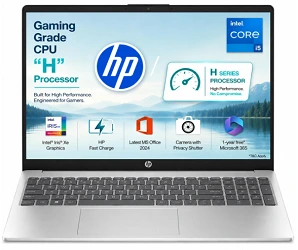
Where it differs is mostly in the details. The HP 15 uses DDR4-3200 memory rather than the faster memory in some rivals, and its FHD anti-glare display sits at a similar 250 nits, so day-to-day visual experience is comparable.
The backlit keyboard, HP Fast Charge support, and micro-edge display design are all present, and buyers frequently mention that HP’s keyboards in this range feel slightly firmer under the fingers than ASUS’s, a matter of preference more than a clear advantage either way.
We’re positioning this as an alternative rather than a co-top-pick specifically because, spec-for-spec, it doesn’t offer anything the ASUS doesn’t already deliver at a lower typical price.
That said, if a local HP service centre is more convenient for you than an ASUS one, or if you simply prefer HP’s design language, this is not a downgrade. It’s a genuinely close alternative with the same core performance.
Pros: Same H-series i5-13420H performance as our top pick, strong HP service network, and backlit keyboard. Cons: Typically priced higher than the equivalent ASUS Vivobook configuration
6. Dell 15, Intel Core i5-1334U, 16GB RAM, 512GB SSD, FHD: Best for Everyday Productivity
The Dell 15 with the i5-1334U strikes a sensible middle ground for students who want strong daily performance without paying for gaming-grade hardware they’ll never use.
The 10-core, U-series chip trades some raw multi-core power for better efficiency and cooler running temperatures compared to the H-series chips above. It is a fair trade for students doing writing, research, spreadsheets, and browser-heavy multitasking rather than compiling code or rendering video.

The 15.6-inch FHD display runs at a 120Hz refresh rate, which is unusual at this tier and makes scrolling through long documents or PDFs noticeably smoother than the standard 60Hz panels most competitors use. Dell backs this configuration with McAfee security software included and a choice of chassis finishes, including a lighter aluminium option for students who want to shave off weight.
Reviewers highlight this laptop’s balance of build quality and everyday speed, though a few note that battery life sits around the 6-7 hour mark under mixed use rather than the all-day figures OLED or ARM-based laptops can achieve.
For commerce, arts, and humanities students who mostly need a fast, reliable machine for writing and research rather than heavy computation, this is one of the smarter buys on this list.
Pros: 120Hz FHD display, efficient U-series processor, 16GB RAM, McAfee security included. Cons: Less raw performance than H-series options like the ASUS or HP i5-13420H models above
7. Dell 15, Intel Core i3/Core 3-100U, 16GB RAM, 512GB SSD: Best Value for Money
This is the laptop to recommend to a student whose budget caps out around ₹50,000 but who still wants 16GB of RAM; a spec that most competitors at this price only offer with half the memory.
The Intel Core 3-100U (Intel’s newer naming for its entry-level 14th Gen chip) isn’t built for heavy computation, but paired with 16GB RAM, it handles the actual bottleneck for most students, running a dozen browser tabs, a video call, and a document editor simultaneously, without the slowdowns that plague 8GB configurations.
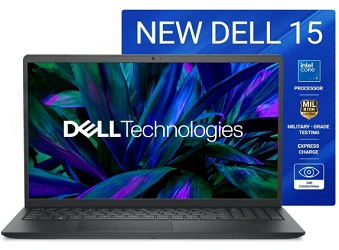
The 15.6-inch FHD IPS display with anti-glare coating and a 120Hz refresh rate is a genuinely nice inclusion at this price, and the 1.63kg carbon black chassis feels sturdier than its price tag suggests. Dell includes Microsoft Office Home 2024 and typically bundles a McAfee subscription as well.
The honest compromise here is raw CPU performance. This chip will noticeably struggle with anything resembling video editing, serious coding compilation, or running multiple heavy applications at once.
But for browsing, note-taking apps, Google Docs, Zoom classes, and general coursework, the extra RAM makes this a smarter buy than several pricier laptops on this list that pair a similar-tier chip with only 8GB.
Pros: 16GB RAM at a genuinely budget price, 120Hz FHD display, sturdy build. Cons: Entry-level CPU struggles with heavier computational tasks
8. Lenovo IdeaPad Slim 3, AMD Ryzen 5 7520U, 16GB RAM, 512GB SSD: Best Budget Pick
The IdeaPad Slim 3 with the Ryzen 5 7520U consistently shows up as one of the best-reviewed budget laptops in India, and it’s easy to see why once you look past the price tag.
You’re getting a quad-core Ryzen 5 chip, 16GB of LPDDR5 memory (faster than the DDR4 found in several competitors here), and a 512GB SSD, all in a 1.6kg chassis with a backlit keyboard.

The 15.6-inch FHD display is TÜV-certified for low blue light, a detail that matters more than it sounds for students doing long study sessions.
Lenovo also includes practical touches like a privacy shutter on the webcam and a claimed 12-hour battery life, with rapid charge technology that adds roughly 2 hours of use from a 15-minute top-up, genuinely useful between back-to-back classes.
Buyer feedback across retailers is strongly positive, particularly around the display quality and day-to-day multitasking smoothness, a direct result of the 16GB RAM configuration at this price. If your budget sits in the ₹50,000–60,000 range and you want the best all-around spec sheet you can get without stepping into H-series or gaming territory, this is the laptop to buy.
Pros: 16GB fast LPDDR5 RAM, low blue-light certified display, strong buyer reviews, webcam privacy shutter. Cons: Ryzen 5 7520U is a U-series chip, so it won’t match H-series laptops on sustained heavy workloads.
9. HP 15, Intel Core i3-1315U, 12GB RAM, 512GB SSD: Best for Basic Use
For students whose laptop needs are genuinely limited to browsing, typing assignments, and video calls, this HP 15 configuration offers a small but meaningful edge over most i3-based budget laptops: 12GB of RAM instead of the more common 8GB.
That extra 4GB makes a real difference in how many browser tabs and background apps you can keep open before things start to lag.
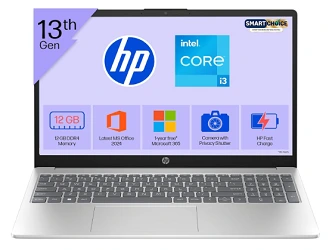
The Core i3-1315U is a 6-core, 8-thread chip that comfortably handles document editing, web research, streaming, and standard coursework, though it’s not built for coding-heavy workloads or any kind of creative software.
The 15.6-inch FHD anti-glare display and micro-edge design keep the laptop looking more premium than its price suggests, and HP’s Fast Charge support helps offset the relatively modest 41Wh battery, which delivers around 7-8 hours of light use.
This is a sensible pick for first-year students, those studying humanities, commerce, or arts subjects that don’t demand heavy software, or anyone who wants a reliable secondary laptop without spending on hardware they won’t use.
It’s not a laptop that will comfortably carry you through four years of increasingly demanding coursework, but for its intended use case, it does the job cleanly.
Pros: 12GB RAM (more than typical for this price tier), FHD anti-glare display, HP Fast Charge. Cons: Not suited to coding, editing, or design work; modest battery capacity
10. Lenovo IdeaPad Slim 3, Intel Core i3-1315U, 8GB RAM, 512GB SSD: Best Compact Budget Pick
This is the laptop for the tightest budgets on this list, and it’s worth including specifically because Lenovo doesn’t cut corners on the things that matter most for daily comfort.
The 15.6-inch Full HD anti-glare display, backlit keyboard, and 1.62kg weight all match what you’d expect from laptops costing considerably more, even though the internal specs, an i3-1315U and 8GB RAM, sit at the entry level.

The 512GB PCIe SSD is the same generous storage found throughout this list, so you won’t run out of space even if the processing power is more modest.
Lenovo’s build quality on the IdeaPad Slim 3 series consistently earns praise for feeling sturdier than its price class suggests, and the fingerprint sensor available on some configurations adds a security touch rarely seen this low in the market.
The 8GB RAM is the main limiting factor here. It’s enough for browsing, typing, and light multitasking, but you’ll notice slowdowns if you regularly run 15+ browser tabs alongside a video call.
If you can stretch your budget slightly, the Dell Core 3-100U with 16GB RAM (our Best Value pick above) offers more headroom for a similar price. But if this is genuinely the ceiling of your budget, this remains one of the better-built options at this price point.
Pros: Solid build quality for the price, FHD anti-glare display, compact and light. Cons: 8GB RAM limits heavier multitasking; consider the 16GB Dell option above if your budget allows
What to Look for in a Student Laptop
a) Processor
For most students, a recent-generation Intel Core i3 or AMD Ryzen 3 handles browsing, documents, and video calls comfortably.
If your course involves coding, data analysis, or any creative software, aim for an i5 or Ryzen 5, and specifically look for H-series chips (like the i5-13420H on this list) over U-series chips if you want noticeably more multi-core power for the same price bracket.
b) RAM
8GB is the bare minimum in 2026, and it shows its limits quickly once you have a video call, a dozen browser tabs, and a document editor open together. 16GB is genuinely worth the extra spend if your budget allows it; several laptops on this list prove you don’t need to spend a fortune to get there.
c) Storage
512GB SSD is now the standard across this list, and for good reason: it’s fast, reliable, and rarely the bottleneck. Avoid anything with a traditional hard drive if you can help it. The speed difference for everyday tasks like booting up and opening apps is significant.
d) Display
A Full HD (1920×1080) display is the baseline to look for. If you spend long hours reading or writing, look for extras like anti-glare coating, TÜV low blue-light certification, or a higher refresh rate (90Hz or 120Hz). Several laptops on this list include these at surprisingly reasonable prices.
e) Battery Life
If you’re moving between classes, libraries, and hostels, look for at least 6-8 hours of real-world battery life. The HP OmniBook 5 OLED stands well apart from the rest of this list here, while gaming laptops like the Dell G15 trade battery life for raw performance.
f) Weight and Portability
Anything under 1.7kg is comfortable for daily carrying in a backpack. Gaming laptops like the Dell G15 sacrifice portability for performance, which is a reasonable trade-off only if you genuinely need the GPU.
g) Warranty and Service Network
Brands with a wide service network across India ( Dell, HP, and Lenovo all qualify) make repairs and support meaningfully easier if something goes wrong, especially if you’re studying away from a major city.
Related: How to Choose a Good Laptop? A Laptop Buying Guide India
Common Mistakes to Avoid
- Buying based on brand alone. Two laptops from different brands with the same processor and RAM will perform almost identically. The differences are usually in build quality, display, and service network, not raw speed.
- Ignoring RAM in favour of a “better” processor. An i5 with 8GB RAM will often feel slower in real daily use than an i3 with 16GB RAM, because most student workloads are RAM-bound, not CPU-bound.
- Overbuying a gaming laptop “just in case.” Unless you specifically need a dedicated GPU for editing, CAD, or gaming, the extra weight and reduced battery life of a gaming laptop are rarely worth it for general coursework.
- Skipping the return window check. Test your laptop thoroughly; screen, keyboard, ports, battery drain, within the first week, since manufacturing defects are far easier to resolve through an immediate replacement than a later warranty claim.
Expert Tips
- Register your laptop’s warranty with the manufacturer as soon as you set it up. This speeds up any future service claims significantly.
- If your budget allows a small stretch, prioritise RAM over storage upgrades; 512GB is plenty for most students, but going from 8GB to 16GB RAM makes a bigger day-to-day difference.
- Keep your laptop’s Windows and driver updates current in the first few weeks. Some early-batch units ship with outdated drivers that get fixed quickly post-launch.
Conclusion
For most students, the ASUS Vivobook 15 (i5-13420H, 16GB) offers the strongest all-around mix of performance, display quality, and price. If battery life and display quality matter more than raw power, the HP OmniBook 5 OLED is worth the extra spend. And if you’re working with a tighter budget, the Dell 15 (Core 3-100U, 16GB) gives you more RAM for your money than almost anything else on this list.
Related: Best i5 Laptop Under 50000 in India: Unbeatable Value
Frequently Asked Questions
RAM, SSD, and CPU each have an impact on how quickly your laptop works. High RAM capacity, an SSD, and a quicker processor will ensure good performance in your laptop.
The Dell 15 with the Core 3-100U and 16GB RAM offers the best value in this range, thanks to its unusually generous RAM configuration for the price. The Lenovo IdeaPad Slim 3 (i3-1315U, 8GB) is a solid pick if your budget is tighter still.
It’s workable for basic browsing and document editing, but 16GB is increasingly the practical minimum if you multitask heavily across browser tabs, video calls, and applications simultaneously.
Only if your coursework involves video editing, 3D modelling, CAD software, or gaming. For most students, including most engineering coursework, integrated graphics on a capable processor is sufficient.
H-series chips (like the i5-13420H on this list) offer more sustained multi-core performance, which helps with coding, compiling, and multitasking. U-series chips run cooler and often deliver better battery life, which suits students who prioritise portability over raw power.
A genuinely capable laptop with 16GB RAM and a modern processor typically falls between ₹47,000 and ₹60,000 in 2026. Laptops below this range usually compromise on RAM, while gaming or premium OLED laptops push well above it.
It’s an excellent choice if your work is mostly browser-based, Office apps, and general study tasks. The battery life and display quality are outstanding. Check software compatibility first if you need specific Windows-only engineering or design tools.
We hope you are interested in our articles similar to this and consider following our Facebook, Instagram, and Twitter pages for regular updates.
Also, subscribe to our free newsletter so that you will get regular updates, informational ebooks, and the latest deals& offers directly in your Email.
Subscribe to be the first to learn about new information
Disclosure: If you follow our links to a retailer’s website and make a purchase, we will get an affiliate commission on some, but not all, of the items or services we recommend.







I’m blown away by the quality of your content. Your post is a masterpiece of information. [Link to external website is removed from the comment]