No Internet, Secured Error in Windows 10 & 11: 15 Fixes
Quick answer: “No Internet, Secured” means your PC is successfully connected to your Wi-Fi network, but that network isn’t passing traffic through to the internet. Start with the fast fixes: toggle Wi-Fi off and on, restart your PC and router, and if those don’t work, move on to network reset, driver updates, and DNS changes. Most cases resolve within the first five fixes below.
Few Windows errors are as misleading as this one. Your Wi-Fi icon shows a connection. Your taskbar might even show full signal bars. And yet nothing loads; no websites, no emails, no updates.
That gap between “connected” and “actually online” is exactly what this error is telling you about, and once you understand why it happens, fixing it stops feeling random.
What Does “No Internet, Secured” Actually Mean?
Your computer isn’t connected to the internet directly. It’s connected to your router, and the router is what talks to the wider internet (your ISP’s network).
These are technically two separate networks. The LAN (Local Area Network; your PC, router, and other home devices) and the WAN (Wide Area Network; everything beyond your router, including the internet itself).
“No Internet, Secured” means the LAN connection is working fine. Your PC has successfully joined the secured Wi-Fi network. But something is blocking the WAN side, so no data is actually reaching the internet.
The “Secured” part just confirms the Wi-Fi password and encryption worked; it’s not related to the actual fault.
Common causes include a router or ISP outage, an incorrect IP or DNS configuration, an outdated or corrupted network driver, VPN software interfering with the connection, or occasionally a security app blocking network traffic.
Step 1: Figure Out Where the Problem Is
Before trying any fix, spend 30 seconds narrowing down the cause. It saves you from working through fixes that were never going to help.
Check whether other devices on the same Wi-Fi network are also affected. Your phone, another laptop, a smart TV. This one check tells you which half of the guide you need.
If Multiple Devices Are Affected
If every device on your network has lost internet access, the problem is almost certainly your router or your internet connection itself, not your Windows PC.
- Restart your router and modem. Unplug both for at least 10 seconds, then plug the modem back in first, wait for it to fully reconnect, and then power on the router.
- Check for an outage. Log into your account with your ISP (via their app or a mobile data connection) to see if there’s a known outage in your area.
- Wait and reconnect. Give the router 2–3 minutes to fully re-establish its connection, then check each device again.
If every device is back online after this, you’re done. The issue was never on the Windows side. If only your Windows PC still shows the error, move to the next section.
If Only Your Windows PC Is Affected
This is the more common scenario, and it means the fault is somewhere in your PC’s network configuration, drivers, or software.
Work through the fixes below roughly in order. They’re arranged from fastest/most likely to fix things to more advanced options for stubborn cases.
Related: Windows 10 End of Support: What Are Your Options
Quick Fixes (Try These First)
1. Toggle Your Wi-Fi Connection
Click the Wi-Fi icon in the system tray, select your network, click Disconnect, wait about 30 seconds, then click Connect again.
This forces your PC to re-negotiate the connection from scratch and resolves a surprising number of cases on its own.
2. Restart Your Computer
It’s an obvious step, but a full restart clears temporary network stack glitches that a simple Wi-Fi toggle won’t touch.
Give it a genuine shot before moving on. This alone resolves the error for many users.
3. Move Closer to Your Router
If your signal is weak, your PC can technically “connect” to the Wi-Fi network without a strong enough link to actually pass data, which triggers exactly this error.
Move closer to the router, or move the router to a central, elevated spot away from walls and large appliances. If your home is large, a Wi-Fi extender or mesh system can solve this permanently.
4. Disconnect Other Devices Temporarily
A phone connected via mobile hotspot, a second router, or another device aggressively using bandwidth can occasionally interfere with your PC’s connection on some home networks.
Temporarily disconnecting other devices helps you confirm whether this is a factor.
5. Switch to a Wired (Ethernet) Connection
If you have an Ethernet cable available, plug it in and see if the internet works over the wired connection.
If it does, you’ve confirmed the problem is specifically with your Wi-Fi adapter or Wi-Fi settings, which narrows down exactly where to focus your remaining troubleshooting.
Intermediate Fixes
6. Run the Windows Network Troubleshooter
Windows has a built-in tool specifically designed to detect and often auto-fix this exact error, and it’s worth running before anything more manual.
- Windows 11: Settings > System > Troubleshoot > Other troubleshooters > run Network and Internet.
- Windows 10: Settings > Update & Security > Troubleshoot > Additional troubleshooters > run Internet Connections.
Apply any fixes it recommends, then check your connection again.
7. Update Your Network Adapter Driver
An outdated or corrupted network driver is one of the most common causes of this error.
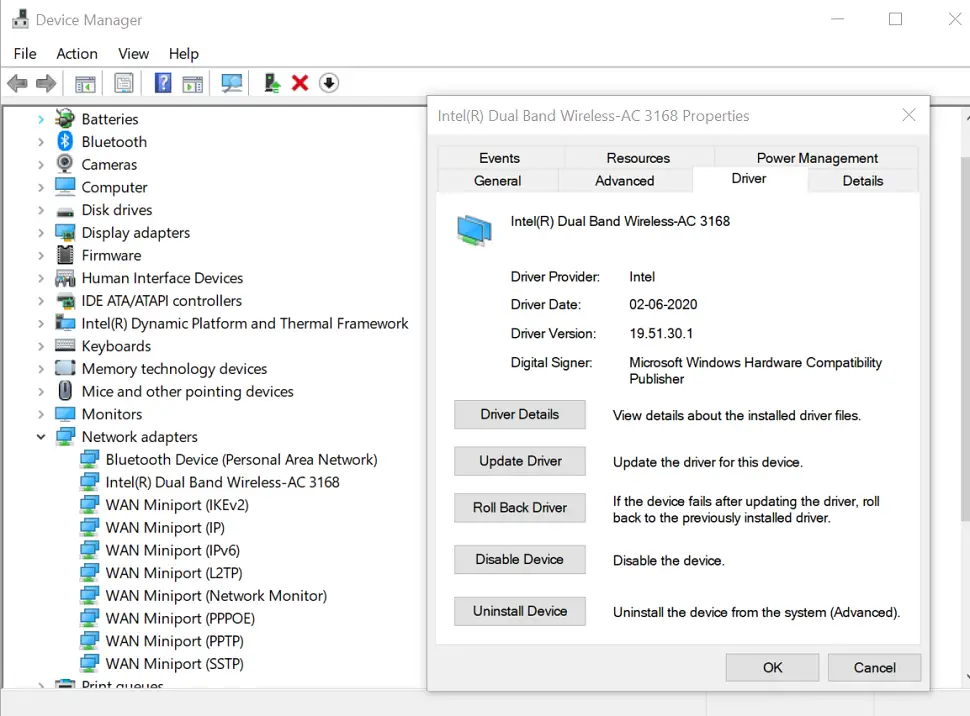
- Right-click Start and select Device Manager.
- Expand Network adapters and find your Wi-Fi adapter.
- Right-click it and select Update driver, then choose Search automatically for drivers.
- Restart your PC once the update completes.
If updating doesn’t help, right-click the adapter again and select Uninstall device. Restart your PC. Windows will automatically reinstall a fresh copy of the driver on boot, which resolves corruption issues an update alone sometimes can’t fix.
8. Check Your Network Adapter Properties
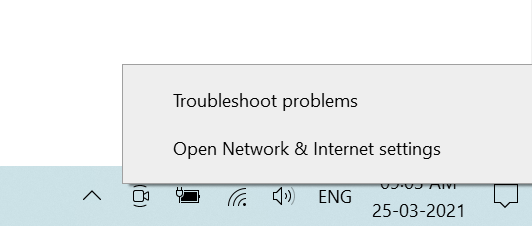
Right-click the Wi-Fi icon in the system tray and select Network & Internet settings, then open your Adapter options. Right-click your Wi-Fi connection, select Properties, and confirm the following are checked:
- Client for Microsoft Networks
- File and Printer Sharing for Microsoft Networks
- Internet Protocol Version 4 (TCP/IPv4)
- Internet Protocol Version 6 (TCP/IPv6)
If you had to check any of these, restart your computer afterwards.
9. Disable IPv6 Temporarily
IPv6 is the newer internet addressing protocol, but it occasionally causes connectivity issues that IPv4 doesn’t.
In the same adapter Properties window from the step above, uncheck Internet Protocol Version 6 (TCP/IPv6), leave IPv4 checked, and click OK.
If this fixes your connection, you can leave IPv6 disabled. Most home networks function fine on IPv4 alone. Re-enable it later if you notice other issues.
10. Disable Your VPN
VPN apps, particularly their built-in “kill switch” features, designed to cut your internet if the VPN connection drops, are a well-documented cause of this exact error.
Disconnect or fully quit your VPN app, then try reconnecting to Wi-Fi directly. If that resolves it, check for a VPN app update, or try connecting to a different VPN server.
11. Check Your Antivirus or Firewall Software
Some third-party antivirus and firewall tools include network-filtering features that can misidentify a network as unsafe and block traffic, even when nothing is actually wrong.
Temporarily disable your antivirus’s firewall or network protection component (not the whole antivirus) and test your connection. If it resolves the issue, check for an update or add an exception for your network within the antivirus settings.
Related: Secure Your PC With Dynamic Lock in Windows
12. Uninstall Recently Installed Software
If the error started shortly after installing a new app, particularly Wi-Fi sharing tools, network utilities, or other VPN-adjacent software. Uninstall it and restart your PC.
These tools sometimes install virtual network adapters that conflict with your real Wi-Fi connection.
Advanced Fixes
13. Reset Winsock
Winsock (Windows Sockets API) governs how your PC’s applications communicate over the network. A corrupted Winsock catalogue can trigger this exact error.
Open Command Prompt as Administrator and run:
netsh winsock reset
Restart your PC after the command completes.
14. Renew Your IP Address and Flush DNS
This refreshes your PC’s IP address and clears any stale DNS records that might be causing the issue.
Open Command Prompt as Administrator and run these commands one at a time:
ipconfig /release
ipconfig /renew
ipconfig /flushdns
15. Change Your DNS Server
Your Wi-Fi connection normally uses the DNS server provided automatically by your ISP, but a misbehaving ISP DNS server can itself cause connectivity errors. Switching to a public DNS server often fixes this.
- Open your Wi-Fi adapter Properties (see step 8 above).
- Double-click Internet Protocol Version 4 (TCP/IPv4).
- Select Use the following DNS server addresses.
- Enter
8.8.8.8and8.8.4.4(Google DNS), or1.1.1.1and1.0.0.1(Cloudflare DNS). - Click OK and restart your connection.
Last Resort: Full Network Reset
If nothing above has worked, a complete network reset will remove and reinstall all network adapters and restore every network setting to its Windows default.
- Windows 11: Settings > Network & Internet > Advanced network settings > Network reset > Reset now.
- Windows 10: Settings > Network & Internet > Status > Network reset > Reset now.
Heads up: this removes all saved Wi-Fi passwords and any configured VPN connections. You’ll need to reconnect to your network and re-enter your Wi-Fi password afterwards, and reconfigure any VPN profiles.
Fix Comparison: What to Try First
| Situation | Recommended First Fix |
|---|---|
| Just started happening, no recent changes | Toggle Wi-Fi (Fix 1), then restart PC (Fix 2) |
| Started after installing a VPN or new app | Disable VPN (Fix 10) or uninstall the app (Fix 12) |
| Weak signal / far from router | Move closer to router (Fix 3) or add a Wi-Fi extender |
| Happens on all your devices | Restart your router; see “If Multiple Devices Are Affected” above |
| Only happens on this one PC, tried the basics | Update network driver (Fix 7), then run Network Troubleshooter (Fix 6) |
| Nothing else has worked | DNS change (Fix 15), then full Network reset (last resort) |
Common Mistakes When Troubleshooting This Error
- Jumping straight to advanced fixes. Command-line resets and driver reinstalls are sometimes unnecessary. A simple restart or Wi-Fi toggle resolves this error more often than people expect.
- Forgetting to check other devices first. Spending 20 minutes on Windows-specific fixes when the actual problem is your router wastes time you didn’t need to spend.
- Disabling IPv6 permanently without noting it. If you disable IPv6 to fix this error, remember you did. It can occasionally cause unrelated issues on newer networks or smart-home devices down the line.
- Not restarting after driver or Winsock changes. Several of these fixes only take effect after a full restart. Closing and reopening apps isn’t enough.
- Running a full network reset too early. It works, but it also wipes every saved Wi-Fi password and VPN profile on your PC. It is worth trying only after the fixes above haven’t helped.
When to Call Your ISP Instead
If you’ve restarted your router, confirmed other devices on the network also can’t get online, and the issue persists after 15–20 minutes, the problem is very likely on your internet provider’s end rather than anything fixable on your PC.
At that point, contacting your ISP’s support line or checking their app or website for an outage map is a more productive use of your time than continuing to troubleshoot Windows settings that were never the actual cause.
Related: How to Fix the ” Windows could not automatically detect this network’s proxy settings ” Error?
Conclusion
The “No Internet, Secured” error looks alarming, but it’s rarely a sign of anything seriously wrong. In the vast majority of cases, it’s a stuck VPN, an outdated driver, a bad IP or DNS configuration, or simply a router that needs a restart.
Work through the fixes above roughly in order, starting with the quick ones, and you should be back online well before you reach the advanced fixes.
If you’ve worked through every fix here and you’re still seeing the error, it’s worth checking whether the issue follows your PC to a different network (a coffee shop, a friend’s house, a mobile hotspot).
If it does, the fault is genuinely on your computer, and a fresh driver reinstall or Windows update is the next step. If the PC connects fine elsewhere, the problem was always your home network, not your PC.
Related: First 10 Things to Do After Installing Windows
Frequently Asked Questions
It means your PC has successfully connected to a Wi-Fi network (the “Secured” part confirms the password worked), but that network isn’t passing data through to the actual internet. So you’re connected locally but not online.
They’re closely related variations of the same underlying issue. Your PC is on the local network but can’t reach the internet. The exact wording depends on your Windows version and whether the network uses a password (secured) or not.
Signal strength (bars) only reflects the connection to your router, not whether your router itself has internet access. You can have full signal bars and still see this error if your router has lost its connection to your ISP.
Often, yes. Especially if other devices on the same network are also affected. A router restart clears temporary connection issues with your ISP and is one of the most reliable single fixes for this error.
Only if disabling it actually fixed your issue, and even then, it’s better treated as a workaround than a permanent setting. Re-enable it if you later run into unrelated network issues, since some newer devices and services rely on it.
Yes. This is one of the most common causes. Many VPN apps include a “kill switch” that deliberately blocks all internet traffic if the VPN connection drops, which shows up in Windows as exactly this error.
No. A network reset only affects network-related settings: Wi-Fi passwords, adapter configurations, and VPN profiles. It does not touch your personal files, installed applications, or other system settings.
Check whether other devices on the same Wi-Fi network can access the internet. If they can and only your PC can’t, the issue is on your PC. If none of your devices can get online, the issue is almost certainly your router or ISP.
Recurring instances usually point to a specific root cause rather than a one-time glitch; commonly an unstable network driver, a VPN app with a persistent kill-switch bug, or a router that periodically drops its WAN connection. If it recurs frequently, focus on driver updates and checking your router’s connection logs.
It’s far less common over Ethernet, since a wired connection removes signal-strength and Wi-Fi-driver variables from the equation. If you see this error over Ethernet, the cause is more likely to be your router, modem, or ISP than your PC’s network adapter.
Toggling your Wi-Fi connection off and back on, followed by a full PC restart, resolves this error for a large share of users without needing any of the more advanced fixes.
Yes, it’s a widely used and safe alternative. Public DNS services like Google DNS and Cloudflare DNS are reliable, often faster than ISP-provided DNS, and commonly recommended specifically to resolve connectivity errors like this one.
We hope you are interested in this article and consider following Infobits on Facebook, Instagram, and Twitter for more troubleshooting guides like this.
Also, share this article with your friends and relatives.
Subscribe to our free newsletter to receive similar articles and regular updates directly in your Email Inbox.
Subscribe to be the first to learn about new information
Disclosure: If you follow our links to a retailer’s website and make a purchase, we will get an affiliate commission on some, but not all, of the items or services we promote. This will cause no price change for you.