
How to Test a Linux Distribution Online Without Installing
Picking a Linux distro used to mean downloading a 2–4 GB ISO, burning it to a USB drive, and rebooting your PC just to see if you liked the desktop. Do that five or six times while “distro hopping,” and you’ve burned an entire weekend.
There’s a simpler way. Websites like DistroTest.net let you boot a real Linux system inside your browser tab, poke around for half an hour, and close the tab when you’re done. Nothing touches your hard drive.
In this guide, I’ll walk you through exactly how DistroTest works in 2026, what its real limitations are (including a few things older tutorials don’t mention), and which alternatives are worth bookmarking if DistroTest is slow or unavailable when you need it.
Quick Answer: How to Test Linux Online in 3 Steps
- Go to distrotest.net and pick a distribution from the A–Z list.
- Choose the version you want and click Start.
- Wait for your slot, then use the distro live in your browser (or connect via a VNC client).
That’s the whole process. The rest of this guide covers the details, the catches, and what to do if DistroTest isn’t cooperating.
Related read: Best OS for Low-End PCs in 2026
What Is DistroTest?
DistroTest is a free, browser-based service that lets you test Linux and Unix operating systems without downloading or installing anything. It’s been around since the early 2010s and has introduced thousands of curious users to their first Linux desktop.
Instead of running a virtual machine on your own computer, DistroTest boots the distro on its own servers using QEMU (an open-source machine emulator) and streams the screen to you over a remote-desktop connection. Similar to how TeamViewer or AnyDesk work, just built specifically for testing operating systems.
You get a genuinely usable session. Install and remove packages, create or delete files, poke around the file manager, and generally treat it like a real machine. Because for that half hour, it is one.
A quick note on reliability: DistroTest has had rough patches over the years, including stretches where the site went down for extended periods and some users assumed it had shut down for good.
As of writing, the site is back online and functional, but the homepage’s “Top 10” list still shows some fairly old builds, which suggests it isn’t updated as actively as it once was. If it’s unresponsive when you try it, jump to the alternatives section below. DistroSea has become the more consistently reliable option in 2026.
How Does DistroTest Actually Work?
When you click Start next to a distribution, DistroTest spins up a virtual machine on its own servers with that OS already installed or ready to boot. You’re not downloading anything; you’re remotely controlling a computer that isn’t yours.
A few practical details worth knowing before you dive in:
- Session length: Most sessions run for around 30 minutes, and some setups let you extend by another 15 minutes if no one else is waiting.
- No internet access inside the VM: This trips up a lot of first-time users. DistroTest disabled internet access inside the test sessions after people misused it, so you won’t be able to update packages or browse the web from within the test OS. If you specifically need to test app installation or online features, this is a real limitation.
- Real changes, temporary machine: You can genuinely delete files, format the virtual disk, or install software. But the whole VM resets once your session ends, so none of it persists.
- Performance depends on load: Response time is tied to how many people are using the service and your own internet connection. Slow connections make dragging windows and typing feel laggy.
Step-by-Step: How to Use DistroTest in Your Browser
Step 1: Open the Official Website
Go to the official DistroTest website. You’ll land on a homepage listing every supported distribution alphabetically, along with a “Top 10” panel showing what’s currently popular among testers.
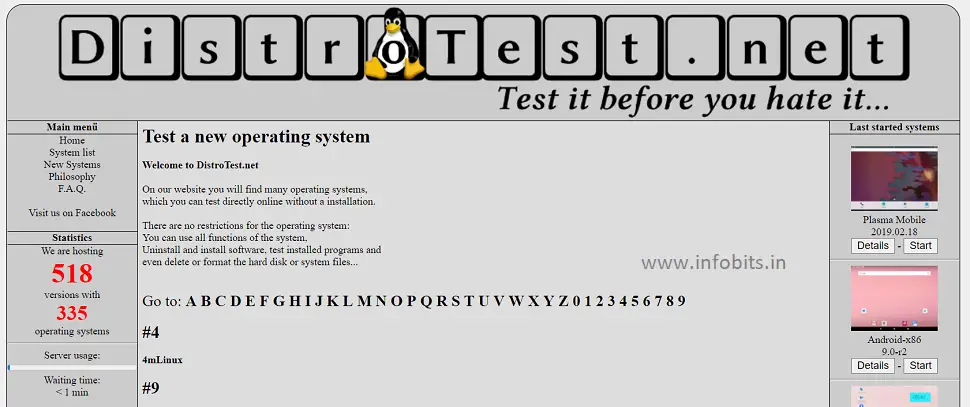
Step 2: Pick a Distribution and Version
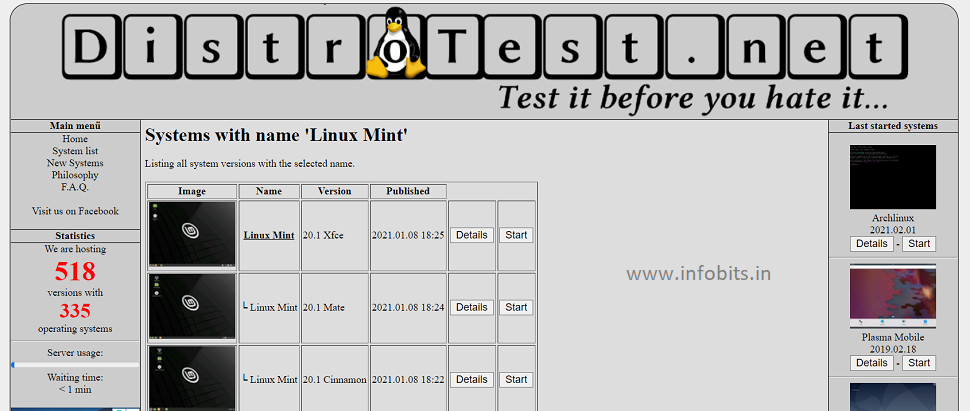
Click on the distro you want. Say, Linux Mint or Zorin OS. You’ll see a list of available versions, since most distros have several builds (different desktop environments, releases, or architectures) listed on DistroTest.
Always pick the newest version available unless you have a specific reason to test an older release. Each entry shows Details and Start buttons.
Step 3: Click Start and Wait Your Turn
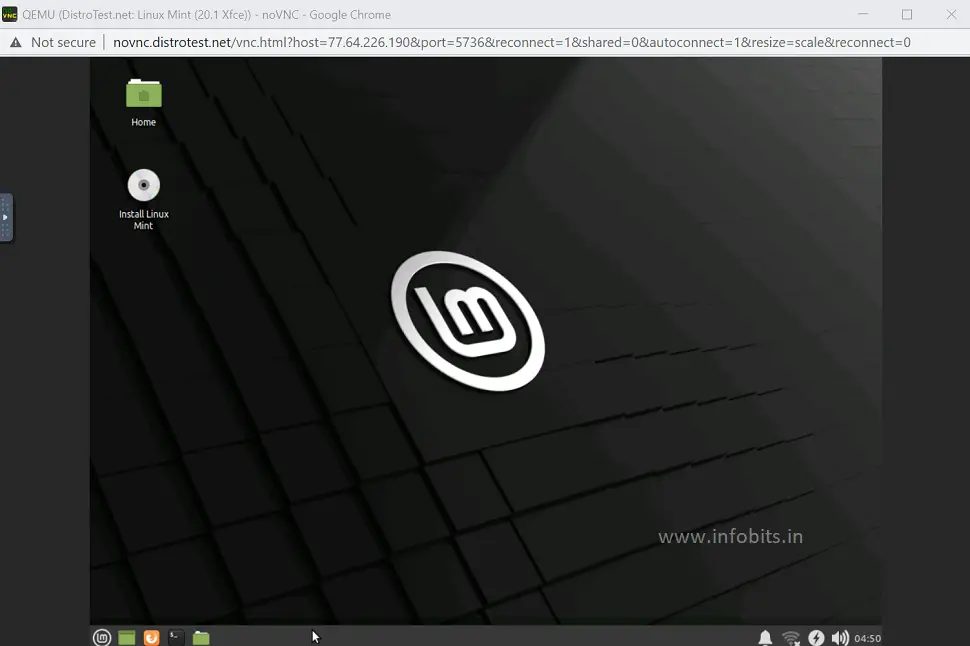
Hit Start, and a new browser window opens. If the servers are busy, you’ll see a queue position. Response time depends entirely on how many people are testing distros at that moment.
Step 4: Use the Distro Live
Once connected, the distro boots just like it would on real hardware. Follow any on-screen setup prompts, then start exploring: open the file manager, check the app menu, try the settings panel, and get a feel for how the desktop behaves.
Step 5: Use a VNC Client Instead (Optional)
If the in-browser session doesn’t work well on your device, DistroTest shows the server address and port for that session so you can connect using any standard VNC client (like RealVNC or TigerVNC) instead of the browser window.
This tends to feel smoother on older or slower computers, since a dedicated VNC client is lighter than a browser tab.
Beginner-Friendly Distros Worth Testing First
If you’re new to Linux, don’t start with something technical like Arch. These four are designed to work well right out of the box, and they’re a great way to get comfortable with DistroTest itself before testing anything more advanced.
Linux Mint (Cinnamon): The default layout feels familiar to anyone coming from Windows, with a taskbar, start menu, and system tray in roughly the same places. It’s built on Ubuntu, so it inherits Ubuntu’s massive software library.
Ubuntu: One of the most widely used distros in the world, and the one most laptop manufacturers pre-install when they ship with Linux. The interface is approachable, and there’s no shortage of tutorials if you get stuck.
Elementary OS: Closer to macOS in feel, with clean typography and a dock-based layout. It’s Ubuntu-based underneath, so compatibility isn’t usually an issue.
Zorin OS: Another Ubuntu-based distro, and one specifically designed to ease the transition from Windows or macOS. The Core edition is free, and the Lite edition runs well on older hardware if you’re testing this because you have an ageing laptop to revive.
DistroTest vs. DistroSea vs. OnWorks
DistroTest isn’t the only option anymore. Here’s how the main three compare if you’re deciding where to spend your 30 minutes.
| Feature | DistroTest | DistroSea | OnWorks |
|---|---|---|---|
| Distro count | 300+ (some listings outdated) | 80+ (actively maintained) | Fewer, but includes installed VMs |
| Internet access in session | No | No | Limited, on some systems |
| Underlying tech | QEMU + remote desktop | Quickemu + noVNC | Browser-based VM hosting |
| Reliability in 2026 | Inconsistent; history of downtime | Generally reliable | Generally reliable |
| Best for | Widest distro selection | Quick, dependable testing | Testing with light internet use |
Bottom line: Try DistroTest first if you want access to obscure or older distros. If it’s slow or down, DistroSea is the better bet for mainstream distros like Ubuntu, Fedora, Debian, Arch, and Mint.
Common Mistakes to Avoid
- Expecting internet access inside the test session. It’s disabled on most of these platforms, so you can’t test cloud sync, browsing, or online app installs this way.
- Judging real-world performance from a laggy remote session. A slow test session often reflects server load or your connection, not how the distro actually performs on real hardware.
- Testing on a poor internet connection. Streaming a remote desktop needs a stable connection; on patchy Wi-Fi or mobile data, even a great distro will feel sluggish. [Affiliate Opportunity]
- Assuming your hardware will behave the same way. DistroTest and similar tools run generic virtual hardware, so they won’t tell you if your specific Wi-Fi card, GPU, or touchpad will work properly. For that, you still need a live USB on your actual machine.
- Forgetting to check the version date. Some distros listed have older builds; check the version number against the distro’s official site if you want to test the latest release.
Myth vs. Fact
Myth: “If it runs well on DistroTest, it’ll run well on my laptop.” Fact: DistroTest runs distros on its own server hardware and streams the screen to you. Your actual performance depends on your PC’s specs, not the test session’s speed.
Myth: “DistroTest lets you try any Linux distro that exists.” Fact: It only hosts distros the maintainers have added. Newer or niche distributions may not be available yet.
Myth: “Testing online is the same as installing it.” Fact: It’s close, but you can’t test Wi-Fi drivers, GPU acceleration, battery behaviour, or peripheral support this way. Those only show up on real hardware or a live USB.
When You Should Use a Live USB Instead
Online testing is great for a quick look at the desktop, apps, and overall feel of a distro. But if you’re deciding whether to actually switch, a live USB session on your own machine will tell you things DistroTest can’t:
- Whether your Wi-Fi and Bluetooth work out of the box
- Real battery life and thermal behaviour
- How responsive the desktop feels on your actual hardware
- Whether your external monitor, printer, or webcam is detected
If you’re at that stage, a good 64GB USB 3.0 flash drive (available on Amazon) and a free tool like Rufus or Balena Etcher will get you there in about ten minutes.
Related: How to Install Windows From a USB Drive? Step-by-Step Guide
Best DistroTest Alternatives in 2026
If DistroTest is down, overloaded, or just doesn’t have the distro you want, these are solid substitutes:
DistroSea: The most actively maintained alternative right now, covering 80+ mainstream and niche distros including Ubuntu, Debian, Arch, Fedora, openSUSE, Kali, Manjaro, and Pop!_OS. It uses Quickemu and noVNC under the hood and tends to load faster than DistroTest during peak hours.
OnWorks: A smaller catalogue, but some of its systems are installed VMs rather than live-boot images, and a few offer limited internet access. It is useful if you specifically need to test package installation online.
A local virtual machine: If you’re testing repeatedly, installing VirtualBox (free) on your own PC and downloading a couple of ISOs gives you unlimited time, real internet access, and no queue. It takes longer to set up but pays off if you’re comparing five or six distros over a weekend.
Troubleshooting: DistroTest Not Working?
Site won’t load or times out: DistroTest has a history of intermittent downtime. Wait a few minutes and retry, or switch to DistroSea in the meantime.
Stuck in a long queue: Try during off-peak hours (early morning or late night, IST) when fewer users worldwide are testing distros simultaneously.
Black screen after clicking Start: This usually means the VM is still booting. Give it 20–30 seconds before assuming something’s wrong; if it persists, refresh and start a new session.
Keyboard layout not switching correctly: Some users have reported that manual keyboard layout commands don’t take effect inside DistroTest sessions. If you rely on a non-US layout, this is worth testing early in your session rather than assuming it’ll work.
No sound or internet: This is expected behaviour on DistroTest, not a bug. Audio support is inconsistent across builds, and internet access is disabled by design.
Frequently Asked Questions
Yes, DistroTest is completely free, with no account or payment required to test any distro on the site.
No. Everything runs on DistroTest’s servers, and you interact with it through your browser or an optional VNC client; nothing is installed on your computer.
Most sessions run for around 30 minutes, with an option to extend if the server isn’t busy with other users.
No. Internet access inside test sessions is disabled to prevent misuse, so you can’t browse the web or update packages during your session.
Yes. You’re interacting with a temporary virtual machine on DistroTest’s servers, not your own computer, so nothing you do inside the session affects your actual PC.
No. The virtual machine resets once your session ends, so any files, installs, or settings changes are lost.
Performance depends on current server load and how many people are testing distros at the same time, along with your own internet connection speed.
No, DistroTest is focused on Linux and Unix-based operating systems, not Windows.
Not always. Some listings on the homepage reflect older builds, so it’s worth checking the distro’s official website if you specifically want the newest release.
It can be, especially on older or slower devices, since a dedicated VNC client is generally lighter than running everything inside a browser tab.
Availability varies by platform. DistroSea specifically markets support for server-oriented distros like CentOS Stream and Rocky Linux, while DistroTest’s catalogue leans more toward desktop distributions.
No. Online testers use generic virtual hardware, so hardware compatibility ( Wi-Fi, GPU, touchpad) needs to be checked with a live USB on your actual machine.
Technically yes, since it runs in a browser, but the experience is much better on a laptop or desktop with a keyboard and mouse.
Absolutely. Distros like Linux Mint, Ubuntu, and Zorin OS are designed to be usable without typing a single terminal command.
Historically, DistroTest has advertised 300+ distributions across 1,000+ versions, though not every listing is actively updated.
Yes, within the session, but since there’s no internet access, you’re generally limited to software that’s already bundled with the ISO.
It depends on your needs. DistroSea currently offers more consistent uptime and a cleaner interface, while DistroTest still has a wider (if less current) distro catalogue.
No. Since the actual distro runs on DistroTest’s servers, your device just needs a modern browser and a stable internet connection.
Online testing is faster to set up and requires no downloads, but a live USB reflects your actual hardware’s performance, battery life, and driver compatibility. Something no browser-based tester can replicate.
Conclusion
DistroTest pioneered browser-based distro testing, and it’s still worth trying for its sheer breadth of options; 300-plus systems is hard to match. But its uptime has been inconsistent over the years, so it’s smart to keep an alternative like DistroSea bookmarked as a backup.
Either way, spending 30 minutes testing a distro online before committing to an install is one of the smartest habits a new Linux user can build. It turns “which distro should I pick?” from a guessing game into something you can actually see for yourself, before you touch your own hard drive.
We hope this guide helped. Follow us on Facebook and Twitter for more how-tos like this.
Subscribe to our free newsletter to receive similar articles and regular updates directly in your Email.
Subscribe to be the first to learn about new information
Disclosure: If you follow our links to a retailer’s website and make a purchase, we will get an affiliate commission on some, but not all, of the items or services we promote. This will cause no price change for you.