No-Cost EMI Explained: How It Really Works on Amazon and Flipkart
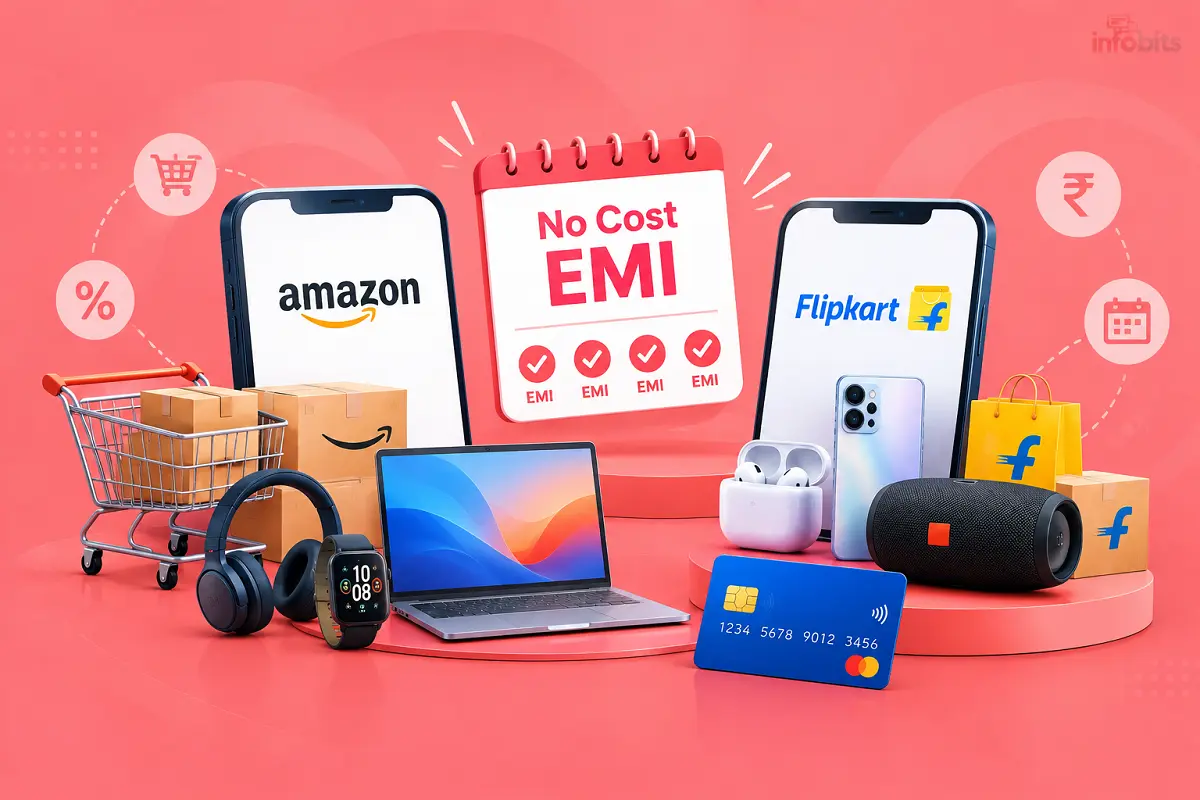
“No-cost EMI” sounds like free money. You pay the same price, just in monthly parts, with no interest. But banks don’t lend for free, so someone is paying for that interest.
Before I tap the No-Cost EMI option, I ask one question: what would I pay if I bought this in full? That single check has changed my decision more than once. This guide shows you how to run the same check.
The timing matters. Amazon’s Great Indian Festival starts on October 8, 2026, and Flipkart’s Big Billion Days opens on October 9, with early access from October 8 for eligible members. Both will push no-cost EMI hard.
Quick answer: No-cost EMI is a payment option where you repay the product’s price in equal monthly instalments with no visible interest. The bank still charges interest, but the seller gives you an upfront discount that cancels it out. You still pay 18% GST on that interest, and sometimes a processing fee. You may also lose other discounts you’d get by paying in full.
Important Note: This guide is general information, not financial advice. Check your own card’s terms before you buy.
What is no-cost EMI?
No-cost EMI (equated monthly instalment) lets you pay for a product in equal monthly parts without any visible interest. It’s offered mostly on credit cards, some debit cards and “pay later” services, and it’s common on phones, laptops, TVs and appliances.
The name is slightly misleading. “No-cost” means the interest is not added to your price. It doesn’t mean there are zero charges.
How no-cost EMI works, step by step
Here’s what happens behind the scenes.
- You pick a product and choose No-Cost EMI at checkout, usually for 3, 6, 9 or 12 months.
- The bank works out the interest it would charge on your loan.
- The seller reduces the product price by that exact interest amount, shown as an instant discount.
- The bank lends you the lower price and charges you interest on it.
- Your total repayment to the bank ends up equal to the original price.
Amazon explains it the same way. Under a no-cost EMI offer, the interest is already adjusted in the order price, so the total you pay the bank equals the product price.
Longer tenures mean more interest, so the seller has to fund a bigger discount. That’s why no-cost EMI is usually limited to shorter tenures.
Is no-cost EMI really “zero interest”?
No. The Reserve Bank of India said in a 2013 circular that zero-percent interest doesn’t truly exist and is a marketing idea. Interest is always there. The seller’s discount just pays for it on your behalf.
So the honest description is: the interest is hidden inside a discount you were given.
Where the real cost hides
| Hidden cost | What it means | Who pays |
|---|---|---|
| 18% GST on interest | The bank charges GST on the interest part. The discount doesn’t cover it | You |
| Processing fee | Some banks and lenders add a one-time fee, plus GST | You |
| Lost upfront discounts | Cash or card offers may not apply with EMI | You (as lost savings) |
| Blocked credit limit | The full amount reduces your available limit | You (as reduced flexibility) |
| Foreclosure charges | Some options charge a fee if you close early | You |
| Late fees and penalty interest | Missed EMIs cost extra | You |
GST is the most common surprise. Several finance guides confirm that the 18% tax applies to the interest component and isn’t offset by the discount.
A worked example
These numbers are illustrative, but the method is real. You’re buying a ₹30,000 phone on a 6-month no-cost EMI at an assumed bank rate of 15% a year.
| Item | Amount |
|---|---|
| Listed price | ₹30,000 |
| Interest the bank will charge | about ₹1,270 |
| Instant “no-cost EMI” discount | about ₹1,270 |
| Price you’re financing | about ₹28,730 |
| Total repaid to the bank (price + interest) | ₹30,000 |
| 18% GST on interest | about ₹229 |
| Your real total | about ₹30,229 + any processing fee |
So the monthly instalment looks like ₹5,000, but you pay roughly ₹38 more a month on average as GST.
Now compare this with paying in full. Say your bank offers a 10% instant discount on full payment (capped, as these usually are). You’d pay about ₹27,000 instead of ₹30,229. The no-cost EMI would cost you over ₹3,000 more.
The EMI wasn’t expensive on its own. The cost came from the discount you gave up.
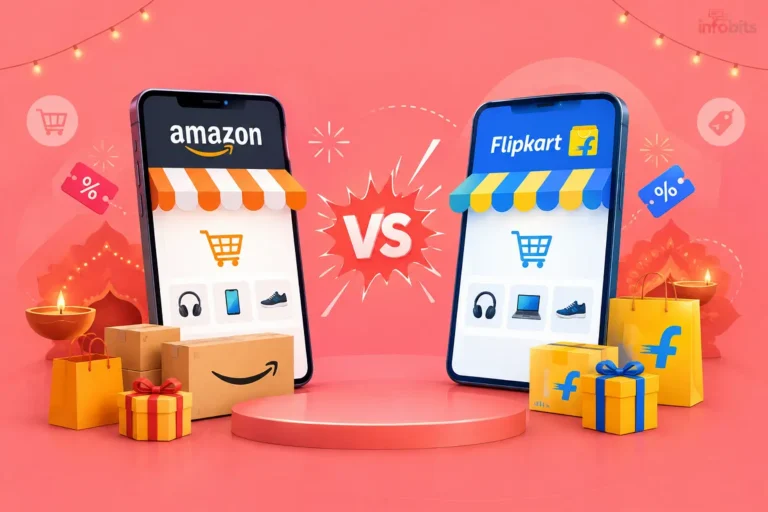
Amazon vs Flipkart: How no-cost EMI differs
| Feature | Amazon India | Flipkart |
|---|---|---|
| Typical tenures | 3, 6, 9, 12 months | 3, 6, 9, 12 months |
| Payment options | Credit cards, some debit cards, Bajaj Finserv, Amazon Pay Later | Credit cards, debit cards, Flipkart EMI, Flipkart Pay Later |
| How the interest is handled | Shown as a discount at checkout | Shown as a discount at checkout |
| Credit limit | Full order amount is blocked on cards | Full order amount is blocked on cards |
| Returns | Handled through the lender or bank | Handled through the lender or bank |
Tenures and partners change between sales, so always check the checkout screen. Banks and lenders also decide which products and tenures qualify.
Two details are worth knowing. First, for card EMIs, Amazon says your bank blocks your credit limit by the full purchase amount. For example, an ₹18,000 purchase blocks ₹18,000 of limit on a 9-month plan. Second, the limit is released gradually as you repay.
What the 2026 festive sales are offering
Amazon has announced that the Great Indian Festival starts on October 8, 2026, with a 10% SBI instant discount and extra benefits for Prime members. Amazon hasn’t announced an end date.
Flipkart’s Big Billion Days main sale starts on October 9. Early access opens at midnight on October 8 for eligible Flipkart Plus, Black and co-branded credit card members.
Early reports say Flipkart will pair no-cost EMI with a flat ₹1,000 discount on Flipkart EMI and ₹500 on Pay Later. Credit limits vary by user, so confirm yours in the app. Final terms only become clear once each sale goes live.
For live deals, see our pages on Amazon offers and Flipkart Big Shopping Days.
No-cost EMI vs standard EMI vs paying upfront
| Pay upfront | No-cost EMI | Standard EMI | |
|---|---|---|---|
| Interest | None | Covered by a discount | You pay it |
| GST on interest | None | Yes, 18% | Yes |
| Bank/card discount | Often available | Often limited or unavailable | Varies |
| Cash flow | Money leaves at once | Spread over months | Spread over months |
| Credit limit | Not blocked | Blocked | Blocked |
| Best for | Buyers with spare cash | Buyers who want to keep cash free | Rarely the best choice |
Is no-cost EMI worth it? A decision guide
| Your situation | What to do |
|---|---|
| You have the cash and a good upfront bank offer | Pay in full |
| You’d have to break an FD or investment to pay upfront | No-cost EMI may be better |
| The EMI price matches the upfront price exactly | EMI is a small cost for flexibility |
| The EMI price is higher than the upfront price | Skip it |
| You’re stretching your budget to afford the product | Don’t buy yet |
| You may miss a payment | Avoid EMI. Late fees can wipe out any benefit |
One financial expert quoted in Business Standard makes a useful point. If paying upfront means breaking an investment that earns more than the discount, no-cost EMI can make sense even without the lump-sum discount.
But don’t let a discount decide what you can afford. Late fees and penalty interest can be bigger than the savings.
If you’re paying off a phone over 12 months, protect it. A tough case and a tempered glass guard cost very little compared with paying instalments on a damaged screen.
What happens if you return or cancel the product?
This is the part most guides skip. Return rules depend on how you paid.
If you paid with a Bajaj Finserv card or Amazon Pay Later, Amazon says the lender cancels the loan if you haven’t paid the first instalment. If you’ve paid, the instalments are refunded, and Amazon says there’s no foreclosure charge for those options.
For bank credit cards, the process can take longer. Ask your bank to reverse the interest, GST and processing fee when the refund arrives. Check your next statement to confirm.
If you pay off early on your own, some bank EMI options charge foreclosure fees. Ask before you commit.
How no-cost EMI affects your credit
Your credit card EMI blocks your limit. The full amount counts as used until you repay it.
A high utilisation can lower your credit score for a while. It’s not a permanent problem, but it matters if you plan to apply for a home or car loan soon.
Common mistakes to avoid
- Assuming “no-cost” means no charges at all.
- Not comparing the EMI price with the pay-in-full price.
- Forgetting that the full amount blocks your card limit.
- Choosing a long tenure just to get a smaller monthly number.
- Missing one instalment and paying late fees.
- Not checking whether your bank’s instant discount works with EMI.
- Stacking multiple EMIs on one card until the limit runs out.
Warning signs to watch for
- The EMI price is higher than the pay-in-full price.
- A processing fee appears only at the last step of checkout.
- The bank says the interest discount isn’t applied after the order.
- Offers that seem to hide the total payable amount.
- Calls or links asking you to “activate” your EMI with an OTP.
Myth vs fact
| Myth | Fact |
|---|---|
| No-cost EMI means zero interest | The interest exists. A discount cancels it out |
| It costs nothing extra | GST on interest and processing fees can apply |
| It’s always better than paying upfront | Not if you lose a bigger upfront discount |
| EMI doesn’t affect my card limit | The full amount is blocked |
| All products and banks offer it | Eligibility is decided by the seller and the bank |
Expert tips
- Compare the final payable amount. Ignore the EMI size. Look at the total.
- Pick the shortest tenure you can afford. It usually means lower GST.
- Check the offer terms of your card. Instant discounts often have separate EMI rules.
- Screenshot the checkout page. It helps if you need to dispute charges later.
- Look at the price history first. A fake sale price makes any EMI look better than it is. Our guide to tracking Amazon price history shows how.
Troubleshooting
The EMI option isn’t showing. Your card or bank may not be eligible for that product. Try another card, tenure or Pay Later.
The bank charged interest on my statement. That’s normal. The discount you got at checkout offsets it. Check that the numbers match.
The EMI wasn’t converted. Some banks convert the purchase into EMI only after a few days. Contact the bank before the due date.
My refund is delayed. Contact the lender (for Pay Later or Bajaj Finserv) or your card bank. Keep your order ID ready.
I’m being charged GST every month. This is expected because GST applies to the monthly interest part.
Stay safe: EMI scams and fake apps
Scammers love sale seasons. Never share your OTP, CVV or card PIN with anyone claiming to “activate” your EMI.
Use only the official Amazon and Flipkart apps. Be careful with unknown “instant loan” apps. Read our guides on fake loan apps and how to protect your bank account from hackers.
A TV, fridge or AC you’re paying off for months deserves protection from power surges. A good voltage stabiliser or surge protector is a small add-on that protects a big purchase. Read our explainer on whether a stabiliser is needed for an LED TV first.
Some product pages on Amazon also offer an optional extended warranty or protection plan. If you’re buying an expensive appliance on EMI, it’s worth reading what onsite warranty actually means before adding one.
Your pre-checkout checklist
- [1] I know the pay-in-full price, after the best bank offer.
- [2] I’ve compared it with the final EMI total, including GST.
- [3] I’ve checked for a processing fee.
- [4] I’ve confirmed my card limit can handle the blocked amount.
- [5] I picked the shortest tenure I can afford.
- [6] I know the return and foreclosure rules for my payment method.
- [7] I’ve set a reminder for every instalment.
Planning a laptop on EMI? Our guide to the best laptops for students and our laptop buying guide help you choose first, so the EMI is for the right machine.
Conclusion
No-cost EMI isn’t a trick, but it isn’t free either. It’s a financing option with a discount that covers the interest, and you still bear the GST and any lost offers.
Check the final amount, compare it with paying in full, and pick the shortest tenure you can manage. Then buy when the numbers work for you, not when the sale banner makes you hurry.
Frequently Asked Questions
It’s a payment option where you repay the product’s price in equal monthly instalments with no visible interest. The seller’s discount covers the bank’s interest.
Not completely. You still pay 18% GST on the interest, and sometimes a processing fee. You may also lose other discounts.
The bank charges interest as usual, and Amazon shows that interest as an instant discount at checkout. Your total payment to the bank equals the product’s price.
It works the same way. The interest is deducted as a discount at checkout, and you repay the lower price plus the bank’s interest in instalments.
The bank still charges interest, and 18% GST applies to that interest. The seller’s discount doesn’t cover the tax.
Some banks and lenders charge one, plus GST. Check it before you confirm the order.
Only if you don’t lose a bigger upfront discount. Compare the final total of both options.
Sometimes. Instant discounts often have separate rules for EMI transactions, so read your card’s offer terms.
It can indirectly. The full amount blocks your card limit, and high utilisation may lower your score temporarily.
Yes, on card EMIs. The limit is freed up gradually as you repay.
The loan is cancelled, or the instalments are refunded, depending on your payment method. For cards, ask your bank to reverse interest, GST and fees.
Often yes, but some banks charge foreclosure fees. Ask your bank before you do it.
Many major bank credit cards do, and some debit cards. Eligibility depends on the bank, product and tenure.
On some banks’ pre-approved debit card plans, yes. Your bank may block funds or use a pre-approved EMI limit.
Not exactly. Pay Later is a credit line from a lending partner, and it can offer no-cost EMI on some purchases.
Sellers fund the discount, so they limit it to selected products and shorter tenures.
You may pay late fees and penalty interest. These can easily cancel out the savings.
RBI has said that truly zero-interest schemes don’t exist. No-cost EMI works through a discount that offsets the interest.
Amazon’s Great Indian Festival starts on October 8, 2026. Flipkart’s Big Billion Days starts on October 9, with early access from October 8.
Add the discounted price, the bank’s interest, the GST on that interest and any fees. Then compare the total with your best pay-in-full price.
We hope you are interested in our articles and consider following our Facebook, Instagram, and Twitter pages for regular updates.
Also, share this article with your friends and relatives. Bookmark this page for future reference.
Subscribe to our free newsletter to get similar articles and regular updates directly in your Email Inbox.
Subscribe to be the first to learn about new information
Disclosure: If you follow our links to a retailer’s website and make a purchase, we will get an affiliate commission on some, but not all, of the items or services we promote. This will cause no price change for you.