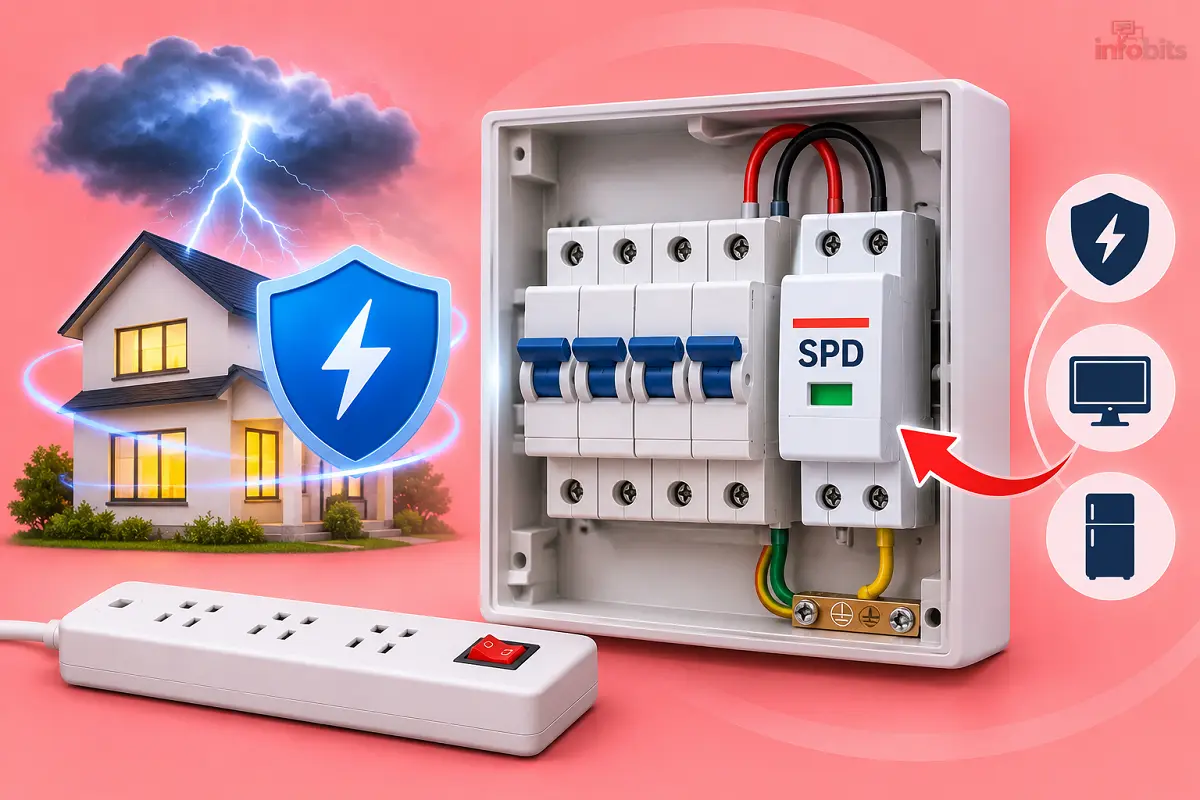
How to Install a Surge Protection Device (SPD) at Home: Step-by-Step Guide
Quick Answer: To install a home SPD, switch off and prove the supply dead (including inverter and solar feeds). Mount a Type 2 SPD and its backup MCB on the DIN rail next to the incomer. Wire phase through the backup MCB, neutral to the neutral bar, and the SPD’s PE terminal to the earth bar with 6 mm² copper. Keep all leads under about 0.5 m in total. Then restore power, confirm the green indicator and test your earthing. If the board is sealed, has no earth, or is three-phase, hire a licensed electrician.
A plug-in surge strip protects only what is plugged into it. Ceiling fans, ACs, LED drivers, the fridge circuit and your inverter are all hardwired, so an SPD at the distribution board (DB) is the only thing that covers them.
If you want to understand SPDs first, read our complete surge protector guide. This article covers installation only.
Is installing an SPD a DIY job?
It depends on your board and your skills. Use this table to decide.
| Situation | Who should do it |
|---|---|
| Single-phase DB with a free DIN-rail slot, working earth, plain MCB/RCCB layout | A competent person, or an electrician (you supervise) |
| Three-phase supply | Electrician |
| No earth, or earth is doubtful | Fix earthing first, using an electrician |
| SPD needs to go in the meter board or service cut-out | DISCOM or licensed contractor only |
| Old rewirable-fuse board or aluminium wiring | Electrician (consider upgrading the board) |
| Solar, inverter or DG changeover wired into the DB | Electrician |
Safety rules before you touch anything:
- Never open sealed meter boxes or the service cable side. That equipment belongs to the electricity board.
- Switch off the main switch, and also your inverter, solar and generator feeds. A home inverter can back-feed the DB even when the grid is off.
- Test the busbars and terminals you will touch with a multimeter. Do not trust the switch position.
- Wear insulated tools and work with dry hands on a dry floor.
- This is general guidance and not a substitute for a licensed electrician’s judgment on your wiring.
Tools and materials
- Type 2 SPD (single-phase 1P+N for most flats and houses)
- Backup MCB, usually single-pole, C-curve (the SPD datasheet decides the rating, commonly 20–32 A), like Schneider Electric Acti9 xC60 32 A 1-pole MCB available on Amazon.
- Copper wire: 4–6 mm² for phase and neutral leads, 6 mm² green/yellow for earth (FRLS)
- Ferrules or lugs, and a crimper (see on Amazon)
- Insulated screwdrivers (available on Amazon), preferably a torque screwdriver
- Digital multimeter and non-contact voltage tester like KAIWEETS Voltage Tester/Non-Contact Voltage Tester (view on Amazon)
- Earth resistance tester (to verify your earth, not a multimeter)
- Cable labels and cable ties
Choose the right SPD before you start
| Spec | What to pick for an Indian home | Why |
|---|---|---|
| Type | Type 2 (Type 1+2 if you have a lightning rod, an overhead service line, or live in a high-lightning area) | Type 2 is the standard DB-level protection |
| Poles | 1P+N for single-phase, 3P+N for three-phase | Protects line-to-neutral and neutral-to-earth |
| Uc (max continuous voltage) | 275 V standard, 320 V where grid swings are common | Higher Uc lasts longer on unstable supply but clamps slightly higher |
| Discharge current | In 20 kA, Imax 40 kA (8/20 µs) or higher | More headroom means longer life |
| Protection level (Up) | 1.5 kV or lower | Lower is better for sensitive electronics |
| Standard | IEC 61643-11 (many Indian makers also quote IS/IEC 61643-11) | Confirm on the datasheet |
| Design | Pluggable cartridges with a status window | You replace only the cartridge after it wears out |
Type 2 units from Schneider, Havells, Legrand, Hager and L&T are the usual choices. Avoid unbranded units with no datasheet.
How the SPD is wired
The SPD connects in parallel with the supply. Load current never flows through it. Three connections matter:
Main switch / incomer
   │
   ├──► RCCB ──► MCBs ──► your circuits
   │
   └──► Backup MCB (C-curve) ──► SPD  [L]
Neutral bar ───────────────────────► SPD  [N]
Earth bar ─────── (short, straight) ► SPD  [PE]
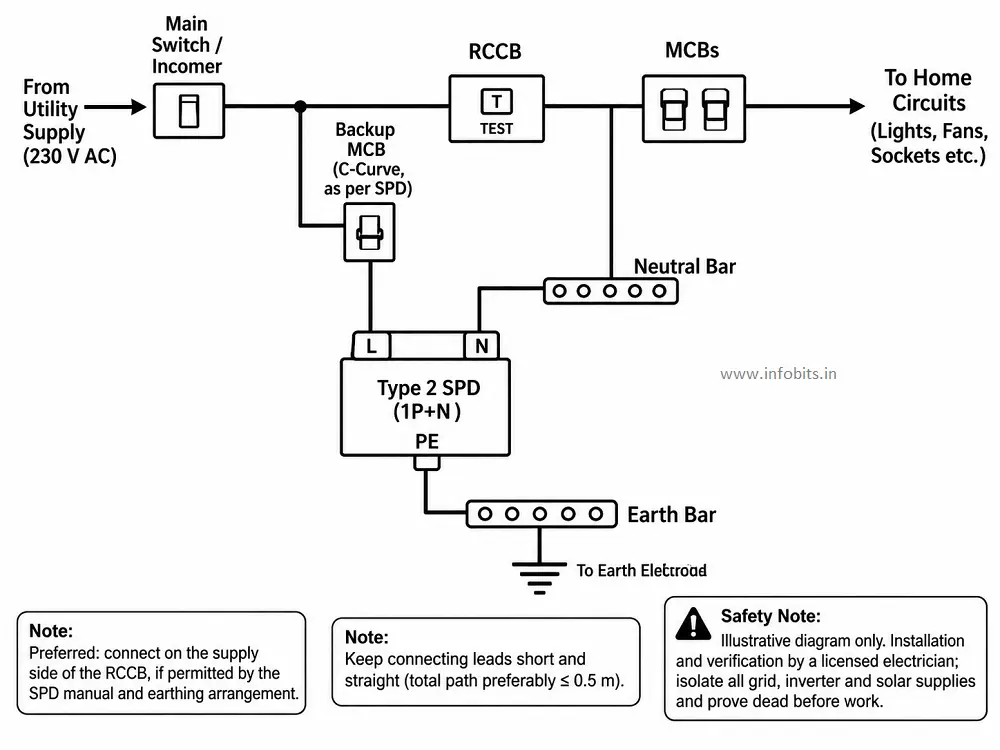
Where to tap in relative to the RCCB:
| Option | How it works | What to check |
|---|---|---|
| Upstream of the RCCB (preferred) | Tap on the supply side so surge current to earth never passes through the RCCB | Check the SPD manual allows it for your earthing arrangement |
| Downstream of the RCCB | Tap on the load side | Use a surge-proof or time-delayed (S-type) RCCB, or it may trip on every surge |
If you’ve ever wondered why your RCCB trips in a storm, see why RCCB trips when lightning strikes. When tapping supply-side, use a proper connector or busbar. Never double up two wires in one terminal that is rated for one.
Step-by-step installation (single-phase DB)
Step 1: Check the basics.
- Confirm you have a working earth.
- Confirm you have 2–4 free DIN-rail modules for the SPD plus 1–2 for the backup MCB.
- Read the SPD manual’s wiring diagram.
A rough earth check with a multimeter: phase-to-earth should read close to phase-to-neutral (about 230 V). Neutral-to-earth should be only a few volts at most.
This is a screening test only. A large neutral-earth voltage, or a phase-earth reading far below phase-neutral, means a call to an electrician before you go further.
Step 2: Isolate and prove dead.
- Switch off the main switch, inverter changeover, solar and any DG feed.
- Check that the non-contact tester stays silent on the busbars.
- Confirm 0 V with a multimeter between phase and neutral and between phase and earth.
- Put a “Do not switch on” tag on the main switch.
Step 3: Mount the SPD and backup MCB.
- Snap both onto the DIN rail as close to the incomer and the earth bar as possible.
- Short distance is the whole game, because every extra centimetre of lead adds voltage the SPD can’t clamp.
- Keep the SPD away from the load-side wiring if you can.
Step 4: Connect phase.
- Take the phase from the supply side (the incomer output) to the backup MCB’s input.
- Run the backup MCB’s output to the SPD’s L terminal.
- Strip about 10–12 mm of insulation, use a ferrule and tighten to the specified torque.
Step 5: Connect neutral.
- Connect SPD N to the neutral bar.
- Do not join neutral and earth together at the SPD. Mistaking the N and PE terminals is a known and dangerous error, and it can trip RCCBs or create hazards.
Step 6: Connect earth.
- Run 6 mm² green/yellow copper from SPD PE to the main earth bar by the shortest straight route.
- No coils, no sharp bends.
- Count the full lead path: phase lead + earth lead (+ the backup MCB path) should preferably total no more than about 0.5 m.
Step 7: Tidy and label.
- Tighten all terminals again.
- Label the backup MCB “SPD”.
- Check for stray strands.
Step 8: Restore power and read the indicator.
- Switch on the backup MCB, then the main.
- The SPD window should show green. Red or no colour means the SPD is faulty or wired incorrectly.
Testing after installation
| Test | How | Pass looks like |
|---|---|---|
| Status indicator | Look at the SPD window | Green |
| Terminal tightness | Switch off and re-check | No movement |
| Earth resistance | Use an earth tester, not a multimeter | As low as practicable, commonly 5 Ω or less. Ask your electrician for the measured value |
| Wiring insulation test | Disconnect the SPD first | An insulation tester can drive the SPD into conduction and give a false low reading |
| After-storm check | Look at the window after thunderstorms | Still green |
Check monthly in monsoon season, and after any nearby lightning strike or transformer fault. When a cartridge turns red, replace it. If the SPD is a non-pluggable type, replace the whole unit.
What it costs in India
| Item | Indicative cost |
|---|---|
| Type 2 1P+N SPD (home) | ₹1,200–₹4,500 |
| Type 1+2 SPD | ₹6,000–₹12,000 |
| Backup MCB (C32 single-pole) | ₹150–₹350 |
| Wire, ferrules, labels | ₹200–₹600 |
| Electrician labour | Varies by city and job. Get a quote |
| New earth pit (if needed) | Can add several thousand rupees. One owner’s full three-phase job came to about ₹21,000 |
Prices change quickly. Check current listings.
Common installation mistakes
- No backup MCB. If the SPD fails short, nothing disconnects it.
- Long, looped leads. They raise the voltage reaching your appliances even with a good SPD.
- Weak or missing earth. The SPD has nowhere to send the surge. See our surge protector guide for why earthing matters.
- Swapping N and PE. This can cause shorts and constant RCCB trips.
- Two wires in one terminal. Use a connector, busbar or the SPD’s second terminal.
- Forgetting the inverter or solar feed. The DB can stay live with the grid off.
- Mixing SPD ratings. A 3-phase 3P+N unit on a single-phase supply, or the wrong Uc, causes early failure.
- Megger testing with the SPD connected.
- Assuming the job is done forever. Cartridges wear out and need checking.
Myths vs facts
| Myth | Fact |
|---|---|
| “A plug-in surge strip protects the whole house.” | It protects only what is plugged into it. Hardwired loads need a DB-level SPD. |
| “Any wire will do for earthing the SPD.” | Use short, straight, 6 mm² copper. |
| “An SPD makes me safe from direct lightning.” | No SPD guarantees that. It reduces risk from grid and nearby-strike surges. See BLDC fan lightning protection. |
| “A UPS or inverter replaces an SPD.” | It does not. See inverter basics. |
| “I don’t need earthing if I have an SPD.” | The SPD depends on the earth. |
Final thoughts
A correctly installed Type 2 SPD costs a few thousand rupees and covers every circuit in the house.
The three things that decide whether it works are a good earth, short leads and a proper backup MCB. If any of these is uncertain on your board, pay an electrician for an hour. It is cheaper than a burnt-out fridge or fan.
Frequently Asked Questions
If you are a competent person with a single-phase DB, a free DIN slot and a working earth, it is possible. Otherwise, use a licensed electrician. Never touch the meter side.
In the main distribution board, close to the incomer and earth bar. It is wired in parallel with the supply.
Type 2 for most homes. Choose Type 1+2 if you have a lightning rod, an overhead feed, or live in a high-lightning area.
Yes, in most cases. It disconnects the SPD if it fails short. Use the rating on the SPD datasheet, commonly 20–32 A.
Upstream (supply side) is preferred. If downstream, use a surge-proof or S-type RCCB, or it may trip.
About 4–6 mm² copper for phase and neutral leads, and at least 6 mm² for earth, following the SPD manual.
Keep the total path preferably within about 0.5 m, as short and straight as possible.
No. It diverts surge energy to earth, so a poor earth defeats it.
A rough check with a multimeter, then a proper reading with an earth tester. Fix any weak earth before installing.
The device is roughly ₹1,200–₹4,500 for Type 2 single-phase, plus a backup MCB, wire and labour.
1P+N for single-phase homes, 3P+N for three-phase supplies.
Check the status window. Green is healthy. Red means replace the cartridge or unit.
It depends on how many and how large the surges are. Check the indicator regularly, especially after storms.
A multimeter is fine for dead checks. Disconnect the SPD before an insulation test.
It reduces risk from nearby strikes and grid surges but cannot guarantee protection from a direct strike.
Yes, as a final layer for sensitive devices like PCs and TVs. See best UPS for Wi-Fi router for router protection.
Yes. Solar needs DC-side and AC-side protection, ideally designed by the installer. See on-grid vs off-grid solar.
No. An SPD handles microsecond spikes; a stabiliser handles sustained over/under-voltage. See: Is a stabiliser required for LED TV?.
We hope you are interested in our articles and consider following our Facebook, Instagram, and Twitter pages for regular updates.
Also, share this article with your friends and relatives. Bookmark this page for future reference.
Subscribe to our free newsletter to get similar articles and regular updates directly in your Email Inbox.
Subscribe to be the first to learn about new information
Disclosure: If you follow our links to a retailer’s website and make a purchase, we will get an affiliate commission on some, but not all, of the items or services we promote. This will cause no price change for you.
You May Be Interested to Read:
- CAMM2: The New RAM Format Set to Replace SO-DIMM (and Maybe DIMM)
- How to Connect a Soundbar to a TV Without HDMI ARC (7 Easy Ways)
- What Is an Isolation Transformer? A Complete Beginner’s Guide
- BLDC Fan Lightning Protection: Does It Exist & How to Add It
- Why Does RCCB Trip When Lightning Strikes? (Causes, Fixes & Prevention)