14 Best Multimeters in India (2026): Digital & Analogue, Tested & Compared
A multimeter is one of those tools that quietly separates people who can actually diagnose an electrical problem from people who are guessing.
Whether you’re a student learning the basics, a hobbyist building circuits, or an electrician who needs a meter that survives being dropped off a ladder, the right multimeter makes the difference between a confident diagnosis and a burnt-out fuse.
The Indian market is flooded with multimeters; most of them are low-cost clones with inconsistent accuracy.
We’ve gone through 14 of the most searched-for and best-reviewed models, from ₹500 pocket meters to ₹5,000+ professional-grade units, to help you pick the right one for your actual use case rather than the flashiest spec sheet.
A quick primer before you buy: the two numbers that matter most on any multimeter are its count (resolution, how many digits it can display; higher is more precise) and its CAT rating (a safety classification for the maximum transient voltage it can safely handle).
If you’re only testing batteries and low-voltage electronics, a basic 2000-count meter is fine. If you’re working anywhere near household mains wiring, you want at minimum a CAT II or CAT III rated meter.
Quick Picks: Best Multimeter in India
Editor’s Choice: KAIWEETS HT118A
Best Premium/Smart Pick: KAIWEETS KM601S
Best for Professionals: Fluke 101
Best Compact Professional: Fluke 106
Best Modern Display: FNIRSI DMT-99
Best for Beginners: ASTROAI AM33D
Best Palm-Sized Budget: UNI-T UT33D+
Best Basic Pick #1: MEXTECH MAS830L
Best Ultra-Budget Pick: MECO 108B+ TRMS
Best Value (True RMS): Themisto TH-M100
Best Value (Budget): Themisto TH-M98
Best Basic Pick #2: HTC Instrument MAS830L
Best Upgraded Basic: HTC-830L+
Best Analogue Multimeter: Sanwa YX360TRF
Best Multimeters: Usage Cases at a Glance
| Category | Product | Best For |
|---|---|---|
| Editor’s Choice | KAIWEETS HT118A | Best all-round balance of features, safety, and price |
| Best Premium/Smart Pick | KAIWEETS KM601S | Auto-detect “Smart Mode,” rechargeable battery |
| Best for Professionals | Fluke 101 | Trusted brand, rugged, dependable basics |
| Best Compact Professional | Fluke 106 | Palm-sized, adds current + True-RMS over the 101 |
| Best Modern Display | FNIRSI DMT-99 | Full-colour TFT screen, USB-C rechargeable |
| Best Value (True RMS) | Themisto TH-M100 | True RMS accuracy at a mid-budget price |
| Best Value (Budget) | Themisto TH-M98 | Reliable basics, dual ceramic fuses |
| Best for Beginners | ASTROAI AM33D | Simple, safe, great for home/auto troubleshooting |
| Best Ultra-Budget Pick | MECO 108B+ TRMS | True RMS at pocket-meter pricing |
| Best Palm-Sized Budget | UNI-T UT33D+ | 2m drop-tested, NCV, compact |
| Best Basic Pick #1 | MEXTECH MAS830L | India’s most common entry-level meter |
| Best Basic Pick #2 | HTC Instrument MAS830L | Budget-friendly MAS830L equivalent |
| Best Upgraded Basic | HTC-830L+ | Adds True RMS over the standard MAS830L |
| Best Analogue Multimeter | Sanwa YX360TRF | Needle-based readings, trusted Japanese build |
1. KAIWEETS HT118A Digital Multimeter: Editor’s Choice
The HT118A remains the best overall pick for most Indian buyers, and after digging into current reviews, it holds up even better than before.
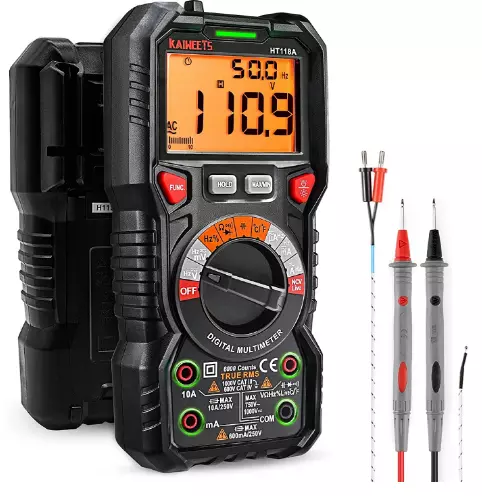
It measures up to 600V AC/DC, 10A AC/DC current, and 60 megaohms of resistance, and also handles temperature, capacitance, frequency, duty cycle, diode testing, and continuity; essentially everything a home, hobbyist, or working electrician would need from one meter.
It’s IEC-rated CAT III 1000V and CAT IV 600V, with CE and RoHS certification, genuinely strong safety credentials for this price bracket.
The auto-ranging function means you don’t need to guess which range to select, and illuminated jacks light up to show you exactly where to plug in your leads, which is a small but genuinely useful touch for beginners.
The 6000-count backlit display is large and easy to read, and it includes Min/Max/Average recording, a kickstand, a pen slot, low-battery alert, data hold, and auto power-off.
KAIWEETS backs this with a 36-month warranty and lifetime technical support, which is among the strongest after-sales commitments on this list.
A common complaint we have, along with other reviews, is that it lacks an hFE transistor-gain testing mode, and the battery isn’t included in the box despite some listings implying otherwise. Please budget for AA batteries separately.
Who should buy this: Anyone who wants one dependable, safety-certified multimeter that covers 95% of home, auto, and hobbyist use cases without overspending.
2. KAIWEETS KM601S Smart Digital Multimeter: Best Premium/Smart Pick
The KM601S is a step above the HT118A in both price and sophistication, built around a “Smart Mode” that automatically detects what you’re measuring ( voltage, resistance, or continuity) and selects the best-resolution range without you turning the dial. For fast diagnostic work, this genuinely speeds things up.
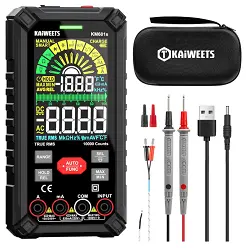
It offers 10,000-count resolution, a large colour LCD with backlight, and, unusually for this category, a built-in rechargeable 1200mAh battery with a 5V DC charging port, so you’re not constantly buying AA/AAA cells.
The rubberised protective housing is built to survive drops, and it includes NCV detection, temperature measurement, frequency counting, and a flashlight.
Reviewers consistently highlight the display quality and the Smart Mode as standout features that make it easier to use than traditional dial-based meters, particularly for less experienced users who don’t want to think about ranges at all.
Who should buy this: Buyers who want the most modern, fastest-to-use experience and don’t mind paying more for it, and don’t want to keep buying disposable batteries.
3. Fluke 101 Digital Multimeter: Best for Professionals
Fluke’s reputation in test equipment is well-earned, and the 101 is their entry point into that reputation. It’s compact, lightweight (around 160g), and rugged enough to survive daily use in a toolbox or work bag.
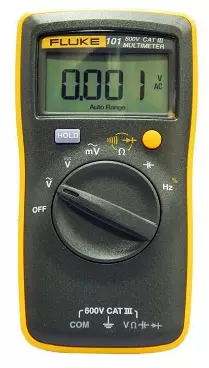
It measures AC/DC voltage, resistance, continuity, and frequency, and carries a CAT III 600V safety rating.
The compromise for the low price within the Fluke range: the 101 does not measure current (amps) or offer True-RMS accuracy.
If your work only ever involves voltage and resistance checks, which covers a large share of basic home and automotive troubleshooting, this is a non-issue. If you need current measurement, step up to the Fluke 106 below.
Who should buy this: Buyers who specifically want the Fluke name and build quality for basic voltage/resistance/continuity work and don’t need current measurement.
4. Fluke 106 Digital Multimeter: Best Compact Professional
The Fluke 106 sits directly above the 101 in Fluke’s 100-series lineup, adding the two features the 101 lacks: current measurement (up to 10A) and True-RMS accuracy for reliable AC readings, while staying in the same palm-sized, pocket-friendly form factor.
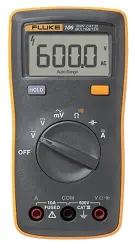
It carries the same CAT III 600V rating and Fluke’s typical solid input protection.
It’s positioned by Fluke as an “electrician’s meter”, small enough for a shirt pocket, but capable enough for real diagnostic work including capacitance measurement.
It’s worth noting the 106 doesn’t include a backlight (that’s reserved for the Fluke 107, the next model up) or milliamp/microamp ranges, so precision electronics work isn’t its focus.
Who should buy this: Electricians and technicians who want Fluke reliability with current measurement in a genuinely pocketable size, and don’t need a backlight for low-light work.
5. FNIRSI DMT-99 Digital Multimeter: Best Modern Display
The DMT-99 stands out immediately for its 2.4-inch full-colour TFT display (240×320 resolution), a genuinely different experience from the grey LCD screens on every other meter in this list.
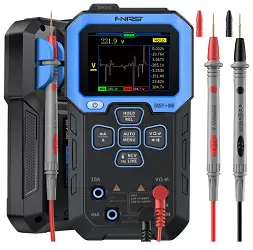
It offers 9999/10000-count resolution, True RMS accuracy, and a wide measurement set: AC/DC voltage and current up to 1000V/10A, resistance, capacitance, frequency, duty cycle, diode testing, temperature, NCV, and live-wire detection.
Its most practical everyday advantage: a built-in 1500mAh rechargeable battery with USB-C charging, eliminating the usual dependence on a 9V or AA cell.
It also includes a data-recording/monitoring mode that logs min/max values and plots a real-time measurement curve on-screen; a feature usually reserved for meters costing significantly more.
One limitation worth flagging clearly is that FNIRSI markets this as suitable for “home use,” but the specific CAT safety rating isn’t consistently stated across listings.
If you plan to test near mains-voltage household wiring, verify the CAT rating printed on your specific unit or in its manual before relying on it for that purpose.
Who should buy this: Buyers who want a modern, rechargeable, feature-rich meter for electronics, automotive, and general diagnostics, and who value screen clarity and data-logging over dial-based simplicity.
6. ASTROAI Digital Multimeter AM33D: Best for Beginners
The AM33D is built specifically to make electrical troubleshooting approachable, aimed squarely at first-time users diagnosing basic automotive and household electrical issues.
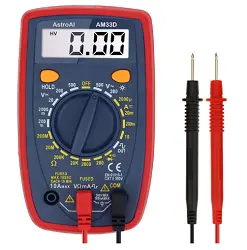
It handles the core functions cleanly ( voltage, current, and resistance measurement, plus continuity, transistor, and diode testing ) without burying beginners in advanced modes they don’t need yet.
The design wraps a protective handle around the entire instrument body, and a rear kickstand makes it comfortable to use hands-free on a bench or workbench for longer sessions.
It includes a low-battery indicator, a continuity alarm, and overload protection, so new users are less likely to damage the meter through an accidental mis-range.
Specifications: 3½-digit (1999-count) display; DC voltage 200mV/2000mV/20V/200V (±0.5%+3), 500V (±1%+5); AC voltage 200V/500V (±2%+10); DC current from 2000µA up to 10A; resistance from 200Ω up to 200MΩ.
AstroAI also sells the DM130B, a pricier, more advanced multimeter from the same company, if you outgrow the AM33D’s basic feature set later.
Who should buy this: First-time multimeter buyers who want something simple, safe, and hard to mess up; students, homeowners, and anyone just starting to troubleshoot car or household electrics.
AstroAI Digital Multimeter DM130B is a professional multimeter from the same company that has more functions and is more costly.
7. UNI-T UT33D+ Reliable Digital Multimeter: Best Palm-Sized Budget
UNI-T is a well-established Chinese test-equipment brand, and the UT33D+ is their compact, budget-focused offering. It measures DC voltage (200mV to 600V), AC voltage (up to 600V), DC current (up to 10A), and resistance across six ranges, on a 2000-count display.
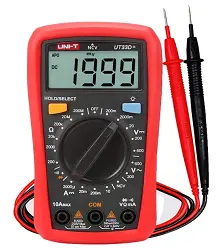
What sets it apart from other similarly priced meters is a genuinely useful durability claim: UNI-T rates it for a 2-meter drop test, and it includes a built-in test-probe holder, auto power-off, auto backlight-off, a loud continuity buzzer, and NCV detection. The ergonomically shaped rotary switch is comfortable for one-handed use.
It’s a manual-range meter, not auto-ranging, so you’ll need to select the correct range yourself; a minor extra step for beginners but not a dealbreaker.
Who should buy this: Buyers who want a genuinely pocket-sized, drop-resistant meter for basic checks and don’t mind manual range selection.
8. MEXTECH MAS830L Digital Multimeter: Best Basic Pick #1
The MAS830L is arguably the most common entry-level digital multimeter sold in India, and Mextech’s version remains a dependable pick.
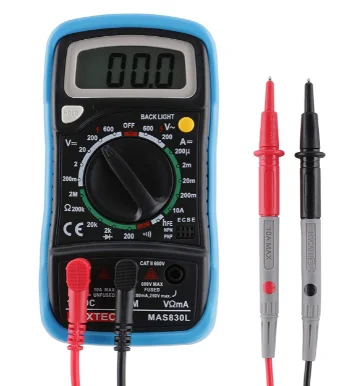
It’s a 3½-digit (1999-count) manual-range meter with a backlight, measuring AC/DC voltage, DC current, and resistance, plus continuity, diode, and transistor (hFE) testing; a feature many pricier basic meters skip.
It includes a low-battery indicator, data-hold, a polarity indicator, and an over-range warning to protect the meter from accidental overload. Build quality is considered solid for the price, and it remains one of the most widely available and cheaply serviced multimeters in the country, which matters if you ever need a replacement part or probe.
Who should buy this: Students, hobbyists, and anyone who wants the cheapest genuinely functional multimeter for basic household and electronics use.
9. MECO Digital 108B+ TRMS Battery-Powered Multimeter: Best Ultra-Budget Pick
MECO is one of India’s most established instrumentation manufacturers, and the 108B+ punches above its price point by offering True RMS measurement. This is a feature usually reserved for meters costing considerably more. It’s pocket-sized, runs on two AAA batteries, and includes a 3½-digit backlit LCD.
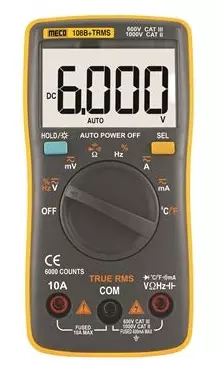
It measures AC/DC voltage and current up to 10A, and includes auto-ranging, automatic power-off, temperature measurement, capacitance measurement, and frequency measurement.
A genuinely comprehensive feature set for what is typically sold as a budget professional tool. Voltage accuracy is rated at ±0.8% (DC) and ±1.5% (AC); current accuracy at ±1.5% (DC) and ±2% (AC); solid numbers for the price bracket.
Who should buy this: Working professionals or serious hobbyists on a tight budget who specifically want True RMS accuracy without paying premium-brand prices.
10. Themisto TH-M100 AC/DC Current, True RMS Digital Multimeter: Best Value (True RMS)
Themisto has built a solid reputation in the Indian budget-to-midrange multimeter space, and the TH-M100 is their step up from the TH-M98 (below), adding True RMS accuracy for genuinely reliable AC current and voltage readings.
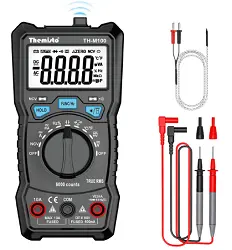
This is important if you’re testing anything with a non-sinusoidal waveform, like variable-speed motors or dimmer-controlled loads.
It’s a 6000-count auto-ranging meter that measures AC/DC voltage and current, resistance, capacitance, temperature, continuity, diode, and frequency.
It includes data hold, NCV detection, a backlit flashlight for low-light use, and auto power-off after 15 minutes of inactivity to save battery. Reviewers consistently highlight it as excellent value for money, with accurate readings and a comfortable, rubber-protected build for drop resistance.
Who should buy this: Buyers who specifically need True RMS accuracy ( for motor testing, variable loads, or general professional use ) but don’t want to pay Fluke or Kaiweets premium pricing.
11. Themisto TH-M98 Digital Multimeter: Best Value (Budget)
The TH-M98 is Themisto’s original budget breakout hit, and remains a strong low-cost option for technicians, students, and hobbyists.
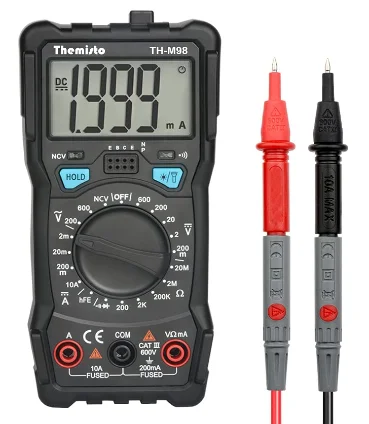
It accurately measures AC/DC voltage, capacitance, duty cycle, resistance, diode continuity, and, notably for this price segment, includes auto-ranging and True RMS for AC current and voltage measurement.
Its standout safety feature is a pair of double ceramic fuses, explosion-resistant and designed to protect the meter from overload, a detail that matters more than it sounds, since a blown fuse in a cheap multimeter can sometimes mean a dead unit rather than a simple fuse swap.
It also includes an NCV detector with a buzzer, a kickstand, data hold, a large backlit LCD, and auto shut-off after 15 minutes.
Across extensive Amazon reviews, buyers consistently cite it as offering “a lot of functions at a low price” with no noticeable flaws in design or build quality relative to its cost, a rare combination in the sub-₹1,000 bracket.
Who should buy this: Anyone who wants Themisto’s reliable basics and safety fusing without stepping up to the TH-M100’s higher price for True RMS.
Related: Unbiased Product Evaluation: Themisto TH-M98 Digital Multimeter
12. HTC Instrument MAS830L Digital Pocket Multimeter: Best Basic Pick #2
This is HTC’s version of the same MAS830L reference design used by Mextech (see #8), essentially the same underlying multimeter, sold under a different brand. It offers the same core measurement accuracy: DC voltage accuracy of ±(0.8%+2 digits), AC voltage at ±(1.5%+10 digits), DC current at ±(1%+10 digits), and resistance at ±(0.8%+2 digits).
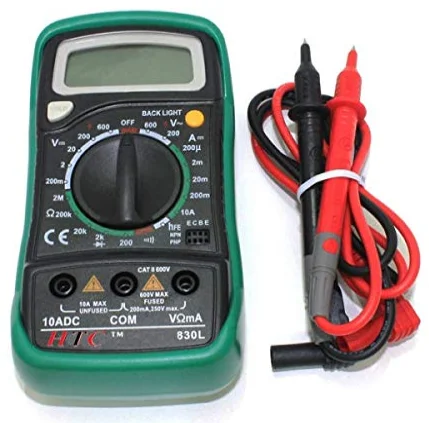
Because it’s functionally a rebadge of the same widely used design, the choice between the HTC and Mextech versions usually comes down to price and current stock availability rather than any meaningful performance difference.
Who should buy this: Buyers who want the most basic, cheapest functional multimeter and don’t have a brand preference. Pick whichever of MAS830L (Mextech or HTC) is cheaper at the time.
13. HTC Instruments HTC-830L+ Digital Multimeter: Best Upgraded Basic
Don’t confuse this with the standard HTC MAS830L above. The “830L+” is a distinct, slightly upgraded model that adds True RMS measurement on top of the same 3½-digit, 2000-count manual-range design.
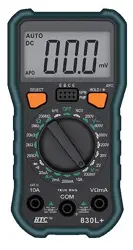
It measures DC voltage from 200mV to 600V, AC voltage up to 600V, DC up to 10A, and resistance, with a CAT II 600V safety rating.
It includes backlight, data hold, transistor and diode testing, overload protection, and low-battery indication. Reviews are mixed on build quality. Several buyers describe the design as good but the plastic housing as feeling less durable than the price might suggest, so treat this as a light-duty meter rather than one for daily field use.
Who should buy this: Buyers who want True RMS accuracy on a tight budget and are comfortable with a manual-range, basic-build meter for occasional use.
14. Sanwa Japan Analogue Multimeter (YX360TRF): Best Analogue Multimeter
Every other meter on this list is digital. If you specifically want (or need) an analogue multimeter, the Sanwa YX360TRF remains the standard recommendation. It is a genuinely well-regarded Japanese-made instrument used in electronics and electrical service for decades.
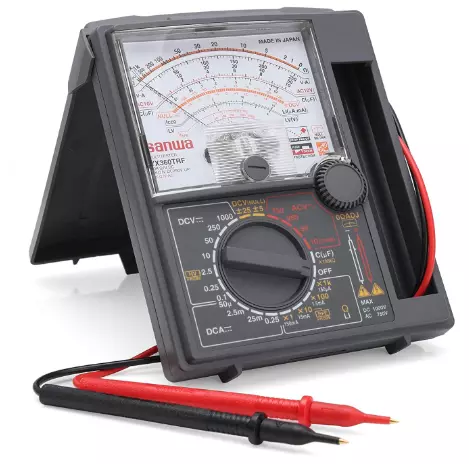
It measures DC voltage up to 1000V, AC voltage up to 750V, DC current up to 0.25A, resistance up to 200 megaohms, capacitance up to 10µF, and decibels from -10dB to 22dB.
Its needle-based display is prized by experienced technicians because a needle can visually show a trend or fluctuation, like a slowly dying capacitor’s charge curve, more intuitively than a digital number that keeps jumping around. The gold-plated test pins provide strong conductivity, and it runs on two AA batteries.
One practical note: the measurement leads on some units are soldered directly to the board rather than being a removable connector, a minor inconvenience if a lead ever needs replacing, but not a build-quality flaw.
Who should buy this: Experienced technicians who specifically prefer (or need) needle-based analogue readings, or anyone who wants a genuinely trusted Japanese-made instrument as a long-term investment.
How We Evaluated These Multimeters
We evaluated each multimeter using several important factors. These included measurement accuracy (where the manufacturer provided the data), safety rating (CAT rating), display resolution (count), and whether it offered auto-ranging or manual-ranging.
We also compared useful features such as True RMS, NCV, temperature measurement, and capacitance testing. Our team checked the build quality and durability during testing.
We also considered genuine customer reviews, warranty, after-sales service, and the latest prices on Amazon, Flipkart, and official brand websites instead of outdated MRP values.
Related: Clamp Meter vs Multimeter: Key Differences and Which One You Need
Buying Guide: What to Look for in a Multimeter
a) Know Your Use Case First
A student needing basic voltage/continuity checks doesn’t need the same meter as an electrician working near mains wiring, or a hobbyist debugging PCBs. Defining your actual use case before shopping prevents both overspending and buying something underpowered for the job.
b) Analogue vs. Digital
Digital multimeters show the measurement as an exact number on the display. This makes them easier for beginners to read and use. Analogue multimeters use a moving needle and a printed scale.
They are usually more affordable than digital models. Some experienced technicians still prefer analogue multimeters because the moving needle makes it easier to observe changing or fluctuating readings.
Today, most buyers choose digital multimeters. However, analogue models, such as the Sanwa multimeter, are still popular among many professionals.
c) Parameters and Range
At minimum, a multimeter should measure voltage, current, and resistance. More advanced meters add temperature, frequency, capacitance, and diode testing. They are useful if you’re doing appliance repair, HVAC diagnostics, or electronics work.
Make sure the measuring range comfortably covers what you intend to test, and never exceed the meter’s rated current range. Doing so is a genuine safety hazard.
Related: Best Clamp Meters in India: Tested Picks & Selection Guide
d) True RMS: When It Actually Matters
Standard (“average-responding”) multimeters estimate AC readings assuming a clean sine wave.
True RMS meters calculate the actual root-mean-square value, giving accurate readings even on distorted waveforms, common with variable-speed motors, dimmers, UPS output, and modern electronic loads.
If you’re only checking simple mains voltage or basic continuity, average-responding is usually fine; for motors, inverters, or anything with electronic switching, True RMS (like the MECO 108B+, Themisto TH-M100, Fluke 106, or FNIRSI DMT-99) gives more accurate results meaningfully.
e) Accuracy and Resolution
Accuracy is the maximum allowable error in a reading; a lower percentage means a more precise meter.
Resolution (count) determines how many digits the display can show; a 6000-count meter shows finer detail than a 2000-count one, though very high resolution can take slightly longer to stabilise on the final digit.
f) Auto-Ranging vs. Manual Ranging
Auto-ranging meters detect and select the correct measurement range automatically, which is ideal for beginners and faster for quick diagnostic work.
Manual-ranging meters require you to set the range yourself using a dial, which some experienced users prefer for finer control, but it does require some familiarity with expected value ranges.
g) Safety Rating (CAT Rating)
The CAT (measurement category) rating indicates the maximum transient voltage a meter can safely handle without risk of arc flash or explosion.
CAT II is typically sufficient for household outlets and appliances; CAT III is recommended for distribution-level wiring and panel work; CAT IV is for utility-level connections.
Always check that a meter is rated appropriately for what you intend to test near. This is not a spec to compromise on to save money.
h) Durability and Build
Look for a meter with a solid, impact-resistant casing, ideally with rubber over-moulding, since a cracked case can expose internal circuitry and create a genuine shock hazard. Some meters, like the UNI-T UT33D+, explicitly advertise drop-test ratings (2 meters in this case), which is a useful benchmark when comparing budget options.
i) Pricing
Multimeter prices in India range from under ₹500 for the most basic pocket meters to over ₹25,000 for lab-grade professional units. Match your spend to your actual usage: students and hobbyists rarely need to go above ₹1,500–2,000; working professionals should prioritise True RMS accuracy and a proper CAT rating even if it costs more.
j) Brand Support and Warranty
Check what warranty and after-sales support a brand actually offers. KAIWEETS’ 36-month warranty with lifetime technical support stands out in this list, while several budget brands offer only 6-month to 1-year coverage on manufacturing defects.
Common Mistakes to Avoid
- Buying a meter with no current (amps) measurement if you actually need it. The Fluke 101, for instance, deliberately omits this to hit a lower price point; check the spec sheet, not just the brand name.
- Ignoring CAT ratings when testing near mains wiring. A CAT I-rated pocket meter is not appropriate for panel-level or distribution work.
- Assuming “digital” means “True RMS.” Most budget meters are average-responding, not True RMS. Check explicitly if you’re testing motors, inverters, or electronic loads.
- Exceeding the meter’s rated current range. This is one of the most common causes of blown fuses and, in worse cases, meter damage or injury.
Conclusion
A good multimeter is an essential tool for anyone working with electricity or electronics. Whether you’re an engineering student, a DIY enthusiast, a homeowner, or a professional electrician, the right multimeter can help you troubleshoot problems quickly and safely. The best choice depends on the type of work you do, the features you need, and your budget.
If you want the best overall balance of accuracy, safety, and features, the KAIWEETS HT118A is our top recommendation. Professionals who trust premium brands can confidently choose the Fluke 101 or Fluke 106.
If you’re looking for an affordable option for home use or learning, models like the Themisto TH-M98, MECO 108B+, or ASTROAI AM33D offer excellent value. Those who still prefer a traditional needle display can consider the Sanwa YX360TRF, which remains a trusted analogue multimeter.
Before making your purchase, always check the meter’s CAT safety rating, measurement range, and whether you need features like True RMS, auto-ranging, or NCV detection. Investing in the right multimeter today will save you time, improve your accuracy, and make electrical testing much safer in the long run.
Quick Picks Summary:
| # | Product | Category | Count | True RMS |
|---|---|---|---|---|
| 1 | KAIWEETS HT118A | Editor’s Choice | 6000 | Yes |
| 2 | KAIWEETS KM601S | Best Premium/Smart Pick | 10000 | Yes |
| 3 | Fluke 101 | Best for Professionals | 6000 | No |
| 4 | Fluke 106 | Best Compact Professional | 6000 | Yes |
| 5 | FNIRSI DMT-99 | Best Modern Display | 9999/10000 | Yes |
| 6 | Themisto TH-M100 | Best Value (True RMS) | 6000 | Yes |
| 7 | Themisto TH-M98 | Best Value (Budget) | — | Yes |
| 8 | ASTROAI AM33D | Best for Beginners | 1999 | No |
| 9 | MECO 108B+ TRMS | Best Ultra-Budget Pick | — | Yes |
| 10 | UNI-T UT33D+ | Best Palm-Sized Budget | 2000 | No |
| 11 | MEXTECH MAS830L | Best Basic Pick #1 | 1999 | No |
| 12 | HTC Instrument MAS830L | Best Basic Pick #2 | 1999 | No |
| 13 | HTC-830L+ | Best Upgraded Basic | 2000 | Yes |
| 14 | Sanwa YX360TRF | Best Analogue Multimeter | Analogue | N/A |
Frequently Asked Questions
Fluke remains the most respected name for build quality and reliability, particularly for professional use. For better value at a lower price, Kaiweets, Themisto, UNI-T, and MECO are all well-regarded alternatives, each with strong reviews in their price bracket.
Start with your use case. Basic home checks, automotive diagnostics, or professional electrical work each need different feature sets. At minimum, ensure your meter measures voltage, current, and resistance accurately, and check for a backlight, continuity/diode testing, and an appropriate CAT safety rating for what you’ll be testing.
Digital multimeters have largely replaced analogue ones for general use, since they offer more measurement functions (capacitance, frequency, temperature, diode/transistor testing) and are easier to read precisely. Analogue multimeters, like the Sanwa YX360TRF, remain popular among experienced technicians for visually tracking fluctuating values.
For students, beginners, and basic household use, a low-cost multimeter (like the Mextech or HTC MAS830L) is genuinely sufficient. For professional or safety-critical work, especially near mains wiring, invest in a meter with a verified CAT rating and better accuracy, such as a Fluke, Kaiweets, or a True RMS-rated model.
Electricians working on distribution panels or building-level wiring should look for at minimum a CAT III rating; those working closer to the utility connection point may need CAT IV. Always check the specific CAT rating and voltage figure together (e.g., “CAT III 1000V”) rather than the category alone.
10A refers to the maximum current the meter can measure on its highest current range; mA (milliamps) is a much smaller unit used for measuring low-current circuits like small electronics. Most general-purpose multimeters offer both a high-current (10A) and low-current (mA/µA) range, selected via the dial or a separate input jack.
This depends entirely on what you’re measuring. A 10A meter is sufficient for the vast majority of home, hobbyist, and light automotive use; 20A-rated meters are aimed at heavier industrial or automotive current-draw scenarios and are less commonly needed for typical household diagnostics.
True RMS meters calculate the actual root-mean-square value of an AC signal rather than assuming a clean sine wave, giving accurate readings on distorted waveforms from motors, dimmers, and electronic loads. If you mainly test simple mains circuits, it’s optional; if you work with motors, inverters, or variable-frequency drives, it’s worth prioritising.
We hope this guide helps you pick the right multimeter for your needs, whether that’s a first tool for a student, a daily-carry meter for a working electrician, or a precision instrument for serious electronics work.
If you found it useful, share it with others and follow Infobits for more buying guides, product reviews, and practical technology tips.
If you’ve used a multimeter that deserves a spot on this list, let us know, and we’ll test it for a future update.
Also, consider following our Facebook and Twitter pages for regular updates.
Subscribe to our free newsletter so that you will get similar articles and regular updates directly in your Email.
Subscribe to be the first to learn about new information
Disclosure: We will receive an affiliate commission on some, but not all, of the products or services we recommend if you follow our links to a retailer’s website and make a purchase.