How to Earth Your Home Electrical System Properly (India Guide)
Most Indian homes have an earth wire. Far fewer have an earth that actually works. The difference only shows up on the day a live wire touches a metal body, and by then it is too late to fix.
This guide walks you through proper home earthing, from choosing an electrode to testing the finished pit. It follows IS 3043, the Indian code of practice for earthing, in plain language. You will also see what you can check yourself and what to leave to a licensed electrician.
Quick answer: To earth a home properly, bury an earth electrode (GI pipe, copper-bonded rod or plate) about 3 m deep in a covered pit. Surround it with earth-enhancing compound and join it to the earth bus bar in your main distribution board (DB) with a thick copper conductor or GI strip. Run a separate green or green-yellow earth wire to every socket and metal-bodied appliance. Keep neutral and earth separate, test the earth resistance (5 Ω or less for homes, lower is better) and retest every year.
What Does Earthing Actually Do?
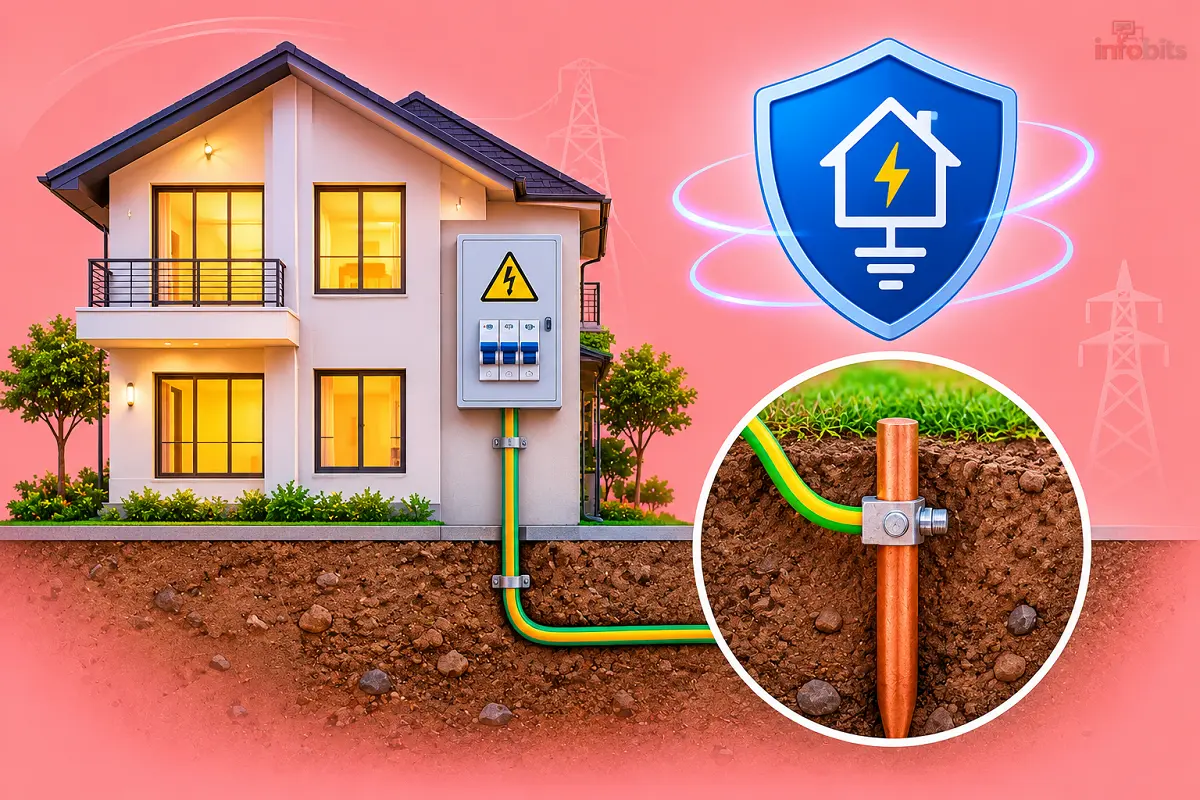
Earthing connects the metal parts of your electrical system to the ground through a low-resistance path. Its job is to give stray current somewhere safe to go. That one job protects both people and appliances.
Picture your fridge. A worn wire touches its metal back panel. Without an earth, the body turns live, and the next person who touches it gets the shock. With a good earth, the fault current rushes down the earth wire, the MCB or RCCB trips quickly and the body stays safe.
Earthing does two more things. It gives surge and lightning current a path into the ground. It also gives your protective devices a stable reference to work against.
Earth, Neutral and Ground: Are They the Same?
No, and people mix them up all the time. Neutral is a working conductor. It carries current back to the transformer whenever a load is on. Earth carries current only during a fault. “Grounding” is simply the American word for earthing.
In India, the utility earths the neutral at its own transformer. Inside your home, the neutral and earth wires must stay separate. Never join them at a socket or inside a switchboard to “fix” a problem.
Check What You Already Have First
Before you dig anything, find out how your current earthing is doing. Many homes already have a pit that has simply dried out or corroded. Work through this list:
- Look for a green or green-yellow wire running from your main DB to the outside. Locate the pit and its cover.
- Plug a three-pin socket tester into every socket. It shows whether an earth connection is present.
- Note any tingling or buzzing when you touch the fridge, washing machine, geyser or AC body.
- Measure the voltage between neutral and earth at a socket. It should be only a few volts at most. A reading that stays high points to a wiring or earthing fault.
A multimeter makes the voltage check easy, but live sockets are risky. If you are not confident, ask an electrician to do it. Not sure which meter to buy? Our guides to the best multimeters in India and clamp meter vs multimeter will help.
A basic plug-in socket tester (view on Amazon) costs very little and tells you a lot in ten seconds. If you do not own one, pick up a three-pin socket tester that shows earth, neutral and phase faults with indicator lights.
If any socket shows a missing earth, or you feel a tingle from a metal body, treat it as urgent. Stop using that appliance until an electrician has checked it.
Pick the Right Type of Earthing
Indian homes mostly use one of four types. Here is how they compare:
| Type | What it is | Pros | Cons | Best for |
|---|---|---|---|---|
| Pipe earthing | GI pipe, about 40–50 mm wide and 2.5–3 m long, with charcoal-salt or compound and a funnel for water | Cheap; any local electrician knows it | Needs regular watering; salt corrodes metal over time | Budget homes with moist soil |
| Plate earthing | GI plate (600 × 600 × 6 mm) or copper plate (600 × 600 × 3 mm) buried vertically | Large contact area | Wider, deeper pit and more costly | Homes with space to dig |
| Copper-bonded rod | Steel core with a copper coating, about 14–17 mm wide and 3 m long | Durable, corrosion resistant, small footprint | Needs a proper bore, higher price | Most homes, especially dry or rocky soil |
| Chemical (maintenance-free) | Hollow electrode filled with mineral compound, plus backfill | Stable resistance, little upkeep | Highest cost, quality varies by brand | Sandy, rocky or hard-to-water spots |
If you want a simple default, a copper-bonded rod with earth-enhancing compound in a pit with an inspection cover suits most homes. Ask your electrician to confirm the sizes against the product’s datasheet and IS 3043.
Choose the Location and Know Your Soil
Soil changes everything. Wet, loamy soil conducts well. Dry sand, gravel and laterite (common across Kerala and parts of the coast) conduct poorly, especially in summer. In such soil, you may need a deeper bore, more compound or more than one electrode.
Use these rules when picking the spot:
- Place the pit close to the main DB so the earth lead stays short and straight.
- Check for buried water lines, cables and drains before you dig.
- Keep the pit accessible. Do not bury it under tiles, a parked car or a planter.
- Keep it away from the lightning arrester earth, or bond the two on purpose through your electrician.
- If you use more than one electrode, space them apart. Roughly twice the electrode length is a good target.
- For pipe earthing, choose a spot near a tap so watering is easy.
How to Earth Your Home: Step by Step
Digging and placing the electrode is manageable for a careful homeowner with help. The final connection at the DB belongs to a licensed electrician. Here is the full sequence.
- Switch off and plan. Turn off the main switch before anyone touches the DB. Mark the pit location and check for buried services.
- Dig the pit. Make a pit about 0.5–1 m wide at the top. Go down to roughly 3 m for a pipe or rod, using a bore if the soil is hard. A plate needs a wider pit.
- Set the electrode. Place it upright in the centre. Keep its top around 20 cm below ground level, inside a small chamber.
- Backfill. The old method uses alternating layers of charcoal and salt. The modern method uses an earth-enhancing compound mixed with water as the maker instructs. Salt works, but it eats into metal over the years.
- Fix the earth lead. Use a bolted copper or brass lug or a proper clamp at the electrode. Use a thick copper conductor or GI strip sized by your electrician. Keep every joint inside the chamber where you can see it. Never bury a joint.
- Route it to the DB. Run the lead through a conduit with no sharp bends. Keep it short and continuous.
- Connect at the DB. The electrician fixes the lead to the earth bus bar and tightens it properly.
- Cover and label. Fit an inspection cover flush with the ground. Mark it “EARTH PIT – DO NOT DISTURB”.
- Wet, wait and test. Water the pit if you used pipe or salt-charcoal. Give it a few days, then have the resistance tested.
A copper-bonded rod kit with earth-enhancing compound is easy to find online. Look for one that states the copper coating thickness and comes with a lug.
Add a plastic or concrete inspection cover too. It keeps soil out and makes yearly checks painless.
Wire the Earth Inside Your Home
The pit is only half the job. Every socket and metal appliance must connect back to it.
- Run a separate green or green-yellow earth wire from the DB earth bus bar to every socket earth pin. Use modern copper cable that carries its own earth core.
- Earth the metal DB box, geyser, AC, fridge, washing machine, microwave, water pump and metal switch boxes.
- Use three-pin sockets that really are connected. An earth pin wired to nothing gives false comfort, which is worse than no earth pin.
- Never use the neutral wire as an earth.
- Ask your electrician to size the earth conductors for each circuit per IS 732, the wiring code of practice.
Working on live mains can kill. Keep a few safe tools handy, like a non-contact voltage tester pen and insulated screwdrivers. Both are easily available o n Amazon.
Geysers deserve extra attention. Hot water and a damaged element are a bad combination. Our 3-litre water heater guide covers what to look for in a safe unit.
Test the Earth: How to Know It Works
A pit you cannot measure is a pit you cannot trust. Here are the checks that matter:
| Test | What it tells you | Typical target |
|---|---|---|
| Earth resistance (3-point or clamp-on earth tester) | How well the electrode connects to the soil | 5 Ω or less for homes under NBC guidance. Many electricians aim for 1–2 Ω |
| Earth fault loop impedance | Whether the breaker will trip fast enough in a fault | Low enough for your MCB or RCCB to trip in time. An electrician measures this |
| Neutral–earth voltage at a socket | Early hint of wiring or earthing faults | A few volts at most |
| Socket tester | Earth present, polarity correct | Correct indication on every socket |
A common mistake is measuring earth with a normal multimeter. It cannot give a true earth pit resistance, because the test needs a special earth tester with auxiliary spikes. Ask your electrician to bring one and to write the reading down.
Test in the dry season too. Resistance is highest when the soil is driest, so that is the reading that counts.
If you like having your own instruments, a basic clamp-on or 3-pole earth resistance tester lets you track the pit yourself each year.
Pair Earthing With an RCCB and a Surge Protector
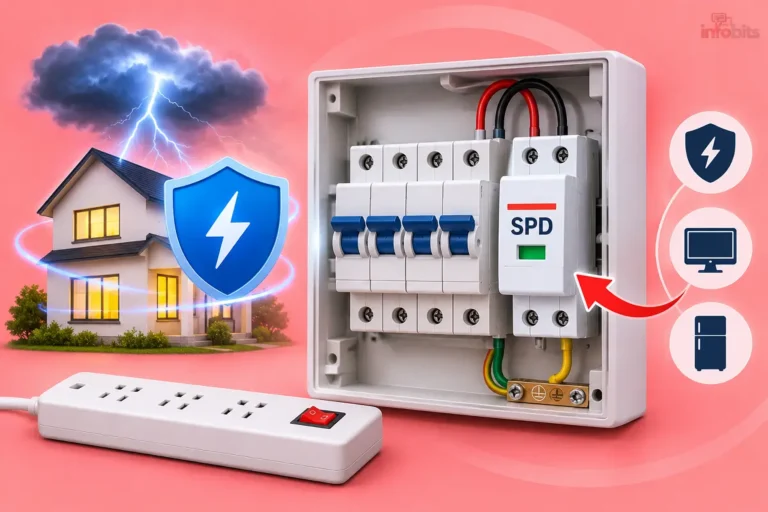
Earthing alone is not a complete shield. A 30 mA RCCB or RCBO watches for leakage and cuts the supply within a fraction of a second. A surge protective device (SPD) diverts surge energy to earth.
Both depend on a good earth. A poor pit weakens the RCCB’s protection and gives an SPD nowhere to send the surge. Think of the three as a team.
If your RCCB trips every time it thunders, read why an RCCB trips during lightning. Fan owners should also see how to protect a BLDC fan from lightning.
For TVs, routers and computers, a surge-protected extension board like the Belkin 6-Socket Extension Board (available on Amazon) gives you one more layer at the point of use. Choose one with an earth connection and a stated joule rating.
Earthing for Inverters, Solar and Lightning Protection
One rule runs through all of these systems. Separate electrodes for separate jobs are fine, but they must be bonded together. That keeps all the earths at the same potential so no dangerous voltage appears between them.
- Inverters: Earth the inverter body and its AC side. Our inverter basics guide explains the parts involved.
- Solar: Panel frames, the DC side, the AC side and the lightning arrester each need their own earthing path, joined at a common point. Your installer should do this. See our guides on choosing solar panels and on-grid vs off-grid systems.
- Lightning: A lightning down-conductor needs its own dedicated route to a pit. Do not improvise this one.
Ask for the final bonding arrangement in writing or as a simple sketch. It helps future repairs and resale.
Living in a Flat or a Rented Home
You usually cannot dig a pit in a flat. Ask your society or builder where the building’s earth pits are and whether your flat DB connects to them. Then check your sockets with a tester.
If a socket shows no earth, raise it with the society electrician or your landlord. Do not try workarounds like joining earth to neutral or clamping it to a water pipe. Those shortcuts can put dangerous voltage on taps and appliances.
Maintain Your Earth Pit
An earth pit is not a fit-and-forget item. Soil dries, metal corrodes, and connections loosen. A simple routine keeps it healthy:
- Every week or two in dry months: Pour water through the funnel if you have pipe or salt-charcoal earthing. Maintenance-free systems do not need this.
- Before the monsoon: Open the cover. Check lugs, clamps and the conduit for rust or looseness.
- Every year: Get the resistance tested and note the reading with the date.
- After a heavy lightning strike: Retest, especially if appliances were damaged.
- After any tiling or construction near the pit: Confirm the cover is still reachable, and the lead is intact.
Warning Signs Your Earthing Is Failing
Watch for these clues:
- A tingle or mild shock from the fridge, washing machine, geyser or AC body
- A socket tester showing open earth
- An RCCB that trips for no clear reason
- A TV, router or charger that gets damaged during every storm
- A buzzing or burning smell near the DB or sockets
- A laptop charger that feels “live” to touch. Our post on using a laptop while charging explains the tingle many people notice
Any shock from a metal body is a reason to call an electrician the same day.
Troubleshooting Common Earthing Problems
| Symptom | Likely cause | What to do |
|---|---|---|
| Mild tingle from a metal appliance body | Poor or missing earth connection | Check with a socket tester, then have the earth retested |
| RCCB trips often | Leakage in one appliance, wet wiring, or neutral touching earth | Unplug appliances one at a time. If it still trips, call an electrician |
| High neutral–earth voltage | Loose neutral, heavy load on neutral, or weak earth | Have connections tightened and the pit tested |
| Earth reads fine in monsoon but poorly in summer | Dry soil around the electrode | Water the pit, add compound, or add a second electrode |
| Electronics damaged after storms | No SPD or weak earth path | Add an SPD and check the earth resistance |
| Socket tester shows open earth | Broken or unconnected earth wire | Electrician traces and repairs the earth continuity |
Common Earthing Mistakes to Avoid
- Digging a shallow pit to save effort
- Using thin wire for the main earth lead
- Joining neutral and earth inside the house
- Using a water pipe, gas pipe or iron grill as the “earth”
- Burying joints where nobody can inspect them
- Skipping the inspection cover
- Packing the pit with salt and forgetting about corrosion
- Testing once and never again
- Leaving three-pin sockets with an unconnected earth pin
Earthing Myths vs Facts
| Myth | Fact |
|---|---|
| Earthing lowers my electricity bill | It does not. It is a safety system, not a saving system |
| The neutral wire can act as earth | Neutral carries working current. Using it as earth is dangerous |
| Any iron rod in the ground is an earth | Electrodes must meet IS 3043 material and size rules. Pipes of the water or gas supply must never serve as electrodes |
| A multimeter can measure my earth pit | You need an earth tester with auxiliary spikes for a true reading |
| Charcoal and salt last forever | Moisture dries out and salt corrodes metal, so the pit needs upkeep or a better compound |
| One reading at installation is enough | Soil changes by season, so test every year |
DIY or Electrician? A Simple Decision Guide
You can usually handle: buying the kit, digging with care, watering the pit, visual checks and socket testing.
Leave to a licensed electrician: the DB connection, wire sizing, resistance testing, bonding with solar, inverter or lightning systems, and anything that touches live mains.
Cost varies by soil depth, electrode type and city. A basic rod or pipe installation usually costs a few thousand rupees, while chemical systems and extra pits cost more. Get two quotes and ask for a written resistance reading when the job is done.
Final Home Earthing Checklist
- Electrode installed to proper depth with a covered, labelled pit
- Earth lead thick, short, continuous and joint-free
- Lead bolted to the DB earth bus bar
- Separate earth wire to every socket and metal appliance
- Neutral and earth kept separate
- Earth resistance measured and recorded
- 30 mA RCCB and an SPD installed
- Yearly test and pre-monsoon inspection scheduled
Conclusion
Good earthing is quiet, cheap and easy to forget. That is exactly why so many homes get it wrong. A properly built and tested pit protects your family every single day without anyone noticing.
Start small. Check your sockets with a tester this week and ask an electrician for an earth resistance reading. If the numbers look weak, fix the pit before the next monsoon.
Once your earthing is solid, build on it with an RCCB, a surge protector and the right backup system. Our inverter and battery selection guide is a good next read.
Frequently Asked Questions
Earthing connects the metal parts of your wiring and appliances to the ground through a low-resistance path. If a fault makes a metal body live, the current flows into the earth and trips the breaker instead of shocking you.
Yes. Indian wiring practice and electrical safety rules expect every consumer installation to be earthed, and inspectors or your electricity board can ask for it. Always confirm local requirements with a licensed electrician.
Pipe, rod and plate electrodes are usually installed about 3 m deep. Rocky or dry soil may need a deeper bore or extra electrodes.
NBC guidance puts it at 5 Ω or less for residential buildings. Many electricians aim for 1–2 Ω for extra margin, particularly in lightning-prone areas.
No. Neutral carries working current all the time, so using it as earth can put live voltage on metal bodies. Keep the two separate inside the house.
No. Water and gas pipes and structural steel must not serve as earth electrodes. Use a proper electrode that meets IS 3043.
Most single-phase homes work with one good pit. You may need more if the resistance stays high, or a separate lightning earth that is bonded to the main one.
For most homes, a copper-bonded rod with earth-enhancing compound is a solid choice. Pipe earthing is cheaper but needs watering. Chemical earthing helps in dry, sandy or rocky soil.
A basic rod or pipe installation usually costs a few thousand rupees. Chemical systems, deeper bores and extra pits cost more, so compare two quotes.
If you have pipe or salt-charcoal earthing, water it every week or two in dry months. Maintenance-free systems do not need regular watering, but they still need a yearly check.
Use a socket tester on every socket and look for a tingle on metal bodies. For a real answer, an electrician must measure the earth resistance with an earth tester.
It should be only a few volts at most. A reading that stays high points to a loose neutral, heavy neutral load or a weak earth, and needs an electrician’s check.
This usually means the earth connection is poor or missing, or the appliance is leaking current. Stop using it and have the earth and the appliance checked.
No. Earthing is a safety measure. It protects people and appliances but does not cut your consumption.
Yes. An RCCB works best with a good earth, and earthing also protects against faults the RCCB alone cannot handle. Use both together.
You can handle digging, buying materials and routine upkeep if you are careful. The DB connection, wire sizing and resistance testing should be done by a licensed electrician.
Each part gets its own earth path, and all the earths are bonded together at a common point. Your solar installer or electrician should plan and test this.
Ask your society or builder where the building earth pits are and request a proper earth connection to your DB. Do not use workarounds like joining earth to neutral or to a water pipe.
We hope you are interested in our articles and consider following our Facebook, Instagram, and Twitter pages for regular updates.
Also, share this article with your friends and relatives. Bookmark this page for future reference.
Subscribe to our free newsletter to get similar articles and regular updates directly in your Email Inbox.
Subscribe to be the first to learn about new information
Disclosure: If you follow our links to a retailer’s website and make a purchase, we will get an affiliate commission on some, but not all, of the items or services we promote. This will cause no price change for you.