7 Best Clamp Meters in India 2026: Tested Picks & Selection Guide
A clamp meter is a must-have instrument for electricians and technicians. A good one needs to be precise, dependable, and efficient, and with so many manufacturers selling clamp meters in India, picking the right one isn’t always straightforward.
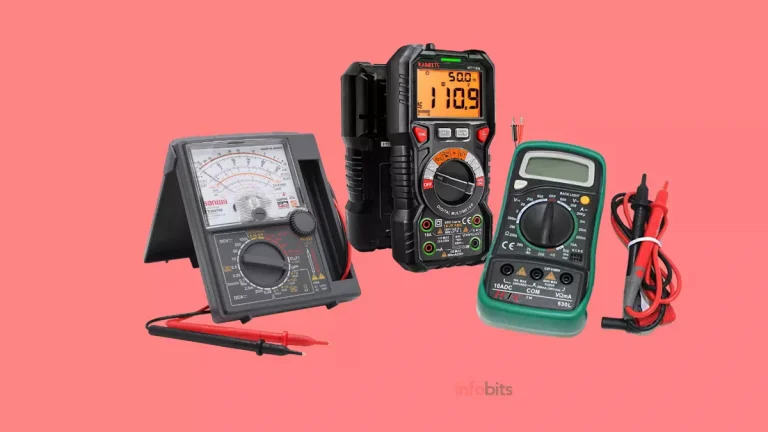
A clamp meter and a reliable multimeter are both essential tools for anyone working in electrical measurement and testing. We’ve already covered how a clamp meter compares to a multimeter in detail, if you’re still deciding which tool you actually need.
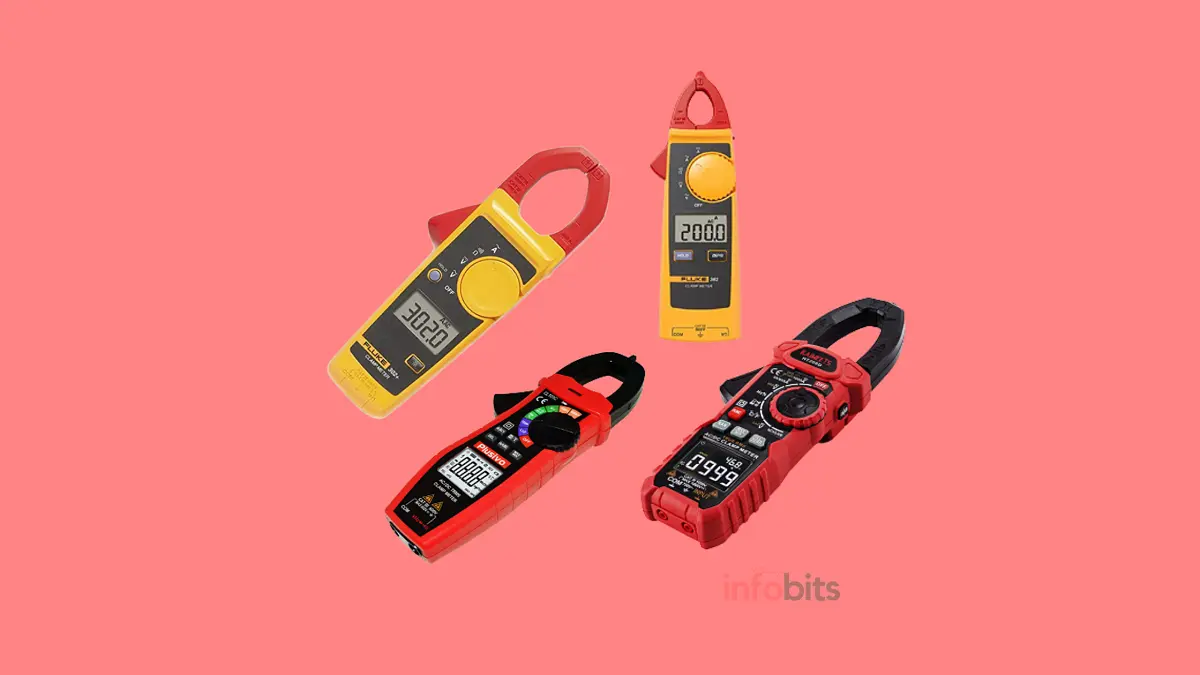
This guide covers the 7 best clamp meters available in India right now, along with a complete buying guide to help you pick the right one for your specific work.
Quick Picks: Best Clamp Meter in India
Editor’s Choice: Kaiweets HT206D
Value for Money: Kaiweets HT208D
Best Professional: Fluke-325
Best Compact: Fluke 362
Best Value AC/DC: Themisto TH-M88D
Best Beginner Friendly (AC only): Meco 27
Best Beginner Friendly (with NCV): HTC CM-2030
The 7 Best Clamp Meters in India
| Category | Clamp Meter | Why It Wins |
|---|---|---|
| Editor’s Choice | Kaiweets HT206D | Best all-round balance of features, accuracy, and price |
| Value for Money | Kaiweets HT208D | Higher 1000A/1000V range for a modest price step up |
| Best Professional | Fluke 325 | Trusted Fluke reliability with a strong core feature set |
| Best Compact | Fluke 362 | Slim 18mm jaw for tight panel spaces |
| Best Value AC/DC | Themisto TH-M88D | Auto-ranging AC/DC (current), frequency, and LoZ mode for less than its equivalents |
| Best Beginner (AC only) | Meco 27-Auto | Simple, no-frills option from a trusted Indian brand |
| Best Beginner (with NCV) | HTC CM-2030 | Budget-friendly with non-contact voltage detection |
1. Kaiweets Digital Clamp Meter HT206D: Editor’s Choice
The Kaiweets HT206D is a highly accurate, versatile true-RMS clamp multimeter built for electricians and technicians who need to measure AC/DC voltage and current, resistance, capacitance, frequency, and duty cycle, alongside diode, temperature, and continuity tests.
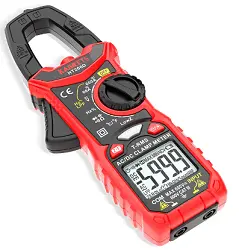
It measures up to 600A AC/DC, and its low input impedance helps prevent false readings caused by ghost voltage. A low-pass filter (LPF) also improves accuracy when measuring motors and transformers running on variable-frequency drives.
The non-contact voltage (NCV) detector lets you check for live wires without touching them, and the two-colour backlit display switches to red when voltage or current exceeds 80V or 3A.
A built-in flashlight helps in low-light testing conditions, and the included K-type thermocouple lets you measure air or liquid temperature.
It meets IEC 61010-1 safety standards with CAT III 600V double insulation, and comes with a 3-year manufacturer’s warranty.
Best for: Buyers wanting one dependable, feature-rich clamp meter across labs, workshops, and home use.
Consider skipping if: You specifically need a 1000A/1000V range or inrush current measurement. The HT208D below covers that.
2. Kaiweets HT208D Inrush Clamp Meter: Value for Money
The HT208D builds on the HT206D with a higher measurement ceiling, up to 1000A current and 1000V AC/DC voltage, plus the ability to monitor inrush current, which is genuinely useful for diagnosing motor-starting issues.
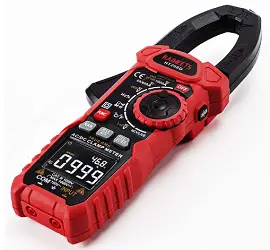
It measures true-RMS values alongside frequency, duty cycle, resistance, capacitance, diode, continuity, and temperature, making it a strong all-round clamp multimeter for professional use in labs, industry, or at home.
Like the HT206D, it includes a built-in NCV detector and an LED flashlight for poorly lit work areas. Its Variable Frequency Drive Filtering (VFD) and Low Input Impedance (LoZ) modes both help deliver more accurate readings in tricky electrical environments.
It complies with IEC 61010-1, CAT IV 600V, and CAT III 1000V ratings, and its double-insulated build offers strong protection against electrical shock.
Best for: Professionals who specifically need inrush current measurement or a higher voltage/current range than the HT206D.
Consider skipping if: You don’t work with motor-starting diagnostics, the HT206D covers everyday use at a lower price.
If you’d rather not select measurement modes manually, Kaiweets also sells the KC602, a Smart Digital Clamp Meter that automatically identifies AC/DC voltage, resistance, and continuity as soon as you connect it, in addition to its usual current, capacitance, diode, NCV, and temperature functions.
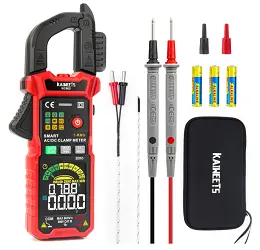
It shares the HT208D’s inrush current measurement (5–600A, AC only) and CAT IV 600V safety rating, but swaps the D-shaped jaw and standard LCD for a large HD colour screen that’s easier to read in low light.
Kaiweets KC602 is a good pick if you’d prefer an auto-sensing meter over manually cycling through modes on the HT206D or HT208D.
3. Fluke 325 Clamp Meter: Best Professional
The Fluke 325 True-RMS Clamp Meter is a dependable, adaptable troubleshooting tool for both commercial and household electrical work. Its slim form factor makes it easy to carry and use, paired with a large display for quick readouts.
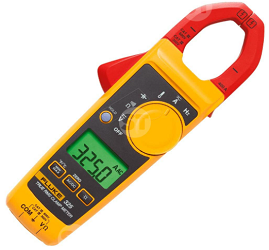
It measures true-RMS AC and voltage on non-linear loads, alongside DC, DC voltage, temperature, and frequency.
Specifically, it covers AC/DC up to 400A via the jaw, AC/DC voltage up to 600V via test leads, frequency from 5Hz to 500Hz, resistance to 40kΩ, and temperature from -10°C to 400°C using the integrated K-type thermocouple.
It’s rated to CAT III 600V and CAT IV 300V safety standards, and its Min/Max feature helps capture important measurement data during troubleshooting.
Fluke backs the 325 with a 2-year warranty against manufacturing defects.
Best for: Buyers who want proven Fluke reliability for AC/DC measurement up to 400A at a reasonable price.
Consider skipping if: You need a genuinely compact meter for tight panel spaces, the Fluke 362 below is built specifically for that.
4. Fluke 362 200A AC/DC Clamp Meter: Best Compact
The Fluke 362 is small enough to fit in your pocket, with an 18mm triangular jaw that reaches into confined spaces other clamp meters can’t access, while still delivering the precision Fluke is known for.
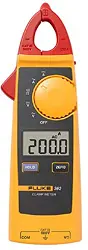
It measures up to 200A AC/DC, a 600V AC/DC voltage range, up to 3000Ω resistance, and detects continuity, solid coverage for basic maintenance and everyday clamp readings.
A data hold feature lets you freeze the displayed value for easier note-taking.
It carries a CAT III 600V safety certification for reliable shock protection, and its large, easy-to-read LCD keeps the interface simple.
Overall, it’s a genuinely compact, easy-to-operate clamp meter built for straightforward AC/DC measurement work.
Best for: Electricians who regularly work in tight panels or confined spaces and want Fluke reliability in a pocket-sized form.
Consider skipping if: You need to measure beyond 200A, the Fluke 325 or Kaiweets HT208D offer higher current ranges.
5. Themisto TH-M88D Auto Range Clamp Meter: Best Value AC/DC
The Themisto TH-M88D is a genuinely well-rounded auto-ranging clamp meter that measures both AC and DC (current) up to 600A, along with AC/DC voltage, resistance, capacitance, frequency, diode, and continuity; a broader feature set than most meters at this price point offer.
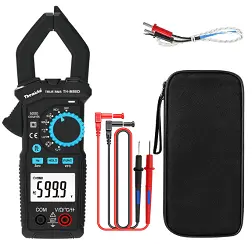
Its True-RMS technology keeps readings accurate even on non-linear loads, which matters if you’re troubleshooting inverters, VFDs, or switching power supplies rather than simple resistive circuits.
A built-in LoZ (Low Impedance) mode up to 600V helps filter out ghost voltage readings that can otherwise mislead you during live circuit testing.
The 6,000-count display gives noticeably finer resolution than basic 2,000–4,000-count meters, and the built-in NCV detector lets you check for live wires without direct contact.
One user testing it on a home solar setup specifically praised its DC (current) accuracy for monitoring solar panel and battery charge/discharge current, and used its diode, continuity, and resistance functions to trace a shorted MOSFET on a power inverter’s PCB.
It’s built to IEC 61010-1 safety standards, and its auto-ranging function removes the need to manually select measurement ranges, a genuine convenience for anyone who isn’t a full-time electrician.
Best for: Buyers who want strong AC/DC versatility, including solar and battery current monitoring, without paying Fluke or Kaiweets pricing.
Consider skipping if: You specifically need the current measurement above 600A; the Kaiweets HT208D covers that higher range instead.
6. Meco 27-Auto Digital Clamp Meter: Best Beginner (AC Only)
The Meco 27-Auto is a straightforward, well-built digital clamp meter from a respected Indian measuring-instruments brand. The Meco MC 27T measures up to 400A AC with auto-ranging, displayed on a 3½-digit, 2000-count LCD.
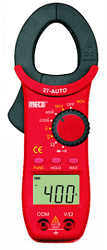
It’s important to know upfront: this meter cannot measure DC. Beyond AC, it covers AC/DC voltage up to 400V, resistance, DC voltage, and temperature, along with data hold, audible continuity, and diode test functions.
This is a genuinely low-cost clamp meter, so don’t expect high-precision accuracy from it. That said, it’s a solid choice for beginners who mainly need AC measurement and want a trusted, affordable Indian brand.
Best for: Beginners on a tight budget who only need AC (current) measurement.
Consider skipping if: You need a DC (current) measurement. This model simply doesn’t support it.
7. HTC Instrument CM-2030 Digital AC Clamp Meter: Best Beginner (with NCV)
The HTC CM-2030 is another AC-only clamp meter, measuring up to 1000A AC. It cannot measure DC (current), so keep that in mind if your work involves DC circuits.
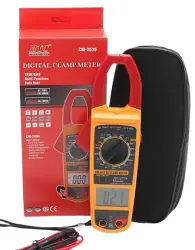
It also measures AC/DC voltage and resistance, with additional continuity and non-contact voltage (NCV) testing built in, a genuinely useful safety feature that the Meco 27 above doesn’t include.
Its large 3½-digit LCD panel includes a backlight for clear readouts, and it delivers a reasonably accurate true-RMS value measurement.
A built-in lamp helps with visibility in poorly lit testing areas, making this another solid, budget-friendly option for beginners.
Best for: Budget buyers who specifically want NCV detection alongside basic AC measurement.
Consider skipping if: You need a DC (current) measurement, or a higher accuracy rating for professional work.
Comparison Table
| Model | Max Current | Max Voltage | CAT Rating | True RMS | AC/DC | Warranty |
|---|---|---|---|---|---|---|
| Kaiweets HT206D | 600A | 600V | CAT III 600V | Yes | Both | 3 years |
| Kaiweets HT208D | 1000A | 1000V | CAT IV 600V / CAT III 1000V | Yes | Both | 2 years |
| Kaiweets KC602 | 600A | 600V | CAT IV 600V | Yes | Both | 3 years |
| Fluke 325 | 400A | 600V | CAT III 600V / CAT IV 300V | Yes | Both | 2 years |
| Fluke 362 | 200A | 600V | CAT III 600V | Yes | Both | 2 years |
| Themisto TH-M88D | 600A | 600V | NA | Yes | Both | 6 Months |
| Meco 27-Auto | 400A | 400V | NA | No | AC only | Standard |
| HTC CM-2030 | 1000A | NA | NA | Yes | AC only | Standard |
Note: Verify current CAT ratings and warranty terms directly with the seller before purchasing, since specifications can be revised between production batches.
Things to Consider While Selecting a Good Clamp Meter
Clamp meters measure current in a circuit by clamping a jaw around a conductor and displaying the result on a digital screen. Here’s what actually matters when choosing one.
1. Determine the Purpose
Start by identifying what you’ll actually use the meter for. Some clamp meters are built for industrial use, others for residential or office work. Match the meter to the job, not the other way around.
2. Accuracy
Accuracy is one of the most important factors, especially for professional use. Most quality clamp meters carry an accuracy rating of around ±1%, while some low-cost devices may vary more, so check that the meter’s precision suits your specific work.
3. Range of Measurement
The meter’s current and voltage range should match the work you’ll be doing. Higher-range meters are needed for industrial or high-current environments. As a rule, price tends to scale with the meter’s maximum measurable range.
4. Build Quality
Look for a clamp meter built from durable materials that can withstand repeated daily use, especially if you’re using it professionally rather than occasionally.
5. Brand and Price
Choose a reputable brand known for reliable measuring instruments. Price matters, but it shouldn’t be the only factor. Look for a meter that’s fairly priced for the value and features it actually offers.
6. Support
A well-written user manual and responsive after-sales support matter more than they might seem to at first. Established brands like Fluke and Kaiweets generally offer stronger support than lesser-known alternatives.
7. Additional Features
Extra features like a backlit display, data hold, NCV detection, and auto-ranging can genuinely improve day-to-day usability. Look for the combination that fits how you’ll actually use the meter.
Understanding CAT Safety Ratings
CAT (Category) ratings indicate how much voltage transient protection a clamp meter offers, and choosing the wrong one for your work is a genuine safety risk, not just a spec-sheet detail.
| CAT Rating | Typical Use Case |
|---|---|
| CAT II | Household appliances, portable tools, and wall outlets |
| CAT III | Distribution panels, motor control centres, and most commercial/industrial feeders |
| CAT IV | Service entrances, outdoor conductors, and utility-side connections, where transient voltages can spike much higher |
For most residential and light commercial electrical work, a CAT III 600V rating is sufficient.
If you work on service entrances, outdoor wiring, or utility-side connections, choose a CAT IV-rated meter instead, since transients in those environments can exceed what a CAT III meter is built to handle safely.
Choosing the Right Jaw Size
Jaw size determines the maximum conductor (or bundle of conductors) your clamp meter can physically fit around, and it’s an easy detail to overlook until you’re standing in front of a panel with the wrong tool.
- Standard 30–35mm jaws, like on the Fluke 325, handle most residential and light commercial conductors without issue.
- Larger conductors in feeders or service entrances may need a 40mm or wider jaw opening to fit properly.
- Compact jaws under 20mm, like the Fluke 362’s 18mm triangular jaw, are built specifically for tight breaker panels where a standard-sized jaw simply won’t fit.
If you regularly work across different panel types and conductor sizes, it’s worth prioritising jaw size alongside the current range when choosing between similarly specced meters.
Common Mistakes to Avoid
- Buying based on the maximum current rating alone. A 1000A-rated meter isn’t automatically “better” than a 400A one if your actual work never exceeds 100A; you’re paying for headroom you won’t use.
- Ignoring the CAT rating for the environment you’ll actually work in. Using a CAT III meter on service-entrance or utility-side work is a genuine safety risk, not just a technicality.
- Assuming all meters measure DC (current). As this list shows, both the Meco 27 and HTC CM-2030 are AC-only; always confirm this specifically if your work involves DC circuits like solar panels, batteries, or automotive systems.
- Overlooking jaw size for your typical conductor bundles. A meter with excellent specs on paper is still frustrating to use if its jaw can’t comfortably fit around the conductors you actually work with.
Summary
Choosing the right clamp meter matters just as much as choosing the right multimeter, and the market has no shortage of options to sort through. The meters covered here represent strong choices across the Indian market, each with a distinct strength that sets it apart.
If you’re a professional electrician or technician, a high-end option like the Kaiweets HT208D or Fluke 325 is worth the investment; both are powerful, long-lasting, and built for demanding daily use.
If you want a feature-rich meter without the premium price, the Kaiweets HT206D remains our top all-around pick for most users. The Fluke 362 is the best choice if compact size for tight panels matters more than maximum current range.
The Themisto TH-M88D is a strong pick if you want broad AC/DC versatility, including solar and battery diagnostics, at a mid-range price. While the Meco 27 and HTC CM-2030 are dependable, affordable options for beginners, just remember neither measures DC (current).
Ultimately, the right clamp meter for you depends on your specific work, budget, and required range. A quality meter is a genuinely worthwhile investment for anyone using it regularly, since it will last longer and handle more complex electrical challenges reliably.
Frequently Asked Questions
Not all clamp meters can measure both. Check the specific model’s specs. The Meco 27 and HTC CM-2030 in this list, for example, only measure AC, while the Kaiweets and Fluke models measure both AC and DC.
Yes, when used correctly and rated appropriately for your work. Always check the CAT rating matches your working environment, follow the manufacturer’s safety guidelines, and wear proper PPE when working near live conductors.
Yes, most modern clamp meters also measure voltage, resistance, capacitance, frequency, and temperature, depending on the specific model. Check the meter’s full spec sheet to confirm which additional measurements it supports.
Fluke, Kaiweets, Meco, HTC, and Themisto are among the most trusted clamp meter brands available in India, each covering different budgets and use cases. Fluke and Kaiweets generally offer the strongest overall feature sets and after-sales support.
High-quality clamp meters typically offer around ±1% accuracy, while lower-quality models may have error margins up to 10%. Always check the specific accuracy rating listed for the model you’re considering.
Current transformer clamp meters can only measure alternating current (AC), while Hall effect clamp meters can measure both AC and DC. This distinction explains why some budget meters, like the Meco 27, only measure AC.
CAT III is rated for distribution panels and most commercial/industrial feeder work, while CAT IV is rated for service entrances and utility-side connections where voltage transients can spike much higher. Always match the CAT rating to your actual working environment.
Standard 30–35mm jaws handle most residential and commercial conductors, while larger feeders may need 40mm+ jaws. Compact jaws under 20mm, like on the Fluke 362, are built for tight panel spaces that standard jaws can’t access.
Not necessarily, match the meter’s range to your actual work rather than buying the highest rating available. A 1000A-rated meter offers no real advantage if your work never exceeds a few hundred amps.
Non-contact voltage (NCV) detection lets you check for live wires without touching them, which is a genuine safety feature worth prioritising, especially for beginners. Not all budget clamp meters include this; the Meco 27 in this list doesn’t, while the HTC CM-2030 does.
Some models can, including the Kaiweets HT208D featured in this list, which is specifically useful for diagnosing motor-starting issues. Not all clamp meters support this, so check for it specifically if you work with motors regularly.
True RMS (Root Mean Square) measurement provides accurate readings even on non-linear loads and distorted waveforms, such as those from variable-frequency drives or electronic dimmers. Non-True-RMS meters can give inaccurate readings on these types of loads, which matters for professional diagnostic work.
It depends on your work. HVAC technicians and those diagnosing motor or transformer issues benefit from built-in temperature measurement via a K-type thermocouple. If your work is purely electrical, it’s a nice-to-have rather than essential.
With proper care and regular battery maintenance, quality clamp meters from established brands can last many years of regular professional use. Warranty length (2–3 years on most models in this list) is a reasonable indicator of manufacturer confidence in long-term reliability.
Fluke generally offers stronger calibration accuracy and brand-backed reliability, which matters for critical professional diagnostic work. For everyday use and DIY work, budget brands like Kaiweets offer strong value and comparable everyday accuracy at a lower price.
We hope you found this guide on the best clamp meters in India useful. Follow Infobits on Facebook, Instagram, and Twitter for more updates like this.
Subscribe to our free newsletter to get similar articles and regular updates directly in your Email Inbox.
Also, share this article with your friends and relatives. Bookmark this page for future reference.
Subscribe to be the first to learn about new information
Disclosure: If you follow our links to a retailer’s website and make a purchase, we will get an affiliate commission on some, but not all, of the items or services we promote. This will cause no price change for you.