
Fosi Audio BT20A Review 2026: BT20A vs Pro vs MAX Explained
Quick answer: The original Fosi Audio BT20A (dual TPA3116D2 chips, 100W x 2 RMS) is still a genuinely excellent budget Class D amplifier for driving passive bookshelf speakers over Bluetooth. But Fosi now sells three different amps under a very similar name: BT20A, BT20A Pro, and BT20A MAX, and picking the wrong one is the single most common mistake buyers make. This review covers the original BT20A in depth and tells you exactly when to spend more on the Pro or MAX instead.
I’ve been using the Fosi Audio BT20A for six months, connected to a pair of budget bookshelf speakers in a small home setup.
Before you scroll down to the review, it’s worth flagging something upfront. If you’ve searched around and seen wildly different specs for “the BT20A” ( some listings mention 100W, others mention 300W ), you’re not going crazy.
Fosi has three separate amplifiers in this family now, and this review is specifically about the original BT20A, the one with dual TPA3116D2 chips. More on the other two below, because choosing the right one matters more than any single spec on the box.
Fosi Audio BT20A: Quick Specs
| Spec | Detail |
|---|---|
| Amplifier chips | 2x Texas Instruments TPA3116D2 |
| Power output | 100W RMS x 2 (4 ohms, 20Hz–20kHz, 0.04% THD) |
| Max speaker compatibility | Up to 320W (4 ohms) / 280W (8 ohms), passive speakers only |
| Bluetooth version | 5.0, up to ~50 ft range |
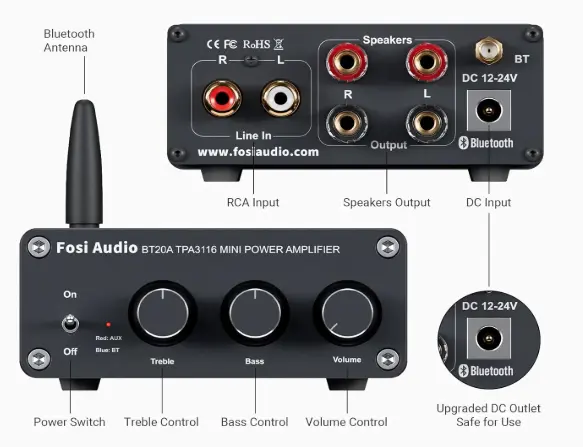
| Inputs | Bluetooth + RCA |
| Frequency response | 20Hz – 20kHz (±1dB) |
| Signal-to-noise ratio | ≥ 98dB |
| Power adapter included | 24V/4.5A |
| Tone controls | Bass and treble knobs on the unit |
| Warranty | 24-month, per Fosi’s standard listing |
First, Which Fosi BT20A Should You Actually Buy?
This is the section most reviews of this amp skip, and it’s genuinely the most useful thing you can know before spending your money.
| Model | Chip(s) | Power (4Ω) | Bluetooth | Extra Features | Roughly Who It’s For |
|---|---|---|---|---|---|
| BT20A (this review) | 2x TPA3116D2 | 100W x 2 | 5.0 | Bass/treble knobs, RCA input | Budget bookshelf setups, first amp for beginners |
| BT20A Pro | 1x TPA3255 | Up to 300W x 2 | 5.0 | REAL-OFF zero-power shutdown, swappable op-amps for tuning | Larger speakers, hobbyists who like tweaking |
| BT20A MAX | TPA3255 + NE5532 | 300W x 2 | 6.0 (LDAC, aptX Lossless) | Built-in cooling fan, PFFB tech, remote, subwoofer output, dual power supply | 2.1 home systems, higher-fidelity listeners, living-room setups |
The jump from BT20A to BT20A Pro is a genuine power upgrade, roughly triple the rated output, for a relatively small price increase.
The jump to BT20A MAX adds a proper feature set (subwoofer output, remote control, higher-end Bluetooth codecs) but costs meaningfully more, and it’s really aimed at a different use case: a living-room 2.1 system rather than a simple desktop or bookshelf pairing.
Bottom line: if you’re driving a pair of modest bookshelf speakers on a desk or in a small room, the original BT20A reviewed here remains the sensible pick. If you’re powering larger speakers or want more headroom, the Pro is worth the extra spend. If you want a subwoofer output, a remote, and the latest Bluetooth codecs for a living-room setup, go straight to the MAX.
Related: Best Stereo Amplifiers in India: How to Choose the Right One
Key Features of the BT20A
1. Genuinely Clean Sound for the Price
The dual TPA3116D2 chip setup is a well-proven Class D design, and it shows. The sound is detailed without harshness, and the amp doesn’t struggle at higher volumes with efficient bookshelf speakers.
2. Bluetooth 5.0 With a Stable Connection
Pairing is quick, and reconnection to a previously paired device is automatic. In day-to-day use across six months, I haven’t had a single dropped connection at normal listening distances.
3. Genuinely Compact Footprint
It’s small enough to sit on a desk or a shelf without dominating the space. It is a real departure from older-generation stereo amps and receivers.
4. Plug-and-Play Setup
Speaker wire in, power adapter in, pair your phone, done. There’s no app, no firmware setup, no menu diving, which is exactly what a lot of buyers want from an entry amp.
5. Bass and Treble Controls
Two physical knobs let you shape the sound without needing an external EQ. Of course, it is basic, but genuinely useful for matching the amp to different speakers or room acoustics.
6. No Pop or Switching Noise
A known annoyance with cheap Class D amps is a loud pop or thump when the Bluetooth connection establishes or when switching inputs. The BT20A avoids this cleanly.
My 6-Month Experience
Sound Quality
Paired with a set of Polk Audio T15 bookshelf speakers (available on Amazon), the BT20A produces clear, controlled sound with reasonable bass extension for the price.
It won’t compete with a proper Class AB integrated amp costing several times more, but for casual listening, background music, and even movie audio through a basic 2.0 setup, it’s genuinely more capable than its price suggests.
Bluetooth Performance
Consistently the standout feature in daily use, like fast pairing, no latency issues while watching video, and reliable reconnection. If wireless convenience is a priority, this amp delivers on it.
Build and Heat
The chassis feels solidly made for the price, and, unlike its bigger sibling, the BT20A MAX, which needs an active cooling fan to manage the heat from its more powerful chip, the original BT20A stays comfortably cool under normal listening levels, since it isn’t pushing anywhere near as much power.
Where It Shows Its Limits
- No dedicated app or remote. Volume, bass, and treble are all controlled on the unit itself; there’s no way to adjust from the couch.
- Passive speakers only. This bears repeating because it trips up a lot of first-time buyers. If your speakers have their own power cable, this amp won’t work with them at all.
- Basic tone controls only. Bass and treble knobs are useful, but they’re not a substitute for a real parametric EQ if you want fine control over your sound.
Pros
- Clean, detailed sound that outperforms its price point
- Reliable Bluetooth 5.0 with no noticeable latency
- Compact design that fits almost anywhere
- Genuinely simple, beginner-friendly setup
- No pop or switching noise
- Runs cool under normal use, no fan needed
- Strong value if you’re not planning to push large, inefficient speakers
Cons
- Passive speakers only; a dealbreaker if you already own powered ones
- No app or remote control
- Basic EQ (bass/treble knobs only, no deeper tuning)
- At higher volumes with lower-efficiency 8-ohm speakers, you may find yourself wanting the extra headroom of the Pro model
Common Mistakes People Make Before Buying
- Confusing the BT20A, Pro, and MAX listings. Always check the exact chip and power rating on the listing you’re buying. Names alone aren’t enough since all three share the “BT20A” branding.
- Buying it for powered speakers. This amp is exclusively for passive speakers with bare wire or banana plug connections. Check your speakers’ spec sheet first.
- Expecting deep bass from small bookshelf speakers. The amp itself has decent low-end control, but no amplifier can add bass extension your speaker’s drivers physically can’t produce. Pair it with a subwoofer-capable setup (like the MAX) if deep bass matters to you.
- Skipping the impedance check. It’s rated for 2–8 ohm passive speakers. Confirm your speakers’ impedance before connecting, especially if reusing older speakers.
- Assuming louder always means better. Running the amp near its rated maximum for long periods with inefficient speakers can push both the amp and speakers harder than necessary. Matching sensible speaker sensitivity to the amp’s power avoids this entirely.
Fosi BT20A vs Other Budget Class D Amps
| Amp | Chip | Power (4Ω) | Standout | Best For |
|---|---|---|---|---|
| Fosi Audio BT20A | 2x TPA3116D2 | 100W x 2 | Best balance of price and simplicity | Budget bookshelf/desktop setups |
| AIYIMA A07 | TPA3255 | ~150–160W x 2 | Slightly more headroom, no tone controls | Purists who don’t need bass/treble knobs |
| Fosi Audio BT20A Pro | TPA3255 | Up to 300W x 2 | Swappable op-amps, more power | Larger passive speakers, tinkerers |
| SMSL AO200 / AD18 | Infineon MA12070 | Comparable to Pro | Front display, subwoofer output, remote | Users wanting a fuller feature set at a higher price |
Independent measurement-focused reviewers have found the Fosi/AIYIMA-class amps in this segment to perform close to their rated specs with strong signal-to-noise figures for the price, which is a large part of why this category has become so popular with budget-conscious hi-fi hobbyists in the first place.
Related: Sony SA-D40M2 Review: 4.1 Channel Home Theatre Speaker
Who Should Buy the Fosi Audio BT20A?
- First-time amp buyers who want a genuinely capable, no-fuss introduction to powered passive speakers
- Desktop and small-room listeners driving efficient bookshelf speakers
- Anyone prioritising Bluetooth convenience over deep customisation
- Budget-conscious buyers who don’t need a subwoofer output or remote control
Who Should Look at the Pro or MAX Instead
- Owners of larger, less efficient speakers that need more current – the Pro’s TPA3255 chip gives real headroom here
- Anyone building a proper 2.1 system with a subwoofer – only the MAX has a dedicated subwoofer output.
- Listeners who want a remote and higher-end Bluetooth codecs like LDAC or aptX Lossless – again, the MAX.
- Owners of powered/active speakers – none of the three BT20A models will work; look at a preamp or DAC instead.
Final Verdict: Is the Fosi Audio BT20A Worth It?
Six months in, the original BT20A remains a genuinely impressive amplifier for what it costs; clean sound, dependable Bluetooth, and a setup process that takes minutes, not hours.
It won’t replace a proper hi-fi separates system, and it’s strictly limited to passive speakers, but within that scope, it punches well above its price.
The one thing I’d tell anyone before they buy: decide which BT20A you actually need. If you’re driving modest bookshelf speakers and want simplicity, this base model is the smart, affordable choice.
If you already know you’ll want more power or a subwoofer down the line, it’s worth paying more upfront for the Pro or MAX rather than buying this one twice.
Related: Best Soundbars in India: Tested Picks for Every Budget & Room Size
Overall Rating: 4.6/5 ⭐⭐⭐⭐⭐
- Sound Quality: ⭐⭐⭐⭐☆ (Excellent for the price; not a substitute for larger, more powerful amps)
- Build Quality: ⭐⭐⭐⭐⭐ (Solid, compact, well put together)
- Connectivity: ⭐⭐⭐⭐⭐ (Fast, stable Bluetooth 5.0 pairing)
- Ease of Use: ⭐⭐⭐⭐⭐ (Genuinely plug-and-play)
- Value for Money: ⭐⭐⭐⭐⭐ (Hard to beat at this price point)
Would I recommend it? Yes, as long as you’ve confirmed it’s the right BT20A for your speakers and your goals, this is one of the easiest ways to get real, room-filling sound out of a pair of passive bookshelf speakers without spending on a full hi-fi setup.
Where to Buy
If you’re setting this up for the first time, a decent pair of banana plug speaker cables (available on Amazon) makes wiring cleaner and connections more reliable than bare wire, especially if you’ll be moving the setup around.
For anyone repurposing old passive bookshelf speakers to pair with the BT20A, a basic speaker stand pair (view on Amazon) improves both sound dispersion and room aesthetics. This will be a small addition that makes a real difference to how the setup actually sounds and looks.
Frequently Asked Questions
No. It’s built exclusively to drive passive speakers through its amplifier output. Powered speakers already have their own built-in amplifier and should be connected via a preamp or line-level source instead.
The base BT20A uses two TPA3116D2 chips for 100W x 2 output. The Pro upgrades to a single TPA3255 chip for up to 300W x 2. The MAX adds a cooling fan, PFFB technology, Bluetooth 6.0 with LDAC, a remote, and a subwoofer output, aimed at fuller home systems.
No, the base BT20A runs standard Bluetooth 5.0 with SBC/AAC support. If high-resolution Bluetooth codecs matter to you, the BT20A MAX supports LDAC and aptX Lossless.
It supports passive speakers rated between 2 and 8 ohms.
No, none of the controls is remote-operable on the base BT20A. Volume, bass, and treble are all adjusted on the unit itself. Only the BT20A MAX includes a remote.
For most small-to-medium rooms with reasonably efficient bookshelf speakers, yes. For larger rooms or less efficient speakers, the Pro’s extra headroom will give more comfortable volume without strain.
No. Only the BT20A MAX includes a dedicated subwoofer output for 2.1 setups.
Both use TI’s Class D chips and deliver clean sound at similar prices. The BT20A includes bass/treble tone controls, which the A07 typically lacks, making the BT20A slightly more flexible for tuning to different speakers and rooms.
Only through a phono preamp. Like most amplifiers in this class, it accepts line-level RCA input, not a raw phono signal, so a turntable needs to be pre-amplified first.
In six months of regular listening at moderate volumes, it has stayed comfortably cool without needing active cooling. It is a benefit of its lower power ceiling compared to the Pro and MAX.
The amplifier unit, a 24V/4.5A power adapter, an AC cord, a Bluetooth antenna, and a user manual.
Yes. Its plug-and-play setup, reasonable price, and genuinely clean sound make it one of the more approachable entry points into passive speaker setups for beginners.
On the Pro model, an optional higher-voltage power supply unlocks more of its rated power ceiling. The base BT20A ships with a fixed 24V/4.5A adapter suited to its 100W rating, so there isn’t the same upgrade path.
Yes, it supports the 2–8 ohm range, so 6-ohm bookshelf speakers are well within its compatible range.
Fosi has built a strong reputation in the budget Class D amplifier space over several years, with an active community of users and consistently positive feedback across independent audio forums and review sites.
We hope you are interested in our articles and consider following our Facebook, Instagram, and Twitter pages for regular updates.
Also, share this article with your friends and relatives. Bookmark this page for future reference.
Subscribe to our free newsletter to get similar articles and regular updates directly in your Email Inbox.
Subscribe to be the first to learn about new information
Disclosure: If you follow our links to a retailer’s website and make a purchase, we will get an affiliate commission on some, but not all, of the items or services we promote. This will cause no price change for you.