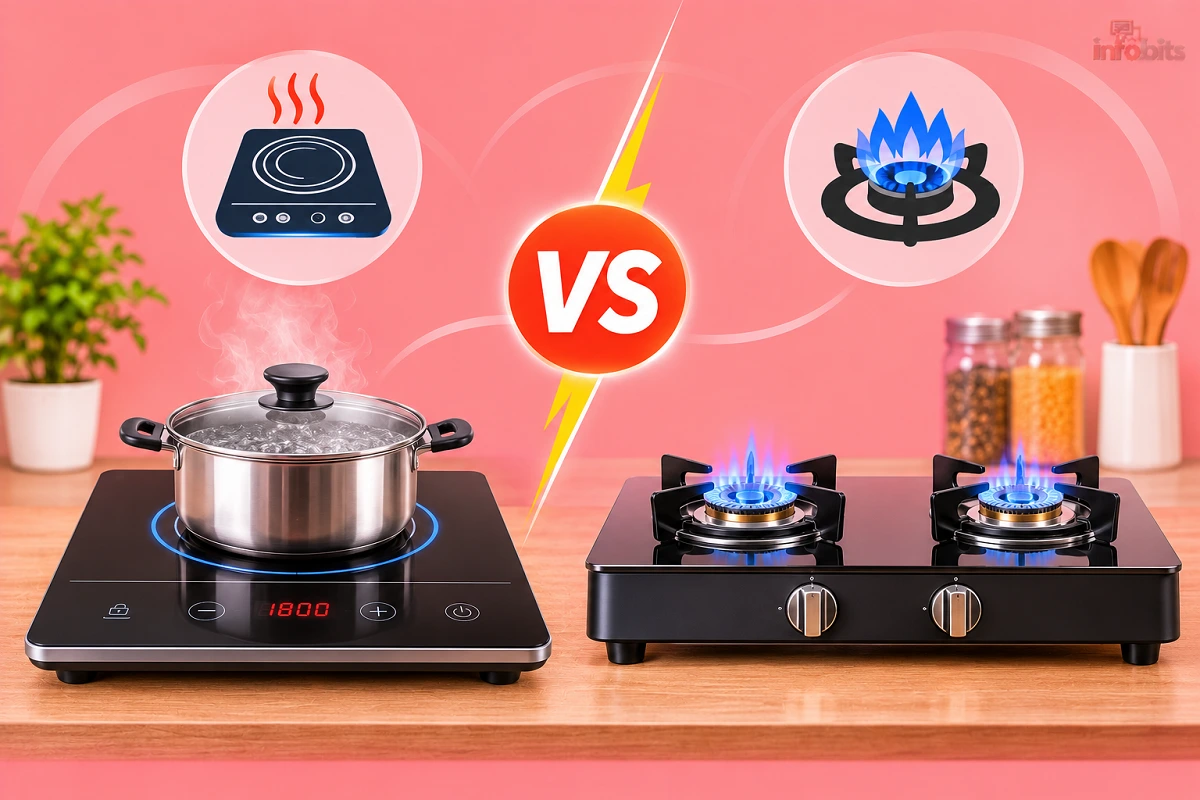
Induction Cooktop vs Gas Stove: Full Comparison for Indian Kitchens
Quick Answer: Neither wins for everyone. Induction is cleaner, safer and usually a little cheaper to run. Gas works in every power cut and is the only way to puff a phulka on an open flame.
- Choose induction if: your vessels are steel or cast iron, your power supply is steady, and you want a cooler, easier-to-clean kitchen.
- Choose gas if: you cook in aluminium, copper or clay vessels, face long power cuts, or make phulkas every day.
- Best for most Indian homes: one induction cooktop for daily dal, rice, tea and sabzi, plus a gas stove for phulkas and power cuts.
- Running cost: the heat in one 14.2 kg LPG cylinder needs about 85 to 130 units of electricity on induction. That is roughly ₹430 to ₹1,150 at ₹5 to ₹9 per unit, against about ₹942 for a cylinder in Delhi.
Every Indian kitchen reaches this question sooner or later. One relative swears by induction. Another says nothing beats a real flame for rotis.
Both are right, and that is why the choice feels hard. I am an electrical engineer, so I look at this the way I look at any appliance. What does it cost to run? What does it demand from your wiring? Where does it fail in a real Indian home?
By the end of this guide, you will know the real running cost per cylinder, what happens to your phulkas, what to do in a power cut, and which setup fits your kitchen. No brand hype. Just numbers and trade-offs.
Induction Cooktop vs Gas Stove: Quick Comparison
| Factor | Induction cooktop | Gas stove (LPG) |
|---|---|---|
| How it heats | A magnetic field heats the vessel itself | A flame heats the vessel from below |
| Energy efficiency | About 85 to 90% | Roughly 40 to 60% in real kitchens |
| Speed | Fast, especially for boiling | Fast on high flame, but heat escapes around the vessel |
| Running cost | Usually slightly lower | Depends on cylinder price (₹942 in Delhi, Nov 2026) |
| Upfront cost | About ₹1,500 to ₹4,500 for most single burners | About ₹1,000 to ₹6,000 depending on burners and body |
| Cookware | Magnetic, flat-base vessels only | Almost anything |
| Phulka, papad, baingan on flame | Not possible | Easy |
| Power cut | Stops without an inverter | Keeps working |
| Heat control | Precise and instant | Good, by eye |
| Kitchen temperature | Much cooler | Noticeably hotter |
| Main safety risk | Electrical faults, hot vessels | Gas leaks, open flame, fumes |
| Air at the stove | No combustion fumes | Releases nitrogen dioxide and carbon monoxide |
| Cleaning | Wipe a flat glass top | Scrub grates and burners |
| Wiring needs | A proper 16A socket | None |
What Is an Induction Cooktop, and How Is a Gas Stove Different?
An induction cooktop heats the vessel, not the stove. A copper coil under the glass carries fast-alternating current. That creates a magnetic field, which makes the steel base of your vessel heat up. The glass stays comparatively cool.
A gas stove burns LPG (or piped natural gas) at a burner. The flame heats the base and sides of the vessel. A lot of that heat escapes into the room, which is why a gas kitchen feels hot in summer.
Want the electric alternative that works with any cookware? Our guide to induction vs infrared cooktops covers it.
Which Is Cheaper to Run in India? The Real Numbers
Most comparisons say “induction is 85 to 90% efficient” and stop there. That does not tell you what lands on your bill. So let us convert one cylinder into units of electricity.
A 14.2 kg LPG cylinder holds about 180 units (kWh) of heat energy. That is my calculation from LPG’s typical energy content of roughly 46 MJ per kg. Not all of it reaches your food.
Induction passes on about 85 to 90% of the electricity it draws. A gas burner passes on far less. Brand blogs quote anything from 35% to 60%. I have used 40%, 50% and 60% below, so the table stays fair to gas.
| Your gas stove’s real efficiency | Heat reaching your food from one cylinder | Units induction needs for the same job | Cost at ₹5/unit | Cost at ₹7/unit | Cost at ₹9/unit |
|---|---|---|---|---|---|
| 60% (good) | About 109 units | About 128 units | ₹640 | ₹896 | ₹1,152 |
| 50% (typical) | About 91 units | About 107 units | ₹535 | ₹749 | ₹963 |
| 40% (poor) | About 73 units | About 86 units | ₹430 | ₹602 | ₹774 |
Now compare each figure with the price of one cylinder. In Delhi, that is ₹942 as of November 2026. Across cities, it runs from about ₹940 to just over ₹1,030.
What the table tells you. Induction is cheaper when your electricity rate is below roughly ₹7 to ₹11 per unit, depending on how efficient your gas setup is. For a typical stove, the break-even sits near ₹8.80 per unit. Most households pay less than that, so induction usually wins. But not by much.
The monthly reality. Say a family finishes a cylinder every 40 days. That is about ₹706 of gas a month. The same cooking on induction takes roughly 65 to 95 units a month. At ₹7 per unit, that is ₹450 to ₹670.
So the savings can be anywhere from nothing to about ₹300 a month. Do not switch only to save money. Switch for a cooler kitchen, easier cleaning and no cylinder hassle. Savings are a bonus.
Three things that change the math
1. Your electricity slab. In slab-based billing, extra units can push you into a costlier slab. In Kerala, for example, once monthly use crosses 250 units, one higher rate applies to every unit. Check your state’s slabs before you go fully electric.
2. Your cylinder price. LPG rates are revised every month. The 14.2 kg price in Delhi has stayed at ₹942 since June 2026, after hikes in March and June. Check your distributor’s current rate and redo the table.
3. Piped gas (PNG). If you have PNG, the gap narrows. By my rough conversion, PNG at about ₹50 per SCM in Delhi works out close to LPG per unit of heat, since one SCM carries roughly 10 units of heat energy. Run the same math with your own PNG bill.
Measure your own cost
The best way to settle this is to measure it. Plug your cooktop into an energy-monitoring plug and note the units used per week. Our smart plug guide lists several 16A models. Always confirm the 16A rating before you buy, because a 2000W cooktop is a heavy load.
No plug? Note your meter reading before and after one week of induction-only cooking. It works just as well.
What about upfront cost?
A good single-burner induction cooktop is cheap. The real expense is cookware. If your vessels are not magnetic, a basic daily set can cost ₹3,000 to ₹6,000 to replace.
If you save ₹150 to ₹300 a month, that cookware takes 10 to 40 months to pay back. Another reason to replace only what you actually use every day.
Cookware: The Deciding Factor in Most Indian Kitchens
Ask anyone who has switched from gas, and cookware is usually the story. Induction is strict. Gas does not care.
The 10-second magnet test. Hold a fridge magnet to the base of the vessel. If it sticks firmly, the vessel works on induction. If it slides off or barely holds, it will not heat.
Usually works: magnetic stainless steel, cast iron, iron tawas, and aluminium cookers with a bonded induction base.
Does not work: pure aluminium, copper, brass, glass and clay. That includes the old aluminium kadhai, the copper tapeli and the clay handi.
Shape matters too. The base must be flat and sit fully on the ring. A round-bottom wok or kadhai wobbles and heats poorly. Very small tadka pans and oversized pots that overhang the ring also give uneven results.
You do not have to replace everything. Start with four vessels: a pressure cooker, a flat kadhai, a tawa and a small saucepan for tea and milk. If you can only convert one, make it the cooker. An induction-base pressure cooker (view on Amazon) costs far less than a new set and handles daily dal and rice.
Roti, Dosa and Tadka: Dish-by-Dish Verdict
This is where the real arguments happen at home. Here is how common dishes behave on each.
| Dish | Induction | Gas |
|---|---|---|
| Roti on a tawa | Works well on a flat iron tawa | Works well |
| Phulka puffing | Weak. No open flame | Best. Direct flame puffs it fully |
| Roasting papad, baingan, chillies | Not possible directly | Easy |
| Dosa and uttapam | Very even, steady heat | Needs practice to keep heat even |
| Tadka and tempering | Instant on and off, easy to control | Strong, classic |
| Dal and sambar simmering | Excellent low, steady heat | Good, but watch for burnt bottoms |
| Pressure cooker | Needs an induction-base cooker | Any cooker |
| Deep frying | Good temperature control | Fine, but heat can swing |
| Idli steaming | Works with a steel idli cooker | Works |
| Dum biryani in a clay handi | Not possible | Possible |
A heavy flat iron tawa (see the options on Amazon) holds heat well on induction and suits rotis and dosa. To help a roti puff without a flame, press its edges gently with a folded cloth right after flipping.
We would like to suggest that if phulkas are a daily ritual, keep one gas burner. That single decision settles most arguments at home.
Power Cuts and Inverters: The Gap Most Guides Skip
Gas keeps working when the power goes out. Induction stops the moment the supply does. If your area has frequent or long cuts, this matters more than any efficiency number.
Can you run induction on an inverter? Yes, but only with the right inverter. Use a pure sine wave type. Our guide on sine wave vs square wave inverters explains why.
Size matters. Most home inverters of 900 to 1100 VA are too small for an induction cooktop. As a thumb rule, use 2 kVA or more for a 1,000 to 1,400W setting and about 3 kVA for a full 2,000 W. Check your inverter’s manual before you try.
Battery drain is the hidden cost. Cooking for 30 minutes at 1,000W uses about 0.5 units. On a 12V system, that is roughly 45 to 50 Ah from the battery, after inverter losses.
A 150 Ah battery has about 75 Ah to spare if you want to protect its life, so you get only a few sessions before your lights and fans need that charge. See our guide to selecting an inverter and its battery.
A simple plan that works:
- Cook on a low-power setting (800 to 1,000W) during cuts.
- Keep one gas burner for long outages.
- Do not expect a small portable power station to run it. Even a 300W unit is far too small.
Have rooftop solar? Daytime cooking on induction uses power you would otherwise export. Our guide on the energy a 3 kW solar system produces helps you size it.
Wiring and Sockets: Check This Before You Buy
The first thing I check is the socket, not the cooktop. A 2000W cooktop draws about 8.7 amps at 230V. That is too much for the 5A or 6A sockets meant for chargers and lamps.
Use a 16A socket on a proper circuit. A 2.5 sq mm copper wire and a suitable MCB are the usual standard for 16A circuits. Avoid cheap extension boards, and do not run a geyser, AC and induction on one overloaded line.
A plug that feels warm after 20 minutes is a warning sign. Stop using it and have an electrician check the socket. Our explainer on RCCB vs MCB vs SPD shows which protection devices you need.
Voltage matters as well. Low voltage cuts heating power, and some budget models shut down during dips. Look for wide voltage tolerance and surge protection.
Safety: Gas Leaks, Hot Vessels and Pacemakers
Gas stove risks
Gas is safe when it is maintained. Most accidents come from old hoses, loose regulators and smells that people ignore.
Warning signs to act on:
- A rotten-egg or cabbage smell near the stove or cylinder
- A yellow or orange flame instead of a steady blue one
- Black soot on vessel bottoms
- A cracked, stiff or old rubber hose
- Hissing when the knob is off
- A rusted or dented cylinder
Check the test-date code on the cylinder’s collar. The letters A, B, C and D stand for the four quarters of a year, and the number is the year. B-28 means the cylinder is due for testing in April to June 2028. Many distributors also advise changing the rubber tube about every five years.
A gas leak detector with alarm (available on Amazon) adds a second layer of safety. LPG is heavier than air, so mount it low and follow the manufacturer’s distance from the stove.
If you smell gas:
- Do not switch any light, fan or appliance on or off. Do not light a match.
- Close the regulator knob.
- Open all doors and windows.
- Step out of the kitchen. Move the cylinder outside only if it is safe to do so.
- Call your distributor’s emergency number or the LPG emergency helpline, 1906.
Induction risks
Induction removes the flame and the leak risk. It does not remove every risk.
- Hot glass: the surface warms from the hot vessel. Watch the residual-heat light.
- Electrical faults: wet hands, damaged cords and overloaded sockets are the usual culprits.
- Metal on the surface: knives, spoons and foil can heat up.
- Spills into the vents: wipe spills quickly and never pour water near the cooktop.
- Children: use the child lock if your model has one.
Pacemakers and implanted devices
Normal home use of induction is considered safe for healthy adults. It uses a non-ionising magnetic field, not the kind of radiation that damages cells.
People with pacemakers or implanted cardiac devices should check with their cardiologist before buying. Keep a sensible distance, centre the vessel fully over the ring, and avoid leaning over it while it runs.
What about indoor air?
Studies in US homes found that gas and propane stoves release nitrogen dioxide and other pollutants. Electric stoves release none at the stove itself.
Those studies were on US homes and natural gas or propane, so results in Indian kitchens will differ with LPG, kitchen size and ventilation.
The sensible takeaway is simple. If you cook on gas, use a chimney or exhaust fan and keep a window open. Induction removes combustion fumes but not oil smoke from tadka, so ventilate either way.
An air purifier helps with lingering smoke, but it is not a substitute for ventilation. See our air purifier buying guide.
Everyday Life: What Actually Changes in Your Kitchen
Summer heat. A gas flame warms the whole kitchen. Induction keeps most of the heat in the vessel, so the room stays noticeably cooler.
Cleaning. A flat glass top wipes clean in seconds. Gas grates and burners need scrubbing, and boil-overs clog the burner holes.
Cylinder hassle. With gas, you book, wait, receive and store a cylinder. With induction, you flip a switch. That alone wins over many families.
Cooking habits. Induction heats food very fast. You will reduce the heat sooner than you expect. Give yourself a week to adjust.
Rented homes and hostels. Induction is easy to carry and needs no connection. Just check house rules and the wiring first.
Common Mistakes to Avoid
- Buying before the magnet test. Test your most-used vessels first.
- Using a 5A or 6A socket. Use a 16A socket on a proper circuit.
- Cooking in round-bottom vessels. They wobble and heat unevenly on induction.
- Using cheap extension boards. They overheat under a 1,500 to 2,000W load.
- Judging only on running cost. Savings are small. Comfort and safety matter more.
- Expecting a small inverter to cook. Size the inverter and battery first.
- Running the cooktop with an empty vessel. It overheats and shuts down.
- Blocking the vents. Never place it on a cloth, foam mat or soft surface.
- Ignoring an old gas hose or regulator. Replace them on schedule.
Myth vs Fact
Myth: Induction cooktops give off dangerous radiation. Fact: They use a non-ionising magnetic field. Normal use is considered safe for healthy adults. People with pacemakers should ask their cardiologist.
Myth: Induction will blow up your electricity bill. Fact: A family that finishes a cylinder every 40 days adds roughly 65 to 95 units a month. Check your slab, but the jump is usually modest.
Myth: Food cooked on an open flame tastes better. Fact: Taste comes from ingredients, oil and technique. Only direct charring, like a puffed phulka or roasted baingan, needs a flame.
Myth: Gas is always cheaper than induction. Fact: At typical tariffs, induction is slightly cheaper. Gas can win if your rate is above roughly ₹9 per unit and your stove is efficient.
Myth: Any steel vessel works on induction. Fact: Some stainless steel is non-magnetic. Always do the magnet test.
Induction Cooktop Troubleshooting
| Problem | Likely cause | What to try |
|---|---|---|
| Beeps or shows no vessel detected | Non-magnetic, too small or off-centre vessel | Do the magnet test, centre the vessel, use a larger base |
| Switches off mid-cooking | Overheating, blocked vents, empty vessel, low voltage | Let it cool, clear the vents, check the socket and voltage |
| Buzzing or humming | Thin or warped vessel base, high power setting | Lower the power, use a heavier flat-base vessel |
| Trips the MCB | Overloaded or shared circuit | Move it to a dedicated 16A circuit |
| Heats slowly | Low voltage, small vessel, low power setting | Use a proper-size vessel and a higher setting |
| Fan keeps running after use | Normal cooling | Wait for it to stop. Do not unplug early |
| Error code on display | Sensor, overheating or voltage issue | Check the manual. If it repeats, get it serviced |
A Two-Week Plan to Switch Without Regret
- Days 1 to 3: use induction for tea, milk and boiling water only.
- Days 4 to 7: move rice, dal and sabzi to induction-compatible vessels.
- Week 2: try tadka, dosa and frying.
- Keep gas for phulkas, roasting and power cuts.
- Note your meter reading on day 1 and day 14 to see the real extra units.
- Decide: go induction-first, stay hybrid, or add only the vessels you truly miss.
How to Choose: Buying Tips
Induction cooktop
- Wattage: 1,400W is enough for one or two people, or as a second cooktop. Choose 1,600 to 2,000W for a family. Beyond about 2,000W, the time saved on everyday dishes is small.
- Voltage tolerance and surge protection: important if your supply swings.
- Features: Indian presets, a timer, child lock and auto shut-off are useful. A strong cooling fan and open vents matter more than extra presets.
- Service and warranty: check the service network in your town. Our guide on what onsite warranty means helps you read the fine print.
For a second cooktop, a 1,300W model such as the Philips HD4934/00 (view on Amazon) covers tea, milk and small batches. For primary cooking, the Philips Viva Collection HD4928/01(see on Amazon) is the kind of 2,100W model worth shortlisting. Check the price trend first with our Amazon price history guide.
Gas stove (if you are keeping or upgrading)
- Two burners are enough if you add an induction cooktop.
- Look for brass burners, toughened glass, an ISI mark and a reliable regulator and hose.
- Use a chimney or exhaust fan.
Simple ways to cut LPG use: cook in a pressure cooker, cover your vessels, soak dal before cooking, match the vessel to the burner size, and keep burners clean for a steady blue flame.
Which Should You Choose? A Simple Decision Guide
Choose induction if:
- Most of your vessels are steel or cast iron, or you are happy to replace a few.
- Your power supply is steady, or you have a proper inverter.
- You want a cooler kitchen, easier cleaning and no cylinder booking.
Choose gas if:
- You cook mainly in aluminium, copper or clay vessels.
- Your area has long power cuts.
- You make phulkas, roast papad or baingan daily.
Choose both if:
- You cook a wide range of dishes every day. This is what most Indian homes end up doing.
| Your situation | Best setup | Why |
|---|---|---|
| Hostel, bachelor or rented room | Induction only (check house rules) | No cylinder, cheap and portable |
| Couple in an apartment with steel cookware | Induction plus a small gas backup | Low running cost, cooler kitchen |
| Family of four to five, phulkas daily | 2-burner gas plus a 1,600 to 2,000W induction | Flame for rotis, induction for the rest |
| Frequent long power cuts | Gas first, induction second | Gas keeps working |
| Elderly members or small children | Induction first (pacemaker check if needed) | No open flame, cooler surface |
| Rooftop solar owner | Induction first | Uses daytime solar power |
| Mostly aluminium or clay cookware | Gas first, add induction gradually | Avoids replacing everything |
| Bulk cooking for gatherings | Gas | Bigger vessels, higher heat |
Final Verdict: What I Would Do in an Average Indian Kitchen
If I were setting up an ordinary family kitchen today, I would keep a 2-burner gas stove and add one 1,600 to 2,000W induction cooktop. Daily dal, rice, tea and sabzi go on induction. Phulkas, roasting and power cuts go on gas.
You get a cooler kitchen, easier cleaning and a lower gas bill without giving up anything you love. And you can switch further, step by step, once you see your own numbers.
Frequently Asked Questions (FAQs)
Usually, but only slightly. About 85 to 130 units of electricity do the work of one 14.2 kg LPG cylinder, which costs ₹942 in Delhi. At ₹5 to ₹7 per unit, induction wins. Above roughly ₹9 per unit, gas can be cheaper. Expect savings of ₹0 to ₹300 a month.
Neither is better for every kitchen. Induction suits dal, rice, sabzi, tea and pressure cooking. Gas suits phulkas, roasting, clay and aluminium vessels, and power cuts. Most Indian homes do best with both: induction for daily cooking and one gas burner for the rest.
A 2000W cooktop at full power uses 2 units an hour. In practice, it cycles and runs lower on simmer, so an hour of real cooking often uses 1 to 1.5 units. A 1,400W model uses at most 1.4 units an hour.
For most dishes, yes. The gaps are open-flame roasting, phulka puffing, clay or aluminium vessels, and cooking during power cuts. Many families go induction-first and keep one gas burner for these jobs.
Roti cooks well on a flat iron tawa. Phulkas puff less because there is no open flame. Press the roti’s edges with a folded cloth to help it puff, or keep a gas burner for puffing.
Any vessel with a magnetic base: magnetic stainless steel, cast iron, iron tawas and induction-base aluminium cookers. Pure aluminium, copper, glass, brass and clay do not work. Stick a fridge magnet on the base. If it holds firmly, the vessel will work.
Yes, with a pure sine wave inverter of enough capacity. Most 900 to 1100 VA home inverters are too small. As a rule of thumb, use 2 kVA or more for a 1,000 to 1,400W setting and about 3 kVA for 2,000 W. Check your inverter manual first.
In most homes, yes. There is no flame, no gas leak risk, and the surface stays cooler. Induction still has electrical risks and hot vessels, so use a proper 16A socket and keep it dry. Gas needs a good regulator, hose and ventilation.
Induction uses a non-ionising magnetic field, and normal home use is considered safe for healthy adults. Use a vessel that covers the ring and do not lean over it. People with pacemakers should check with their cardiologist first.
Yes. Burning gas releases nitrogen dioxide and carbon monoxide. US studies found stove use can raise indoor nitrogen dioxide to unhealthy levels, especially in small, poorly ventilated kitchens. Use a chimney or exhaust fan and open a window. Indian homes and LPG may differ from those studies.
A 1,600 to 2,000W cooktop suits most families of four. Beyond about 2,000W, the time saved on everyday Indian dishes is small. A 1,400W model works for one or two people, or as a second cooktop.
No. A 2000W cooktop draws about 8.7 amps, which is too much for a 5A or 6A socket meant for chargers. Use a 16A socket on a proper circuit with suitable wiring and an MCB. A plug that gets warm is a warning sign.
If you cook entirely on induction, expect about 65 to 95 extra units a month for a family that uses a cylinder every 40 days. At ₹7 per unit, that is ₹450 to ₹670. Check your state’s slabs, because extra units can push you into a higher slab.
Yes. Heat responds instantly, so tadka is easy to control, and temperature control is more precise for frying. Use a flat-bottom kadhai. Never leave hot oil unattended on any stove.
Common causes are overheating from blocked vents or an empty vessel, low voltage, a vessel that is too small or off-centre, or an overloaded socket. Let it cool, clear the vents, centre a magnetic vessel and try another socket. If it keeps happening, get it serviced.
About 85 to 130 units, depending on how efficient your gas stove is. This is an estimate based on a cylinder holding about 180 units of heat and induction wasting very little. Measure your own usage with an energy meter for accuracy.
Induction is usually easier. There is no cylinder to book, store or transfer, and a basic model is cheap and portable. Check house rules and the wiring, and carry a magnet to test vessels.
No. Taste comes from ingredients, oil and technique, not the heat source. The real differences are no smoky char from a direct flame, and more precise heat control, which many cooks find gives steadier results.
We hope this comparison helped you decide. Share it with someone who is stuck between the two, and bookmark it for your next kitchen upgrade.
Consider following our Facebook, Instagram, and Twitter pages for regular updates.
Also, share this article with your friends and relatives. Bookmark this page for future reference.
Subscribe to our free newsletter to get similar articles and regular updates directly in your Email Inbox.
Subscribe to be the first to learn about new information
Disclosure: If you follow our links to a retailer’s website and make a purchase, we will get an affiliate commission on some, but not all, of the items or services we promote. This will cause no price change for you.