Do You Need a 1000W Mixer Grinder? Wattage Explained (500W vs 750W vs 1000W)
Walk into any appliance store, and the salesperson will point you to the biggest number on the shelf. “Sir, this one is 1000 watts.” It sounds like more power, so it must be better.
But is it? A mixer grinder isn’t a car engine. The wattage on the box tells only part of the story.
I’m an electrical engineer by training, so I like to look at what that number really means. In this guide, I’ll explain wattage in simple words, show you the real electricity cost, and help you decide if you need a 1000W mixer grinder or if a cheaper one will do.
Quick Answer: Do you need a 1000W mixer grinder? Most Indian homes don’t. A good 750W mixer grinder handles daily chutneys, dosa batter and masalas for a family of 2 to 5. A 1000W model makes sense if you grind in bulk, cook for a large joint family, or run a home food business. It uses only a little more electricity, but it needs a stronger power supply and costs more.
What Does Wattage Mean in a Mixer Grinder?
Wattage tells you how much electrical power the motor can draw. A 1000W motor draws more electricity than a 500W motor when it runs at full load. That’s all the number says.
It doesn’t tell you how well the blades cut. It doesn’t tell you how good the jar design is. And it doesn’t tell you how long the motor will last.
On most labels, the wattage is input power, not output power. Input power is what the motor pulls from your socket. The power delivered at the blades is lower because some energy is lost as heat and friction. So a “1000W” mixer does not give you 1000W of grinding force.
You can also work out the current. Divide watts by voltage (230V in our case). A 1000W mixer draws about 4.3 amps. A 750W one draws about 3.3 amps, and a 500W one about 2.2 amps.
500W vs 750W vs 1000W: The Real Difference
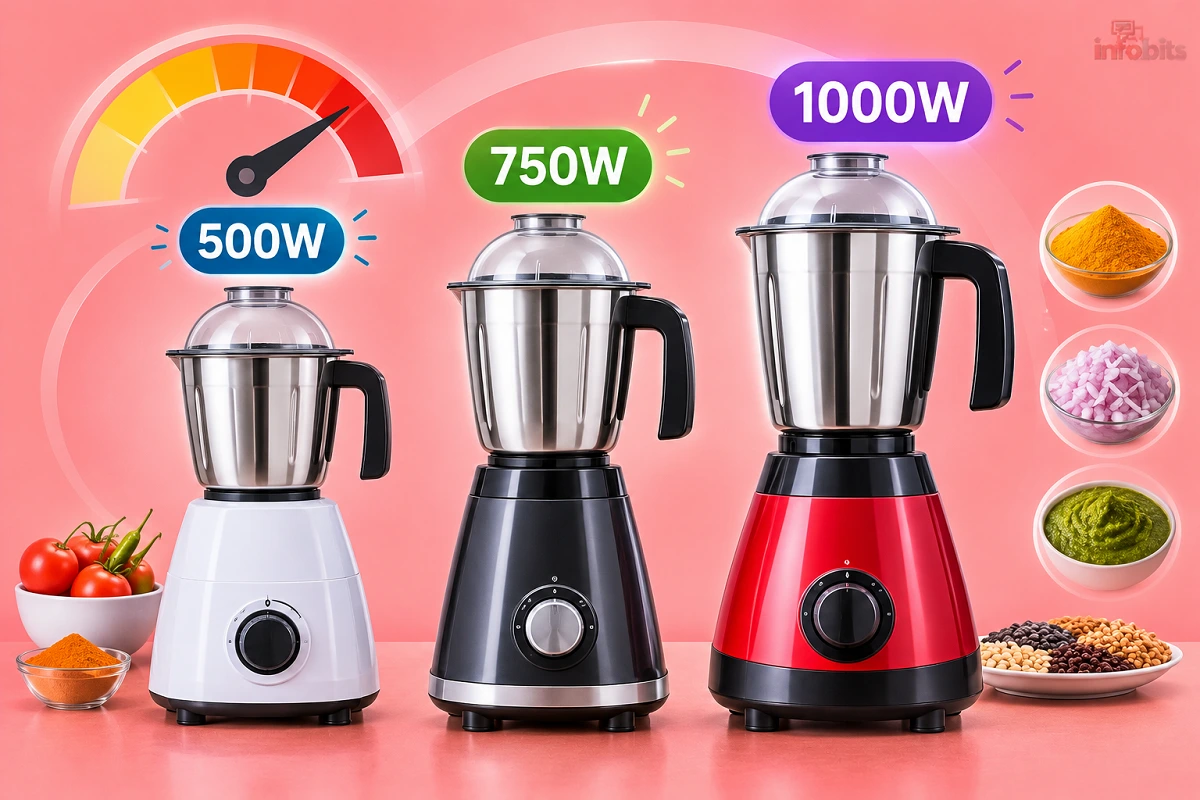
Here’s how the three common ratings compare in everyday use.
| Feature | 500W | 750W | 1000W |
|---|---|---|---|
| Current drawn (approx.) | 2.2 A | 3.3 A | 4.3 A |
| Best for | 1 to 3 people, light use | 2 to 5 people, daily use | 5+ people, bulk or business use |
| Chutney and thin batter | Easy | Easy | Easy |
| Thick idli/dosa batter | Okay in small batches | Good | Very good in large batches |
| Dry turmeric, chilli, pulses | Slow, heats up | Good | Handles it with less strain |
| Typical price | Lowest | Mid-range | Highest |
| Power needs | Any home socket | Any home socket | Strong wiring, bigger inverter |
Notice something? For soft jobs like chutney, all three perform alike. The gap shows only when the load is heavy, or the batch is big.
When a 1000W Mixer Grinder Makes Sense
A 1000W model is worth it in a few specific situations.
- You cook for 6 or more people and grind batter or masala every day.
- You grind in bulk, such as a week’s worth of dry masala at once.
- You run a home kitchen business, like a tiffin service, small bakery or masala unit.
- You grind hard dry ingredients often, such as dry turmeric, whole red chilli and coriander.
- You want more headroom. A motor that isn’t pushed to its limit usually runs cooler.
If this sounds like your kitchen, the Bosch Pro 1000W mixer grinder (available on Amazon) is the one I’d shortlist first.
Prefer to stay a little lower on power but keep a long run time? The Sujata Dynamix 900W on Amazon is rated for 90 minutes of continuous running.
You can compare more models in our best mixer grinders in India guide.
When 750W (or Even 500W) Is Enough
If you cook for a small family, a 1000W motor is overkill. You’ll pay more upfront and carry a heavier machine. You’ll also need a stronger power supply, and you won’t notice much difference in daily use.
A 750W mixer grinder is the sweet spot for most homes. It handles dosa batter, coconut chutney and dry masala without drama. The Philips HL7756 750W is a good example for first-time buyers and is easily available on Amazon.
Living alone or cooking lightly? A 500W model like the Bajaj Rex 500W (this is also available on Amazon) is plenty for chutneys and thin batters.
Does a 1000W Mixer Grinder Raise Your Electricity Bill?
This is the most common worry, and the answer is: barely.
A mixer grinder runs for minutes, not hours. Electricity use is watts multiplied by time. A 1000W mixer running for 10 minutes uses about 0.17 units (kWh). That’s tiny.
Here’s a simple monthly estimate, assuming ₹7 per unit. Your tariff may differ, so check your bill.
| Daily use | 500W | 750W | 1000W |
|---|---|---|---|
| 10 minutes/day | ~2.5 units (₹18) | ~3.8 units (₹26) | ~5 units (₹35) |
| 30 minutes/day | ~7.5 units (₹52) | ~11 units (₹79) | ~15 units (₹105) |
So moving from 750W to 1000W adds roughly ₹9 a month at 10 minutes a day. A faster machine can also finish the job sooner, which narrows the gap further.
Want to see your own number? Plug your mixer into an energy-monitoring plug like the TP-Link Tapo P110 and read the real power draw. We’ve also compared options in our best smart plugs in India guide.
The Spec That Matters More Than Watts: Motor Rating
Here’s something most guides skip. Look for the motor rating, also called the duty cycle. It tells you how long the motor can run before it needs a rest.
The numbers vary a lot. One popular 750W model from V-Guard is rated for 30 minutes, run as 5 minutes on and 2 minutes off. Sujata rates its 900W Dynamix for 90 minutes of continuous running.
So a well-rated 750W can beat a poorly rated 1000W in real use. Always read the rating on the exact model you plan to buy. Never run the motor past it.
Another Surprise: RPM Under Load
Box claims of “22,000 RPM” are usually measured with no load. Once you add ingredients, the speed drops sharply.
V-Guard’s spec sheet for a 750W model, for example, lists about 20,500 RPM with no load and around 11,000 RPM at rated load. That drop is normal. What matters is how well the motor holds its torque under load.
What Matters More Than Wattage
Before you pay extra for 1000W, check these first:
- Motor rating: 30, 60 or 90 minutes? Longer is better for heavy use.
- Bearings: Ball bearings last longer than plain bushings.
- Winding: Look for 100% copper winding.
- Overload protector: A resettable cut-off saves the motor from burning out.
- Blade and jar design: Flow breakers and sharp, well-shaped blades do half the work.
- Service network: A great warranty means little if no technician is near you.
Will Your Home Handle a 1000W Mixer Grinder?
A 1000W mixer draws about 4.3 amps. A standard 6A socket can carry that, but only if the wiring and socket are in good shape. Don’t plug it into a loose, old or overloaded point.
On an inverter: This is where many people get caught. Inverters are rated in VA, not watts. Usable power is often only 70 to 80 per cent of the VA rating.
As a thumb rule, I’d want an inverter of 1.5 kVA or more for a 1000W mixer. A small 850VA unit will beep with an overload. Our guides on fixing inverter overload and selecting an inverter and its battery explain how to size it.
On low voltage: If your area has weak supply, the motor runs hotter and weaker. Check your wall voltage with a multimeter. If it often drops well below 230V, consider a stabiliser.
Myth vs Fact
| Myth | Fact |
|---|---|
| 1000W grinds twice as fast as 500W. | Speed depends on torque, blades and jar design, not watts alone. |
| A 1000W mixer doubles your bill. | At a few minutes a day, the extra cost is only a few rupees a month. |
| More watts means a longer-lasting motor. | Bearings, winding and how you use it matter more. |
| The wattage is the grinding power. | It’s usually input power. Output at the blade is lower. |
| 1000W is always better for Indian cooking. | For most families, 750W is plenty. |
Common Mistakes to Avoid
- Buying on wattage alone and ignoring the motor rating.
- Overfilling the jar. This is the top cause of motor burnout.
- Running past the rated time without a cooling break.
- Grinding hot or frozen ingredients, which stresses the motor and seals.
- Using it on an undersized inverter.
- Skipping the service-centre check before buying.
Troubleshooting: Mixer Stops or Acts Up
| Problem | Likely cause | What to do |
|---|---|---|
| Stops suddenly mid-grind | Overload protector tripped | Let it cool, press the reset button, reduce the load |
| Burning smell | Overloaded or overheated motor | Switch off, rest 30 minutes, use smaller batches |
| Trips the MCB | Overloaded circuit or fault | Unplug other loads; get the wiring checked |
| Inverter beeps overload | Inverter too small | Use a larger inverter or run it on mains |
| Grinds slowly | Blunt blades or low voltage | Replace blades; check voltage |
| Jar leaks or wobbles | Worn gasket or coupler | Replace the gasket or coupler |
Quick Decision Guide
- 1 to 3 people, mostly chutney and light batter: 500W.
- 2 to 5 people, daily batter and masala: 750W.
- 6+ people or bulk grinding: 900W to 1000W.
- Home business or heavy dry grinding: 1000W with a long motor rating.
- Want low noise and low power draw: consider a BLDC model. Read our BLDC mixer grinder review.
Expert Tips for a Longer Motor Life
- Start on low speed, then step up.
- Fill the jar only to the recommended level.
- Grind in short bursts with pauses.
- Dry the jars and couplers fully after cleaning.
- Keep the vents on the base clear of dust.
Conclusion
So, do you need a 1000W mixer grinder? For most homes, no. A well-built 750W model does the job and costs less. Choose 1000W only if your cooking is heavy, bulk or commercial.
Watts are just one number. The motor rating, build quality and service support decide how long your mixer lasts. Match the machine to your kitchen, not to the biggest number on the box.
Frequently Asked Questions
Most homes don’t. A 750W mixer grinder handles daily chutneys, batter and masalas for 2 to 5 people. Choose 1000W only for bulk grinding, large joint families or home-based food work.
Yes, for most households. A good 750W handles dosa and idli batter, coconut chutney and dry spices without strain, provided the motor rating and blades are good.
Neither wins outright. 1000W grinds bigger batches faster and has more headroom. 750W costs less and suits everyday use. Pick by batch size and how often you grind.
Only slightly. At 10 minutes a day, a 1000W model uses about 5 units a month, roughly ₹35 at ₹7 a unit. A 750W model uses about ₹26.
About one unit (1 kWh) per hour of continuous running. In real kitchens, you run it only 5 to 15 minutes a day, so daily use is a small fraction of a unit.
Yes, especially for large batches. But batter quality depends on jar design, flow breakers and run rating as much as watts. A good 750W is enough for a family batch.
Somewhat. Hard dry ingredients load the motor heavily, and a 1000W motor stays under less strain. Blade design and run rating still matter.
Only on a large one. A 1000W mixer draws about 4.3 amps. As a rule of thumb, use an inverter of 1.5 kVA or more and check its manual.
Not always. Speed depends on torque, blade shape, jar design and load. Many models across 500W to 1000W list similar no-load speeds of around 20,000 to 22,000 RPM.
On most labels, it is input power, meaning what the motor draws. The power delivered at the blades is lower, so 1000W does not mean 1000W of grinding force.
Check the motor rating. It ranges from about 30 minutes to 90 minutes depending on the model. Give the motor rest breaks and never run it beyond the rating.
Not always, but it helps if your area has low voltage. Low voltage makes the motor run hotter and weaker. Check your wall voltage with a multimeter first.
Not by itself. Bearings, copper winding, overload protection and how you use it matter more. A 750W motor used within limits can outlast an overloaded 1000W one.
Yes, if the socket and wiring are in good condition. It draws about 4.3 amps, within a 6A socket’s limit. Avoid sharing the point with other heavy loads.
A BLDC mixer can give similar grinding at lower input wattage, often with quieter and cooler running. It usually costs more. A 1000W universal motor is cheaper per unit of power.
Usually, the overload protector trips. Let the motor cool, press the reset button and reduce the load. Overfilled jars, hard ingredients and long runs are common triggers.
We hope you are interested in our articles and consider following our Facebook, Instagram, and Twitter pages for regular updates.
Also, share this article with your friends and relatives. Bookmark this page for future reference.
Subscribe to our free newsletter to get similar articles and regular updates directly in your Email Inbox.
Subscribe to be the first to learn about new information
Disclosure: If you follow our links to a retailer’s website and make a purchase, we will get an affiliate commission on some, but not all, of the items or services we promote. This will cause no price change for you.