Best Solar Panel Brand in India 2026: Compared & Explained
Quick answer: There’s no single “best” solar panel brand for everyone .But for most Indian homeowners, Waaree Energies offers the best balance of price, availability, and service network, Adani Solar leads on raw efficiency with its TOPCon panels, Tata Power Solar wins on after-sales trust and end-to-end installation support, and Vikram Solar offers some of the longest warranties in the industry.
Whichever brand you pick, the one non-negotiable check is that the specific panel model is on MNRE’s ALMM List-I ; without it, you lose eligibility for the PM Surya Ghar subsidy of up to ₹78,000.
If you’ve been searching for “the best solar panel brand in India,” you’ve probably noticed every article gives you roughly the same five names with vague praise.
These are just mentions as “known for innovation,” “trusted by customers”, without telling you what actually changes your decision, such as subsidy eligibility, real efficiency numbers, warranty enforcement, and which brand fits your specific roof and region.
This guide fixes that gap with the details that actually matter before you sign an installation contract.
The One Thing That Matters More Than Brand Name: ALMM Listing
Before comparing brands, understand this, because it affects your wallet more directly than any brand reputation does.
ALMM (Approved List of Models and Manufacturers) is a government-maintained list of solar panel models approved for use in subsidy-linked and government-related projects.
Only panels on ALMM List-I qualify for the PM Surya Ghar Muft Bijli Yojana subsidy (up to ₹78,000 for eligible residential rooftop systems).
Here’s the financial reality: a non-ALMM panel might save you ₹5,000–₹8,000 on the purchase price, but it costs you the entire subsidy, a net loss of roughly ₹70,000 or more.
Always verify the specific panel model’s ALMM status directly on the MNRE portal (solarrooftop.gov.in) before signing anything, not just the brand name. You should keep in mind that the ALMM status applies to specific models, not entire brand catalogues.
Related: How to Select Solar Panels for Home or Office in India?
Note: “Which solar panel brands are eligible for PM Surya Ghar subsidy?” Panels from Waaree, Adani Solar, Tata Power Solar, Vikram Solar, Premier Energies, and several other Indian manufacturers have models on the current ALMM List-I, making them eligible. But always confirm the exact model your installer is quoting, since eligibility is model-specific, not blanket brand-wide.
Quick Glossary: Terms You’ll See on Every Quote
| Term | What It Actually Means |
|---|---|
| ALMM | Government-approved list of panel models eligible for subsidy-linked projects |
| DCR (Domestic Content Requirement) | Panels manufactured using India-made solar cells often require a subsidy and government project eligibility |
| Bloomberg NEF Tier 1 | A bankability rating (whether banks finance projects using that brand), not a direct quality or performance rating |
| Mono PERC | The industry-standard panel technology until around 2023, offering roughly 19–22% efficiency |
| TOPCon (N-Type) | The current premium technology, offering roughly 21–23% efficiency with lower degradation over time |
| Bifacial | Panels that capture reflected sunlight on their rear side, too, adding roughly 10–15% more output, especially over light-coloured rooftops |
| Linear performance warranty | A guarantee that panel output won’t fall below a set percentage (commonly 80–87%) by year 25, with gradual allowed degradation each year |
| Product warranty | A separate, usually shorter warranty (commonly 10–12 years) covering manufacturing defects specifically |
Myth vs Fact: “Tier 1” and Quality
| Myth | Fact |
|---|---|
| “A Tier 1 rating means it’s the highest quality panel available.” | Tier 1 (BloombergNEF) measures financial bankability and manufacturing scale, not panel performance. Plenty of excellent panels exist outside this classification, and not every Tier 1 model from a brand is automatically their best one. |
| “Polycrystalline panels are still a common, cost-effective option in 2026.” | Most major Indian manufacturers have largely phased out polycrystalline production in favour of Mono PERC and TOPCon, which now dominate the market at increasingly competitive prices. |
Top Solar Panel Brands in India (2026 Comparison)
| Brand | Best Known For | Typical Efficiency | Warranty (Product / Performance) | Indicative Price (₹/watt, module only) |
|---|---|---|---|---|
| Waaree Energies | Widest dealer network, best overall value | 19–22% (Mono PERC), TOPCon available | 12 years / 25 years | ₹22–₹30 |
| Adani Solar | Highest efficiency, vertically integrated manufacturing | 21–22.5% (TOPCon) | 12 years / 25–30 years | ₹22–₹29 |
| Tata Power Solar | After-sales trust, end-to-end EPC installation | Up to 22.1% | 10 years / 25 years | ₹25–₹32 |
| Vikram Solar | Innovation leader, longest warranties | 21–23% (TOPCon) | Up to 15 years / up to 30 years | ₹24–₹33 |
| Premier Energies | Strong premium-tier value | 20–22% | 12 years / 25 years | ₹23–₹30 |
| Goldi Solar | Budget ALMM-certified option | 19–21% | 10–12 years / 25 years | ₹20–₹26 |
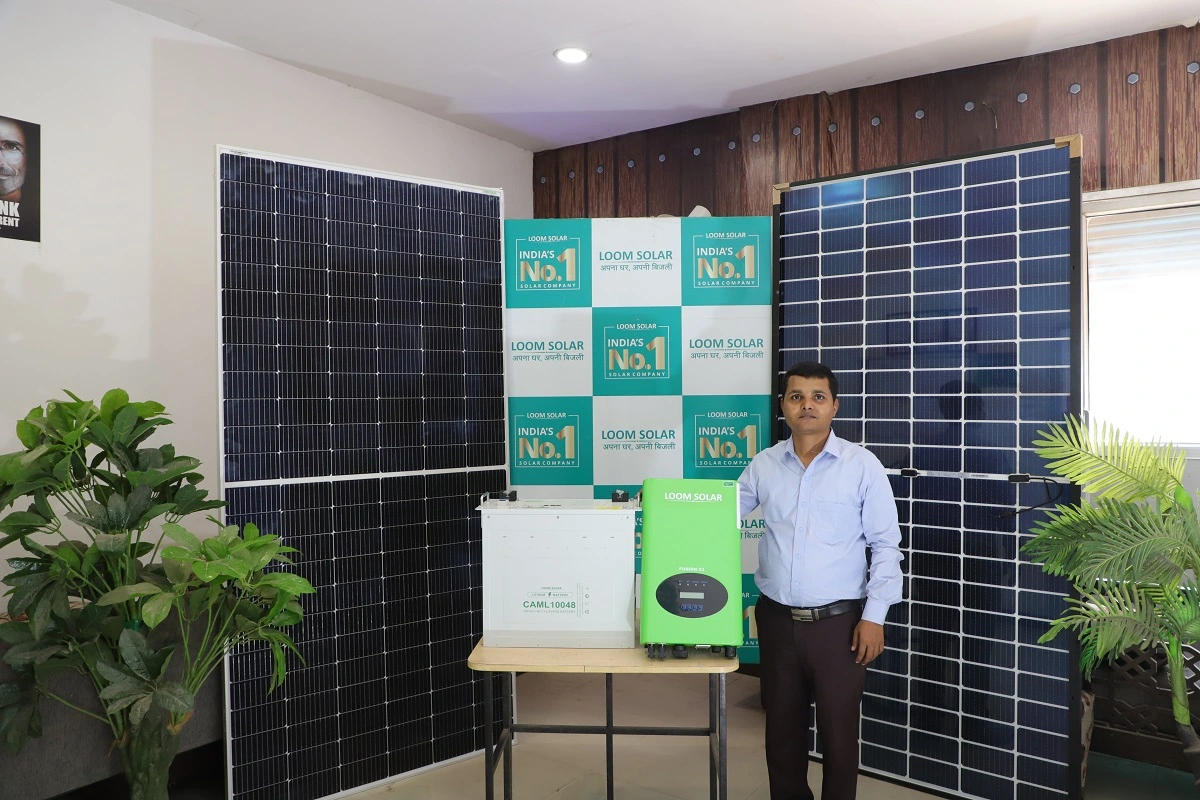
| Loom Solar | Compact, high-wattage panels for small rooftops | 20–22% | 10–12 years / 25 years | ₹22–₹28 |
| Luminous Solar | Deepest retail presence in smaller towns | 18–20% | 10 years / 25 years | ₹20–₹27 |
Prices listed are module-only indicative ranges for 2026 and exclude inverter, structure, labour, and GST. A fully installed residential system typically runs ₹55–₹85 per watt, or roughly ₹55,000–₹85,000 per kW. Always get itemised quotes rather than comparing only the headline per-watt figure.
Waaree Energies: Best All-Round Choice for Most Homeowners
Waaree is India’s largest solar panel manufacturer by capacity, with over 12 GW of annual manufacturing capacity and a target of 20 GW by the end of 2026.
Their flagship residential lines, the ARKA and Aditya series, sit in the 540–550W Mono PERC range, with TOPCon options also available.
What actually sets Waaree apart isn’t raw specs; it’s reach. Waaree panels are stocked by the widest distributor and installer network in the country, including a strong presence in Tier 2 and Tier 3 cities, where after-sales support for other brands can be harder to come by.
For most homeowners, that practical accessibility matters more day-to-day than a percentage point of efficiency difference.
Best for: homeowners prioritising price-to-efficiency value and the easiest access to local installer support, especially outside major metros.
Adani Solar: Best for Maximum Efficiency
Adani Solar operates India’s first and largest vertically integrated solar manufacturing facility at Mundra, Gujarat, producing everything from ingots and wafers through to finished modules under one roof.
This scale lets them offer some of the most competitively priced high-efficiency panels in the country.
Their N-Type TOPCon panels (commonly in the 535–660W range) reach efficiencies of 21–22.5%, with a notably low temperature coefficient.
This means they lose less output in extreme heat, a genuinely relevant advantage for installations in North India’s summer temperatures. Bifacial variants add further output over reflective or light-coloured rooftops.
Best for: homeowners and commercial buyers who want maximum output per square foot, and installations in particularly hot regions where temperature performance matters.
Tata Power Solar: Best for After-Sales Trust
Tata Power Solar has been manufacturing since 1989, making it one of India’s longest-standing solar brands, backed by the broader trust the Tata Group commands across Indian consumers.
Their Mono PERC panels (540–555W range) reach up to 22.1% efficiency.
What genuinely differentiates Tata isn’t a spec sheet number; it’s their EPC (Engineering, Procurement & Construction) model. Here, Tata handles the complete installation and maintenance lifecycle directly rather than leaving it entirely to a third-party installer.
For a 25-year asset, having one accountable party for both the panel and its installation meaningfully simplifies warranty claims down the line.
Best for: homeowners who want a genuine “install and largely forget” experience without juggling separate panel and installer relationships.
Vikram Solar: Best for Maximum Warranty Length
Kolkata-headquartered Vikram Solar is a globally recognised Indian manufacturer, exporting to markets including the US and Japan, with manufacturing capacity exceeding 3 GW.
They’ve been an early mover into TOPCon cell technology, and select models carry product warranties up to 15 years and performance warranties up to 30 years. These are genuinely longer than the industry-standard 12/25-year combination most competitors offer.
Best for: buyers specifically prioritising the longest available warranty coverage, and premium installations where efficiency and long-term degradation resistance are the top priority.
Other Notable Brands Worth Knowing
- Premier Energies: strong premium-tier positioning with solid efficiency and warranty terms, a reasonable alternative to the “big four” above.
- Goldi Solar: a genuinely budget-friendly, ALMM-certified option, particularly relevant for monsoon-heavy regions where corrosion resistance and price both matter.
- Loom Solar: known specifically for compact, high-wattage panels suited to space-constrained urban rooftops, such as smaller Delhi-area homes where every square foot of roof counts.
- Luminous Solar: the deepest retail distribution presence in smaller towns, making it an accessible, recognisable choice for homeowners outside major metro installer networks.
Indian Brands vs International (Chinese) Brands: What Actually Matters
International brands like LONGi, Jinko Solar, JA Solar, and Canadian Solar offer comparable, sometimes slightly higher, efficiency than Indian brands (up to 23–24% on premium models). So why do most Indian buying guides still steer toward domestic brands?
- A 40% Basic Customs Duty has applied to imported solar modules in India since April 2022, making international brands significantly less price-competitive for residential buyers.
- Most imported panels lack ALMM certification, which directly disqualifies them from the PM Surya Ghar subsidy, a far bigger financial factor than a small efficiency edge.
- Warranty enforcement is genuinely harder without an established local distributor and service network. A 25-year warranty is only as good as your ability to actually claim it a decade from now.
Some international brands (LONGi, Jinko, JA Solar) do manufacture or assemble within India, which can partially offset both the duty and the service concern.
But always verify ALMM status and local warranty support specifically before assuming this applies to the model you’re being quoted.
Related: What Is Net Metering in a Solar Power System and How Does It Work?
PM Surya Ghar Muft Bijli Yojana: How the Subsidy Actually Affects Brand Choice
This government scheme has been the single biggest driver of rooftop solar adoption in India over the past two years, and it directly shapes which panels make sense to buy:
- Eligibility requires the panel model to be on ALMM List-I, and in most cases also DCR-certified (manufactured using India-made solar cells, not just assembled in India).
- The subsidy can be worth up to ₹78,000 for an eligible residential system, which is large enough to outweigh almost any brand-to-brand price difference on the panels themselves.
- Waaree, Tata Power Solar, and Adani Solar all have DCR-certified models specifically positioned for PM Surya Ghar installations, typically priced around ₹27/watt for DCR-compliant modules.
Practical takeaway: Confirm your installer is sourcing a specific ALMM List-I, DCR-certified model by name before signing anything, rather than trusting a brand name alone to guarantee subsidy eligibility.
Related: How To Convert A Normal Inverter To A Solar Inverter?
Choosing by Region and Roof Type
Climate and roof space genuinely change which brand makes the most practical sense:
- Coastal regions (Mumbai, Chennai, Kochi) or monsoon-heavy areas: prioritise corrosion-resistant mounting structures and proven coastal installation experience; Waaree and Tata Power Solar both have strong track records here.
- Hot, high-temperature regions (Delhi, Rajasthan, parts of Gujarat): look specifically at the panel’s temperature coefficient (a lower negative number is better); Adani Solar’s TOPCon range performs particularly well in sustained heat.
- Small or space-constrained rooftops (typical in dense urban areas): prioritise wattage per panel over brand reputation; Loom Solar’s compact, high-wattage panels are built specifically for this scenario, letting you generate more from limited roof space.
- Budget-conscious buyers in any region: Goldi Solar and Premier Energies offer ALMM-certified options at a meaningfully lower price point without dropping out of subsidy eligibility.
Common Mistakes to Avoid When Choosing a Solar Panel Brand
- Choosing a panel purely for a few percentage points of extra efficiency while ignoring ALMM/DCR status, the subsidy loss almost always outweighs the efficiency gain for residential systems.
- Assuming “Tier 1” means “best quality”, it’s a bankability classification, not a performance ranking.
- Comparing only the per-watt panel price across quotes, while ignoring inverter quality, mounting structure, and installation labour, these often account for more of the total cost than the panels themselves.
- Trusting brand reputation over your specific installer’s track record. Installers widely agree: a great installer with a solid mid-tier panel consistently outperforms a poor installer working with a premium one, particularly when it comes to actually getting warranty claims honoured years later.
- Not checking ALMM status at the specific model level; a brand can have some ALMM-listed models and other non-listed ones in their catalogue simultaneously.
Related: String Inverters vs Micro Inverters: Which One’s Best for You?
Troubleshooting and Practical Verification Steps
- How to verify ALMM status: visit the MNRE ALMM portal (solarrooftop.gov.in) and search for the exact model name and manufacturer your installer has quoted; don’t rely on a verbal assurance alone.
- How to read a basic datasheet: look specifically for wattage (Wp), efficiency percentage, temperature coefficient, and the two separate warranty figures (product vs linear performance). These four numbers tell you most of what you need beyond the brand name.
- If your installer can’t provide a written datasheet or ALMM confirmation for the specific model being quoted, treat that as a warning sign and ask again before proceeding.
- For ongoing monitoring after installation, most modern solar inverters come with a basic app showing daily generation. But if yours doesn’t, or you want independent verification of your system’s actual output, a separate energy monitoring tool can help you track real savings against what was promised at the time of sale.
If you want to independently verify your new solar system’s real-world output rather than relying solely on the installer’s app, a basic digital clamp meter like Themisto TH-M89 (view on Amazon) lets you measure actual current and power generation yourself. It is useful both at installation time and periodically afterwards to catch any unexpected drop in performance early.
Related: Best Clamp Meters in India: How to Select a Good Clamp Meter
Decision Guide: Which Brand Should You Actually Choose?
- Want the easiest installer access and best overall value? Waaree Energies.
- Want maximum efficiency and strong heat performance? Adani Solar.
- Want one company handling installation and service end-to-end? Tata Power Solar.
- Want the longest warranty coverage available? Vikram Solar.
- Working with a tight budget but still need ALMM/subsidy eligibility? Goldi Solar or Premier Energies.
- Have a small or space-constrained rooftop? Loom Solar.
- Live in a coastal or monsoon-heavy region? Waaree or Tata Power Solar.
- Live in a particularly hot region? Adani Solar.
Whichever you choose, the honest expert consensus across the installer community is this: panel brand matters less than installer quality and ALMM/DCR compliance. Pick your installer with as much care as your panel brand.
Expert Tips Before You Sign an Installation Contract
- Always get at least three quotes from different installers, and compare the complete installed system cost (panels + inverter + structure + labour + GST), not just the headline per-watt panel price.
- Ask each installer for the exact model name and wattage they’re quoting, then independently verify its ALMM and DCR status yourself before signing.
- Check your installer’s track record specifically in your region’s climate; coastal corrosion resistance and high-heat performance aren’t universal strengths across all brands.
- Get the warranty terms in writing, including who is responsible for honouring claims (the brand directly, or the installer as an intermediary). This matters enormously for a 25-year asset.
- Since a solar inverter and connected home electronics remain vulnerable to voltage fluctuations and surges from the grid side, pairing your new system with a dedicated voltage stabiliser (find on Amazon) or surge protector for sensitive appliances adds a meaningful layer of protection that’s easy to overlook during the excitement of a new installation.
Conclusion
There’s genuinely no single “best” solar panel brand in India for 2026. There’s the best brand for your specific roof, region, budget, and priorities.
Waaree wins on accessibility and value, Adani on raw efficiency, Tata Power Solar on service trust, and Vikram Solar on warranty length.
What should change your decision more than any of these brand reputations, though, is one simple, non-negotiable check: confirm the exact panel model is ALMM List-I listed and DCR-certified before you sign anything, since that single detail is worth far more to your wallet than any efficiency percentage point.
Pick your installer with as much scrutiny as your panel brand, get everything in writing, and you’ll be in a strong position regardless of which of these well-established Indian manufacturers you ultimately choose.
Frequently Asked Questions
There’s no single universal answer; Waaree Energies offers the best overall value and availability, Adani Solar leads on efficiency, Tata Power Solar offers the strongest after-sales trust, and Vikram Solar offers the longest warranties. The right choice depends on your specific priorities.
ALMM (Approved List of Models and Manufacturers) is a government list of approved panel models. Only ALMM List-I listed panels qualify for the PM Surya Ghar subsidy, making this check more financially significant than most brand comparisons.
Under the PM Surya Ghar Muft Bijli Yojana, eligible residential systems can receive a subsidy of up to ₹78,000, provided the panels used are ALMM List-I listed and typically DCR-certified.
Tier 1 is a Bloomberg New Energy Finance classification indicating a manufacturer’s financial bankability and scale. It does not directly measure product quality or performance.
Adani Solar generally offers higher peak efficiency, particularly with its TOPCon range, while Waaree offers a wider dealer network and often more competitive overall pricing. Neither is universally “better”. It depends on whether efficiency or accessibility matters more to you.
Mono PERC was the industry standard until around 2023, offering roughly 19–22% efficiency. TOPCon is the newer, premium technology, offering roughly 21–23% efficiency with lower long-term degradation, typically at a moderate price premium.
Some international brands offer marginally higher peak efficiency, but a 40% import duty, limited ALMM certification, and weaker local warranty support make Indian brands the more practical choice for most residential buyers in India.
Most major Indian brands offer a 25-year linear performance warranty (guaranteeing a minimum output percentage, commonly 80–87%, by year 25), alongside a separate 10–12-year product warranty covering manufacturing defects.
Module-only prices in 2026 typically range from ₹20 to ₹35 per watt depending on brand and technology, while a fully installed residential system generally costs ₹55–₹85 per watt, including inverter, structure, and labour.
Bifacial panels can add roughly 10–15% more output by capturing reflected light on their rear side, which is particularly worthwhile over light-coloured or reflective rooftops, but less impactful on darker roofing materials.
Vikram Solar offers some of the longest warranty terms in the industry, with select models reaching up to 15-year product warranties and 30-year performance warranties, ahead of the more typical 12/25-year combination.
According to most experienced installers, no, a high-quality installer working with a solid mid-tier panel typically delivers a better long-term outcome than a poor installer working with a premium brand, especially when it comes to honouring warranty claims.
DCR (Domestic Content Requirement) means a panel is manufactured using India-made solar cells, not just assembled domestically. It’s commonly required alongside ALMM listing for subsidy and government project eligibility.
Loom Solar is specifically known for compact, high-wattage panels designed to maximise output on limited roof space, making it a strong option for dense urban homes.
Adani Solar’s TOPCon panels are noted for a particularly low temperature coefficient, meaning they retain more of their rated output in sustained high-heat conditions compared to many competitors.
Visit the MNRE ALMM portal (solarrooftop.gov.in) and search using the exact model name and manufacturer provided by your installer. Verify this yourself rather than relying solely on a verbal assurance.
Product warranty (commonly 10–12 years) covers manufacturing defects in the physical panel. Performance (or linear power) warranty (commonly 25 years) guarantees the panel won’t degrade below a set output percentage over that period. They’re separate guarantees covering different things.
If after-sales trust, end-to-end installation accountability, and brand-backed service matter to you, yes. If you’re comfortable managing the installer relationship separately and prioritising price, a budget ALMM-certified brand can perform comparably well.
Most have largely moved to Mono PERC and TOPCon technology, having phased out polycrystalline production. However, the exact efficiency, warranty, and pricing still vary meaningfully model-to-model within each brand’s range.
Yes, getting at least three quotes comparing the complete installed system cost (not just panel price) is the single most useful step in making sure you’re getting a fair, comparable deal across brands and installers.
We hope you are interested in our articles and consider following our Facebook, Instagram, and Twitter pages for regular updates.
Subscribe to our free newsletter to get similar articles and regular updates directly in your Email Inbox.
Also, share this article with your friends and relatives. Bookmark this page for future reference.