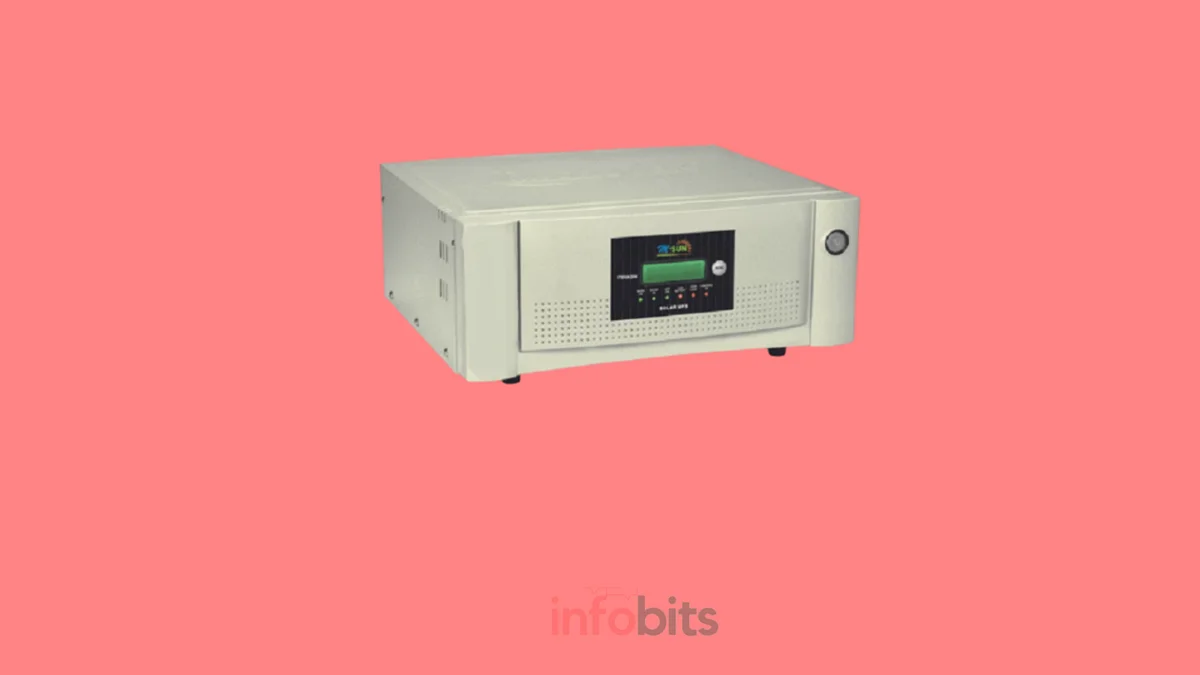
What Is an Inverter? How It Works & Types Explained
Every time the power goes out and your lights, fan, or Wi-Fi router keep running anyway, there’s an inverter quietly doing the work behind the scenes. It’s one of the most common pieces of electrical equipment in Indian homes, and yet most people who own one couldn’t explain what’s actually happening inside the box.
This guide breaks that down properly: what an inverter is, exactly how it converts power internally, and the different types you’ll come across when you’re shopping for one, using one, or just trying to understand your home’s power backup setup.
Quick answer: A power inverter is a device that converts DC (direct current) electricity ( the kind stored in batteries and generated by solar panels) into AC (alternating current) electricity, the kind your home’s outlets and appliances actually use. It does this through a switching circuit that rapidly flips the DC current back and forth, then shapes that output into a usable AC waveform.
What Is an Inverter?
A power inverter is an electrical device that converts direct current (DC) into alternating current (AC), at a specific voltage and frequency. In simple terms, it takes the steady, one-directional electricity stored in a battery or produced by a solar panel and turns it into the back-and-forth electricity your home’s appliances are built to run on.
It’s worth knowing the reverse process too, since the two terms come up together constantly: a rectifier does the opposite job, converting AC into DC. This is what happens inside most of your electronic devices’ chargers before the current reaches the battery inside. An inverter is essentially running that conversion backward.
How Does an Inverter Work?
A power inverter system is built from several core components working together. A DC source, a charging/rectifier section, an oscillator (pulse-generating circuit), a control circuit, a drive circuit, a switching circuit, and ( in transformer-based designs) a step-up transformer.
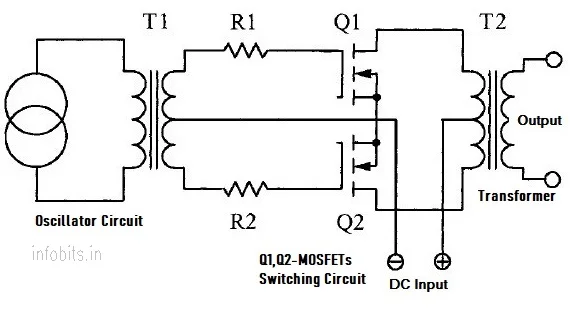
Newer transformerless inverter designs have also become common, achieving the same voltage step-up electronically instead.
Here’s the conversion process, stage by stage:
- DC input. The inverter’s input is typically 12V or 24V DC, coming from a battery in standalone systems, or directly from solar panels in an off-grid solar setup.
- Switching. That DC voltage is fed through a switching circuit ( built around power transistors or MOSFETs) that rapidly turns the current on and off at a controlled frequency. An oscillator circuit governs exactly how fast this switching happens.
- Step-up transformation. In transformer-based designs, this switched output feeds a step-up transformer with a primary voltage matching the battery (commonly 12V or 24V) and a secondary voltage matching standard household supply, 230V in India. The transformer typically uses a centre-tapped, push-pull winding: as one transistor switches on and the other off, current flows through one half of the winding; then the roles reverse, sending current through the other half in the opposite direction.
- Frequency matching. How many times per second the transistors switch on and off determines your output frequency. Since India’s standard AC frequency is 50Hz, the switching circuit needs to complete this on-off cycle 50 times every second.
- Waveform shaping. A basic DC-to-AC conversion naturally produces a square waveform, not the smooth sine wave that grid power actually looks like. To fix this mismatch, additional circuitry shapes and smooths the raw output. How well this is done is exactly what separates the different inverter waveform types below.
Types of Inverters by Output Waveform
Square Wave Inverter
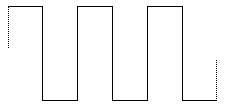
The simplest and cheapest design, but with poor output quality. Total harmonic distortion (THD) typically exceeds 45%. This rough, unrefined waveform can damage sensitive electronics, so square wave inverters are rarely used in modern products.
Modified Square Wave Inverter
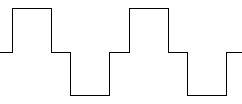
A meaningfully better version, with THD reduced to around 24%. Most standard electronic devices tolerate it fine, though it can cause an audible buzz or hum in some equipment, an indicator sign you’re running on a modified square wave inverter.
Pure Sine Wave Inverter
The highest-quality output, with THD under 3%, close enough to genuine grid power that sensitive equipment like medical devices and laser printers can run on it safely.
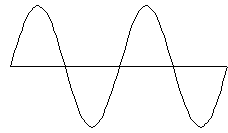
On-grid and grid-tied systems specifically require pure sine wave output. It costs more to produce than the alternatives, but it’s now the standard in the large majority of commercially available inverters.
For a deeper side-by-side comparison, see our dedicated guide on sine wave vs square wave inverters.
Types of Inverters by Mode of Operation
Stand-Alone Inverters
The most basic and common setup: just a battery and an inverter. It charges from the mains when grid power is available, then supplies your connected loads from the battery when the power cuts out.
Solar Inverters
Functionally similar to a stand-alone inverter, but its DC input comes from solar panels rather than a battery, and it typically has no provision for a separate battery connection.
Hybrid Inverters
A combination of the two. The DC input can come from either a battery or solar panels. This flexibility means your backup battery can be charged both from the grid and from solar generation, and during daylight hours, your home can run directly on solar power rather than drawing from the grid or battery at all, which is where the real electricity bill savings come from.
Types of Inverters by Grid Connection
On-Grid (Tie-Grid) Inverter
An on-grid inverter feeds its output directly into the main electrical distribution line, with excess solar generation exported back to the grid through a net metering system.
These systems typically use a pure solar inverter without battery backup, and include a safety interlock that automatically cuts solar output during a grid power cut, meaning your solar panels won’t power your home during an outage unless paired with a hybrid battery setup.
Installing an on-grid system also requires approval and inspection from your local electricity authority.
Off-Grid Inverter
An off-grid inverter’s output isn’t connected to the main power grid at all. It’s a fully self-contained system, typically built around a hybrid inverter with battery storage. Because it isn’t tied to the grid, it doesn’t require the same utility approval process that on-grid systems do.
For more on how these two approaches differ in practice, see our full breakdown of on-grid vs off-grid solar systems.
Inverter vs UPS: What’s the Real Difference?
In Indian retail, “inverter,” “home UPS,” and “UPS” often get used interchangeably. But there’s a real technical distinction worth knowing.
A standard inverter setup has a brief switching delay when the mains supply cuts out, since the battery only connects to the switching circuit once mains power actually fails.
A true UPS (Uninterruptible Power Supply) is designed differently: it draws its DC input from rectified AC mains during normal operation, and switches to battery power the instant mains fails, with effectively no time lag.
This near-zero switchover time is exactly why UPS units, rather than standard inverters, are used for computers and sensitive electronic equipment, where even a fraction of a second of power loss can cause problems.
Three-Phase Inverters
A three-phase inverter converts DC power into three-phase AC output instead of the single-phase output covered above. They are used for larger, heavier electrical loads like factories, commercial buildings, and multi-storey properties with a three-phase grid connection.
Its three circuit arms are typically offset by 120 degrees to produce a balanced three-phase supply.
This is a genuinely different category of equipment from the home inverters most of this article covers, and it’s not the right choice for every situation. Our detailed guide on whether a three-phase inverter is worth buying covers exactly who actually needs one.
Common Applications of Inverters
- Home backup power – the standalone inverter setup found in most Indian households.
- Solar power systems – both on-grid and off-grid, converting solar-generated DC into usable AC.
- Uninterruptible Power Supplies (UPS) – for computers, servers, and other equipment that can’t tolerate any interruption.
- SMPS (Switched-Mode Power Supply) – inverter circuitry forms a core building block inside SMPS units, found in nearly all modern electronic device chargers and power adapters.
- Vehicle and portable power adapters – small-scale inverters that let you run AC devices from a car battery or portable power bank.
Conclusion
At its core, an inverter is doing one job: turning stored or generated DC electricity into the AC power your home actually runs on. But the specifics of how it does that job (waveform quality, operating mode, grid connection) determine everything from cost to appliance safety to whether it’s even the right category of device for your situation.
If you already understand the basics and are ready to actually size and buy one for your home, our companion guide on selecting the right inverter and battery for your home walks through VA sizing, battery capacity, and practical buying advice in detail.
Frequently Asked Questions
An inverter is a device that converts DC (direct current) electricity, like what’s stored in a battery, into AC (alternating current) electricity, the kind your home’s appliances actually use.
They do opposite jobs. An inverter converts DC to AC; a rectifier converts AC to DC, which is what happens inside most device chargers before power reaches an internal battery.
A modified sine wave inverter produces a rougher approximation of AC power (around 24% total harmonic distortion) that’s fine for most basic appliances, while a pure sine wave inverter produces a much smoother, cleaner waveform (under 3% distortion) safe for sensitive electronics.
Not exactly. A standard inverter has a small switching delay when mains power fails, while a true UPS switches to battery power with virtually no delay, which is why UPS units are used for computers and equipment that can’t tolerate any interruption.
An on-grid inverter connects to and exports power to the main electricity grid via net metering, and shuts off automatically during a power cut. An off-grid inverter is fully self-contained, typically with battery storage, and isn’t connected to the grid at all.
Yes. A solar inverter takes its DC input directly from solar panels rather than a battery. A hybrid inverter goes a step further, accepting input from both a battery and solar panels.
This is typically a sign of a modified square wave inverter, whose rougher output waveform can cause an audible buzz or hum in certain connected devices, especially at higher power draw.
50 Hertz (Hz), matching India’s standard grid frequency, which means the inverter’s switching circuit completes 50 full on-off cycles every second to produce that output.
This depends on your total connected load in watts, converted to VA using a power factor (commonly 0.8). Our detailed guide on selecting the right inverter and battery walks through the full calculation.
A stand-alone inverter only accepts DC input from a battery. A hybrid inverter can accept input from both a battery and solar panels, letting your home run on solar during the day and charge its battery from either source.
Yes. Periodically check battery water levels (for non-sealed batteries), keep terminals clean and corrosion-free, and ensure adequate ventilation around the unit, since heat buildup shortens component lifespan over time.
A poor-quality square or modified square wave inverter can potentially stress or damage sensitive electronics due to its rougher output waveform. Pure sine wave inverters avoid this risk and are the safer choice for sensitive equipment.
It’s a newer inverter design that achieves the DC-to-AC voltage step-up electronically rather than through a physical step-up transformer, typically resulting in a smaller, lighter unit.
Grid power is a smooth, pure sine wave. A basic inverter’s raw conversion naturally produces a rougher square waveform, which is why additional circuitry is needed to shape it into a cleaner, appliance-safe output.
An SMPS (Switched-Mode Power Supply), found in most modern device chargers, uses inverter circuitry as a core building block, switching DC power at high frequency as part of its own conversion process.
If you feel that this article about inverter basics is helpful, please share this information with your friends and family.
Don’t forget to like and follow us on Facebook and Twitter for the most up-to-date information.
Sign up for our free newsletter to stay updated on the latest deals, offers, and ebooks.
Subscribe to be the first to learn about new information