
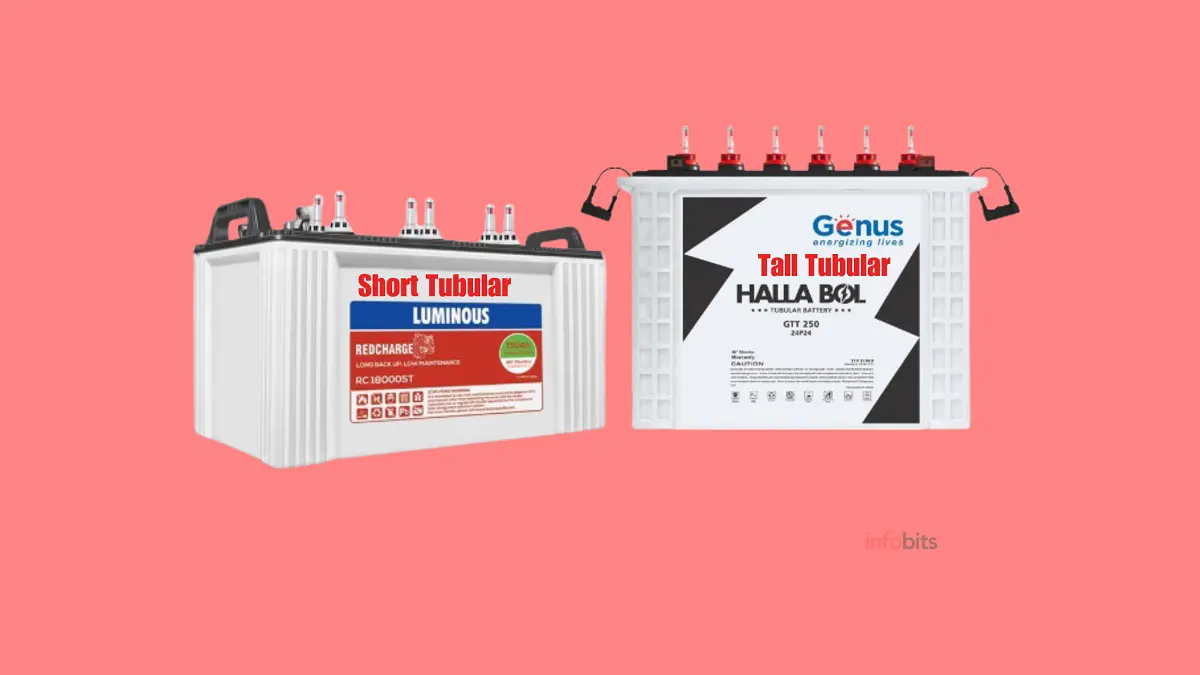
Short Tubular vs Tall Tubular Battery: Differences, Uses & Which Is Right for You
Walk into any inverter battery shop in India, and the salesperson will almost certainly ask you: “Sir/Madam, do you want a short tubular or a tall tubular?”
Most buyers have no idea what to say. Both look like large rectangular boxes. Both say “tubular battery” on the label. Both are made by the same brands. And both seem to cost similar amounts of money.
So what exactly is the difference? And more importantly, which one should you buy for your home?
This guide answers both questions completely. We’ll go through every real difference between short and tall tubular batteries, physical dimensions, electrolyte volume, plate height, cycle life, maintenance frequency, price, and suitability, using actual product specifications where possible, so you can make an informed decision rather than guessing.
Quick Answer: Short tubular and tall tubular batteries are both flooded lead-acid tubular batteries that use the same basic chemistry. The key difference is physical: tall tubular batteries have longer positive plates and contain approximately 30% more electrolyte per tube than short tubular batteries of the same Ah rating.
This gives tall tubular batteries better deep-cycle performance, longer service life (typically 5–8 years vs 4–5 years), and longer battery warranties. Short tubular batteries are shorter and wider , easier to fit in tight spaces and less expensive. For Indian homes with frequent, long power cuts, tall tubular is almost always the better long-term investment.
What Is a Tubular Battery? (Quick Refresher)
Before comparing the two types, a brief recap of what makes any tubular battery different from the flat plate batteries that were common in older inverter setups.
In a flat plate battery, the positive electrode is a flat lead-alloy grid with active material (lead dioxide, PbO₂) pasted onto its surface. Over repeated deep discharge cycles, this active material tends to shed and fall away from the grid, progressively reducing the battery’s capacity and lifespan.
A tubular battery solves this problem by replacing the flat positive plate with a gauntlet construction: a central conducting spine (the current collector) is surrounded by active material (lead dioxide) held in place by woven polyester or glass fibre tubes, called gauntlets or tubes.
The tubes physically contain the active material even as it softens with cycling, dramatically reducing shedding.
The result: tubular batteries outlast flat plate batteries by 2–3× in deep-cycle applications, require less maintenance, and are better suited for the frequent, deep power cut scenarios common across India.
Both short tubular and tall tubular batteries use this gauntlet plate construction. The difference is in the geometry of those tubes.
Related: PAM/NAM Ratio in Lead Acid Batteries: What It Is and Why It Matters
What Is a Short Tubular Battery?
A short tubular battery (sometimes just called a “tubular battery” without the “short” qualifier by retailers) uses shorter positive plate tubes relative to its footprint.
To achieve the same Ah capacity as a tall tubular battery, a short tubular battery uses more plates per cell, packed side by side, making the case wider rather than taller.
Typical physical dimensions of a 150 Ah short tubular battery (e.g., Luminous Red Charge RC 18000ST 150 Ah):
- Length: ~505 mm
- Width: ~220 mm
- Height: ~308 mm
- Weight: ~42–44 kg
The design is compact in the vertical direction; it fits under worktops, in low-clearance utility spaces, and in inverter trolleys designed for smaller batteries. However, it compensates with extra width compared to a tall tubular battery of the same capacity.
What Is a Tall Tubular Battery?
A tall tubular battery uses longer positive plate tubes, making the battery case significantly taller. The longer tubes hold more active material per tube and, crucially, contain more electrolyte per cell, which is the key to the tall tubular battery’s superior performance.
Typical physical dimensions of a 150 Ah tall tubular battery (e.g., Luminous Red Charge RC 18000 150 Ah):
- Length: ~502 mm
- Width: ~191 mm
- Height: ~440 mm
- Weight: ~52–54 kg
Note that the tall tubular battery is approximately 132 mm taller but 29 mm narrower than the equivalent short tubular battery. It is also approximately 10–12 kg heavier, primarily due to the extra electrolyte volume.
The Core Technical Difference: Electrolyte Volume
This is the most important technical difference that most comparison articles miss or gloss over.
Tall tubular batteries carry approximately 30% more electrolyte per tube than short tubular batteries of the same Ah rating.
Why does this matter so much?
In a flooded lead-acid battery, the electrolyte (dilute sulphuric acid, H₂SO₄) participates directly in the electrochemical reactions that store and release energy. During discharge, the acid is consumed into the plates (forming lead sulphate). During charging, it is regenerated.
More electrolyte means:
- More reserve acid available during long discharge cycles; the battery sustains its voltage better through longer outages before the electrolyte is depleted
- Better thermal management: a larger electrolyte volume absorbs and dissipates heat more effectively, which is critical in India’s hot climate (temperatures regularly exceeding 40°C in summer)
- Slower electrolyte consumption: since the same reactions draw on a larger reservoir, the relative depletion rate is lower, meaning water needs to be topped up less frequently
- Lower stress on the plates per cycle: the larger electrolyte volume distributes the electrochemical stress over more material, reducing plate degradation per cycle and extending service life
This is why tall tubular batteries have longer warranties and longer actual service lives than short tubular batteries of the same Ah rating; it’s not marketing; it’s chemistry.
Physical Dimensions Comparison: Real Numbers
Using the Luminous Red Charge 150 Ah range as a concrete example (one of the most popular inverter battery ranges in India):
| Parameter | Short Tubular (RC 18000ST) | Tall Tubular (RC 18000) |
|---|---|---|
| Length | ~505 mm | ~502 mm |
| Width | ~220 mm | ~191 mm |
| Height | ~308 mm | ~440 mm |
| Weight | ~42–44 kg | ~52–54 kg |
| Height difference | — | ~132 mm taller |
| Width difference | — | ~29 mm narrower |
Practical implication: The tall tubular battery requires about 132 mm more vertical clearance. In many Indian homes, inverter batteries are placed in under-stair storage, kitchen utility rooms, or on dedicated inverter trolleys.
If vertical space is limited, say, under a low counter or inside a built-in cabinet, the short tubular battery may be the only physically feasible option.
Equally important: both batteries should be placed on a sturdy surface that can support at least 55–60 kg (for the tall tubular). Many households in India use basic plastic trolleys that are not rated for this weight; always check the trolley’s weight capacity before placing a tall tubular battery on it.
A heavy-duty metal inverter trolley (view on Amazon) designed for batteries up to 80 kg is a worthwhile investment if you’re placing a tall tubular battery. You can check the latest high-quality inverter trolley options on Amazon India.
Warranty Comparison: What Brand Data Shows
Warranty periods are one of the clearest indicators of manufacturer confidence in the product’s longevity. Looking at actual warranty data from major Indian brands:
| Battery | Type | Ah | Warranty (Typical) |
|---|---|---|---|
| Luminous Red Charge RC 18000ST | Short Tubular | 150 Ah | 36 months |
| Luminous Red Charge RC 18000 | Tall Tubular | 150 Ah | 36–48 months |
| Luminous Shakti Charge SC18054 | Tall Tubular | 150 Ah | 54 months |
| Exide InvaTubular IT500 | Tall Tubular | 150 Ah | 36 months |
| Exide InvaMaster IMTT1500 | Tall Tubular | 150 Ah | 54 months |
| Amaron AR150TN54 | Tall Tubular | 150 Ah | 54 months |
Warranties vary by specific model and may have pro-rata terms after an initial replacement period. Always check the current warranty card for your specific purchase.
The pattern is clear: tall tubular batteries from premium variants of major brands offer significantly longer warranty periods, up to 54 months, compared to 36 months typically offered for short tubular batteries.
Premium tall tubular variants (like Luminous Shakti Charge, Exide InvaMaster, and Amaron’s higher-end models) carry higher electrolyte volumes as a further differentiator over standard tall tubular models.
Performance Differences: Deep Cycle Life and Backup Duration
Cycle Life
Deep-cycle life refers to how many charge-discharge cycles a battery can complete before its capacity degrades below 80% of its rated value.
- Short tubular batteries: Typically rated for 400–500 deep discharge cycles at 80% Depth of Discharge (DoD)
- Tall tubular batteries: Typically rated for 500–700+ deep discharge cycles at 80% DoD (premium models with higher electrolyte volume can exceed 700 cycles)
This difference in cycle life directly translates to service life. In an Indian home that experiences 2 power cuts per day (a common scenario in many states during peak summer), a battery completes approximately 700 cycles per year.
A short tubular battery at 450 cycles would last under a year in this scenario, while a tall tubular battery at 600–700 cycles would survive a full year of such heavy use and continue for several more under lighter conditions.
Important clarification: The rated cycle life assumes deep discharges (80% DoD). In practice, most inverters in Indian homes switch to battery mode when mains power fails and switch back to mains as soon as power is restored.
Shallow discharges (20–30% DoD) significantly extend battery life for both types, but the tall tubular still has the advantage.
Backup Duration
Both a 150 Ah short tubular and a 150 Ah tall tubular battery carry the same rated Ah capacity. At the same load, they should theoretically provide the same backup duration.
However, in practice, tall tubular batteries tend to deliver closer to their rated capacity under load because:
- The larger electrolyte volume sustains voltage better through the discharge (less voltage sag)
- The longer plates provide more active material per cell, reducing the localised stress that causes premature voltage cutoff.
- The thermal properties of the larger electrolyte volume prevent heat-related capacity reduction during long discharges in warm environments.
A practical real-world comparison: in India’s summer heat, a tall tubular battery may deliver 140–145 Ah of usable capacity out of its 150 Ah rating, while a short tubular battery of the same nominal rating may deliver 130–135 Ah before the inverter’s low-voltage cutoff is triggered, a meaningful difference during a long afternoon power cut.
Maintenance Requirements
Both short and tall tubular batteries are flooded lead-acid batteries, meaning they contain liquid electrolyte that is accessible through vent caps, and they require periodic topping up with distilled water as the electrolyte level drops due to water loss (evaporation and electrolysis during charging).
Tall tubular batteries require less frequent water top-up than short tubular batteries because:
- Their larger electrolyte reservoir means a higher absolute volume of water is lost before the level drops to a critical point
- The same percentage water loss represents a larger absolute volume, giving more time between top-up intervals
Typical maintenance intervals:
- Short tubular battery: Check electrolyte level every 1–2 months; top up every 2–3 months (in Indian summer conditions, more frequently in very hot, high-discharge environments)
- Tall tubular battery: Check every 2–3 months; top up every 3–4 months under similar conditions
Related: How to Charge the Inverter/UPS Battery Efficiently?
Common maintenance mistakes for both types:
- Using tap water instead of distilled water (tap water contains minerals that contaminate the electrolyte and degrade the plates)
- Letting the electrolyte level drop below the minimum mark (exposing the plates causes irreversible damage; one of the most common causes of premature battery failure in India)
- Ignoring the battery for months without any check (especially during seasons with frequent power cuts, the water level drops faster)
Always use distilled water for battery top-up. Packaged distilled water specifically for inverter batteries is available at most battery shops and on Amazon India.
Price Comparison
As of 2026, approximate retail prices in India for 150 Ah batteries from major brands:
| Battery Type | Price Range (₹) | Notes |
|---|---|---|
| Short Tubular 150 Ah (standard) | ₹9,000 – ₹11,500 | Depends on brand and specific model |
| Tall Tubular 150 Ah (standard) | ₹10,000 – ₹13,500 | Core range from Luminous, Exide, Amaron |
| Tall Tubular 150 Ah (premium / high electrolyte) | ₹12,000 – ₹16,000 | Luminous Shakti, Exide InvaMaster, Amaron Tuff |
Prices vary by retailer, city, and current market conditions. These are approximate indicative ranges.
Total Cost of Ownership: The More Important Number
The upfront price difference between short and tall tubular batteries is typically ₹1,500–₹3,000 for equivalent Ah ratings. However, when you factor in:
- Longer service life of tall tubular (5–8 years vs. 4–5 years for short tubular under similar usage)
- Less frequent maintenance visits
- Longer warranty coverage
Overall, the tall tubular battery is almost always the more cost-effective choice over the battery’s lifetime, even though it costs more upfront.
Example: If a short tubular 150 Ah battery costs ₹10,000 and lasts 4.5 years, and a tall tubular 150 Ah battery costs ₹12,500 and lasts 6.5 years, the short tubular costs ₹2,222/year while the tall tubular costs ₹1,923/year.
The tall tubular is cheaper per year of service despite costing more at purchase.
Side-by-Side Comparison: All Key Parameters
| Parameter | Short Tubular Battery | Tall Tubular Battery |
|---|---|---|
| Plate height | Shorter | Taller |
| Physical height (150 Ah) | ~308 mm | ~440 mm |
| Physical width (150 Ah) | ~220 mm | ~191 mm |
| Weight (150 Ah) | ~42–44 kg | ~52–54 kg |
| Electrolyte volume | Lower | ~30% higher |
| Typical warranty | 36 months | 36–54 months |
| Deep cycle life | 400–500 cycles | 500–700+ cycles |
| Service life | 4–5 years | 5–8 years |
| Maintenance frequency | Every 2–3 months | Every 3–4 months |
| Heat performance | Moderate | Better (larger electrolyte buffer) |
| Initial price (150 Ah) | ₹9,000–₹11,500 | ₹10,000–₹16,000 |
| Cost per year (approx.) | Higher | Lower |
| Best for | Limited vertical space, moderate power cuts | Frequent/long power cuts, long-term investment |
Which Battery Is Right for You? A Decision Guide
Choose Short Tubular Battery if:
- Vertical space is genuinely constrained. The installation space has a height clearance of less than ~480 mm, under a low cabinet, in a built-in niche, or in a vehicle/portable application. In this case, the tall tubular battery physically won’t fit.
- Power cuts in your area are short and infrequent. If you experience power cuts of less than 1 hour, once or twice a day, the short tubular battery will serve you adequately and cost less upfront.
- Budget is very tight. If the ₹1,500–₹3,000 price difference between comparable models is a significant constraint, the short tubular provides acceptable performance at a lower initial outlay.
- You’re in a temporary residence and don’t plan to use the battery for its full service life, for example, a rented accommodation where you’ll be moving in 2–3 years.
Choose Tall Tubular Battery if:
- Your area has frequent or long power cuts. In states like Uttar Pradesh, Bihar, Jharkhand, Odisha, West Bengal, Madhya Pradesh, and parts of Maharashtra and Tamil Nadu, where power cuts of 2–6 hours per day are common, tall tubular is the appropriate choice.
- You want maximum value over the battery’s lifetime. The higher upfront cost is recovered through longer service life and lower annual cost.
- Summer heat is extreme in your area. The larger electrolyte volume provides better thermal buffering in states where ambient temperatures regularly exceed 40°C, such as Rajasthan, Gujarat, and Telangana.
- You’re investing in a solar backup system. Solar batteries undergo daily deep discharge cycles; this is one of the most demanding use cases for any battery, and tall tubular (or premium tall tubular with even higher electrolyte volume) is the appropriate choice.
- You want a longer warranty and less maintenance. The peace of mind of a 54-month warranty versus 36 months, and the reduced frequency of water top-up, is worth the modest premium for most Indian households.
Bottom line for most Indian households: The tall tubular battery is the right choice. India’s power supply conditions ( frequent outages, hot summers, voltage fluctuations) are exactly the demanding environment that tall tubular batteries are designed for.
The short tubular battery exists primarily for space-constrained installations where the tall tubular simply doesn’t physically fit.
Tubular vs Flat Plate vs Lithium: The Full Picture
For complete context, here’s how both tubular types compare against the broader battery market in India:
| Battery Type | Typical Life | Maintenance | Deep Cycle | Price (150 Ah equiv.) | Best For |
|---|---|---|---|---|---|
| Flat Plate | 3–4 years | More frequent | Limited | ₹6,000–₹9,000 | Light, occasional backup; tight budget |
| Short Tubular | 4–5 years | Moderate | Good | ₹9,000–₹11,500 | Moderate power cuts; space constrained |
| Tall Tubular | 5–8 years | Less frequent | Excellent | ₹10,000–₹16,000 | Frequent/long power cuts; most Indian homes |
| Lithium (LFP) | 8–15 years | None | Excellent | ₹40,000–₹80,000+ | Solar, premium setups, no maintenance |
Lithium iron phosphate (LiFePO4) batteries are increasingly available in India through brands like Loom Solar and others, and offer superior cycle life and zero maintenance.
However, at 4–5× the upfront cost of a tall tubular, they are primarily relevant for solar installations where the total cost of ownership over 10+ years justifies the investment.
Related: Lithium Battery Advantages in Inverter and UPS Systems
Popular Brand Options in India: Short and Tall Tubular
Short Tubular Battery Options in India
- Luminous Red Charge RC 18000ST 150 Ah; One of the most popular short tubular batteries in India; widely available, known for reliable performance
- Exide Inva Short Tubular series; Exide’s short tubular range for space-constrained installations
- Genus Powercraft Short Tubular series; budget-friendly short tubular option
- Okaya Short Tubular batteries; competitive pricing with reasonable performance
Tall Tubular Battery Options in India
- Luminous Red Charge RC 18000 150 Ah; The standard benchmark tall tubular battery; widely regarded as one of the best value-for-money options
- Luminous Shakti Charge SC18054 150 Ah; Premium variant with 54-month warranty and 47% higher electrolyte volume vs standard tall tubular; highly recommended
- Exide InvaTubular IT500 150 Ah; Exide’s core tall tubular range; consistently good performance and service network
- Exide InvaMaster IMTT1500 150 Ah; Premium Exide tall tubular with 54-month warranty
- Amaron AR150TN54 150 Ah; 54-month warranty tall tubular from Amara Raja Batteries; strong in South India
- V-Guard Dynamo 150 Ah Tall Tubular; competitive pricing with decent performance; V-Guard’s wide service reach is an advantage in South India
The Luminous Red Charge RC 25000 200 Ah tall tubular (view on Amazon) and the EXIDE INVA Master IMTT1500 150Ah (view on Amazon) are consistently among the top sellers on Amazon India in the inverter battery category and are available for purchase online with home delivery in most Indian cities.
Installation Tips for Both Battery Types
For Short Tubular Batteries
- Ensure the trolley or shelf can support at least 50 kg (accounting for the battery weight plus margin)
- Leave at least 10–15 cm of clearance on all sides for ventilation
- Ensure the space has adequate air circulation; batteries emit hydrogen gas during charging, which should not accumulate in an enclosed space
- Keep away from direct sunlight and heat sources
- Position where you can easily access the vent caps for periodic water top-up
For Tall Tubular Batteries
- Measure vertical clearance carefully before purchasing; you need at least 480–500 mm of height clearance above the floor or shelf (440 mm battery height + space for cables and vent cap access)
- Use a heavy-duty inverter trolley rated for at least 70 kg
- Because they are heavier (52–54 kg), ensure two people handle the battery during installation; do not attempt to lift alone
- Keep the battery upright at all times; never tilt a filled flooded battery
- Terminal connections should be tight and corrosion-free; apply petroleum jelly (Vaseline) to terminals after connection to prevent corrosion
Related: How to Select the Right Inverter and Battery for Home in India?
Common Mistakes When Buying Tubular Batteries in India
Mistake 1: Buying the same Ah capacity without measuring the space: The most preventable mistake. Always measure the height clearance at your installation location before buying a tall tubular battery. A 440 mm battery in a 380 mm clearance space is a problem discovered too late.
Mistake 2: Assuming all 150 Ah batteries are equivalent: The rated capacity is the same, but the electrolyte volume, plate quality, active material purity, and resulting cycle life can vary significantly between budget and premium models, and between short and tall tubular designs.
Mistake 3: Choosing based on upfront price alone: As demonstrated in the total cost of ownership analysis, the cheaper battery often costs more per year of service. Factor in the service life and warranty when comparing prices.
Mistake 4: Ignoring the inverter’s charging profile: Your inverter charger must be compatible with the battery you install. Ensure the inverter’s battery type setting matches (flooded tubular, not sealed/SMF) and that the charging voltage is set correctly. Incorrect charging, particularly overcharging, dramatically accelerates electrolyte loss and plate degradation in tubular batteries.
Related: How to Fix the Inverter Overload Problem Efficiently?
Mistake 5: Buying from an unrecognised brand to save money: The Indian battery market has many unbranded or little-known manufacturers offering batteries with inflated Ah ratings and poor-quality active materials. Stick to established brands — Luminous, Exide, Amaron, V-Guard, Okaya, Su-Kam — which have quality control, service networks, and meaningful warranties.
Mistake 6: Mixing battery types in a multi-battery setup: If your inverter requires two batteries (for 24V systems), always use two batteries of identical type, brand, Ah rating, and age. Mixing short and tall tubular batteries or old and new batteries causes unequal charging and reduces the life of both.
Myths vs Facts: Short Tubular vs Tall Tubular
| Myth | Fact |
|---|---|
| “Short tubular and tall tubular are basically the same product in different packaging” | They differ meaningfully in electrolyte volume (~30% more in tall tubular), resulting in longer cycle life, better heat performance, and longer warranties |
| “A 150 Ah short tubular provides the same backup as a 150 Ah tall tubular” | They have the same nominal capacity, but tall tubular delivers closer to rated capacity in real-world conditions, especially under heat and in long discharge scenarios |
| “Short tubular batteries are better for solar because they’re lighter” | Solar applications involve daily deep discharge cycles; this is exactly where tall tubular’s higher cycle life and electrolyte volume matter most. For solar, tall tubular is the better choice |
| “Tall tubular batteries require more maintenance because they’re bigger” | The opposite is true; the larger electrolyte volume means water is topped up less frequently |
| “The Ah rating is all that matters when choosing a battery” | Ah rating tells you capacity, not cycle life, electrolyte volume, plate quality, or heat performance. All of these matter for total value |
Conclusion
Short tubular and tall tubular batteries are both quality products built on the same tubular plate technology.
The difference between them is not trivial; it directly affects how long the battery lasts, how well it handles India’s demanding power cut conditions, how often it needs maintenance, and what total value it delivers over its lifetime.
The simple guide:
- If vertical space allows (480 mm+ clearance) and you have frequent or long power cuts → Choose tall tubular
- If space is genuinely constrained or power cuts are mild → Short tubular is acceptable
- For solar applications → Tall tubular, or premium tall tubular with higher electrolyte volume
- For maximum value and longest life → Premium tall tubular (Luminous Shakti, Exide InvaMaster, Amaron Tuff series)
Most Indian households would benefit from a tall tubular battery. India’s hot summers, frequent power cuts, and voltage fluctuations are precisely the conditions these batteries are designed to handle.
The modest premium over short tubular pays for itself within the first year or two of extended service life.
Frequently Asked Questions
Short tubular and tall tubular batteries are both flooded lead-acid tubular batteries using gauntlet (tube) plate construction. The key difference is physical geometry: tall tubular batteries have longer positive plates and contain approximately 30% more electrolyte per tube. This gives tall tubular batteries better deep-cycle performance, longer service life (5–8 years vs 4–5 years), and longer warranty periods. Short tubular batteries are shorter and wider, easier to install in low-clearance spaces and less expensive upfront, but lower in total value over the battery’s lifetime.
For most Indian homes, a tall tubular battery is the better choice. India’s frequent power cuts, hot summers, and voltage fluctuations are exactly the conditions where tall tubular batteries outperform short tubular batteries. The larger electrolyte volume handles heat and deep discharges better, cycle life is higher, and total cost of ownership over the battery’s life is lower despite the higher upfront price. A short tubular battery is appropriate only when vertical installation space is genuinely constrained.
Tall tubular batteries are better because they contain approximately 30% more electrolyte per tube, which provides: better voltage regulation during long discharge cycles; superior heat dissipation during India’s hot summers; lower water consumption (less frequent top-up required); and higher total cycle life (500–700+ deep cycles vs 400–500 for short tubular). These advantages translate directly into longer service life, longer warranties, and lower annual cost of ownership.
Using the popular Luminous Red Charge 150 Ah range as an example: the short tubular (RC 18000ST) measures approximately 505×220×308 mm and weighs ~42–44 kg. The tall tubular (RC 18000) measures approximately 502×191×440 mm and weighs ~52–54 kg. The tall tubular is about 132 mm taller but 29 mm narrower, and approximately 10–12 kg heavier. Always verify specific dimensions in the manufacturer’s datasheet before installation.
Tall tubular batteries contain approximately 30% more electrolyte volume per tube than short tubular batteries of the same Ah rating. For a 150 Ah battery, this is a meaningful difference; premium tall tubular models like the Luminous Shakti Charge SC18054 are marketed as having 47% higher electrolyte volume compared to standard tall tubular models. This extra electrolyte reserve is the primary reason for the tall tubular’s superior deep-cycle performance and longer service life.
Short tubular batteries in India typically carry 36-month warranties. Tall tubular batteries start at 36 months for standard models and extend to 54 months for premium models (such as Luminous Shakti Charge, Exide InvaMaster, and Amaron’s premium range). The longer warranty on tall tubular batteries reflects the manufacturer’s confidence in the product’s higher cycle life and electrolyte volume. Always check the specific warranty terms, as many warranties have a prorated structure after an initial replacement period.
For solar power systems, tall tubular batteries are significantly better. Solar batteries undergo daily deep discharge cycles; this is among the most demanding use cases for any lead-acid battery. The tall tubular battery’s higher electrolyte volume, better heat performance, and higher cycle count (500–700+ cycles vs 400–500 for short tubular) are all critical advantages for solar applications. For high-capacity or commercial solar installations, premium tall tubular batteries with maximum electrolyte volume (like Luminous Shakti Charge series) are the recommended choice.
Short tubular batteries typically need electrolyte level checks every 1–2 months, with water top-up every 2–3 months in Indian summer conditions. Tall tubular batteries, due to their larger electrolyte reservoir, typically need checks every 2–3 months and top-up every 3–4 months under similar conditions. Always use distilled water, never tap water, for battery top-up. Check more frequently during summer and in areas with frequent long power cuts.
Yes. In areas where power cuts are infrequent (say, 1–2 times per week and shorter than 1 hour each), the premium performance of a tall tubular battery may not be fully utilised. In this scenario, a short tubular battery provides adequate performance at a lower upfront cost, and the longer service life of a tall tubular may not result in as significant a cost-per-year advantage. However, even in these areas, the tall tubular is still a reasonable choice if space allows.
No. Flooded lead-acid batteries, both short and tall tubular, must be kept upright at all times during storage and use. Tilting or laying them on their side causes electrolyte to leak from the vent caps and can result in electrolyte spillage, which is corrosive to surfaces and dangerous to skin. Always transport, install, and store tubular batteries in their upright position.
Standard tall tubular 150 Ah batteries from major brands (Luminous, Exide, Amaron) are available in the ₹10,000–₹13,500 range. Premium tall tubular models with longer warranties and higher electrolyte volumes (Luminous Shakti Charge, Exide InvaMaster, Amaron Tuff) are priced at ₹12,000–₹16,000. Short tubular 150 Ah batteries are typically ₹1,000–₹2,000 less expensive than comparable tall tubular models. Prices vary by retailer, city, and market conditions.
The most reliable tall tubular battery brands in India are Luminous Power Technologies, Exide Industries, Amara Raja Batteries (Amaron), V-Guard, and Okaya. For premium tall tubular performance, the Luminous Shakti Charge series, Exide InvaMaster series, and Amaron Tuff/AR150TN54 are consistently top-rated. Su-Kam and Genus are also reputable brands with good service networks. Avoid unbranded or little-known manufacturers; regardless of price, quality control on active materials and electrolyte volume cannot be verified.
Technically yes, but it’s not recommended for daily solar cycling. Solar batteries undergo a deep discharge cycle every single day — hundreds of cycles per year. A short tubular battery’s lower cycle count (400–500 cycles) means it may need replacement within 2 years of daily solar use. A tall tubular battery (500–700+ cycles) is better suited and more economical for solar applications despite the higher upfront cost.
Short tubular batteries typically last 4–5 years under normal Indian home inverter conditions (moderate daily use, 1–2 power cuts per day). Tall tubular batteries last 5–8 years under similar conditions, with premium models with maximum electrolyte volume lasting at the higher end. In severe conditions- very hot climate, long power cuts, heavy loads- all batteries have shorter lives, but tall tubular batteries have more tolerance for these stresses due to their larger electrolyte reserve.
Yes, in real-world conditions. While the rated Ah capacity is the same, tall tubular batteries deliver closer to their rated capacity in hot weather and under prolonged discharge, due to better voltage regulation from the larger electrolyte volume. A short tubular battery may deliver 130–135 Ah of usable capacity under Indian summer heat conditions, while a comparable tall tubular may deliver 140–145 Ah, a meaningful difference during a long power cut.
Check the physical dimensions on the product specification sheet, specifically the height measurement. For a 150 Ah battery, a height below ~360 mm typically indicates a short tubular design; a height above ~400 mm indicates tall tubular. Also check the product name; manufacturers typically include “ST,” “Short Tubular,” or just “Tubular” for short versions, and “Tall Tubular,” “TT,” or “IT” (for Exide InvaTubular) for tall versions. When in doubt, ask the dealer or check the brand’s official product page.
This is not recommended. When two batteries are connected in series (for a 24V inverter) or parallel (to increase Ah capacity), they should be identical in type, brand, Ah rating, and ideally age. Mismatched batteries, including mixing short and tall tubular, have different internal resistances and charge acceptance rates, which causes unequal charging: one battery tends to be chronically overcharged while the other is chronically undercharged. This significantly reduces the life of both batteries. Always use matched battery pairs or banks.
For 150 Ah batteries, a short tubular typically weighs 42–44 kg while a tall tubular weighs 52–54 kg, a difference of approximately 10–12 kg. This extra weight is primarily due to the additional electrolyte volume in the tall tubular. The weight difference is important for installation planning: tall tubular batteries require sturdier trolleys and shelves, and two people should handle installation. Never attempt to move a filled 54 kg battery alone.
Yes. Tall tubular batteries are appropriate for UPS systems in small offices, shops, and commercial establishments. For larger UPS systems (5 kVA and above) with frequent deep discharges and critical load requirements, tall tubular or even lithium iron phosphate batteries are recommended. For online UPS systems in data centres and critical IT environments, VRLA/AGM batteries are typically preferred over flooded tubular types; consult the UPS manufacturer’s specifications for compatible battery types.
This depends on your load and desired backup duration. Use the formula: Backup Time (hours) = (Battery Voltage × Ah Rating) / Load in Watts. Example: a 150 Ah battery at 12V and 400W load gives (12 × 150) / 400 = 4.5 hours theoretically; practical backup at 80% efficiency is approximately 3.5–3.8 hours. A 200 Ah battery at the same load gives approximately 4.8–5 hours of practical backup. If you need more than 3–4 hours of backup for a moderate home load, a 200 Ah tall tubular battery is worth considering. Always match the Ah rating to your inverter’s maximum battery capacity specification.
We hope you are interested in our articles and consider following our Facebook, Instagram, and Twitter pages for regular updates.
Also, share this article with your friends and relatives. Bookmark this page for future reference.
Subscribe to our free newsletter to get similar articles and regular updates directly in your Email Inbox.
Subscribe to be the first to learn about new information
Disclosure: If you follow our links to a retailer’s website and make a purchase, we will get an affiliate commission on some, but not all, of the items or services we promote. This will cause no price change for you.
Related articles you may find useful:
- How to Charge the Inverter/UPS Battery Efficiently?
- How to Select the Right Inverter and Battery for a Home in India?
- Comparing C10 vs C20 Batteries for Inverters: Which One is Good?
- The Ultimate Guide to Lead Acid Battery BMS: Everything You Need to Know
- How to Fix the Inverter Overload Problem Efficiently?



Your writing is exceptional.