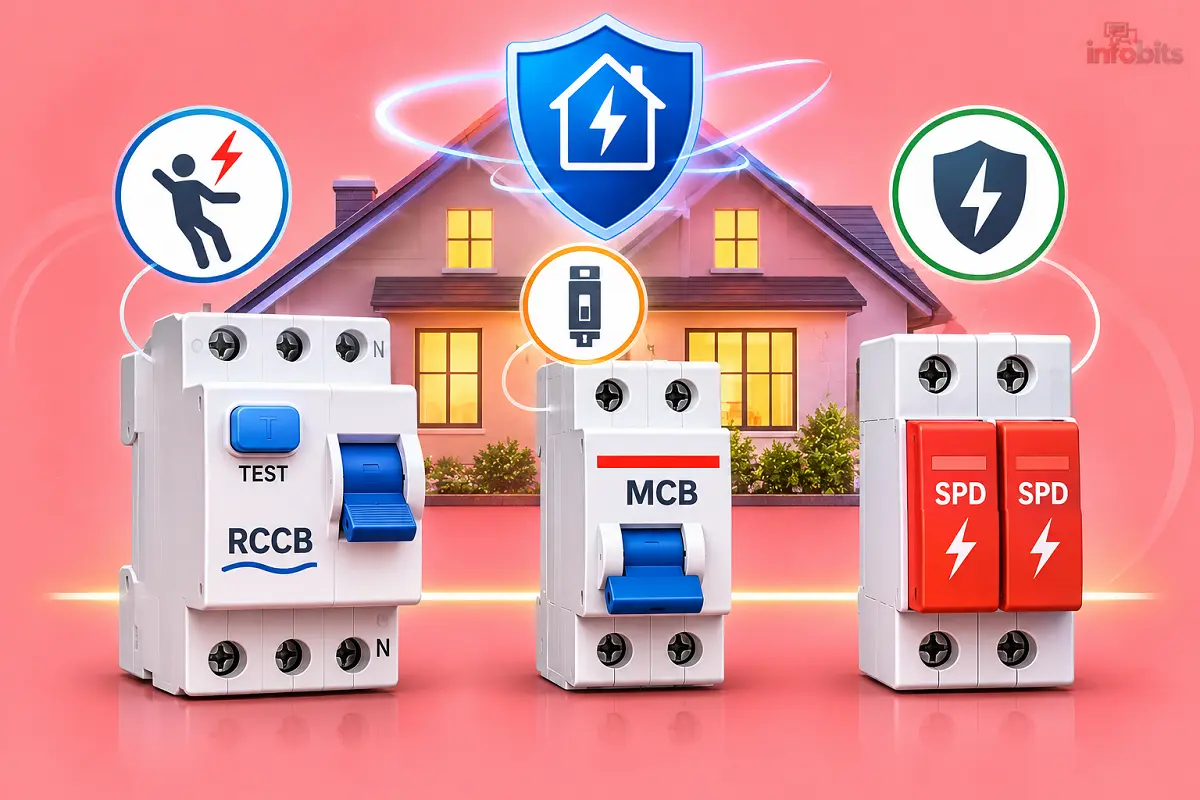
RCCB vs MCB vs SPD: What’s the Difference and Which Do You Need at Home?
Open your home’s distribution board (DB box), and you will see a row of switches. Some are MCBs. One is usually an RCCB. A few homes also have an SPD. Most people cannot tell them apart.
Quick Answer: An MCB protects your wires and devices from overcurrent. An RCCB protects you from electric shockby sensing the leakage current. An SPD protects your appliances from voltage spikes. They do three different jobs, and none of them can replace the other two.
This guide explains each device in simple language. You will also see how they fit together, which ratings to choose for an Indian home, and the most common mistakes people make.
Safety note: DB work involves live mains supply. Use this article to understand and to talk to your electrician. Do not open the DB or rewire it yourself. Always switch off the main supply first, and use a licensed electrician for any change.
RCCB vs MCB vs SPD: At a Glance
| MCB | RCCB | SPD | |
|---|---|---|---|
| Full form | Miniature Circuit Breaker | Residual Current Circuit Breaker | Surge Protection Device |
| Protects against | Overload and short circuit | Earth leakage and electric shock | Voltage surges and spikes |
| Protects mainly | Wiring and the circuit | People | Appliances and electronics |
| Detects | Too much current | Current leaking to earth | Sudden high voltage |
| Reacts by | Tripping (switching off) | Tripping (switching off) | Diverting surge energy to earth |
| Stops electric shock? | No | Yes (30 mA type) | No |
| Stops overload? | Yes | No | No |
| Stops lightning damage? | No | No | Helps reduce it |
What Is an MCB?
An MCB switches off a circuit when too much current flows through it. It has two mechanisms inside. A thermal part handles slow overloads. A magnetic part handles sudden short circuits.
Think of it as a smart fuse that you can reset. Wires heat up when they carry more current than they should. The MCB cuts the supply before the insulation melts or a fire starts.
What an MCB cannot do: It cannot sense a small leakage current. If a faulty geyser leaks a little current through its body, the MCB will not trip. Someone touching that geyser can still get a shock.
MCB curves (B, C and D)
The curve tells you how much surge current the MCB tolerates before tripping instantly.
- B curve: For homes with mostly lights and sockets.
- C curve: The usual choice for homes with ACs, pumps and motors, since they draw a high starting current.
- D curve: For heavy industrial motors and transformers. Rarely needed at home.
What Is an RCCB?
An RCCB (also called an RCD) compares the current going out through the phase wire with the current coming back through the neutral. In a healthy circuit, both are equal. If some current leaks to earth, the two values differ.
That leak could be a faulty appliance, damaged wire insulation, or a human body. When the difference crosses the set limit, the RCCB trips within a fraction of a second.
For homes, choose a 30 mA RCCB. This is the level generally used for protection against electric shock. Higher ratings like 100 mA or 300 mA are meant for fire protection or upstream protection, not for personal safety.
What an RCCB cannot do: It does not protect against overload or short circuit. It also has no idea if the load is too heavy. That is why you must always install an MCB with it.
RCCB types: AC and A
Type AC RCCBs detect plain AC leakage. Type A RCCBs also detect pulsating DC leakage.
Many modern appliances, such as inverter ACs, washing machines with drives, and EV chargers, can produce this kind of leakage. Ask your electrician which type suits your loads. Type A is the safer pick for most new homes.
2-pole or 4-pole RCCB?
A 2-pole (phase and neutral) RCCB is for single-phase homes. A 4-pole RCCB is for three-phase supply.
What Is an SPD?
An SPD limits sudden voltage spikes. These spikes come from lightning strikes nearby, grid switching, or heavy loads turning on and off. They last a few microseconds. But they can kill TVs, routers, inverters, LED drivers and refrigerator control boards in that instant.
An SPD sits across the supply lines and earth. When the voltage jumps beyond a safe level, the SPD conducts and sends the surge energy to the earth wire. When the voltage returns to normal, it stops conducting.
Important: An SPD is only as good as your earthing. A weak or missing earth means the surge has nowhere to go.
SPD types (Type 1, Type 2, Type 3)
- Type 1: Fitted at the service entrance where there is a lightning protection system on the building.
- Type 2: Fitted in the main DB. This is the standard choice for most homes.
- Type 3: Plug-in surge protectors for a single device, such as a TV or computer.
For a typical Indian home, a Type 2 SPD in the DB plus a good plug-in surge strip at your costliest electronics is a sensible setup.
Related: Type 1 vs Type 2 vs Type 3 Surge Protectors: Which Does Your Indian Home Need?
What to check on an SPD
- Type 2 marking.
- Maximum discharge current (Imax): Higher is better. 40 kA is common for home use.
- Nominal discharge current (In): Often 20 kA.
- Maximum continuous voltage (Uc): Should suit a 230 V supply (commonly 275 V or higher).
- Voltage protection level (Up): Lower is better.
- Status indicator window: It shows when the SPD has worn out and needs replacement.
- Backup MCB: Many SPDs need a specified backup MCB. Follow the datasheet.
RCCB vs MCB vs SPD: Full Comparison
| Feature | MCB | RCCB | SPD |
|---|---|---|---|
| Main job | Stop overload and short circuit | Stop shock from earth leakage | Clamp surge voltage |
| Responds to | Current above rating | Phase-neutral current imbalance | Voltage spike |
| Speed | Seconds (overload) to milliseconds (short circuit) | Tens of milliseconds | Nanoseconds |
| Needs earthing? | Not for operation | Works best with proper earthing | Yes, essential |
| Manual reset after trip? | Yes | Yes | No (self-resets, but wears out) |
| Has a test button? | No | Yes | Usually an indicator window |
| Typical home rating | 6 A to 63 A | 25 A or 40 A, 30 mA | Type 2, 20/40 kA |
| Replace when | Faulty or after repeated heavy trips | Test button fails | Indicator shows failure |
| Can replace the others? | No | No | No |
Do You Need All Three?
Yes, if you want complete protection. Each device covers a gap the other two leave open.
- Without an MCB, an overloaded wire can start a fire.
- Without an RCCB, a leaking appliance can give you a fatal shock, and the MCB will stay quiet.
- Without an SPD, a nearby lightning strike can fry your electronics, even when your MCB and RCCB are perfectly fine.
What about an RCBO?
An RCBO combines an MCB and an RCCB in one unit. It protects against overload, short circuit and earth leakage on a single circuit.
Its biggest advantage is that a fault trips only that circuit, not the whole house. It costs more per circuit, but it is worth considering for kitchens, bathrooms and AC circuits.
Correct Order in a Home DB
A common arrangement in an Indian home looks like this:
- Incoming supply from the energy meter.
- Main switch or main MCB at the top.
- SPD with its own backup MCB, as the manufacturer’s diagram specifies.
- RCCB (30 mA) feeding the final circuits.
- Individual MCBs for lights, fans, sockets, AC, geyser and so on.
The exact layout depends on your supply, the SPD brand and the earthing system. Ask your electrician to follow the wiring diagram printed in the SPD and RCCB manuals. The RCCB also needs an upstream MCB or main breaker of equal or lower rating for short-circuit backup.
If you are planning a solar or inverter setup, mention it to your electrician before they finalise the DB layout. Changeover wiring can cause neutral problems that trip RCCBs.
Related: What Is an Inverter? How It Works & Types Explained
Real-Life Scenarios: Which Device Acts?
Scenario 1: A geyser’s heating element leaks to its body. The MCB does nothing. The RCCB trips. It is what saves the person who touches the tap.
Scenario 2: You plug three heavy appliances into one extension board. Current shoots past the safe limit. The MCB trips. The RCCB stays on.
Scenario 3: Lightning hits a transformer down the road during a monsoon storm. A surge races through the supply. The SPD diverts most of it to earth. Without it, your router, TV or fridge board could be the one that absorbs the hit.
Scenario 4: Rainwater seeps into an outdoor junction box. A small leakage current begins to flow. The RCCB trips long before anyone gets hurt.
Scenario 5: A dead short in a socket circuit. The MCB trips almost instantly through its magnetic mechanism.
Related: Is It Safe to Use a Phone During Lightning? The Real Answer
Myth vs Fact
| Myth | Fact |
|---|---|
| “My MCB will save me from a shock.” | MCBs sense overcurrent, not small leakage. A shock can happen with the MCB still on. |
| “An RCCB protects against overload.” | It does not. It needs an MCB alongside. |
| “A surge protector strip is the same as an SPD.” | A plug-in strip is Type 3. It helps one device, but it does not protect the whole house. |
| “An SPD fixes low or high voltage.” | It handles brief spikes only. Long-lasting low or high voltage needs a stabiliser or voltage protector. |
| “If the RCCB trips often, I should bypass it.” | Never. Frequent tripping means there is a real leakage or wiring issue to find. |
| “Once installed, an RCCB works forever.” | It can fail. Test it monthly using the test button. |
| “With an SPD, lightning cannot harm my home.” | A direct strike can still cause damage. An SPD reduces the risk. It does not remove it. |
Related: Does Your Smart TV Need a Voltage Stabiliser?
How to Choose the Right Ratings
MCB sizing (as a general guide)
- Lights and fans: 6 A, usually with 1.5 sq mm wire.
- Sockets and general power: 16 A, with 2.5 sq mm wire.
- AC and geyser: 16 A to 20 A, often with 4 sq mm wire. Follow the appliance manual.
- Main incomer: Based on your sanctioned load.
The MCB must always protect the wire. A larger MCB on a thin wire defeats the purpose. Your electrician should match the MCB rating to the wire size.
RCCB sizing
- Sensitivity: 30 mA for home use.
- Current rating: 25 A or 40 A for most flats. Choose a higher rating when the total load is high.
- Type: AC or A (Type A is preferable for modern appliances).
- Poles: 2-pole for single phase, 4-pole for three phase.
SPD sizing
- Type 2 for the main DB.
- Imax around 40 kA and In around 20 kA are typical for homes.
- Uc suited for 230 V supply.
- Backup MCB as the manufacturer specifies.
Choose products from known brands that carry ISI or equivalent test marks. Cheap, unbranded breakers are a false saving.
Related: Best Multimeters in India: Digital & Analogue, Tested & Compared
Simple Pre-Purchase Checklist
- Have you noted your home’s total connected load and sanctioned load?
- Is the earthing in good condition? (Test it before adding an SPD.)
- Is the main wiring of adequate gauge for each circuit?
- Do you know whether your supply is single-phase or three-phase?
- Are the MCB, RCCB and SPD all from reputable, certified brands?
- Have you asked your electrician to share the final DB wiring diagram?
A basic digital tester from Amazon helps you check that the earth connection is actually live-safe before the electrician hands over the work.
If you want to do basic voltage and continuity checks yourself, a decent digital multimeter such as the Kaiweets or Fluke models available on Amazon India is a handy tool to keep at home, as long as you only use it on circuits you know are safe.
Common Mistakes to Avoid
- Installing only MCBs. Many older homes still do this. There is no shock protection at all.
- Skipping earthing. An RCCB and an SPD both depend on a proper earth.
- Sharing a neutral between circuits on different RCCBs. This causes false tripping.
- Putting a bigger MCB to stop nuisance tripping. The wire can overheat before the MCB acts.
- Bypassing a tripping RCCB. You remove the safety layer you installed.
- Ignoring the SPD indicator. A failed SPD gives zero protection while looking fine.
- Mixing brands without checking compatibility. The datasheet should confirm the backup protection needed.
- Never pressing the test button. An untested RCCB may not work when you need it.
Warning Signs Your Protection Needs Attention
- The RCCB trips often with no obvious cause.
- The RCCB test button does nothing.
- The MCB feels hot or smells burnt.
- You get a tingling feeling when touching a fridge, washing machine or metal tap.
- The SPD indicator window has changed colour.
- Lights flicker during storms and gadgets fail after power cuts.
- Your DB has no earth connection or a loose, corroded one.
If you notice any of these, stop using the affected circuit and call an electrician.
Troubleshooting: Why Does My RCCB Keep Tripping?
Work through these steps in order. Stop if you are not comfortable at any point.
- Switch off every MCB and reset the RCCB. If it holds, the fault is in one of the circuits.
- Switch the MCBs on one by one. The one that makes the RCCB trip points to the faulty circuit.
- Unplug appliances on that circuit and try again. Geysers, ACs, washing machines, water pumps and irons are common culprits.
- Look for damp. Bathrooms, kitchens and outdoor points are often to blame during monsoon.
- Check for a neutral mix-up. Shared neutrals between circuits are a classic reason for nuisance trips.
- If you run an inverter, ask the electrician to check the changeover and neutral-earth arrangement.
- Call a licensed electrician if tripping continues. A professional insulation resistance test finds hidden leaks.
Related: Why Does RCCB Trip When Lightning Strikes? (Causes, Fixes & Prevention)
Simple Monthly Maintenance
- Press the RCCB test button once a month. It should trip at once. Switch it back on.
- Check the SPD indicator window.
- Look for discolouration, loose wires or heat marks on the breakers.
- Keep the DB dry, closed and free of dust and insects.
- Get a full electrical safety inspection every few years, particularly for older homes.
A small point-of-use surge strip at your TV unit or workstation adds a final layer of protection for sensitive gear. Look for one that lists its joule rating, has an indicator light, and carries a clear safety certification, like the Belkin 6-Socket Extension Board on Amazon India. Do not treat it as a replacement for a DB-level SPD.
If you work from home, remember the router and modem are the first to go in a surge. A compact router UPS with surge protection, or a combination with a good UPS and a power strip with SPD, keeps the internet alive during short power cuts and shields the router from spikes.
Related: Best UPS for WiFi Router & Modem in India (Tested Picks)
Does Your Home Also Need a Voltage Stabiliser or Isolation Transformer?
Not necessarily. A stabiliser corrects long-term low or high voltage. An isolation transformer separates your equipment from the mains.
Neither replaces an MCB, RCCB or SPD. Think of them as extra layers for specific equipment.
Special Cases: Solar, Inverters and Outdoor Wiring
Solar and inverter installations bring their own protection needs. They include DC-side surge protection on the panel side and AC-side protection near the inverter. If you have solar on your roof, ask your installer about both.
For outdoor lights, gate motors and garden pumps, always use RCCB-protected circuits. Moisture and mud make leakage far more likely outdoors.
Final Verdict
You need all three. The MCB keeps your wiring from overheating. The RCCB keeps your family safe from shock. The SPD keeps your electronics alive through storms and surges.
If budget is tight, prioritise in this order: a properly rated MCB setup with good earthing, then an RCCB, then an SPD. Then add the SPD as soon as you can. In lightning-prone regions, move it up the list.
And please do not leave it for later. An RCCB costs a fraction of one hospital visit.
Frequently Asked Questions (FAQ)
An MCB protects wiring from overload and short circuit. An RCCB protects people from electric shock caused by earth leakage. An SPD protects appliances from sudden voltage spikes.
No. An RCCB does not detect overload or short circuit. You need an MCB, or an RCBO, along with it.
No. An MCB trips on high current, but a shock can occur at a much lower current. For shock protection, you need a 30 mA RCCB.
Indian safety norms expect earth-leakage protection in electrical installations. Rules differ by state, supply type and load, so check with your electrician or distribution company.
It trips when the leakage current reaches about 30 milliamperes. That is the level generally used for personal protection against shock.
An SPD, or surge protection device, diverts sudden voltage spikes to the earth wire. It protects connected appliances from lightning and switching surges.
It reduces the damage from nearby strikes and surges. It cannot guarantee protection from a direct hit. A lightning protection system is a separate requirement.
A Type 2 SPD in the main DB is the usual choice. Add Type 1 if the building has an external lightning protection system, and Type 3 plug-in strips for sensitive devices.
It is normally fitted near the incoming supply, often with its own backup MCB. Follow the manufacturer’s wiring diagram, as layouts vary.
A main breaker or MCB sits upstream for backup. Individual MCBs for each circuit then sit downstream of the RCCB. The exact scheme depends on the DB design.
An RCCB gives earth-leakage protection only. An RCBO also gives overload and short-circuit protection. An RCBO trips only the faulty circuit.
Moisture can create a small leakage path in outdoor points, geysers, ACs or damaged wiring. Treat it as a real warning and have the wiring checked.
Press the test button once a month. It should trip immediately. If it does not, get it replaced.
It may still trip on a leak that flows through a person. But it works best with a proper earth. A good earthing system is also a must for an SPD.
Not necessarily. An SPD handles short spikes only. A stabiliser corrects continuous low or high voltage for appliances like ACs and refrigerators.
It depends on how many surges it absorbs. Check the status indicator window regularly. Replace it when the indicator shows failure or after a major lightning event.
No. A plug-in strip is a Type 3 device that protects what is plugged into it. A DB-mounted SPD protects the whole circuit.
It is not recommended. A wrong connection can leave you without protection or create a hazard. Hire a licensed electrician.
We hope you are interested in our articles and consider following our Facebook, Instagram, and Twitter pages for regular updates.
Also, share this article with your friends and relatives. Bookmark this page for future reference.
Subscribe to our free newsletter to get similar articles and regular updates directly in your Email Inbox.
Subscribe to be the first to learn about new information
Disclosure: If you follow our links to a retailer’s website and make a purchase, we will get an affiliate commission on some, but not all, of the items or services we promote. This will cause no price change for you.
You May Be Interested to Read:
- AC Power Consumption Calculator: Units Per Hour & Monthly Bill
- How to Install a Surge Protection Device (SPD) at Home: Step-by-Step Guide
- 1400mm vs 1200mm Ceiling Fan: Which Size Do You Actually Need?
- How to Earth Your Home Electrical System Properly (India Guide)
- String Inverter vs Micro Inverter: Which Is Right for Your Roof?