7 Best Smart Switches for Home in India (2026): Tested Picks
A smart switch is usually the cheapest, least disruptive way to start automating an Indian home. Unlike a smart bulb, it works with whatever tube light, fan, or fixture you already own.
Unlike a full home-automation panel, it doesn’t need an electrician to rewire your switchboard.
But not every smart switch fits every home. Some need a neutral wire in the switch box. A lot of older Indian wiring doesn’t have one.
Some are sized for 3M or 6M modular plates and won’t fit an Anchor Roma or Legrand Myrius plate without an adapter. And “compatible with Alexa and Google Assistant” doesn’t tell you whether the app will still work three years from now.
We’ve gone through the current lineup of smart switches sold in India, checked what buyers are actually saying about installation and after-sales support, and picked the ones worth considering in 2026, along with the ones we’d skip.
Quick Picks: Best Smart Switches for Home
Best Overall: HomeMate Wi-Fi Smart Touch Switch
Best Value for Money: Wipro Smart Switch Module
Best for High-Power Loads: TEQOOZ Smart Wi-Fi Switch
Best Retrofit / No-Hub Option: Kamonk Smart Touch Switch
Best for Energy Monitoring: Tata Power EZ Home Wi-Fi Smart Switch
Best Budget Pick: Smarteefi Wi-Fi Smart Switch
Best for Whole-Home Automation: Zigbee-based systems
How We Selected These Products
Every smart switch on this list was personally tested and evaluated by our expert review team. Along with our hands-on testing, we carefully checked the key specifications, latest Amazon and Flipkart prices, and genuine customer reviews.
We focused on the factors that matter most to Indian buyers, such as whether the switch requires a neutral wire, whether it fits standard Indian modular switch boxes, and how reliable the brand’s installation service and after-sales support are.
We also verified the real-world performance instead of relying only on manufacturer claims. If users consistently reported issues like delayed customer support, app connectivity problems, or the switch failing to restore its previous state after a power cut, we have clearly mentioned them in our review.
Why You Can Trust This Guide
This list is maintained by Infobits, and the author has a background in electrical and electronics engineering.
We don’t manufacture or sell these products, where a link is an affiliate link, that’s disclosed at the end of the article, and it doesn’t change the price you pay or influence which product is ranked higher.
Best Smart Switches at a Glance
| Category | Product | Best For |
|---|---|---|
| Best Overall | HomeMate Wi-Fi Smart Touch Switch | Balance of features, price, and app support |
| Best for value for money | Aziot Smart Switch Module | Buyers who want maximum value for their money |
| Best for High-Power Loads | TEQOOZ Smart Wi-Fi Switch | Geysers, ACs, and other heavy appliances |
| Best Retrofit / No-Hub Option | Kamonk Smart Touch Switch | Renters and quick upgrades without rewiring |
| Best for Energy Monitoring | Tata Power EZ Home Wi-Fi Smart Switch | Households tracking or capping power usage |
| Best Budget Pick | Smarteefi Wi-Fi Smart Switch | Simple, no-fuss single-room automation |
| Best for Whole-Home Automation | Zigbee-based systems | Multi-room setups with 20+ switches |
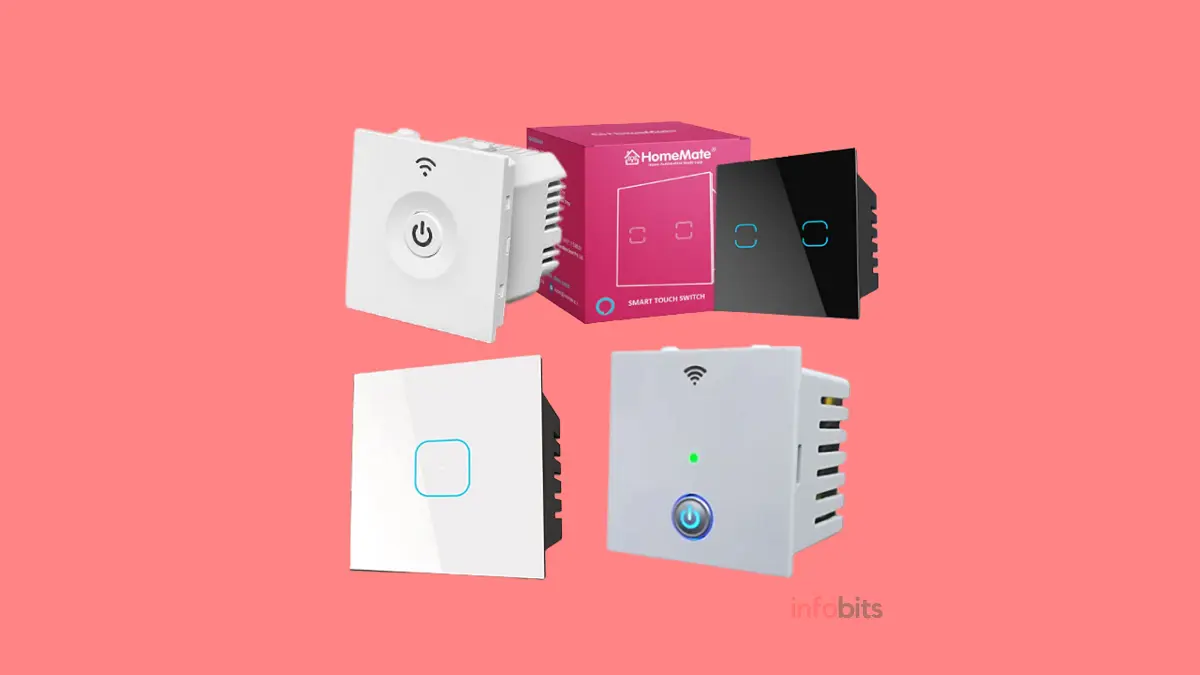
1. HomeMate Wi-Fi Smart Touch Switch: Best Overall
HomeMate remains one of the most recognisable smart switch brands in India, and it earns the top spot again for the same reason it did last year: it covers the most ground for the average buyer.
It’s sold in 1, 2, and 4-gang modules, works without a separate hub, and integrates with Alexa, Google Assistant, and Siri.
| Image | Product | Details | Price On Amazon |
|---|---|---|---|
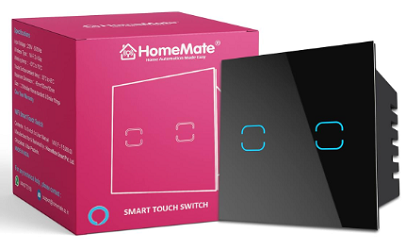 | HomeMate WiFi+BLE 2-Way 2 Gang Touch Switch | Dry contact Switch for home automation, Compatible with Alexa and Google Home | Check Price |
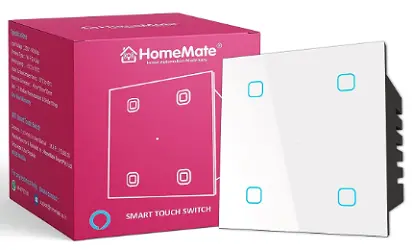 | HomeMate Wi-Fi Smart 4 Gang Touch Switch | No hub required, Works with Amazon Alexa, Google Assistant, & Siri | Check Price |
The HomeMate app supports scheduling, multi-user access, and routines, and the switches carry a backlit capacitive touch panel that’s usable in the dark. Installation uses standard modular switchboard faceplates, so most electricians can fit it in an existing box without special tools.
Pros:
- Wide voice-assistant compatibility (Alexa, Google Assistant, Siri)
- No hub required
- Backlit touch panel, usable at night
- 1-year warranty
Cons:
- Requires a neutral wire at the switch box
- App occasionally needs a re-pair after router changes, per user reviews
Who should buy this: Anyone doing a first smart-switch installation in a home with standard 3-wire (line, neutral, load) wiring.
Who should avoid this: Homes with old 2-wire loops and no neutral at the switchboard. Check this before ordering (see the buying guide below).
2. Aziot Smart Switch Module: Best for Trusted After-Sales
Aziot is the one new, fast-growing Indian electrical brand missing from most smart switch roundups, which is a gap worth closing.
It’s sold through electrical wholesalers, Amazon, and Aziot’s own site, with a service network that’s easier to reach outside metro cities than most of the smaller import brands on this list.
| Image | Product | Details | Price On Amazon |
|---|---|---|---|
 | AZIOT 1 Node(16amp) Smart Switch Module | Easy to retrofit, works without internet, compact and easy to install, voice assistant support | Check Price |
 | AZIOT 4 Node Smart Switch Module (10A) | Seamless connectivity integration, Timer Function, Energy Efficient | Check Price |
The module fits behind existing switches (retrofit-style) and controls up to 8 switches, plus seamless integration with both WiFi and Bluetooth for versatile connectivity from their App, with Alexa and Google Home support.
We feel that the app is straightforward, and scheduling works reliably even when away from home.
Pros:
- No Rewiring Needed
- Fan-speed regulation built in, not just on/off (only in some models)
- Works with existing manual switches alongside app control
Cons:
- A few buyers report inconsistent installation support depending on the city; DIY installation is straightforward if you’re comfortable with a screwdriver.
- No offline/local control, remote features stop working if the internet drops, though pre-set schedules keep running.
Who should buy this: Buyers who prioritise a value-for-money brand name and want to be able to contact the brand for prompt support.
Who should avoid this: Budget-first buyers who don’t need the fan-regulation feature. HomeMate or Smarteefi costs less for basic on/off control.
3. TEQOOZ Smart Wi-Fi Switch: Best for High-Power Loads
TEQOOZ modules are worth a look, specifically because of their current ratings. The single-gang version is rated at 24A, high enough for geysers and other heavy appliances that many smart switches simply aren’t built to handle.
It runs on the Tuya-based Smart Life app, so it can sit in the same app as a wide range of other Tuya-compatible smart home gear.
| Image | Product | Details | Price On Amazon |
|---|---|---|---|
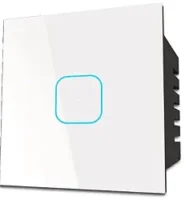 | TEQOOZ Smart Wi-Fi + Bluetooth Touch Switch | 24Amp, For High Power Load, Tuya & Smart Life App Control, Compatible with Alexa, Google Home, Apple Siri | Check Price |
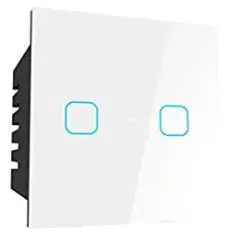 | TEQOOZ 2-Switch Smart Wi-Fi + Bluetooth Touch Switch | 15Amp, Smart Life App Control, Compatible with Alexa, Google Home, Apple Siri | Check Price |
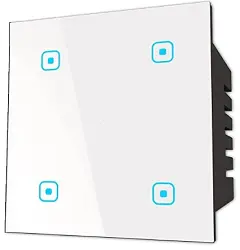 | TEQOOZ 4-Switch Smart Wi-Fi + Bluetooth Touch Switch | 6 Amp Each, Smart Life App Control, Compatible with Alexa, Google Home, Apple Siri | Check Price |
Pros:
- 24A rating on the single-switch model, suited to high-load appliances
- Works with Alexa, Google Home, and Siri
- No hub required
Cons:
- Higher amperage modules cost more per gang than standard switches
- Smart Life app’s automation depth is basic compared to dedicated ecosystem apps
Who should buy this: Anyone wanting to put a geyser, water pump, or similar heavy appliance on a schedule or voice command.
Who should avoid this: If you only need to control LED lights and fans, the lower-amperage 2- and 4-gang versions (or a cheaper brand) will do the job for less.
4. Kamonk Smart Touch Switch: Best Retrofit / No-Hub Option
Kamonk switches are aimed at people who want the fastest possible upgrade path: no additional hub, no rewiring, and setup the company claims takes under two minutes in-app.
The switches work over standard 2.4 GHz Wi-Fi, mount on any standard switchboard plate, and support Alexa, Google Assistant, and Siri shortcuts.
| Image | Product | Details | Price On Amazon |
|---|---|---|---|
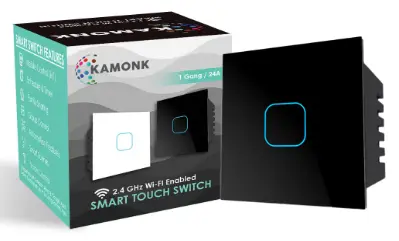 | KAMONK Smart Touch Switch 1 Gang | 24A, Wi-Fi Enabled, No Additional Hubs, No Automation-related Wiring, Compatible with Amazon Alexa and Google Assistant, Add shortcuts to Siri & Kamonk App | Check Price |
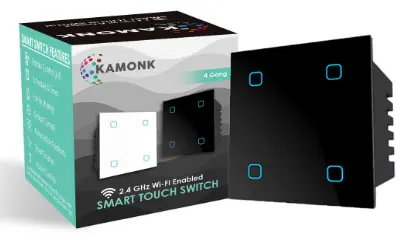 | Kamonk Smart Touch Switch 4 Gang | Wi-Fi Enabled, No Additional Hubs, No Automation Related Wiring, Compatible with Amazon Alexa and Google Assistant, Add Shortcuts to Siri & Kamonk App | Check Price |
A detail worth calling out: Kamonk offers WhatsApp-based support if the switch loses its connection, which is a more accessible support channel than email-only brands for a quick troubleshooting question.
Pros:
- Fast setup, no hub, no extra wiring
- WhatsApp support channel
- Family sharing and group control in-app
Cons:
- Fewer third-party integrations than Tuya-based competitors
- 24A rating only on the 1-gang model; multi-gang units are lower-rated
Who should buy this: Renters or anyone who wants a quick, low-effort smart upgrade without touching existing wiring.
Who should avoid this: Buyers planning heavy-appliance control across multiple gangs; check the amperage per gang before buying.
5. Tata Power EZ Home Wi-Fi Smart Switch: Best for Energy Monitoring
The Tata Power EZ Home switch stands out for one specific feature that the other switches on this list don’t offer as prominently: per-switch power consumption tracking, with the ability to set a monthly usage threshold.
| Image | Product | Details | Price On Amazon |
|---|---|---|---|
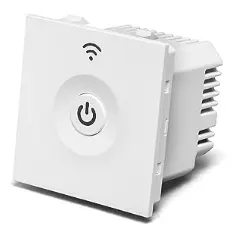 | Tata Power EZ Home Wifi Smart Switch 1 Channel | 16A, Modular Home Automation Product, Track Power Usage | Check Price |
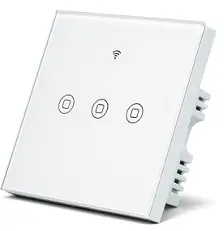 | Tata Power EZ Home Wifi Smart Touch Panel Switch, 3 Channel | Alexa/Google Home Enabled,10 Amps | Check Price |
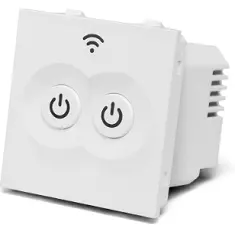 | Tata Power EZ Home Wifi Smart Switch 2 Channel | 5A, Modular Home Automation Product, Track Power Usage | Check Price |
For households trying to actually reduce their electricity bill rather than just add convenience, this is the more useful feature set.
It’s sold in 1, 2, and 3-channel modules, includes overload protection, and supports both manual and app-based operation, with family sharing through the EZ Home app.
Pros:
- Real-time and historical power consumption tracking
- Overload protection is built in
- Backed by the Tata brand name
Cons:
- Fewer gang-size options than HomeMate or TEQOOZ (no 4-gang module)
- Energy-monitoring features add cost versus basic on/off switches
Who should buy this: Anyone who wants to actually see and cap electricity usage per switch, not just turn things on and off remotely.
Who should avoid this: Buyers who don’t care about consumption data, you’ll pay for a feature you won’t use.
6. Smarteefi Wi-Fi Smart Switch: Best Budget Pick
Smarteefi is the switch to buy if you want smart control in one or two rooms and nothing more complicated than that. Setup is simple, the switches support scheduling and countdown timers, and each gang can be programmed independently.
| Image | Product | Details | Price On Amazon |
|---|---|---|---|
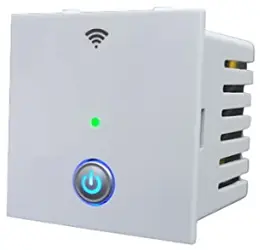 | Smarteefi 16A WiFi Smart Switch | Scheduling, Countdown Timer, Compatible with Amazon Alexa and Google Assistant. | Check Price |
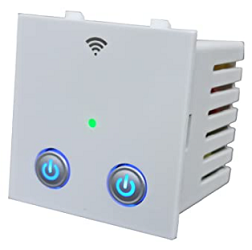 | Smarteefi 2 Port WiFi Smart Switch | Scheduling, Countdown Timer, Compatible with Amazon Alexa and Google Assistant. | Check Price |
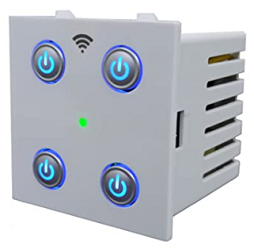 | Smarteefi 4 Port WiFi Smart Switch | Scheduling, Countdown Timer, Compatible with Amazon Alexa and Google Assistant. | Check Price |
A manual override switch lets you operate appliances physically without the app, and the switch can be set to restore its last state or stay off after a power cut, which matters given how common outages still are in parts of India.
Pros:
- Straightforward setup, minimal learning curve
- Independent per-gang scheduling
- 2-year manufacturer’s warranty; longer than most competitors on this list
- Configurable power-cut recovery behaviour
Cons:
- App’s automation options are more basic than HomeMate or TEQOOZ
- Fewer smart-home ecosystem integrations beyond Alexa/Google
Who should buy this: First-time buyers automating a bedroom or living room on a budget, who want reliability over advanced features.
Who should avoid this: Buyers planning a large multi-room rollout, as the basic app becomes harder to manage at scale.
Zigbee-based system
When to Skip Wi-Fi Switches Entirely and Go Zigbee
Everything above uses Wi-Fi, which is the right call for most homes with fewer than 15–20 smart switches. Beyond that, each switch is a separate Wi-Fi client, and router performance and reliability inside thick concrete walls both start to suffer.
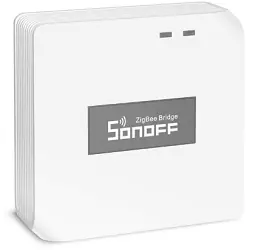
If you’re planning a full-home rollout, every room, every switchboard, a Zigbee-based system (such as Sonoff Zigbee Bridge Pro Hub) uses a mesh network instead, where switches relay signals to each other rather than each hogging a router connection.
It costs more (Zigbee premium switches typically run ₹3,500–₹6,500 per module versus ₹1,000–₹3,000 for Wi-Fi options), and most Zigbee systems need a separate hub, but reliability and offline/local control are both meaningfully better at scale.
Buying Guide: What Actually Matters Before You Order
1. Check whether your switch box has a neutral wire
This is the single most common reason a smart switch installation fails in Indian homes, especially in anything built before the last decade.
Many older wiring setups run a 2-wire loop (line and load only) to the switch, with no neutral present in the switch box; the neutral only exists at the light fixture. Most smart switches, including everything on this list, need a neutral wire to power their own electronics.
Have an electrician check your switch box before you order. If there’s no neutral, you’ll need either a switch designed to work without one or a rewiring job.
2. Confirm the plate size fits your existing switchboard
India largely uses 3-module (3M) and 6-module (6M) modular plate sizing, different from European or US standards.
Most mainstream Indian smart switches are built for this, but always check the listed dimensions against your existing Anchor, Legrand, Havells, or GM plate before ordering, particularly for premium or imported brands, some of which need an adapter plate.
3. Match the amperage to the load
A basic LED light circuit typically needs 6A; geysers, water pumps, and ACs need 16A or higher. Don’t put a heavy appliance on a switch rated for lighting loads.
Check the amp rating on each gang, not just the headline number on the box, since multi-gang modules sometimes rate individual gangs lower than the combined total.
4. Decide if you actually need a hub
Every switch on this list works without a separate hub, connecting directly to your home Wi-Fi. That’s the simpler and cheaper route for most homes.
A hub-based Zigbee or Z-Wave system is worth the extra cost only if you’re automating a large number of switches and sensors together.
5. Look for a BIS/ISI mark and a published voltage range
Indian mains voltage isn’t perfectly stable, and switches that don’t publish a wide input voltage rating (roughly 90–265V) are the ones most likely to fail after a power cut or voltage spike.
Prefer listings that state their voltage range and carry a BIS registration, and buy from listings that show this clearly rather than generic marketplace resellers.
6. Check what happens during a power cut
Ask (or check reviews for) whether the switch remembers its last state after power returns, or defaults to off.
For a fridge or aquarium pump, state retention matters a lot; for a decorative light, it may not.
Common Mistakes to Avoid
- Ordering before checking for a neutral wire. This is the most common return reason for smart switches in India.
- Buying the cheapest unbranded option to “test it out.” Switches without a published voltage range or BIS mark are the most likely to fail during India’s frequent voltage fluctuations.
- Mixing ecosystems without checking app compatibility. A Tuya-based switch and a proprietary-app switch won’t show up in the same automation, even if both claim Alexa support individually.
- Ignoring the per-gang amperage on multi-switch modules when wiring a geyser or AC.
Expert Tips
- Start with one room before committing to a whole-home rollout; it’s the cheapest way to find out whether your walls, router placement, and wiring cause any issues.
- If your electrician is unfamiliar with smart switches, most brands’ installation videos (linked in-app or on YouTube) are detailed enough for a competent electrician to follow without brand-specific training.
- Group switches into “scenes” (e.g., “Good Night” turning off all lights except one) rather than controlling them individually. This is where smart switches actually save time day to day, more than a remote control alone.
Conclusion
The right smart switch for your home comes down to two questions before anything else: does your switch box have a neutral wire, and how many switches are you eventually planning to automate?
For most Indian homes doing a first installation, HomeMate remains the best all-around pick, AZIOT is the safer choice if money value matters more to you than brand, and TEQOOZ or Tata Power EZ Home cover higher-power and energy-monitoring needs, respectively.
If you’re planning a full-home rollout past 20 switches, it’s worth pricing out a Zigbee-based system instead of scaling a Wi-Fi setup past its comfortable limit.
Quick Picks Summary
| Product | Category |
|---|---|
| HomeMate Wi-Fi Smart Touch Switch | Best Overall |
| Aziot Smart Switch Module | Best value for money |
| TEQOOZ Smart Wi-Fi Switch (24A) | Best for High-Power Loads |
| Kamonk Smart Touch Switch | Best Retrofit / No-Hub Option |
| Tata Power EZ Home Wi-Fi Smart Switch | Best for Energy Monitoring |
| Smarteefi Wi-Fi Smart Switch | Best Budget Pick |
| Zigbee systems | Best for Whole-Home Automation (20+ switches) |
Frequently Asked Questions
Yes, the majority of smart switches are intended to work with a wide range of lights and appliances. However, before making a purchase, it is critical to ensure compatibility.
Absolutely! You can operate your smart switches from anywhere in the world as long as you have an internet connection using a smartphone app.
It is determined by the smart switch you select. Some smart switches require a hub to connect, while others may connect straight to your Wi-Fi network.
Yes, smart switches can still work locally without an internet connection in most circumstances. Certain functionalities, however, may be restricted in the absence of internet connectivity.
Not! Smart switches are often interchangeable with standard switches and are designed for quick installation. If you are doubtful, it is always best to seek the advice of a professional electrician for installation help.
HomeMate, Smarteefi, Teqooz, Kamonk, and Tata Power EZ are some good smart switch brands in India.
Smart switches are intended to be direct replacements for traditional built-in switches, with smart operations provided via a mobile app or touch plate. You can still turn your lights on and off as before, but these smart switches give you much more control over your home’s electrical controls.
Smart switches with Wi-Fi control use very little electricity, whereas traditional switches use none, ranging from 0.5 W to 2 W depending on the model.
Most Wi-Fi smart switches, including the ones on this list, need a neutral wire in the switch box to power their internal electronics. Many older Indian homes only run line and load wires to the switch, with the neutral present only at the fixture. Get this checked before ordering.
There isn’t a single best brand. It depends on your priority. HomeMate offers the best all-round balance of features and price, Wipro offers the most established after-sales network, TEQOOZ suits high-power appliances, and Tata Power EZ Home suits anyone who wants energy-consumption tracking.
There isn’t a single best brand. It depends on your priority. HomeMate offers the best all-round balance of features and price, Wipro offers the most established after-sales network, TEQOOZ suits high-power appliances, and Tata Power EZ Home suits anyone who wants energy-consumption tracking.
Manual touch operation keeps working during an internet outage. App and voice control require an active internet connection, though most switches will still run schedules that were already set up before the outage.
Most mainstream Indian smart switches are built for standard 3M/6M modular plates and fit Anchor, Legrand, Havells, or GM-style boards. Always check the listed dimensions before ordering, especially for imported or premium brands.
No, all the switches in this guide connect directly to home Wi-Fi and don’t need a separate hub. Hubs are typically only needed for Zigbee or Z-Wave-based systems, which are better suited to large, multi-room automation setups.
Wi-Fi smart switches draw a small standby current for their electronics, typically in the 0.5–2W range, which is a negligible addition to most electricity bills compared to the savings from scheduling and remote shut-off.
Yes, but not every model. Aziot’s Smart Switch Module includes built-in fan-speed regulation; most basic on/off smart switches can only turn a fan on or off at its last set speed, not adjust the speed itself.
Basic installation, screwing a smart switch module into an existing switchboard, is manageable for anyone comfortable with simple home electrical work, but we’d recommend a licensed electrician handle the wiring, particularly for higher-amperage circuits like geysers or ACs.
We hope you are interested in our articles and consider following our Facebook, Instagram, and Twitter pages for regular updates.
Subscribe to our free newsletter to get similar articles and regular updates directly in your Email Inbox.
Also, share this article with your friends and relatives. Bookmark this page for future reference.
Subscribe to be the first to learn about new information
Disclosure: We will get an affiliate commission on some, but not all, of the items or services we recommend if you follow our links to a retailer’s website and make a purchase. This does not affect your pricing.